TTG Asia
Asia/Singapore Wednesday, 6th May 2026
Page 1227

Chiang Mai needs to diversify to fill hotel rooms: C9

0

After seeing record arrivals in 2018, Chiang Mai is now grappling with a 5.1% drop in market-wide hotel occupancy for the first five months of 2019, compared with the same period last year, according to hospitality data provider STR.

The comparison between 2018, when the gateway airport surpassed a record-high five million passenger arrivals, and now in 2019 as haze and air pollution strongly impacted tourism, “are reminders how fragile travellers shifting appetites can be”, said C9 Hotelworks in its newly released Chiang Mai Hotel Market Update.

Night Bazaar Road in Chiang Mai, with the Royal Lanna Hotel Chiang Mai in the background

International arrivals increased by more than 17% in 2018 on the back of increasing flight connections. Taiwan was one notable growth market, as the number of Taiwanese passengers rose from 2,773 in 1H2018 to 30,660 in 1H2018 with the launch of direct daily flights AirAsia and Eva Air.

Although hotel supply increased by 33% in 2018, both occupancy and ADR were fairly stable with RevPAR standing at 2,417 baht (US$78).

There are five hotels in the pipeline with the majority in the upscale tier and most with brand affiliations, as owners look for a competitive edge. The recent opening of the Novotel Nimman Journeyhub is one example of a Bangkok developer looking to diversify into more affordable hotel assets outside of Thailand’s capital.

However, with 2019 expected to bring challenging trading conditions for hotels and tourism across the board, the total hotel supply of 48,000 keys makes it necessary for Chiang Mai to step outside its boutique image and find ways to fill rooms with more mainstream offerings, C9 recommended.

C9’s research also highlighted Chiang Mai’s mounting reliance on the mainland Chinese sector – which is in the midst of a slowdown – as a cause for concern. In 1H2018, China was the number one international source market, holding a 14% share in hotel guests.

Moving past pollution, Chinacation and over-development issues in the longer term, the bigger issue is how will Chiang Mai evolve from a headlong dive into a far bigger tourism pool and still retain the destination’s long-lasting image as a cultural icon.

Read the complete C9 Hotelworks full Chiang Mai Hotel Market Update here.

PATA announces new executive board for 2019/2020

0
From left: Tourism Solomons' Josefa Tuamoto; Guam Visitors Bureau's board of director Flori-Anne Dela Cruz; PATA's Pairoj Kiatthunsamai, Trevor Weltman and Mario Hardy; TripAdvisor's Sarah Matthews; Capilano University's Chris Bottrill; The Ayre Group Consulting's Bill Calderwood; Asian Trails' Luzi Matzig; Asia Tourism Consulting's Soon-Hwa Wong; Forte Hotel Group's Benjamin Liao; Hawaii Tourism Authority's Jennifer Chun; Macao Government Tourism Office's Maria Helena de Senna Fernandes; Dhaka Regency Hotel & Resort's Shahid Hamid; and Global Tour's Henry Oh

PATA has announced the ratification of the 2019/2020 PATA Executive Board, which sees Capilano University’s Chris Bottrill and TripAdvisor’s Sarah Matthews continue serving for an additional one-year term as chairman and immediate past chairperson, respectively.

The new executive board members were confirmed at the recent PATA Board Meeting, which took place on May 12, 2019 during the PATA Annual Summit 2019 in Cebu.

From left: Tourism Solomons’ Josefa Tuamoto; Guam Visitors Bureau’s board of director Flori-Anne Dela Cruz; PATA’s Pairoj Kiatthunsamai, Trevor Weltman and Mario Hardy; TripAdvisor’s Sarah Matthews; Capilano University’s Chris Bottrill; The Ayre Group Consulting’s Bill Calderwood; Asian Trails’ Luzi Matzig; Asia Tourism Consulting’s Soon-Hwa Wong; Forte Hotel Group’s Benjamin Liao; Hawaii Tourism Authority’s Jennifer Chun; Macao Government Tourism Office’s Maria Helena de Senna Fernandes; Dhaka Regency Hotel & Resort’s Shahid Hamid; and Global Tour’s Henry Oh

During the summit, five members were also elected to its executive board. This includes Asia Tourism Consulting’s CEO Soon-Hwa Wong; chairman of Taiwan-based Forte Hotel Group Benjamin Liao; director, tourism research of Hawaii Tourism Authority Jennifer Chun; IATA’s regional director – airports & external relations Vinoop Goel; and South Korea-based Global Tour’s chairman Henry Oh Jr.

Other executive board members include Maria Helena de Senna Fernandes, director, Macao Government Tourism Office; Bill Calderwood, managing director of Australia-based The Ayre Group Consulting; Jon Nathan Denight, representative at Palau Visitors Authority; Shahid Hamid, executive director of Dhaka Regency Hotel & Resort; Luzi Matzig, chairman of Thailand’s Asian Trails.

Wong was elected as the new vice chairman, while Fernandes remains secretary/treasurer.

Josefa Tuamoto, CEO of Tourism Solomons and Fanny Vong, president of Macau’s Institute for Tourism Studies have been appointed to the executive board as non-voting members.

Flori-Anne Dela Cruz, youth representative of Guam Visitors Bureau Board of Directors and PATA Face of the Future 2019, joins the PATA Executive Board as a non-voting member and observer for a one-year term at the invitation of the PATA chairman.

Marriott brings Ritz-Carlton to Fukuoka in 2023

0

Marriott International has signed an agreement with Japanese property developer Sekisui House to build a new Ritz-Carlton hotel in Fukuoka, the brand’s seventh in the country.

Slated to open in spring 2023, The Ritz-Carlton, Fukuoka will be part of a new 24-storey tower that will include high-end retail and office space. The tower is set to rise within Tenjin Big Bang, a redevelopment project led by Fukuoka City to create an urban lifestyle destination within the city’s core commercial and business districts.

The hotel lobby will be located on the first floor of the building, and the 162 guestrooms and suites will occupy the 18th to 24th floors with views of the city skyline. Facilities will include six F&B outlets, a ballroom, two meeting rooms, chapel, a fitness centre, spa and an indoor swimming pool.

Sekisui House has already worked with Marriott International to open three hotels in Japan, and in addition to The Ritz-Carlton, Fukuoka, has another 19 in its pipeline across the country.

Marriott International currently has eight open luxury hotels in Japan, including four Ritz-Carlton Hotels in Tokyo, Osaka, Kyoto and Okinawa, The St. Regis Osaka, and three Luxury Collection hotels, including The Prince Gallery Tokyo Kioicho, Suiran Kyoto, and IRAPH SUI, Miyako Okinawa – along with eight more luxury projects in the signed pipeline.

Johor’s Desaru Coast throws open its doors

0

Malaysia’s much-anticipated integrated destination resort of Desaru Coast officially threw open its doors last week, in a launch ceremony presided by the sultan of Johor, Ibrahim Ibni Almarhum Sultan Iskandar.

Held at the Desaru Coast Conference Centre, the launch was witnessed by the chief minister of Johor, Sahruddin bin Jamal and Ahmad Pardas Senin, chairman of Desaru Development Holdings One (DH1), the master developer of Desaru Coast, as well as other dignitaries.

Roslina Arbak, CEO of DH1, said in a statement: “With the Visit Malaysia 2020 and Visit Johor 2020 campaigns, Desaru Coast is prepared to collaborate and partner with various stakeholders in pursuit of a common goal to provide a well-rounded, end-to-end spectrum of guest experiences. That is Desaru Coast’s commitment to the wider tourism ecosystem.”

In conjunction with the official launch ceremony, Desaru Coast also hosted the inaugural edition of the Ombak Festival (July 5-7). The Ombak Festival will be an annual event with specially curated activities including culture, music and food that highlight homegrown talent and products, and showcase local expertise and creativity.

After Antarctica, Dynasty Travel now offers expedition cruises to the Arctic

0

Singapore-based Dynasty Travel has unveiled a new expedition cruise in The Arctic, adding to its Antarctic programme announced earlier last year in its push to roll out more ‘experiential’ tour offerings.

Departing on July 2, 2020, the 12N9N Svalbard Expedition starts from S$12,888 (US$9,480) per person for twin-share cabin, for the cruise only on July 2020.

Sailing from Svalbard – the last stop before the North Pole – the seven-night expedition cruise will be onboard the Ocean Atlantic, one of the few ice-class expedition ships built to withstand the North Pole’s pack ice. It will sail as close as possible to the pack ice from the North Pole north of Svalbard.

Wildlife such as birds, polar bears, reindeer and arctic fox can be spotted, and zodiacs allow for travellers to have frequent shore landings and go on exploratory mini cruises in fjords.

Dynasty Travel can also arrange for 16 days and 18 days Svalbard Expedition, pre- or post-tours which comprise land travel to Norway’s Lofoten Islands and fjords. Prices for the pre-post tours start from S$15,888 per person.

Former finance VP becomes GM of Kempinski’s KL outpost

0

Yeoh Soo Hin has been appointed as the pre-opening general manager of 8 Conlay Kempinski Hotel Kuala Lumpur.

He was previously the vice president of finance for Kempinski Asia.

Set to open in 2021 with 260 rooms and 300 suites, the hotel is part of 8 Conlay, an integrated development by lifestyle property developer KSK Land, located between the KLCC area and Golden Triangle. It is currently under construction and will have a four-storey lifestyle retail podium, as well as two towers of branded serviced residences called YOO8 serviced by Kempinski.

World heritage site status for Bagan, Jaipur, among others

0
Myanmar's temple city Bagan awarded UNESCO World Heritage status

Myanmar’s ancient capital of Bagan and India’s fortified city of Jaipur are among the Asian landmarks that are now recognised as UNESCO World Heritage sites, declared the 43rd session of the UNESCO World Heritage Committee held in Baku, Azerbaijan.

Bagan’s inscription comes nearly a quarter of a century after the temples complex was first nominated for listing, Reuters reported.

Myanmar’s temple city Bagan awarded UNESCO World Heritage status

The decision recognises the heritage significance of the site – which includes more than 3,500 stupas, temples, monasteries and other structures built between the 11th and 13th centuries.

Bagan had first been nominated as a World Heritage Site in 1995, but this was later rejected as the military junta in power then was accused of ignoring experts’ advice on restoration efforts, according to the Reuters article.

Myanmar renewed efforts to list the site since a transition from military rule began in 2011.

The International Council on Monuments and Sites recommended the listing, noting that Myanmar had adopted a new heritage law and had formed plans to reduce the impact of hotels and tourism developments around the temple.

With its successful inscription, Jaipur – also known as the Pink City – is now the second Indian city to be featured on the prestigious list after old Ahmedabad.

Founded in the 18th century by Sawai Jai Singh II, the fortified commercial city Jaipur was built according to a grid plan and was painted uniformly in a distinctive terracotta hue.

Other Asian sites added to the UNESCO world heritage list include the Dutch colonial-era Ombilin coal mining heritage site of Sawahlunto in Indonesia, the Mozu-Furuichi group of ancient mounded tombs in Japan,the Plain of Jars in Laos, and the archeological ruins of Liangzhu city in China.

Philippines’ Sagada, home to hanging coffins, starts limiting tourism at popular sites

0
Hanging coffins in Echo Valley

Sagada in the Philippines’ Mountain Province has started implementing new rules, including placing a cap on the number of tourists per site, to avert a possible repeat of the overcrowding crisis experienced during the most recent peak season (from October till April).

Tourists are now required to get complimentary ticket stubs at the entrance of Marlboro Hill, popular for sunrise viewings, in order for the cap of 500 visitors a day to be observed. Past the 500 mark, visitors will be asked to return another day or be diverted to other sites with equally spectacular sunrise views.

Tourists visiting the hanging coffins in Echo Valley

In addition, only select organised tours with registered guides are allowed at all sites. And at Echo Valley and Sumaging Cave, now being promoted as walking tour areas, vehicles are prohibited.

“We still want to establish a more organised tour,” explained Jovita Ganongan, chief tourism operations officer and officer in charge of the Cordillera Administrative Region, where Sagada belongs.

Ganongan told TTG Asia that the local government unit has already issued an order to set up the carrying capacity of every tourism site in Sagada, adding that the Department of Tourism (DoT) is assisting in the implementation.

She said that the caves for which Sagada is also known already have existing management plans limiting the ratio of tour guides: tourists to 1:10. Besides, only three tourists are allowed inside a cave at any one point.

She is pleased that the local government unit is “very responsive” to promote Sagada as an ecotourism destination, protecting the environment and preserving its cultural and heritage sites.

Already popular among European tourists and now gaining traction among tourists from Israel, India and South-east Asia, Sagada is known for its hanging coffins, caves, waterfalls, trails and bucolic scenery.

The destination attracted even more domestic tourists when its Kiltepan Peak was featured in the Filipino rom-com That Thing Called Tadhana, according to Gigi Jamiro, inbound operations manager, Blue Horizons Travel and Tours. Sunrise viewers had flocked to Kiltepan Peak, which remains closed following a fire that engulfed two buildings in November last year.

Jamiro added: “Better road conditions have led to greater ease and comfort in travel, while the increase in the number of public transport connections makes it easier to combine the two main destinations in the Mountain Province – Sagada and Banaue.”

Sagada is also combined with Banaue rice terraces in Ifugao, Baguio, and emerging tourism sites like Kalinga, Apayao and Benguet, which boasts Mount Pulag and new attractions like vegetable and flower gardens.

Travel consultants are supportive of the new tourism rules in Sagada.

Agreeing, Aboex Travel and Tours account executive Joseph Cortez said there’s a real need to start instilling discipline among tourists lest the destination suffers in future.

NDC to unleash demand for premium airline products

0
NDC to open opportunities for premium fares

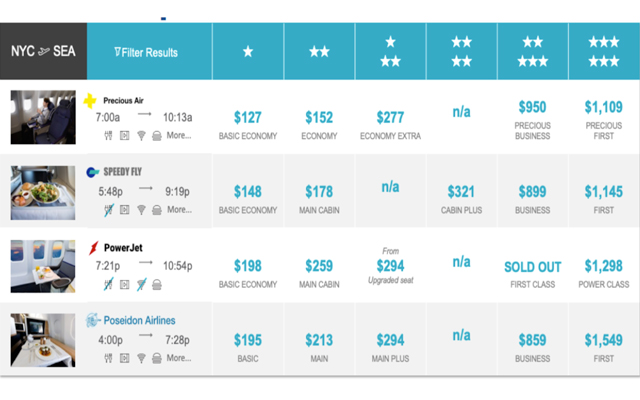
The advent of NDC may help airlines unlock a bigger customer base for their premium products – a segment that has fallen behind in a metasearch realm dominated by the lowest-fare-first approach, say industry names.

To secure mass demand, the majority of online travel aggregators and agencies are focused on pushing out the lowest air fares, offering little to no visibility for premium bundles.

NDC to open opportunities for premium fares

This discrepancy has done a “tragic” disservice to airlines and the sizeable segment of customers that actually would pay for premium seats and services, said Jeff Lobl, managing director of global distribution for Delta Air Lines, at the recent STX 2019 in Las Vegas.

He lamented: “We know there are customers who prefer premium products – we see overwhelming numbers on our direct channels – but 99 per cent of agencies are dominated by the practice of showing the lowest fare first.

“But customers don’t always want that. The lowest fare is no longer as attractive a product as before, and offers can now be personalised and exciting. But if these cannot be displayed properly and customers can’t see it, then they’re not buying.”

This is set to change with technology players such as Sabre churning out NDC-enabled application programme interfaces (APIs) that are becoming more adopted and user-friendly.

These APIs will allow indirect booking channels, such as travel agencies, to suggest and sell customised and complex flight bundles to consumers more easily and dynamically.

Sundar Narasimhan, senior vice president, Sabre Labs and product strategy, shared that there is currently a gap between the expectations of agencies and that of customers.

For example, while Sabre’s agency clientele holds expectations of dynamic retailing that are limited to the Digital Workspace and Sabre Red 360 solutions, customers have even higher expectations of “friction-free” smart shopping.

“We should be rethinking the way shopping ought to work, especially since it’s going to be more complicated with multiple itineraries, fares, ancillaries and other travel-related content coming up,” said Narasimhan.

“Our vision is to move towards offer management, leaning into intelligent advanced retailing. That’s our big target by 2025, and we’re already taking concrete steps now with the SynXis Intelligent Retailing tool.”

APAC travel bookers moving from mobile first to mobile only

0
XX

Travellers are moving beyond using their mobile devices for trip planning and inspiration, to now also making bookings on the go, according to Expedia.

Travellers in particular Asian countries are showing high willingness to make bookings on mobile, with India, Thailand, South Korea, Hong Kong, and Taiwan in the top five, a recent study conducted by Northstar Research Partners on behalf of Expedia found.

More and more travel bookings are being made on mobile devices today

In Thailand for example, of the 600 respondents surveyed, 67% said that they are extremely likely to book their flight tickets on a mobile device, 18% are somewhat likely and 15% least or not likely to do so.

When it comes to hotel bookings, 70% of the respondents indicated that they are likely to book their hotel using a mobile device, 18% are somewhat likely and 12% least or not likely to do so.

Moreover, Expedia said that approximately one in three global hotel room nights are booked via mobile. More than 50% of global traffic on Expedia Group sites are via mobile devices.

Expedia also cited new market research by AppsFlyer that showed that mobile users in Asia-Pacific will account for 50% of global app installs by 2020 – three times more than in any other region.

While growth is forecasted to gradually decrease as the market matures, Expedia expects it will be sustained by “substantial increment in media costs and mobile usage, as well as the overall number of paid campaigns, apps available, and mobile users”.

“The mobile booking findings from the study is an indication that our travellers are looking for speed, travel choices and mobile savings when they plan and book for travel. We continue to work on the areas that need improvement to knock down the barriers to travel,” said Lavinia Rajaram, APAC head of communications, Brand Expedia.