Oyo Hotels and Homes has officially made its foray into Thailand, with the opening of 8,000 rooms in 250 hotels across 13 cities, including Bangkok, Pattaya, Phuket and Hua Hin.
While Thailand is a relatively new market for Oyo, CEO for South-east Asia & Middle East, Mandar Vaidya, said the country will grow to play a significant role in the growth of its business in South-east Asia.
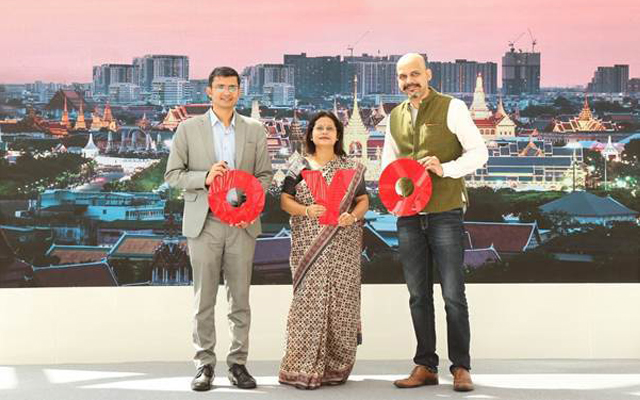
In attendance at the event to announce Oyo’s arrival into Thailand were (from right) Oyo’s Mandar Vaidya; Embassy of India, Bangkok’s Alpana Dubey; and Oyo Thailand’s Ashutosh Singh
“South-east Asia, and in particular Malaysia, was Oyo’s first foray outside of India. Today, Oyo is present in 160-plus cities over 2,500 franchised and leased hotels across Malaysia, Indonesia, the Philippines and Vietnam. That number will rise with the addition of Oyo Thailand,” he added.
“The addition of Thailand to the Oyo family in South-east Asia and the expected influx of tourists particularly from Asia to Thailand, and the increased frequency of flights by airlines into Thailand will reinforce our market leadership position in the region and help us achieve our goal of having two million rooms under management in South-east Asia by 2025.”
Ashutosh Singh, country head, Oyo Thailand, said: “We are bullish about growing our footprint in this beautiful country. Despite coming into Thailand only a few months ago, we have 8,000 rooms in 13 cities. We see strong demand in the middle- to upper-end properties in the tourism market in Thailand and aim to expand our footprint in the country.”
With the launch of the mega event now less than a year to go, Expo 2020 Dubai has signed up more than 1,000 authorised ticket resellers (ATRs) in key markets around the world, including OTAs, tour operators, hotel groups and airlines.
That number puts the event on track to achieving its goal to welcome 70 per cent of visitors from outside the UAE and “make the next World Expo the most international in its 168-year history”.
Expo 2020 Dubai tickets go on sale
Expo 2020 has activated reseller networks in target markets based on how prospective visitors in those countries book tickets at varying stages of their journey-planning process. So far, the ATR network represents indicative commitments for more than two million tickets, said the company.
Sanjive Khosla, CCO, Expo 2020 Dubai, said: “Expo 2020’s comprehensive ATR network surpasses any previous World Expo at this stage of event preparations. The global travel industry is the main conduit that will drive international visitation, and with our solid start, we are on track to attract the most international audience ever to a World Expo.”
A single-day adult (aged 18 and over) ticket will cost AED$120 (US$33). A three-day pass, which is valid for a two-week period after first use, will be priced at AED$260 (US$71).
Expo 2020 will also offer a range of concessions to students, children aged five and under, seniors aged 65 and over, as well as people of determination and their assistants. Tickets go on sale next year.
Expo 2020 Dubai, which runs from October 2020 to April 2021, will feature over 60 live shows daily, performances from world-famous artists, daily parades, more than 200 F&B outlets serving a world of cuisines, and 192 country pavilions, among others.
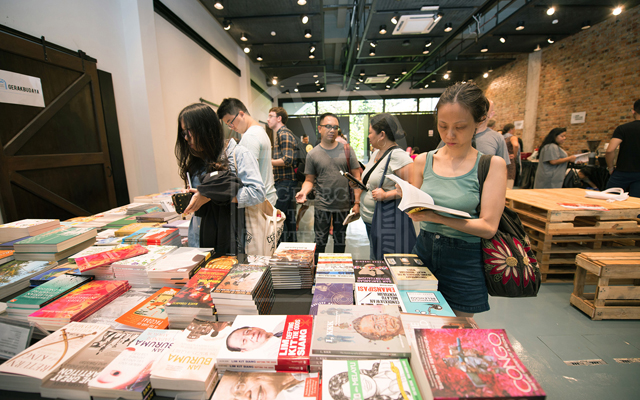
With the ninth edition of the George Town Literary Festival (GTLF) just round the corner, industry players have rolled out efforts to capitalise on the well-loved event by including the GTLF into their Penang itineraries.
Nigel Wong, director of Kuala Lumpur-based Urban Rhythms Tours, Adventures & Travel, shared: “We have seen increased take up of cultural tour packages from the region, and attending the workshops and discussions have the potential of casting new insights and broadening (attendees’) perspectives on pertinent issues.”
Tour operators cash in on popularity of George Town Literary Festival
Johor Bahru-based New Asia Holiday Tours & Travel’s general manager Raaj Navaratnaa, said: “We have received enquiries from student groups from Singapore and international schools from Johor to organise tours in conjunction with the event, and for us to facilitate one-on-one meetings with specific literary figures, with the intention of further developing school poetry and literature clubs.”
This year’s festival theme ‘forewards/afterwards’ will revolve around new beginnings and transitions, with a strong emphasis on history and timely discussions on the future of the planet. A strategic partnership with Penang-based ThinkCity’s Climate Action Week will also result in an increase of ecologically-focused events in the festival programme.
Manfred Kurz, managing director, Diethelm Travel Malaysia, expects the popular event to draw crowds from beyond the region. He said: “Our main markets – Europe and the US – love literature and issues relating to the environment, hence the festival will be of much interest to them.”
ThinkCity’s managing director Hamdan Abdul Majeed shared at a recent press conference: “We are organising the inaugural Penang Climate Action Week from November 16 to 24, and we are strategically aligning with GTLF to reach out to an even wider audience, beyond the radar of urban and climate enthusiasts.
“Our programme will feature a highly anticipated Climathon, a hackathon for climate change, a talk by the highly respected Jane Goodall at Universiti Sains Malaysia, as well as a series of locally directed and produced short-film and documentary screenings.”
A first for this year’s GTLF, which will see over 80 events spread over four days, will be its focus on language and translation, with highlights on the Malay language and Mahua literature.
GTLF’s co-director Pauline Fan shared: “Utilising world literature and translations as a medium to revisit history and foresee global trends in the next decade, the festival hopes to engage the audience with issues such as the ecological crisis, the displacement of indigenous communities around the world and the future of activism, among many other matters.”
This year’s edition sets itself apart from previous years by featuring daily lectures from renowned intellectuals such as Eliot Weinberger and Goenawan Mohamad, conversations with celebrated writers including 2019 Man Booker International Prize winner Jokha Alharthi and 2019 Commonwealth Short Story Prize winner of the Asian region, Saras Manickam.
There will also be panel discussions, showcased readings, writing workshops and performances.
The festival, which will take place from November 21-24, is produced by Penang Convention & Exhibition Bureau, and led by co-directors, Pauline Fan and Sharaad Kuttan.
Admission to all events at GTLF is free, with the exception of workshops and classes with festival headliners.
This article has been updated. An earlier version of this story incorrectly stated that this year is the fourth edition of GTLF.
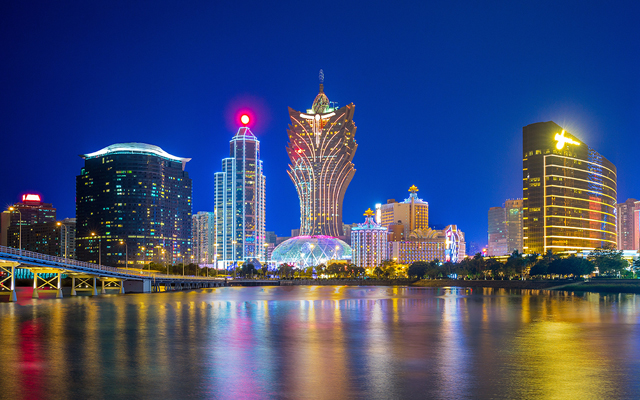
Following its earlier partnership with WebBeds to attract more Indonesian travellers, the Macao Government Tourism Office (MGTO) is now teaming up with Singapore-based travel search engine Wego to promote the city as “a preferred destination of choice” for Asian visitors.
More than 27 million people visited Macau in the first eight months of 2019, with a rise in the overall percentage of visitors travelling from Mainland China (19 per cent), South Korea (3.4 per cent), Hong Kong (21 per cent) and Taiwan (0.9 per cent) as compared to the same period in 2018.
Macao Government Tourism Office partners Wego to promote tourism in Macau
Under the partnership, both Wego and MGTO will work on highlighting key attractions and unique experiences as well as hidden gems in the country.
The opening of Hong Kong-Zhuhai-Macau Bridge has lured more holidaymakers, where an overall increase of nine per cent in Asian tourists is expected during this Chinese New Year holidays.
Ranked among the top 10 most visited cities in the world, Macau expects around 38 million tourists in 2019.
Thai hospitality group Centara Hotels & Resorts has appointed two new additions to its executive management team, as the company embarks on an ambitious plan to double company revenues and optimise profitability.
With more than 30 years of experience in sales and marketing, Tabatha Ramsay has joined the company as vice president commercial, overseeing sales, revenue and distribution. She will report to Centara deputy CEO Markland Blaiklock.
Tabatha Ramsay; Raymond Tong
Prior to joining Centara, Ramsay held a number of management positions with hotel groups, including Intercontinental Hotels Group, Minor Group’s Anantara Hotels, Oakwood Worldwide, and Vinpearl Hospitality.
Meanwhile, Raymond Tong, who has more than 25 years’ experience in hotel development and operations, has been appointed chief development representative China and North Asia. He will report to Centara senior vice president business development Andrew Langston.
Before becoming CEO of Ambassy Hotel Advisors, Tong held a number of senior-level roles during a 20-year career with AccorHotels, during which he helped develop more than 180 hotels, resorts and serviced apartments throughout China, Hong Kong, Macau and Taiwan as well as other Asia markets.
Brought to you by Further East – the newest and most innovative luxury travel show in Asia. As a platform for thought-leaders in hospitality, they’ve curated three brands with compelling sustainability strategies for TTG Asia.
Luxury hospitality has been touted as a potential solution to what is arguably Asia’s fastest-growing crisis: sustainability. Not only in a practical sense – by definition, luxury travel is exclusive, and so brings fewer travellers, thus helping to combat overtourism – but also because an increasing number of luxury hospitality brands are placing sustainability at the very core of their business model. And with the continent at the epicentre of the global sustainability crisis (75% of its protected marine areas are threatened by coastal development; 12 of the world’s 15 most polluted cities are in Asia) now is the time for Asia’s hospitality titans to take urgent action.
For the pioneers below, there is no luxury without sustainability. But they are not only protecting the future of Asia: they’re also future-proofing their brand positioning. Sustainability is a more important factor than ever for luxury travellers, particularly high-net-worth Millennials. A survey by sustainability consultancy Bouteco found that 66% considered sustainability important when choosing a resort, while 42% would pay more to bed down in an eco-friendly resort – as long as they didn’t have to compromise on comfort. “Millennials expect brands to not only manage their (environmental) impact but communicate it,” says Diana Verde Nieto, co-founder of Positive Luxury. Here are three Asia-based brands and resorts doing just that.
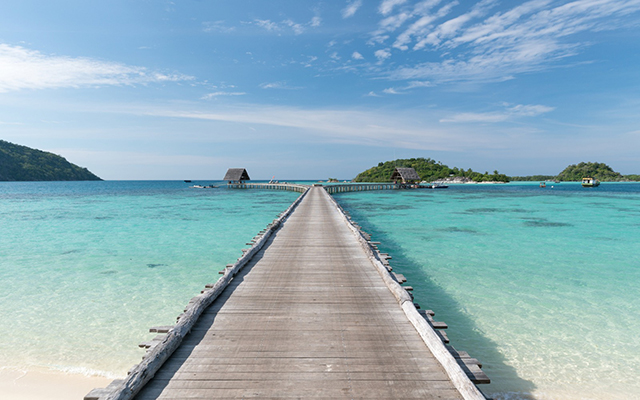
Bawah Reserve
Bawah Reserve: a masterclass in holistic and sustainable luxury
Many brands have pivoted to a sustainable approach only in recent years – but not so with Bawah Reserve, where sustainability is embedded in their brand DNA. From its conception – it was hand-built slowly over five years using reclaimed driftwood, teak and bamboo – to the present day, where the focus is firmly on preserving conservation with a permaculture garden, water treatment plant and micro-power grid. Right down to the details (think organic toothpaste and nontoxic detergent) no luxury is spared, with personalised, eco-friendly gifts communicating their sustainability story given nightly to guests.
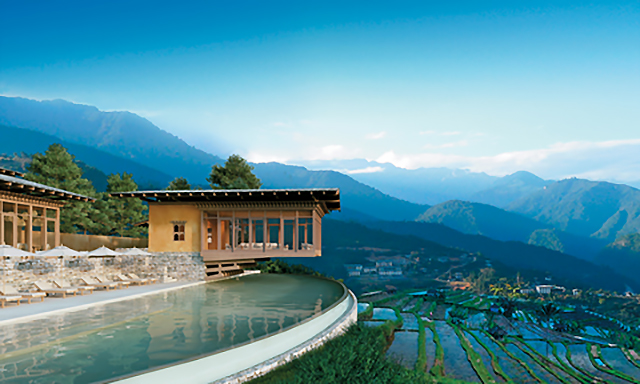
Six Senses Bhutan
Six Senses Bhutan: protecting the world’s last carbon-neutral country
For Guy Heywood, COO of Six Senses, taking an ecological approach to hospitality development actually enhances the guest experience: “far from being a handicap, (it) can bring its own rewards.” It’s an ethos that has clearly filtered down into Six Senses properties, especially its newest outpost in Bhutan, which is currently the world’s only carbon-negative country. And they want to keep it that way by implementing a zero-waste philosophy; a dedicated eco-village farm to grow all produce; and a partnership with the country’s agriculture minister.
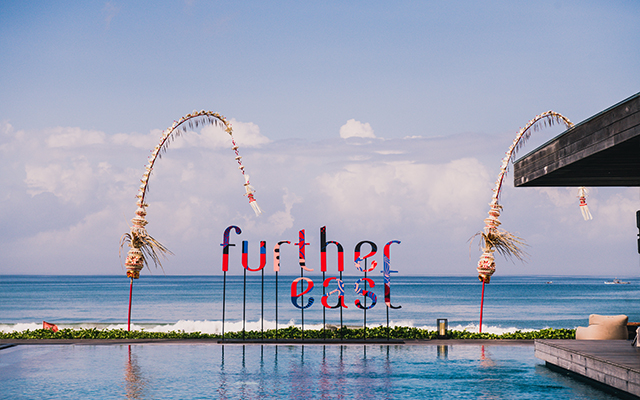
The home of Further East 2019 is also a sustainability powerhouse. For Alila, it’s all about being a “good neighbour – we must always remember that we have to minimise our impact on the environment and respect the local community,” says Doris Goh, Head of Brand and Marketing for Alila Hotels and Resorts.
Alila Seminyak is now mandated to reach ‘zero-to-landfill’ status, alongside an organic permaculture garden and waste composting system.
Bawah Reserve, Six Senses Bhutan and Alila Seminyak will all be exhibiting at Further East 2019: Asia’s newest and most innovative luxury travel show.
Further east begins today Monday 11 November with its un-conference AWAKEN. A place where disruptors from Asian hospitality and beyond come together to connect, innovate and inspire.
Find out more and register for 2020 at furthereast.co – and follow us at @furthereast_.
Hear more inspiration to shape your sustainability strategy at AWAKEN, the half-day unconference that takes place on the first day of Further East. Discover a new dawn of thinking at furthereast.co/awaken
The global economy is in a challenging state, faced with the threat of ‘slowbalisation’, where the world is turning against globalisation, and rising geopolitical risks, according to Andrew Staples, global editorial director of the Economist Corporate Network, The Economist Intelligence Unit, who spoke at the inaugural SG Tourism Leaders Engagement Series last Tuesday.
“This is an age of anxiety, due to VUCA (volatility, uncertainty, complexity and ambiguity),” Staples emphasised.
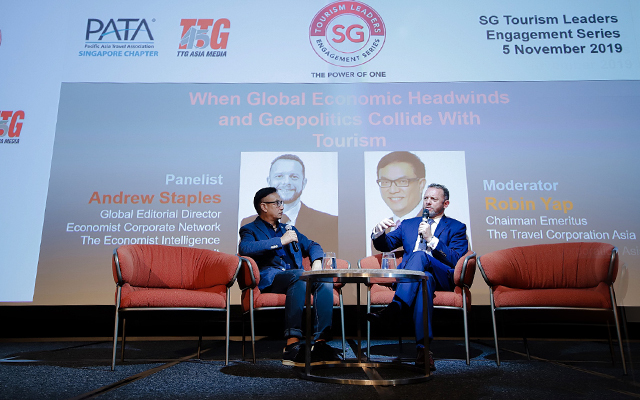
The Travel Corporation Asia’s Robin Yap and The Economist Corporate Network’s Andrew Staples in discussion on the state of the global economy on Asia’s tourism industry at the recent SG Tourism Leaders Engagement Series
“On the one hand, economic growth in financial markets like the US are doing pretty well, at record levels even, and unemployment is in multi-decade lows. In terms of monetary policies, interest rates are virtually zero in most advanced economies around the world. These should be spurring economic growth, yet on the other hand, there is a lot of uncertainty around the world.
“Some of the uncertainty is coming from (US) president (Donald) Trump who is challenging trade relations with China, questioning (the US’) relationship with Europe through NATO, and more. The US, as a global central power, used to quietly support things like the World Bank, the WTO, IMF and all the important infrastructure in the global economy. All that is being questioned now,” he explained.
Closer to home, demonstrations in Hong Kong are also hurting regional economic performance. A recent study by The Economist has placed Hong Kong in a technical recession, due to two negative quarters of growth.
In his presentation, Staples highlighted that the global GDP has slowed to 2.3 per cent in 2019, down from 2.8 per cent last year, with Brexit hurting investment confidence and Germany flirting with recession.
“Global trade this year is expected to post some of the lowest growth rates we’ve seen in the past 11, 12 years since the global financial crises of 2007 and 2008,” he said.
Amid the dreary outlook, Staples offered a sliver of hope through data that pointed to continued economic growth in Asia.
In Asia, India and Australia next year are expected to post stronger year-on-year GDP growth at 6.7 per cent and 2.3 per cent, respectively; while China (six per cent), South-east Asia (4.3 per cent) and Japan (0.4 per cent) are expected to see slower advancement.
Within South-east Asia, Myanmar (7.1 per cent), Laos (6.5 per cent) are expected to put in the strongest GDP performance, while Singapore (1.2 per cent) and Brunei (1.5 per cent) will see slight year-on-year improvements. Malaysia and Indonesia are expected to maintain their GDP growth at 4.4 per cent and 5.1 per cent, respectively.
Thailand (2.1 per cent), Cambodia (6.4 per cent), Vietnam (6.5 per cent) and the Philippines (5.2 per cent) will see slower year-on-year GDP growth.
When asked by session moderator Robin Yap, chairman emeritus of The Travel Corporation Asia, what these projections mean to Asia’s tourism industry, Staples said: “You (tourism players) are in a really good sector. Look at the predicted drivers of growth – emerging economies, growing affluence, greater adoption of technology – that are in your favour.
“The Economist did a research and identified a growing band of people around the world, which we call the Globally Curious. These people are sincerely interested in what is happening around the world and want to learn more. This strata of people will grow, and they will look for more opportunities to travel and learn about other societies and countries.”
Speaking to TTG Asia on event sideline, Jameson Wong, Asia-Pacific business development director of ForwardKeys, agreed that the outlook for Asia’s tourism industry is still bright.
“Asian economies are still performing and there is growing affluence (in the region). At the same time, low-cost carriers (LCCs) are expanding in Asia along with an Internet proliferation which has made travel purchase far more accessible to everyone. These factors are feeding tourism growth,” said Wong.
ForwardKeys data has recorded growth of at least 12 per cent in travel bookings issued for the period November 2019 to April 2020 for all countries, with the exception of Hong Kong and Sri Lanka.
Vietnam sees the strongest forward inbound booking growth at 33 per cent, followed by Japan at 27 per cent.
“We do not foresee a decline in these numbers, as many countries are stepping up promotions and opening up new destinations for tourism. For cost-conscious travellers, Asia is always a more affordable option than longhaul destinations. Furthermore, regional business travel will remain fairly constant,” he added.
Wong believes Asian businesses will continue to be a major driver of tourism traffic in the region, “come rain or shine”.
“Asia sees a lot of intra-regional business travel. Business trips have to be made in good times or bad, although companies will relook their way of travel. In the event that business class and full-service airlines are cut, this region has many LCC options to keep people flying,” he said, adding that intra-Asia travel takes up approximately 65 per cent market share of global travel annually.
The travel trade is mourning the sudden passing of Philippine Airlines Holdings’ (PAL) president Lucio “Bong” Tan Jr, the son of Filipino tycoon Lucio Tan, who died on Monday (November 11) at the age of 53.
The Tan family did not mention the cause of his death, but he reportedly died days after collapsing during a basketball game last Saturday. The Philippine Star reported that his death was due to brain herniation.
Lucio “Bong” Tan Jr passes away at the age of 53
Tan Jr was less than a month in his position as vice chairman of PAL and president of the carrier’s holding company, PAL Holdings.
Vivienne Tan, who is currently serving as PAL executive vice president for treasury, treasurer and chief administrative officer, said in a statement that her brother’s “untimely passing leaves a deep void in our hearts and our group’s management team, which would be very hard to fill”.
“Bong was a son, husband, father, friend and, most importantly, our elder brother whom we all relied on for advice, counsel and leadership.”
The younger Tan is survived by his wife and two sons.
“We grieve the passing of a son, brother, husband, father, business leader and sports enthusiast who served the LT Group of Companies for over two decades,” PAL’s employees said in a statement.
“His non-traditional, ‘one-of-the-boys’, hands-on leadership captured the hearts of those who worked for him. While he advocated productivity at work, he inculcated the value of sports in his corporate culture, thus breaking barriers between management and the employees of the companies he led.”
Tourism industry leader Robert Lim Joseph, a friend of Tan Jr, said: “Bong knew the importance of team effort in and out of the business. We were looking forward when he would take the reigns of PAL.”
Tan Jr’s demise leads to succession questions at PAL, as the younger Tan was seen as the successor to his father. The airline had recently gone through a major reorganisation that led to the retirement of previous president and COO Jaime Bautista after 26 years with the company. Bautista was replaced by aviation newcomer Gilbert Sta Maria.
Great Sights Travel and Tours’ managing director Paul So said that the premature death of Tan Jr at the top of his career is “a big shock”. On how it will impact PAL’s management, So replied: “Your guess is as good as mine.”
Tan Sr, 85, is the chairman and CEO of PAL. Also serving on the PAL board of directors are his wife Carmen and children Vivienne, Michael, and the late Tan Jr.
The travel trade is still reeling in grief at the recent passing of John Gokongwei, 93, who left behind a business conglomerate that includes Cebu Pacific and Go Hotels, helmed by his only son, Lance Gokongwei.
The Mandalika, a purpose-built integrated resort housing Indonesia’s first MotoGP track, is set to enhance the country’s ambitions of becoming a premier race destination.
Scheduled to launch in 2021 leading up to its inaugural MotoGP 2021 race, The Mandalika – which is operated by the Indonesian Tourism Development Corporation (ITDC) – will also offer a mix of luxury accommodation and a multitude of destination activities, with year-round racing designed as a central attraction at the development.
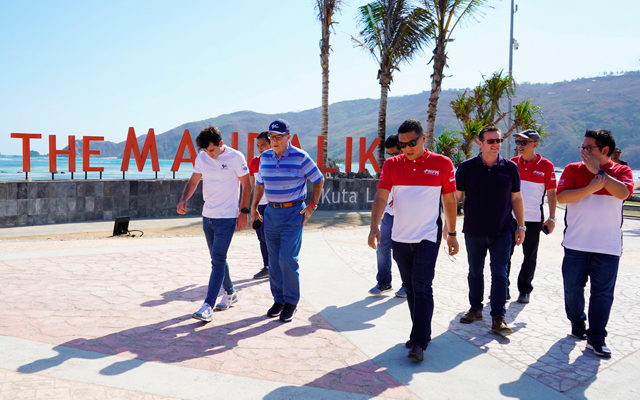
Staffers from the Indonesian Tourism Development Corporation visit The Mandalika
The future of The Mandalika as a race destination will also extend beyond the MotoGP as the Jakarta central government has given the green light to add Formula One racing to resort’s future.
The Indonesian Tourism Development Corporation (ITDC) – which will manage and operate The Mandalika – has signed two contracts with Dorna Sports, the exclusive commercial and TV rights holder for MotoGP, to bring the FIM Road Racing World Championship Grand Prix and the MOTUL FIM Superbike World Championship to Indonesia.
Stretched over a 16km ribbon of beachfront, The Mandalika resort in southern Lombok will feature up to 16,000 hotel rooms, a convention centre, 27-hole golf course, theme park, commercial facilities and retail shops.
The 4.3km Mandalika Street Circuit will feature some 18 sinuous turns designed to specific FIA and FIM grading, a first for the motorsport industry that meant rather than converting existing streets to form a racing circuit, the design allowed ITDC to remap the zoning of future real estate properties and proposed streets to allow for the necessary technical specifications that are required by the FIM.
The new circuit is uniquely built within the tourism complex, a track that wends past a variety of hotel accommodation, residential and retail facilities, a solar cell farm and then hooks around the Spectators Hill.
The racetrack straightaway features a covered paddock integrated in an exhibition centre and several grandstands seating 50,000 and swath of space for nearly 100,000 standing spectators.
Approximately US$25 million has been spent on key infrastructure projects in the construction of The Mandalika. In December 2018, ITDC confirmed further funding from the Asian Infrastructure Investment Bank amounting to US$248.4 million. As well, other international and countrywide investors have shown keen interest in the destination’s future.
ITDC’s CEO Abdulbar Mansoer said: “Our anchor partner and investor, French-based Vinci Construction Grands Projets (VCGP), will complete the rest of the circuit with the necessary facilities to run the races. The partnership with VCGP was finalised with the signing of a Master LUDA (Land Utilization Development Agreement) in 2018, which sees VCGP committing a total investment of around US$1 billion over the coming 15 years for the Entertainment District.”
Final funding to complete the entire infrastructure packages over the next decade will be a proposed US$89 million from Indonesia Exim Bank, according to Mansoer.
He added: “When completed, we expect the destination and race events will be well supported by local, regional and international motorsport fans as well as travellers seeking an all new experience, with or without races in mind.”
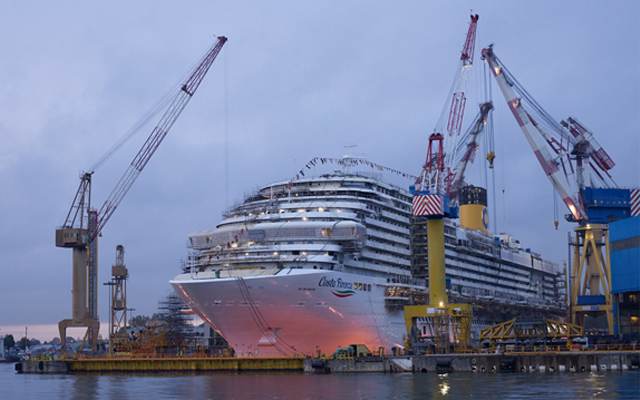
Costa Cruises, the Italian company of Carnival Corporation, and Italian shipbuilder Fincantieri, recently celebrated the official float-out ceremony of Costa Firenze, the cruise liner’s second ship designed and built specifically for the Asian market.
The ceremony was held at the Fincantieri shipyard in Marghera, Italy, where the ship is being built. After her delivery scheduled on September 30, 2020, Costa Firenze will be heading to Singapore to offer cruises to Asian customers.
Costa Cruises floats out new ship Costa Firenze, which is targeted at the Asian market
Costa Firenze is the sister ship of Costa Venezia, built by Fincantieri at the Monfalcone shipyard and launched in Trieste on March 1 this year.
Like her sister ship Costa Venezia, Costa Firenze will offer a series of innovations designed specifically for the Asian market.
With a gross tonnage of 135,500 tons, 323m in length and a capacity for over 5,200 guests, Costa Firenze and Costa Venezia are the biggest ships introduced by Costa to the Asian market. They are part of an expansion plan that includes a total of seven ships being delivered to the Costa Group by 2023, for a total investment of over 6 billion euros (US$6.6 billion).
Costa Firenze officially reached the sea for the first time during the float-out ceremony. The celebration followed the protocol provided by the seafaring tradition for such occasions, by flooding the basin where the ship took shape in recent months, following the cutting of the ribbon and the breaking of the bottle by the float-out ceremony’s godmother Franca Pierobon, an employee of Marghera shipyard.