Veranita Yosephine Sinaga has been appointed as CEO of AirAsia Indonesia, taking over from Dendy Kurniawan with immediate effect.
In her new role, Veranita will be responsible for the company’s airline operations in Indonesia, working with government and industry stakeholders to play a key role in leading local transformation efforts as the company expands beyond air transport to offer travel and lifestyle services, as well as financial services.
Veranita joined AirAsia Indonesia as deputy CEO in July 2019, bringing with her more than 18 years of fast-moving consumer goods sales experience.
Prior to joining AirAsia, Veranita served as sales director at Kraft Heinz Indonesia, where she led and orchestrated multiple commercial growth initiatives. She also spent a number of years with Danone Waters Indonesia and British American Tobacco Indonesia.
Hong Kong-based airport services provider Plaza Premium Group (PPG) is expanding its global footprint and enhancing products across 11 international airports, including Beijing Daxing International Airport, Jakarta Soekarno-Hatta International Airport, Kuala Lumpur International Airport, and Singapore Changi Airport.
“Year 2019 and 2020 mark a big leap forward for PPG and we are committed to serve over 16 million travellers by the end of 2020, a 10 per cent increase compared to where we are now,” said Song Hoi-see, founder and CEO of PPG.
Plaza Premium invests US$55 million into global expansion; Plaza Premium Lounge at Indira Gandhi International Airport pictured
“In addition to expanding in the US, China and Indonesia as part of our US$100 million investment in coming years, we continue to strengthen our leading position in the existing markets by creating a holistic departure, transit and arrival experience.”
The group’s flagship brand Plaza Premium Lounge will open in Dubai International Airport in December 2019, spanning across 1,260m², the largest independent pay-per-use lounge at the airport’s Terminal 3.
Scheduled to fully operate in 2Q2020, a mega lounge will open in Toronto Pearson International Airport International Departures occupying nearly 1,200m² as the largest independent pay-per-use lounge in Canada.
Plaza Premium Lounge will be unveiled in Australia in 1Q2020 at Sydney Airport Terminal 1 while the brand will debut in the US in 2020 with domestic lounge and international lounge at Dallas Fort Worth International Airport and international lounge at Denver International Airport.
A nearly 3,000m² lounge space combining Plaza Premium First, Plaza Premium Lounge and Allways will be built in Jakarta Soekarno-Hatta International Airport to fully open in 1H2020. In its home town of Hong Kong, the brand will appear at two new locations this December and January respectively.
The development of its in-terminal airport hotel concept Aerotel has recently seen two strategic openings at Beijing Daxing International Airport and London Heathrow at Terminal 3 Arrivals.
In 3Q2020, Aerotel will launch in Sydney Airport as the only in-terminal airport hotel in Australia. Meanwhile, Aerotel Kuala Lumpur will see the addition of a select service extension and shared shower facilities. The brand’s inaugural location Aerotel Singapore is undergoing renovation of its outdoor swimming pool with plans to open end 2019 with enhanced services.
By 2020, PPG will be operating in more than 175 locations across 47 international airports.
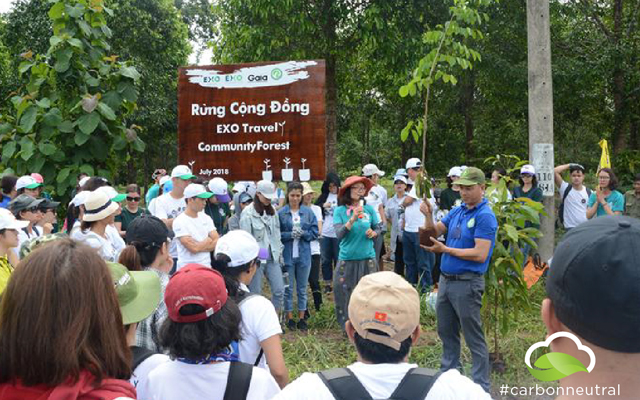
Bangkok-headquartered DMC Exo Travel has announced its latest efforts to fight climate change with carbon neutral holidays, allowing clients to travel carbon neutral with a minimal fee.
Through its not-for-profit arm, Exo Foundation, the DMC is organising tourism activities that minimise travellers’ carbon footprint, promoting wildlife experiences that encourage the preservation of natural habitats, as well as regrowing forests in Vietnam and Borneo. The company is also working with Nexus for Development to purchase carbon credits to offset all regional flights that are purchased via Exo Travel.
Exo Travel's carbon neutral tours
1 of 3
Furthermore, guests who book through Exo Travel can now make their holiday completely carbon neutral by choosing to offset the carbon from their hotels, activities and transport for a small fee. Carbon credits or funds will go towards protecting and regrowing forests, cleaner energy and wildlife protection in places that need them most, said the company in a statement.
Exo has integrated a carbon calculation mechanism into their operating system, so the system will generate the average carbon cost of each trip. This value is then given to their guests who can choose if they’d like to offset the carbon footprint of their trip.
Ruben Derksen, Exo Travel’s product and marketing director, said: “It costs around US$1.50 per person per day to offset their carbon footprint. So for a 10-day holiday, it’ll only cost a guest US$15. It’s incredibly cheap to do the right thing and we think we can generate a lot of funds to protect, regrow and fund reforestation efforts in Asia.”
Exo said it believes that with this new initiative, they should be able to plant at least 20,000 new trees in 2020.
Ireland has been picked as the location for Trafalgar’s 2020 Acclaim rewards trip, a destination the company claims “will appeal to agents all around the world”.
Supporting the brand’s “deep-seated and ongoing commitment to making a positive impact in the places they visit”, 2020’s Acclaim itinerary will focus on experiencing the brand’s JoinTrafalgar initiatives in the Emerald Isle.
Tralfalgar dangles Ireland rewards trips to agents
“Responsible travel is not a passing fad; it’s essential. As both travel companies and travellers, we have a responsibility to ensure that the places we love and the cultures we experience are available for future generations to enjoy too,” said Trafalgar CEO’s Gavin Tollman.
“It’s with this in mind that we’re thrilled to announce Ireland as the location of our 2020 Acclaim trip, giving our valued agent partners the opportunity to experience first-hand the impact that their sales of Trafalgar make to our JoinTrafalgar responsible travel pillars of people, places & wildlife and the planet in just one of the countries we visit,” he added.
Through this rewards trip, agents will receive both the VIP treatment and have the ability to share how the brand makes travel matter with their clients back home, Tollmann added.
The company said the announcement of its Acclaim destination is made earlier than the previous year to offer agents the opportunity to close more Trafalgar bookings during this key selling period and bring themselves one step closer to securing a spot on the rewards trip.
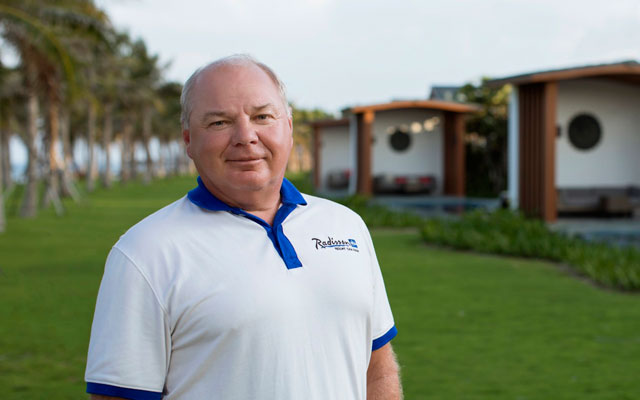
Peter Tichy has been appointed opening general manager for the Radisson Blu Resort Cam Ranh Bay in Vietnam.
With more than 30 years of experience in the hospitality industry, Tichy has previously managed four of Radisson Blu’s hotels, as well as properties under its sister brand, Park Inn by Radisson.
Tichy has also managed and successfully launched new hotels in Russia, Sweden, Germany, Ukraine, Egypt, and Nigeria.
Tourism villages have the potential to become a key engine of Indonesia’s tourism growth and spur the development of small- and medium enterprises across the archipelago, said the country’s industry players.
Speaking at a recent national dialogue on tourism organised by the Indonesian Hotels and Restaurants Association (PHRI), Irfan Wahid, coordinator of Quick Win Team at the Coordinating Ministry of Maritime Affairs and Investments, said that a tourism village strategy could become a powerful tool in the development of the 10 New Bali’s in Indonesia.
Indonesia’s tourism stakeholders propose building more tourism villages to attract visitors; Pujon Kidul tourism village in Malang, Indonesia pictured
The strategy, which Irfan recently proposed to president Joko Widodo, encourages the government to annually create 1,000 digital-based tourism villages across the archipelago to boast culture, ecotourism destinations, as well as agricultural, horticultural and aquatic products.
He said: “A four-legged table will crack if a very heavy load is placed on it. But if it has a thousand legs, it will be much stronger. For me, a tourism village is a leg. The more, the merrier. A tourism village will empower small and medium enterprises. We target one village to focus on producing one export-oriented commodity.”
An example is Pujon Kidul in Malang, East Java, which after becoming a tourism village attracted 241,525 tourists in 2018, up from 619 in 2013. Homestays also rose from 178 properties in 2013 to 758 in 2018, with occupancy rates increasing from 10 per cent to 35 per cent. The Pujon Kidul village contributed 5.3 billion rupiah (US$379,000) in tourism revenue in 2018, up from 34 million rupiah in 2013.
“The more tourism villages we have, the more tourist spots we can develop together,” Irfan said.
In support of the initiative is PHRI’s deputy chairman Maulana Yusran, who believes that tourism villages can showcase the uniqueness of each village and attract more visitors.
However, Maulana expressed concern over the uneven playing field between hotels and homestays, and exhorted the government to exercise greater regulation in the accommodation sector to ensure that all players abide by regulations.
There should be stricter enforcement of homestay owners having to obtain a Tourism Business Registration License (TDUP), said Maulana, as it is a regulation that hospitality players have to comply with because it also entails safety measures. As such, he raised concerns about the safety of tourists who stay in unlicensed homestays.
“The government’s weak law enforcement (around TDUP) has resulted in unfair competition in the accommodation sector. Today, big cities like Jakarta and Bali are oversupplied with homestays, including the unlicensed ones which do not pay a tax that the ministry already stipulated in the regulation,” he said.
Umberto Cadamuro, COO inbound of Pacto, said that the government should prevent oversupply of homestays to prevent diminishing of occupancy rates. But homestays will not disadvantage hotels, he added, because they both have different target markets.
He opined that the Indonesian government should train homestay owners in tourism villages to go digital, and help facilitate partnership deals with accommodation booking platforms like Booking.com and Airbnb so that visitors can make online reservations.
Umberto said that creating homestay facilities was easy but developing a tourism village required careful planning. Therefore, he recommended relevant stakeholders to hire consultants to analyse the target market of each village and to preserve and protect the culture of the villages.
Despite the challenges, he said the initiative to grow homestays and tourism villages across Indonesia “is a feasible and very good idea”.
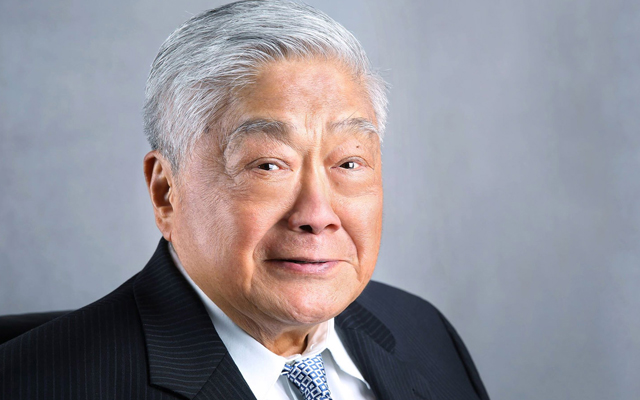
Filipino tycoon and founder of JC Summit Holdings, John Gokongwei Jr, passed away on Saturday night at the age of 93.
The news was confirmed by his son, Lance, in a text message sent out on Sunday, according to media reports.
John Gokongwei Jr passes away at age 93
Today, the Gokongwei Group is one of the Philippine’s largest conglomerates with interests in various industries, including airline, telecommunications, hospitality, and petroleum, among others.
The elder Gokongwei launched budget airline Cebu Pacific in 1996, with the business now headed by Lance as CEO.
“We, the 75,000-strong employees of JG Summit Holdings and Robinsons Retail Holdings, join the nation in paying tribute to the founder of the first Philippine multinational conglomerate, a philanthropist with a passion for education,” the group’s employees said in a statement.
“Mr. John, as we fondly called him, was a visionary. He was an inspiration to entrepreneurs and businessmen around the nation, with his pioneering ideas, his strong work ethic, his passion, and perseverance.”
Gokongwei is survived by his wife of 61 years, Elizabeth, and his children Robina, Lance, Lisa, Faith, Hope and Marcia; his in-laws and grandchildren; brothers Eddie and James Go, sister Lily; and his nieces and nephews.
The family requested in a statement that in lieu of flowers that donations be made to respect-payers’ favourite charity.
Artist’s impression of Legoland Shanghai’s gate entrance
Merlin Entertainments, Madame Tussauds and the Dungeons have entered into an agreement with the Shanghai Jinshan District Government, CMC and Kirkbi to develop a Legoland Resort in Shanghai’s Jinshan District.
Under the terms of the agreement, all parties will form a joint venture company and contribute funding to the construction and development of Legoland Shanghai. The total project investment is expected to be approximately £500 million (US$642 million). The project’s schedule is still to be determined, but it is not expected to open until after 2023.
Legoland Shanghai
1 of 5
Artist’s impression of Legoland Shanghai’s gate entrance
Legoland Hotel
Legoland Discovery Center Beijing
Hotel Legoland
(From left) Merlin Entertainments’ Nick Varney, Kirkbi’s Jorgen Vig Knudstorp, Executive vice mayor of Shanghai Chen Yin, and CMC Inc’s Li Rui Gang at the signing to build a Legoland Shanghai
This latest news follows Merlin’s earlier announcement to build and operate a Legoland Resort in Sichuan Province in Western China, in collaboration with Global Zhongjun Cultural Tourism Development.
Legoland Shanghai will be one of the largest Legoland Resorts in the world and will incorporate a 250-room fully-themed hotel on opening.
China is a strategic growth market for the Lego Group, which has significantly expanded its retail operations in the past few years and is projected to have 220 stores in more than 50 cities by end-2020.
Dependent on opening schedules, Legoland Shanghai will be opened after Legoland New York (scheduled to open 2020) and Legoland Korea (scheduled to open 2022).
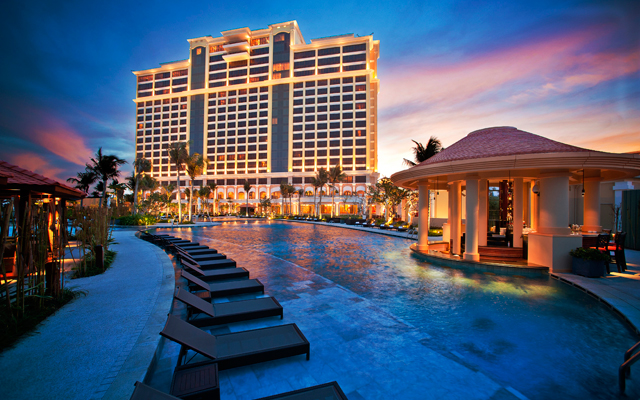
InterContinental Hotels Group (IHG) has signed agreements with Ho Tram Project Company (HTP) to rebrand The Grand Ho Tram at the Ho Tram Strip integrated resort to InterContinental Grand Ho Tram within a year after refurbishments.
The rebranded 533-key InterContinental Grand Ho Tram will be an integrated resort with three F&B outlets, outdoor pools, gym, spa, golf course, along with a retail space featuring a multitude of entertainment options including restaurants, bars, lounges, clubs and a casino gaming floor.
The Grand Ho Tram will be rebranded into InterContinental Grand Ho Tram
A new-build Holiday Inn Resort Ho Tram Beach, the brand’s first in Vietnam, will also open in 2020 as a 502-key hotel to feature family-friendly facilities such as swimming pools and a 360-degree rooftop bar. As well, the hotel will have direct access to facilities including a cinema, bowling arcade, food court and water park.
The two properties will also offer MICE facilities, including a convention centre inclusive of a large ballroom and five meeting rooms which can host up to 1,300 people combined, a casino for international visitors, F&B options as well as entertainment activities. Plans are underway to increase capacity to cater for larger events for up to 3,000 people.
IHG currently has 13 hotels in Vietnam, with more than half under the InterContinental brand, including the InterContinental Danang Sun Peninsula Resort and InterContinental Phu Quoc Long Beach Resort.
Asia continued to dominate the supply of international visitor arrival numbers (IVAs) into Asia-Pacific in 2018, generating close to 63% of the 696.5 million IVAs into the region, according to data from the Annual Travel Monitor 2019 Final Edition released by PATA.
In percentage growth terms between 2017 and 2018, Africa outbound into Asia-Pacific had the strongest annual increase at over 13% year-on-year, followed by Europe at almost 11% and then Asia at 7.3%. The nondescript ‘Others’ category increased by 7.5% in 2018, year-on-year.
Intra-Asia travel remains dominant force in region: PATA
By annual increase in the absolute volume of foreign arrivals over that same period, these positions changed somewhat, with Asia generating close to 30.3 million additional foreign arrivals, followed by Europe with more than 8.5 million and then the Americas with just over 5.9 million.
Africa generated a volume increase of just under half-a-million IVAs.
Out of Africa, it was North Africa that generated the largest volume of additional foreign arrivals into Asia-Pacific between 2017 and 2018.
Across the Americas, North America produced the strongest annual incremental increase in foreign arrivals into Asia-Pacific in 2018, generating almost 4.2 million of the 5.917 million increase in arrivals from the Americas between 2017 and 2018 (70.8%).
In Asia, North-east Asia as an origin market showed the strongest increase in absolute numbers out of this region between 2017 and 2018.
The collective markets of Europe added more than 8.5 million IVAs into Asia-Pacific between 2017 and 2018, with West and East Europe supplying the bulk of that additional volume between those two years.
Additional IVAs into Asia-Pacific from the Pacific between 2017 and 2018 were mostly out of Oceania.
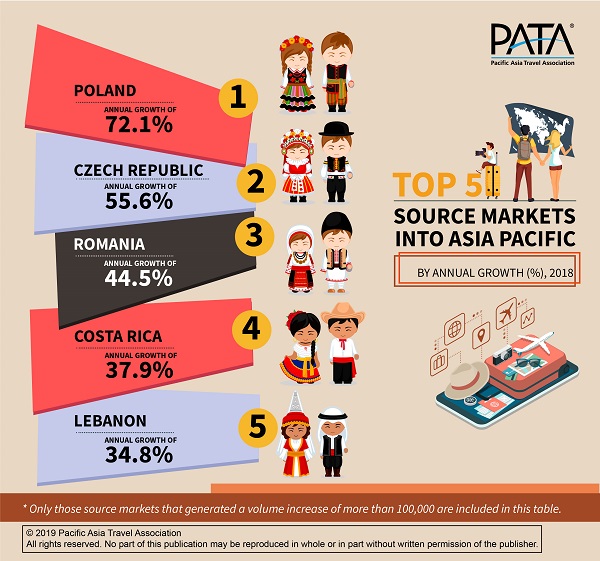
At the individual origin market level, those with the strongest annual percentage growth rates into Asia-Pacific in 2018 were ranked as:
All told, 46% of the 245 origin markets (including ‘Others’) covered in this report had annual growth rates in excess of 10%, while 66% grew by five per cent or more between 2017 and 2018.
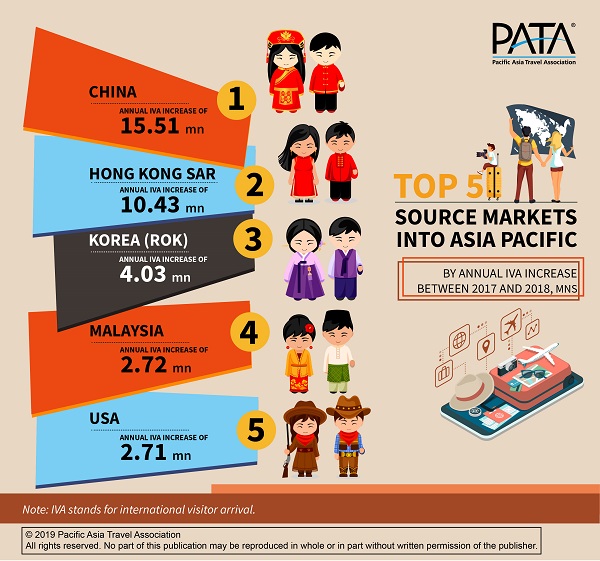
For the absolute volume increase between 2017 and 2018, the strongest source markets into Asia-Pacific were ranked as:
Interestingly, each of these top five origin markets are within the Asia-Pacific region. Intra-regional travel remains very strong.
Of the source markets covered in this report, 12 (about 5%) generated annual volume increases of more than one million each, while 20 (about 8%) produced more than half a million additional IVAs into Asia-Pacific between 2017 and 2018.
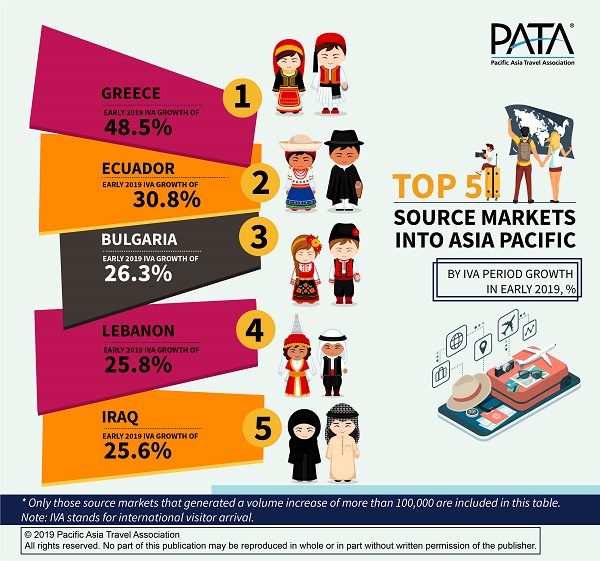
Early 2019 data for foreign arrivals into 37 Asia-Pacific destinations shows strong early performances from a number of destinations including:
While Europe’s Greece and Bulgaria both represent extra-regional increases into Asia-Pacific in early 2019 over early 2018, the remainder in this group are all from within Asia-Pacific.
While only two origin markets have so far added more than one million additional IVAs into Asia-Pacific between early 2018 and early 2019, just under 10% of these 232 markets had already generated more than 100,000 additional arrivals into the region over these periods. Included among these are:
PATA’s CEO Mario Hardy said: “Asia-Pacific is still the major generator of arrivals into Asia-Pacific, with Asia especially playing a lead role in that regard. Outside of Asia-Pacific, Europe is an important contributor, with both West and East Europe in particular, supplying significant numbers of additional arrivals in early 2019.”
“Nothing remains the same however and various tumultuous activities that are currently playing out globally and in the Asia-Pacific region will undoubtedly affect the origin and distribution of international arrivals by the end of the year.
“It remains imperative therefore that the international tourism sector remains agile and able to shift its marketing focus to areas of higher potential as these interventions peak and then ultimately fade. The provision of appropriate and timely intelligence as to what these areas of higher potential may be has never been more critical and could easily spell the difference between growth and contraction for players in this field and at this time.”