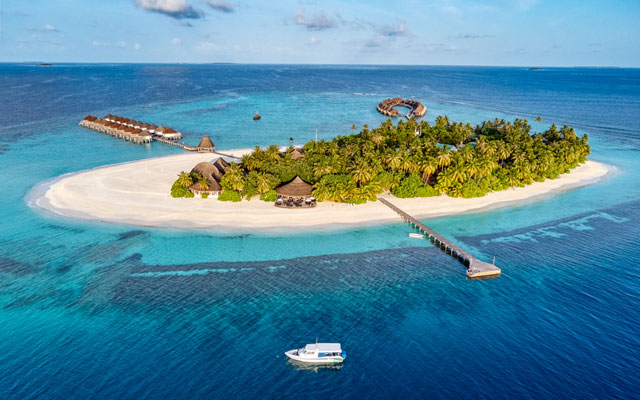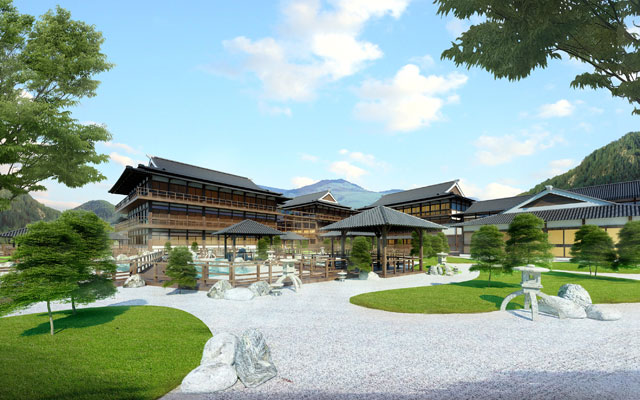
After two years of development, Crossroads, the first and largest integrated leisure and lifestyle destination in the Maldives by Thai developer Singha Estate, will be opening two of its nine islands.
The first island is home to the lifestyle district and heart of the megaproject, The Marina @ Crossroads, an 11,000m2 retail and entertainment space. The attraction, which is in close proximity to the city, houses luxury retail outlets, fine dining restaurants, a state-of-the-art event hall, as well as a PADI-certified water sports and dive centre.
Crossroads, the largest integrated tourism destination in the Maldives, will be opening two of its nine islands
A transit hotel, SAii Lagoon Maldives, which is under the Curio Collection by Hilton, targets short-term visitors who can utilise the facilities at the town centre during their stopover for connecting flights.
The project’s sustainable development aspect can be seen through the efforts made at Maldives Discovery Centre, an interactive educational-centre-cum-museum that promotes environmental conservation and Maldivian local arts and crafts.
Another is the Marine Discovery Centre, a marine life laboratory that hosts biologists who carry out research and longitudinal studies on sea-life and coral propagation through a Junior Coral Curator programme and a clownfish release initiative that span within the area of 64,000m2.
The second island is the Hard Rock Hotel Maldives, which is developed and managed by S Hotels & Resorts. The hotel, which introduces music-inspired stays, is also considered to be the brand’s first Maldivian outpost.
Singha Estate’s CEO Naris Cheyklin said that while setting sights on promoting tourism and the local economy, Crossroads is also committed to its mission of “building big, protecting the small”, which entails promoting the livelihoods of its inhabitants while fashioning this mega project.
British tour operator Thomas Cook announced its collapse on Sunday evening, leaving hundreds of thousands of travellers stranded worldwide as the 178-year-old travel institution ceased trading with immediate effect.
In a statement, Thomas Cook said that the company’s board was left with “no choice but to take steps to enter into compulsory liquidation with immediate effect” after talks of a rescue deal fell through.
Thomas Cook’s collapse left hundreds of thousands of travellers stranded worldwide
Thomas Cook’s chief executive, Peter Fankhauser, said in a statement:
“We have worked exhaustively in the past few days to resolve the outstanding issues on an agreement to secure Thomas Cook’s future for its employees, customers and suppliers. Although a deal had been largely agreed, an additional facility requested in the last few days of negotiations presented a challenge that ultimately proved insurmountable.
“It is a matter of profound regret to me and the rest of the board that we were not successful. I would like to apologise to our millions of customers, and thousands of employees, suppliers and partners who have supported us for many years.”
He added that Thomas Cook’s collapse “marks a deeply sad day for the company”.
Besides grounding its planes, Thomas Cook has been forced to shut its travel agencies, according to an AFP report, leaving the group’s 22,000 employees worldwide jobless, including 9,000 in the UK.
The move has also triggered the biggest peacetime repatriation in UK history, as the UK Civil Aviation Authority seeks to bring home travellers stranded abroad over the next two weeks.
The 178-year-old company had been struggling against stiff online competition for some time, divulging in May that Brexit uncertainty had caused its losses to deepen in first half, and that it was seeking £200 million (US$248 million) from private investors to avert collapse.
China’s Fosun Group, which had led a final bid to save the troubled British travel firm Thomas Cook from bankruptcy, said that it was “disappointed” that the effort had failed.
“Fosun is disappointed that Thomas Cook Group has not been able to find a viable solution for its proposed recapitalisation with other affiliates, core lending banks, senior noteholders and additional involved parties,” Fosun said in a statement to AFP.
“Fosun confirms that its position remained unchanged throughout the process, but unfortunately, other factors have changed.”
“We extend our deepest sympathy to all those affected by this outcome.”
After the rescue deal fell through, Thomas Cook declared bankruptcy on Monday, leaving hundreds of thousands of travellers stranded in the UK’s biggest ever peacetime repatriation, reported the AFP.
Meanwhile, Thomas Cook India pointed out that there is no impact owing to Thomas Cook collapse in the UK. Madhavan Menon, chairman & managing director, Thomas Cook (India) reiterated that it is “business as usual for Thomas Cook India which is a completely independent entity, acquired by Canada based Fairfax Financial Holdings in August 2012 from Thomas Cook in the UK.”
As the protests in Hong Kong stretched into the fourth month without any signs of abating, industry stakeholders are coming to terms with the impacts the turmoil have brought to their business, and are now laying out plans to cushion further fallouts as the crisis drags on.
Inbound arrivals to Hong Kong have been affected. According to Hong Kong Tourism Board (HKTB), total visitor arrivals in July 2019 declined 4.8 per cent year-to-year to 5.2 million, while total overnight arrivals – which amounted to 2.4 million – dipped 5.3 per cent year-on-year. A fall in the total number of both mainland and non-mainland visitor arrivals were also recorded.
Hong Kong tourism players see hope despite drop in number of inbound arrivals to the country
A HKTB spokesman said: “Preliminary figures show a drop of about 30 per cent in the number of visitor arrivals in the first half of August. The travel trade has reported that the number of forward bookings in September and October has also dropped significantly.”
HS Travel International’s executive director, Hazen Tang, said: “The Hong Kong Airport (closure) was a severe blow to my business, (resulting in) numerous cancellations for October and November.”
He added the company is not entirely reliant on Hong Kong and may redirect some bookings to other destinations, including Thailand, Japan, Russia and the UK where it has overseas offices.
Meanwhile, HS Travel International is also keen to explore business opportunities in new markets such as Central Asia.
“Hong Kong is still a safe city for travellers”, stressed Tang, adding that the company sends regular updates to their clients to allay any visitors’ worries.
iVenture Card International, which provides pre-paid destination attraction passes, observed some cancellations and refund requests for Hong Kong’s attractions, but the number was not overwhelming, according to Asia sales manager Nicky Kwok. “Attractions are not affected, and tourists are not targeted,” he said.
“At this stage, safety is not the main concern and queries are mostly about traffic arrangements in Hong Kong. Some visitors encountered trouble when accessing attractions, so we offer advice on public transport and alternative options,” Kwok pointed out.
Like Tang, Kwok foresees a slowdown in inbound business in the near future, but believes Hong Kong remains a “great destination”. But business being business, iVenture Card will manage risks by focusing promotion on its 17 other destinations for now.
It’s not entirely a dismal picture for Hong Kong’s inbound sector, as industry players still see some glimmer of hope.
ATI Travel’s owner Richard Woss shared that longhaul travellers booked with his company are unlikely to cancel their trips, which typically last between a week to 10 nights, and are usually combined with China.
He explained: “As Hong Kong only accounts for one to two nights, clients are very reluctant to (cancel). But it’s a different story for those who treat (Hong Kong) as a mono destination.
“Frankly, Europeans regard protests as a sign of freedom of speech and democracy. If you go to Paris, protesters would be more violent. Our clients take a more mature approach to look at (the current situation), and they have confidence in Hong Kong,” he added.
Sanjay Mehta, chief executive of India-based Trans Globe Travels, also thinks the perception of street violence in Hong Kong is exaggerated by rolling media coverage. “As far as I know, the protests only affect several blackspots in downtown areas on weekends and Sundays, so it’s still safe to visit the city,” he remarked.
“Despite widespread negative media reports on violent actions by protesters, we still send Indians to Hong Kong because of attractive deals promoted by hotels and agents during this period. It’s such a good bargain, and I understand Indians also leverage special cruise offers for ships departing from Kai Tak Cruise Terminal.
“It’s sad to see the plunge in visitors, but I am confident that Hong Kong will rebound swiftly,” Mehta said.
“Safety and security of travellers in Hong Kong is of the utmost importance,” the HKTB spokesman stated, adding the the board is closely monitoring the latest developments, and keep visitors informed via the website, visitor centres and service hotline to help them plan their trips.
The Indonesian parliament’s plans to pass a draft revision to the country’s criminal code (RKUHP) has prompted an outcry from both activists and the public who claim that the proposed bill threatens democracy and violates the rights of the country’s religions and sexual minorities.
Some of the controversial proposed laws in the RKUHP include the criminalisation of acts like cohabitation, insulting the president, spreading fake news, engaging in premarital sex and adultery.
Bali Hotels Association urges all parties involved in tourism to stay calm amid outcry over Indonesia’s draft criminal code (Pictured: Tanah Lot temple in Bali)
In response to the widely-critical media coverage related to the possible changes to the RKUHP, including an updated travel advice from Australia warning its citizens of the revised code and the harsh penalties, the Bali Hotels Association (BHA) has released a statement containing three points:
The recommendation of the full regulations, including what has been commonly referred to as the “Adultery Act”, has not yet been formally issued and cannot be enforced.
The Indonesian government and the parliament have agreed to indefinitely postpone the passing of the bill with those new regulations.
The Bali government office encourages all parties involved in tourism (i.e. persons visiting or planning to visit, as well as industry stakeholders) to stay calm and continue their activities (or planned activities) as usual.
BHA also said that it is monitoring the issue and will update its members and partners if there is any further information in regards to this matter.
Taiwan is hankering after a bigger chunk of the South-east Asian pie, aided by its New Southbound Policy launched in 2017, and the recent mutual extension of visa-exemption agreements with 18 countries.
Subsequently, the share of these 18 markets, which previously stood at 16.7 per cent, grew to 21.2 per cent in 2017 and 23.4 per cent in 2018.
Taiwan wants to attract more South-east Asian tourists (Pictured: Jade mountain, Yushan National Park in Taiwan)
Trust Lin, director for New Zealand, Australia, Singapore, India and the Middle East for the Taiwan Tourism Bureau (TTB), said that a key factor for the increase in visitors from the region was the extended length of visa-free stay, which proved a great incentive for last-minute travel decisions.
“Based on my experience, the length of visa-free stays and ease of obtaining visas really influence the desire to travel to a destination. For 1H2019, arrivals from these 18 markets went up by 4.9 per cent to nearly 1.3 million visitors,” he said, speaking to TTG Asia at the recent PATA Travel Mart in Nur-sultan, Kazakhstan.
Out of the total number of visitors to Taiwan in 1H2019, the majority came from New Zealand (+26 per cent) and Australia (16 per cent), thanks to Air New Zealand’s resumption of a five-times-weekly service – up from three – between Taipei and Auckland.
Lin predicts this upward trajectory will prevail until year-end, owing to favourable factors like the operation of more charter flights from Russia and Scoot starting a daily flight on the Kaohsiung-Singapore route since June 2019. “I reckon South-east Asian traffic will take up a quarter of total visitors arrival this year,” he said.
When asked if Taiwan has benefitted from the diversion of tourists from protest-hit Hong Kong, Lin remarked: “Yes and no, because we work closely with Cathay Pacific Airways to fly Indians via Hong Kong, given only twice-weekly connections from New Delhi by China Airlines. With Hong Kong now in trouble, Cathay’s plan to cut its winter service may affect us.”
Amid greater competition from market rivals like Japan, TTB is sparing no expense in its pursuit of repeat visitors from South-east Asia, said Lin, with a campaign strategy placing greater emphasis on Taiwan’s immersive fun and authentic culinary experiences.
“To tap more new and repeat travellers, 2020 will be designated the year of mountain tours in our first-ever effort to promote mountain trips. Taiwan has 268 mountains above 900m, which is a strong asset for us. Looking ahead, we have set a slew of themes to draw return visitors, for example, bicycle tours for 2021 and railway tours for 2022,” he added.
Furthermore, TTB’s marketing budget has been given a double-digit boost since September 1, 2019, shared Lin. Plus, the bureau recently rolled out a charter flight incentive programme, offering subsidies of US$3,000 for Hong Kong/Macau and US$8,000 for South-east Asia (except the Philippines) and Russia.
Cross Hotels and Resorts has expanded its presence in Vietnam with the signing of a hotel management agreement for the X2 Vibe Halong Bay, in collaboration with Halong Bay Hotel Joint Stock Company, a subsidiary of Vietnamtourism – Hanoi JSC.
Set to open in late 2023, the 470-key, 39-storey property will be located in the heart of the UNESCO World Heritage Site of Halong Bay, less than 60km from Van Don International Airport and a few hours from Noi Bai International Airport in Hanoi.
X2 Vibe Halong Bay is slated to open in late 2023
Catering to both leisure and MICE travellers, the hotel will house facilities like an outdoor swimming pool, meeting and function rooms, an all-day dining restaurant and a fully-equipped gym.
X2 Vibe Halong Bay will be Cross Hotels & Resorts’ fourth property in Vietnam, following the debut of X2 Vibe Viet Tri Hotel last August, and the signing of the luxury X2 Hoi An Resort & Residence (open 2020) and Away Hoi An (open 2021).
Cross Hotels and Resorts currently operates 24 hotels across three distinct brands in Thailand, Vietnam and Indonesia.
Asian Trails has appointed Filippo Sala as the company’s Indochina manager for the Latin and Italian markets.
From his base in the DMC’s Vietnam head office in Ho Chi Minh City, Sala is expected to be the driving force and main contact for all Spanish, Portuguese and Italian-speaking customers for Cambodia, Laos and Vietnam.
Born and raised in Rome, Sala is no stranger to Asia and the travel industry; since 2007, he has gained a wealth of experience and knowledge throughout South-east Asia, with professional stints in Malaysia and Thailand during his travel career. Prior to moving to Asia, Sala has through various appointments chalked up experienced in Italy’s hospitality and aviation industry.
Sala can be reached via filippo.sala@asiantrails.com.vn
Myanmar Tourism Marketing (MTM) and the Myanmar Tourism Federation (MTF) have signed an MoU with Myanmar model-actor Paing Takhon to collaborate on a number of market development initiatives to encourage more Thai tourists to Myanmar.
Paing Takhon was also appointed by MTM in a year-long role as Myanmar’s tourism ambassador to promote the country among the youth population in Thailand.
MTM has appointed Paing Takhon (above) as Myanmar’s tourism ambassador
Thailand is the second largest tourist market source for Myanmar, after China. There are about 25 daily direct flights between Thailand (Bangkok and Chiang Mai) and Myanmar (Yangon, Mandalay and Naypyitaw) which opens many opportunities to further boost tourist arrivals from Thailand and beyond.
Targeting the regional markets, MTF will continue to promote Myanmar’s core destinations as well as new destinations through roadshows, trade shows and media fam trips for journalists.
Tourism businesses in South-east Asia are operating as usual with no cancellations or tour itinerary changes, as the prevailing haze enveloped populated cities in Indonesia, Malaysia and Singapore and caused air quality to drop to hazardous levels.
The haze was due to ash and smoke bellowing from more than 5,000 hot spots in Indonesia, caused by the illegal burning to clear land for palm oil and paper plantations in Indonesia.
Agents indicate tourists are unfazed and still willing to travel to haze-hit countries like Singapore and Malaysia; hazy conditions in Singapore pictured
Mohd Akil Yusof, managing director of Kuala Lumpur-based Triways Travel Network, shared: “Forward bookings are looking good. We don’t have any cancellations and tours are running as normal. We encourage guests to wear face masks when they are outdoors and to stay indoors as much as possible.
“Our guides also give guests the option of walking around and looking at the sights up-close and taking photographs or sitting in an air-conditioned bus.”
Oscar Choo, director of operations, CPH Travel Agencies, in Kuching, Sarawak, shared: “Bookings are coming in as normal despite the haze. We had four bus loads of cruise tourists visiting the Semenggoh Nature Reserve (last week) and no one cancelled because of the haze. We provide guests with face masks and advise them to stay hydrated.”
Sabah-based Myne Travel’s senior manager, RoseMawaty Adil Embun, said that the area had been receiving daily rain in the afternoons in recent days. “We offer face masks to guests going for outdoor tours but many do not take them as the haze is not that bad.”
Malaysia’s tourism, arts and culture deputy minister Muhammad Bakhtiar Wan Chik was reported by the Malay Mail to have said that the haze had not affected the number of tourist arrivals to the country.
Meanwhile, the Singapore Grand Prix 2019 continued to take place over the past weekend, despite coinciding with the city’s worst air quality in three years.
Inbound tourists appeared to be largely undeterred by the hazy conditions. Xperience Singapore’s director Jane Goh shared that she was still bringing groups in for the Grand Prix weekend and has a line-up of incentive groups coming in this week.
Clients from the longhaul markets appear unfazed by the haze and “usually wouldn’t wear masks” while venturing about town, Goh observed.
Likewise, it’s also business as usual for food tour company Wok ’n’ Stroll. Its founder & CEO, Karni Tomer, said: “(The air quality is) terrible, but I haven’t heard any complaints from my clients. Four years ago, when the PSI hit 250, I still had clients – I simply brought masks and explained the situation (to them).”
Tourists are still coming to Singapore and heading out to eat even in these hazy conditions, Tomer added.
Big Almaty Lake in Tien Shan Mountains in Almaty, Kazakhstan, pictured
To cater to an increasingly discerning clientele, travel buyers are showing a greater appetite for novel and exotic destinations still untouched by mass tourism – and Central Asia appears to tick all the right boxes.
The region is dubbed the “last tourism frontier” by Air Astana’s CEO Peter Foster, sentiments that are also borne out by buyers at this year’s PATA Travel Mart (PTM) in Nur-sultan, Kazakhstan, which marks the first time a PATA event is held in Central Asia.
Buyers at the recent PATA Mart 2019 revealed that this year’s destination piques their interest; Big Almaty Lake in Tien Shan Mountains, Kazakhstan, pictured
Several buyers new to PTM said they were drawn to the mart this year because the host destination, Kazakhstan, is a fascinating and largely-unheard of country to them. This is also in line with PATA’s aim to promote emerging and less popular destinations for tourism.
Miroslav Konarik, sales manager for Czech Republic-based Periscope Skandinávie, which specialises in outbound travel for clients based in Scandinavia, Scotland and Iceland, told TTG Asia: “This is my first time in Kazakhstan, and is also my first time at PTM. I joined because the destination is interesting, and I’m excited to find out what the country has to show.”
Aside from “being on the lookout for new destinations”, Konarik is also interested to develop products to less-travelled destinations in the region such as Georgia and Armenia, adding that they are more “interesting than Thailand”.
Similarly, Madalina Nan, manager of outgoing department at Romania-based Atlantic Tours, indicated she would like to see more of Central Asia.
“This is unlike any traditional countries we cover, and not many people know about it,” she opined.
Meanwhile, Brazil-based Venturas’ relationship manager, Leonardo Monteiro, revealed: “Apart from Kazakhstan, I’m also interested in surrounding countries like Uzbekistan, Kyrgyzstan and Turkmenistan, which are all new to me. Also, the region is affordable. My company offers adventure activities like trekking, and cultural experiences, so I’m on the lookout for ground handlers and DMCs.”
Maria Ignatova, general manager of Bulgaria-based Opma Tpaben, hopes to seek out new contacts and network with local sellers at the mart, as her “clients are interested in Kazakhstan as a destination”.
Asian buyers are registering interest in Central Asia too. Paul Yeh, president of Shih Chun Travel Service in Taiwan, believes that Central Area will be a new destination that sophisticated Taiwanese travellers would be interested in.
“I’m hungry for new ideas to sell to high-end Taiwanese travellers, who are already very well-travelled,” he shared.
Instead of selling Kazakhstan as a potential mono destination, Yeh intends to add Kazakhstan to an existing India itinerary, as the country is “easier to visit after India”, rather than flying through Beijing.
Likewise, Fei Xin, deputy general manager outbound of Suzhou China International Travel Service, wants to explore possibilities in bringing high-end Chinese groups to Central Asia.
Xin noted: “The (Chinese) government is pushing the Belt and Road Initiative, but the general public is not familiar with countries along the route, along with its visa requirements, modes of transport, history and culture. Hence, we hope to establish a network that can benefit our business.”