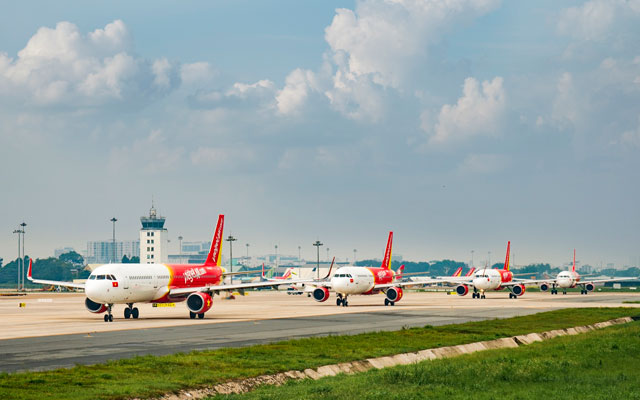
Vietnamese carrier Vietjet is offering insurance for all passengers flying on its domestic flights from March 23, 2020 to June 30, 2020.
Called Sky Covid Care, the insurance coverage ranges from VND 20,000,000 (US$857) to VND 200,000,000.
Vietjet insures its domestic passengers against the coronavirus
All passengers are eligible for the insurance coverage within 30 days from their flight date, regardless of contagion sources.
The insurance premiums will be paid by Vietjet to help its passengers and cabin crew should they test positive for the virus, said the airline in a statement.
To be eligible for this insurance, passengers have to provide all required information in accordance with Vietjet’s “Terms and conditions” when purchasing tickets and using Vietjet’s services.
Passengers also have to comply with all regulations for disease prevention and control by Vietjet, the Ministry of Health and local authorities.
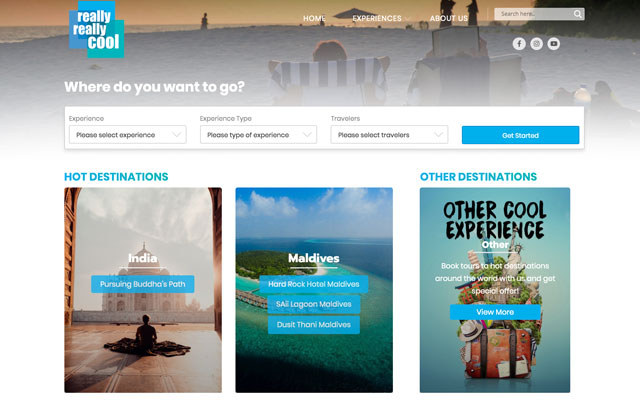
Thailand-based travel company Really Really Cool (RRC) is launching a new global app to assist travel-related businesses in more than 150 countries to bounce back once the Covid-19 pandemic subsides.
The content on the RRC app, which is free for all travel-related businesses to sign up, currently includes more than 500,000 products and services from third parties, SMEs, and local businesses.
Travel experience company Really Really Cool rolls out app to help tourism businesses recover from the virus outbreak
A “Digital Concierge” assists those looking for a “really cool experience”, be it home or abroad. Users can wishlist items, see RRC’s top picks for really cool content, score deals, or get access to other exclusive content.
Machine learning is used as a recommendation engine, which serves up personalised, relevant offers to travellers. It then uses data like geolocation, time, weather, and flight information; and applies algorithms to combine it with other information including previous purchases and ratings, while cross analysing it with other similar users to recommend the best products and experiences.
RRC CEO Patee Sarasin said: “The key reason why we are launching the Really Really Cool application now is to help communities, small travel-related businesses, including everything from attractions, restaurants, cooking classes, ski destinations, to anyone that offers an experience to customers when they travel to any given destination covered.
“These SMEs or businesses are going through a difficult time due to the coronavirus (Covid-19) situation that is happening around the world. We are looking for any way possible to assist them in this time of need.”
The Facebook Live launch of the app will take place today at 20.00 (Bangkok time).
A staggering one million jobs are being lost every day in the travel and tourism sector due to the sweeping effect of the Covid-19 pandemic, according to the World Travel & Tourism Council (WTTC).
In a press statement, WTTC said the job losses are affecting every level of the industry and are gathering pace, as countries go into lockdown to tackle the virus.
Livelihoods of millions of people in the travel and tourism sector are being decimated
The vast closure of hotels, suspension of the majority of international and domestic airline flights, cessation of cruise lines, and growing global travel bans are having a catastrophic ‘domino effect’ hitting huge numbers of suppliers worldwide.
Small and medium sized businesses at every level within the travel and tourism sector, such as tour operators, travel agents and sole-traders, are especially vulnerable.
WTTC, which is already in talks with over 75 governments around the world, has called for countries to urgently do more to intervene to make clearer how businesses can access potentially life-saving loans, and tax breaks, to prevent them from imminent collapse.
WTTC is mindful that while the the travel and tourism sector is facing an economic meltdown, the pandemic is primarily a global health disaster, which governments are doing all they can to contain the spread and reduce the number of deaths.
Gloria Guevara, WTTC President & CEO, said: “It is heartbreaking that the livelihoods of millions of people who have dedicated their lives to the the travel and tourism sector are being decimated; from waiters to taxi drivers, guides to chefs and caterers, pilots to cleaners.
“The relentless cascade of job losses is plunging millions of families into terrible hardship and debt, fearful of how to buy food and pay their bills. The domino effect of Covid-19 is right now having a massive impact, wiping out an entire economic sector.”
Guevara, who published a heartfelt open letter to governments around the world last Wednesday, also shared that businesses of all size are “forced to rip up their three-year plans and focus on a three-month fight for survival on a daily basis”.
“While some governments have been quick to respond with promises of help, the majority of businesses still have no idea how to access these potentially life-saving loans and tax breaks,” she added.
“Today we call on governments around the world to make crystal clear how businesses can access funds, which can prevent the hemorrhage of jobs throughout the travel and tourism sector.”
The plea for urgent action came following an analysis by WTTC of its members, which represents every level of the sector. Up to 50 million jobs throughout the world are at immediate risk, with up to 320 million jobs facing the impact of the dramatic loss of business.
Outbound agents in Singapore and Malaysia are waiting with bated breath for a clear decision on the fate of the Tokyo 2020 Olympic Games, following statements from Japan and the International Olympic Committee (IOC) on March 23 that a postponement may be inevitable.
Alicia Seah, director, public relations & communications, Dynasty Travel, told TTG Asia that several corporate hospitality packages built around the Games, which were customised for clients in better times, were now lying frozen.
Travel agents selling tour packages built around the Games are bracing for their possible cancellation
“These packages were all different, crafted according to what clients wanted to do and see at the games and around the destination. But with so much uncertainty around travel and rising fears of the pandemic, our clients are reluctant to move on with their plans and hope a firm decision would soon be made,” Seah said.
She explained that without a clear decision to cancel or postpone, refunds for opening and closing event tickets cannot be processed.
Seah opined that a postponement of the Games would be ideal to ensure a high quality event that spectators can enjoy, where the full global delegation of athletes is in participation and where all competitors are in top form.
Several media reports are now debating the implications of IOC president Thomas Bach’s revelation on March 22 that a decision on the Games would be made “within the next four weeks”.
Different IOC members have offered their own interpretations. IOC vice president Anita DeFrantz had said that it was “premature” to say that the Games would be postponed to 2021, while IOC member Dick Pound had told the media that the decision to postpone was clear.
Postponing the Games would be better for business, said Rosli Seth, managing director of Feel Japan with K, who has sold ground arrangements – hotel rooms and transport between the sports venues and hotels – for 60 people, largely sports association members in Malaysia and a smaller number of corporate clients.
He believes that clients were unlikely to cancel their bookings and would proceed as planned with the new dates.
“If rooms were cancelled now, it would be difficult to get new bookings closer to the new dates, and the rates would be high. Those who made bookings through us know this,” Rosli said.
He described his Japanese hotelier partners as being understanding and said they would be willing to carry bookings forward to the new dates.
Meanwhile, Kingdom Sports Group (KSG), an authorised ticket reseller for the Tokyo 2020 Olympic Games, has suspended the sale of all event tickets, ticket bundles, ticket packages and tours.
KSG’s website now bears a notice saying: “Given current uncertainties relating to the Games’ start date, in the interest of all our guests, we have decided to temporarily suspend sales, pending further updates from the IOC, IPC (International Paralympic Committee) and Tokyo 2020.”
As a dedicated specialist of international sports ticketing based in Sydney, KSG is the official ticketing agent for Tokyo 2020 in 36 nations, including Malaysia, Brunei, Indonesia, Singapore, the Philippines and Vietnam. – Additional reporting by S Puvaneswary
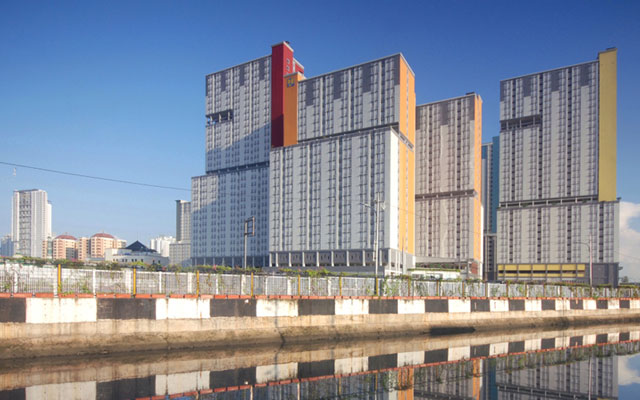
The Indonesian government is collaborating with several hotels to turn their premises into temporary facilities to house medical staff, as well as converting Wisma Atlet Kemayoran, a former 2018 Asian Games’ athletes’ village in Central Jakarta, into an emergency hospital to treat Covid-19 patients, in response to a swell in demand for healthcare services.
The country has seen a spike in confirmed cases of coronavirus, which hit 579 as of March 23, with 49 fatalities, including five medical personnel.
Wisma Atlet Kemayoran, which was used as a residence for athletes during the Asian Games 2018, has been converted into a Covid-19 hospital
Wishnutama Kusubandio, minister of tourism and creative economy, said that he was liaising with hotel chains to use their properties to house medical personnel and members of fast-response team to place them closer to hospitals that handle Covid-19 cases.
“If needed, (the hotels) can become locations for self-isolation,” he said in a web press conference on Monday.
Wishnutama said he is coordinating with Doni Monardo, head of the fast-response team and National Disaster Mitigation Agency, to seek cooperation between the government and the hotels.
Similar coordination, he said, was also carried out with transportation suppliers to ready vehicles for medical personnel and the fast-response team.
Owned by Media Group, Media Hotel & Towers in Jakarta is the first hotel in the country to avail its entire property for the government to house medical personnel at the frontline.
Attended by Doni who represented the government, the handover ceremony took place on March 22. The five-star hotel will be operational for medical use by next week.
All hotel’s facilities, including a ballroom, two restaurants and 188 guestrooms, can be fully utilised by the government until the situation is brought under control, according to Fifi Aleyda Yahya, vice president corporate communications of Media Group.
Maulana Yusran, deputy chairman of the Indonesian Hotels and Restaurants Association (PHRI), lauded Media Hotel’s move.
Patra Comfort Hotel in Jakarta and Kagum Hotels in Bandung, West Java will also open their doors for medical use, according to Maulana.
Maulana explained that PHRI has no intention to call on other members to do the same, as hotels are not a health facility and hotel owners will have their own considerations about this matter.
However, he said he would appreciate if they chose to do so.
As well, four of 10 apartment towers in Wisma Atlet Kemayoran has been converted by the government into an emergency hospital to treat Covid-19 patients.
The four towers, which are ready to use, can accommodate 3,000 patients, according to president Joko Widodo.
The Federation of Associations in Indian Tourism & Hospitality (FAITH), a conglomeration of ten national hotel and tourism bodies, has sought the assistance of India’s prime minister Narendra Modi to weather the financial fallout from the Covid-19 pandemic.
Highlighting how the tourism sector are in the throes of a deep-seated downturn amid the virus outbreak, the umbrella body urged Modi in a letter to offer relief measures to the sector, including a deferment for 12 months of all statuary dues, be it GST, advance tax payments, customs duties at the central or state government level.
Travel Oyster India’s Ajay Jaipuria urges government for a financial package to support the tourism industry
The association also requested a support fund for 12 months to help cover basic salaries, with “direct transfers” to affected tourism employees.
“We request for a 12-month moratorium on our EMIs (Equated Monthly Instalments) of principal and interest payments on loans and working capital from financial institutions (both banking and non-banking). Additionally, we request the doubling of our working capital limits and on interest-free and collateral-free terms. This will prevent all our tourism businesses from going bankrupt,” the letter read.
A video conference was held at the Prime Minister Office on March 23 to take stock of the impact of the pandemic on businesses and address economic challenges that have emerged.
“We expect that some measures that will offer relief to the tourism industry will be announced soon. The first impact of coronavirus has been on our industry. Challenges at present are huge and we are fearing that the retrenchment of staff by some travel agencies is inevitable. Agencies in a situation of no cash flow are not in a position to pay salaries,” said Jyoti Mayal, president, Travel Agents Association of India.
She added that senior staff at some travel agencies have taken salary cuts to help with cash flow, while many are worried that airlines may not offer refunds on air tickets booked on behalf of their clients
The Indian government, which has already banned international flights for a week from Sunday, has also indefinitely suspended domestic commercial flights from March 25.
“We have been one of the largest job creators, however today, we are in a situation which will saw significant job losses. We hope that the industry will be supported by a financial package. We also wish that tax collection at source, which is slated to be implemented on April 1 on overseas travel packages, will be rolled back,” said Ajay Jaipuria, founder, Travel Oyster India, who is also a board member of the national tourism committee of the Confederation of Indian Industry.
Sarbendra Sarkar, founder and managing director, Cygnett Hotels and Resorts, added: “While we are grateful to the government for proactively taking effective measures to contain the virus from spreading rapidly, we are hoping that they will introduce new policies to revive the hospitality industry. What would really help us is a cut in the current GST rates and a tax-free period.”
Yesterday was a sad day. We made the unavoidable decision to close our two New York City hotels, The Standard High Line and The Standard East Village, The Standard Miami and our first international hotel, The Standard London. It was gut-wrenching because hotels, and our hotels, in particular, are anchors of their neighbourhoods. Unlike restaurants, we never close. Ever. We are the places where people feel safe. Where people come together. To eat, drink, stay, play and enjoy each other’s company. To live life to the fullest. Where locals mingle with visitors to our remarkable city. And where our staff makes it their job to take care of all who come, to welcome and delight them.
Our job is to make you happy. And we love to do it. In fact, we live to do it. Our livelihoods depend on making you happy.
View of New York City from across the Hudson River; where two of the Standard Hotels are located
Day in and day out, almost 17 million hospitality workers in this country (and some 266 million globally) take care of you. Housekeepers, front desk agents, concierges, bartenders, security guards, cooks, servers, bussers, maintenance crews. Many unseen, most uncelebrated. They work in a 24×7, 365 days a year. Nights, weekends, holidays. Always. All the while smiling. Because this business attracts people that love to take care of people. That is why I love it. And they are why I do what I do. And that is why I am writing this.
One of our team members reached out to Amber Asher, the president of our company a few days ago. To remind us that in times of trouble, The Standard always helps our local communities. Whether the East Village explosion, Chelsea pipe bomb or the California wildfires. It’s true. And I loved that helping the community during this crisis was his first thought. It speaks volumes to me about the culture of The Standard. But my only response to him was, “I wish we could do something, but this time, we are the community in need.”
This time we need to be taken care of, by you. Today, by you, our government. Tomorrow, by you, our guests. Will you allow us to cash in the loyalty points we have earned?
Despite the big brand names you see, most hotels are owned by small companies or individuals. Hotels are operations that employ lots of people. They have very high fixed costs to operate, and competition is severe. Profit margins are thin, and have been getting thinner even before this crisis. What that means is modest drops in revenue from things like weather hurt profits. Big drops like the financial crisis, bite hard. Epic drops like the past week, kill.
As Arne Sorensen, CEO of Marriott, said in his beautiful message to employees, “Covid-19 is having a more severe and sudden financial impact on our business than 9/11 and the 2009 financial crisis combined.” We simply cannot pay all of our staff if we have no guests.
Our employees, like many others in the service industry, tend to live paycheck to paycheck. Most are hourly, often relying on tips. Many are immigrants without family infrastructure here. Few have savings. Most will not be able to pay rent next month. Without relief, many will leave our cities in a few months altogether.
Lalvani: call for governments to help step in to help with wages for the hospitality government, and for guests to revisit destinations once the outbreak is under control
The government needs to step in now for them to survive on a human level, and for us to be able to reopen when this crisis subsides. This past week the UK government announced measures to cover 80 per cent of employee wages for businesses forced to shut down because of the Covid-19. Our government should follow suit with similar quick, clear, decisive action. If they do not, not only will the personal family tragedies be severe, our ability to reopen our hotels for our communities when this subsides will be impaired.
When, god willing, we do reopen, we also need you, our guests, to step back in. Through our doors. To bring back the spirit of travel, exploration and adventure that makes life richer. The human connections that make life worth living. That brings us closer together in this, more obviously than ever, interconnected world.
Today, Amber announces Standard Stands Together, an employee relief fund she led the creation of to support our employees displaced by the crisis.
What do you say, can we cash in some of the loyalty points we have earned?
Mike Williamson has been appointed general manager for Conrad Singapore.
Williamson has more than 36 years of hospitality management experience, of which he spent 24 with Hilton.
8
The British national brings with him a diverse background in operations, revenue management and business development. His career has taken him to the UK, Belgium, Romania, the Netherlands, UAE (Dubai), China and most recently, Japan, where he was the general manager of Hilton Tokyo.
He has also previously held the positions of general manager in other Hilton hotels, such as Hilton Shanghai Hongqiao, Hilton London Heathrow, Hilton London Green Park, and Hilton London Paddington.
The ultra-luxury destination Amaala, located along Saudi Arabia’s northwestern coastline, has appointed award-winning architect and principal designer of architectural firm Denniston, Jean-Michel Gathy, as master planner for The Island.
The Island is one of Amaala’s three communities, which Amaala CEO, Nicholas Naples, said would cater to select travellers looking for innovative experiential escapes and deliver on personalised experiences that are “entrenched in the philosophies of art, wellness and inspired by the purity of the Red Sea”.
Architect Jean-Michel Gathy and leading architectural firm Denniston will be master planners of The Island
It will be the tranquil home of an exclusive art community, and an Arabic botanical garden bestrewn with sculptural pieces. There will be masterpieces across four key design elements: a contemporary art museum and academy; a Riviera-lifestyle artists’ colony; immersive artistic experiences; and art and sculpture co-creation opportunities.
Gathy describe The Island development a “Diamond of the Red Sea”, adding that it will offer many different venues for permanent installations or temporary exhibitions and artistic performances.
“The graphic layout of its spine will be distinctive from the air and will be recognised internationally as an iconic landmark,” he revealed.
Fully aligned with Saudi Arabia’s ambitions for the future, the development of Amaala is being rolled out across three key phases, with completion of the destination expected before the realisation of Saudi Vision 2030.
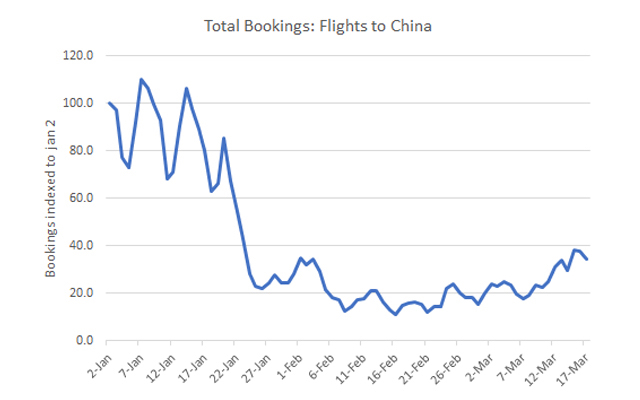
Traveller intelligence provider, Adara, has picked up a new upward trend in data relating to China travel in an analysis published on Saturday.
It noted that China was the first global market that was impacted by Covid-19, and travel both to and from the country had started declining beginning in mid-January.
Analysing anonymised behavior of travellers on air and hotel bookings for 2020 year-to-date, Adara has found that there are promising signs for a rebound in flights within China and to China from international origins that align with the trajectory of the pandemic.
Travel to China
For this analysis, travel to China is referring to both domestic China origin travel (example: Beijing to Harbin) and international original travel (example: Sydney to Shanghai) with China as the destination.
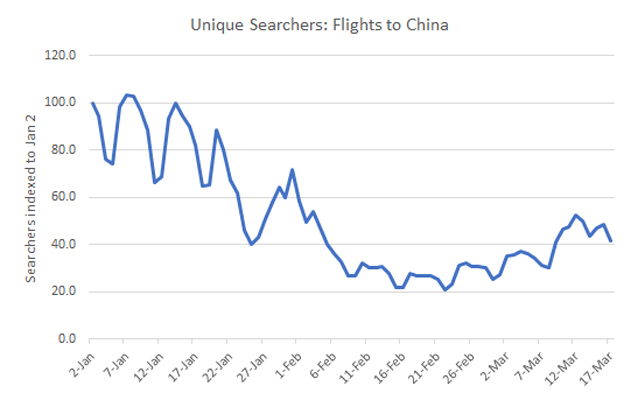
The number of unique travellers (both domestic and inbound international) searching for flights to China declined during three weeks in February to only one-third the number of searchers that was seen in early-January. In the past two weeks, Adara has seen an uptick in the number of searchers. Unique searchers were up 29% for the week of March 8, compared to the week of March 1.
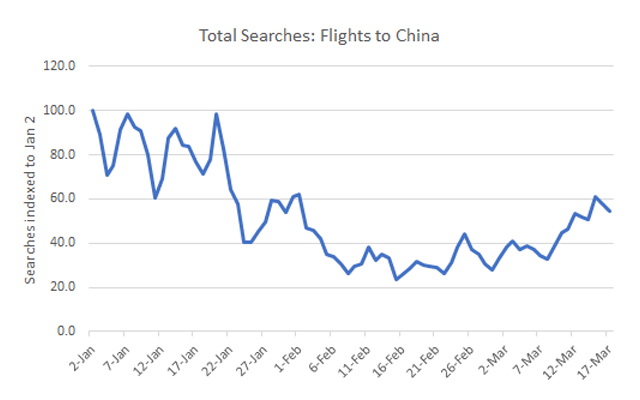
The number of total searches follows a similar pattern. The total number of searches for flights to China (both domestic and international inbound) is currently 55% of the volume of searches seen in the week of January 5, up from a low of 34% in mid-February. The average number of searches per searcher has increased in the past month, with an average of five to six searches per unique searcher.
Those who have searched for flights to China (domestic and inbound international) in the past several weeks are looking for flights with shorter booking windows. 58% of flights searched were with a 0-15 day advanced booking window versus only 38% of flights in early January. In addition, the percentage of flights searched for business travel has almost doubled since pre-Covid-19 levels (38% versus 20% in early January). As the Chinese government ramps up its efforts to boost the economy, these shorter booking windows and increased flight intent for business travel is not surprising.
Total bookings to China are also rebounding, but at a slower pace. They are currently at about 30% of the level of flights that were booked to China in early January. Based on February 2020 data, time from initial flight search to booking data is an average of 13 days. Adara said that it will continue to monitor whether flight bookings to China will catch up to the trends we see in increased searches for flights to China.
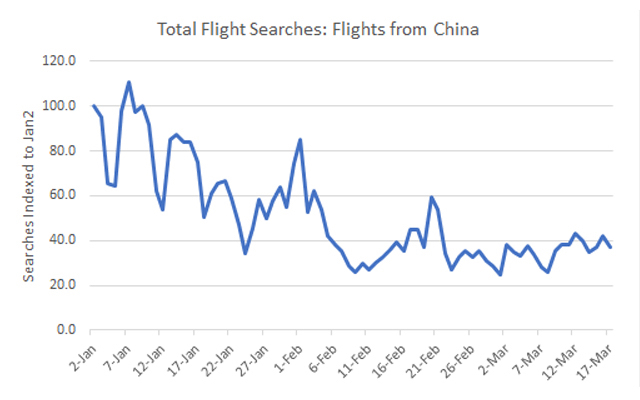
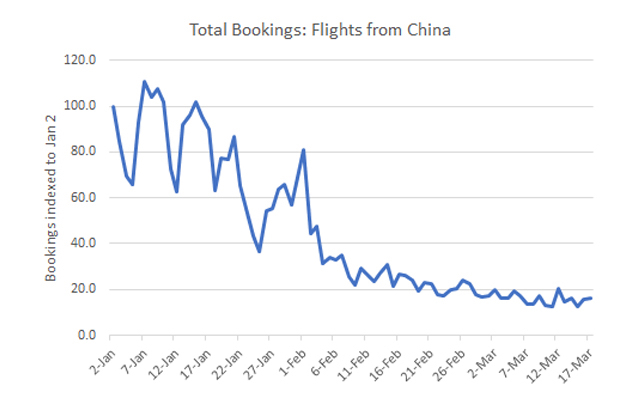
Travel from China
Travel from China, for this analysis, refers to travel with origin in China and with an international destination, such as travel from Beijing to London.
Flight bookings from travellers in China outbound to International destinations have yet to post any genuine rebound, either in searches or bookings. Adara said this is expected bases on the travel bans that are still in place.
“We are seeing subtle but meaningful changes across flight bookings and searches for China travel. While it is too early to predict any long-term patterns, these insights serve to help travel brands better understand how quickly the market shifts as the Coronavirus evolves,” said Carolyn Corda, CMO at Adara.







 8
8