Oakwood Hotel & Apartments Shin-Osaka, Japan
The first international serviced apartment brand in the Umeda and Shin-Osaka areas offers a total of 185 units, comprising 59 hotel rooms and 126 fully furnished serviced apartments. Guests will have access to facilities such as a 24-hour gym, a meeting room, two laundry rooms, a car park and the all-day Café O. The serviced residence will also provide services such as concierge and reception services and housekeeping.
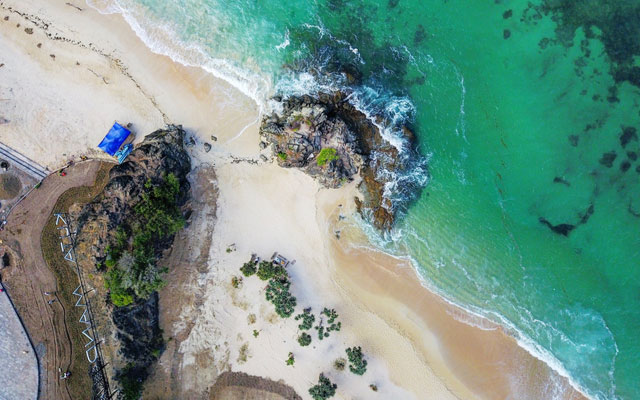
Dash Resort, Langkawi
Recently opened in April, Dash Resort, Langkawi offers 108 rooms and one private villa, all of which come furnished with complimentary Wi-Fi and LED TVs with satellite channels. The hotel features two restaurants, a poolside bar, an outdoor pool, a fitness centre and spa. For functions, the property also has a grand ballroom and two meeting rooms. Meanwhile, the Dash Beach Club offers entertainment by international DJs and fusion cuisine.
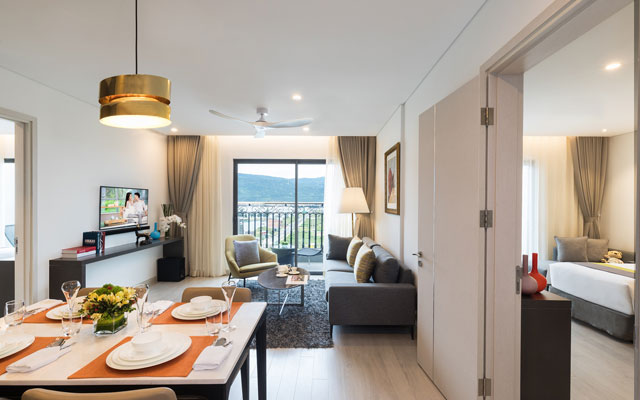
Citadines Blue Cove Danang, Vietnam
Part of an integrated development a 15-minute drive from Danang International Airport, the Citadines Blue Cove Danang offers a mix of 548 studio, one-, two- and three-bedroom apartments, most of which overlook Danang Bay. Recreational facilities include a 24k gold-plated infinity pool, jacuzzi, fitness centre, spa, and children’s playroom. There is also a ballroom and meeting rooms, and residents can also avail optional services such as courier, babysitting, laundry and dry cleaning.
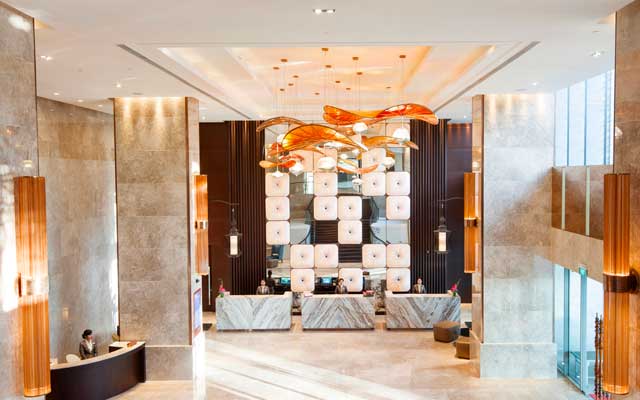
Cachet Boutique Zhejiang Racetrack Circuit Hotel, China
This property, located adjacent to the Zhejiang Circuit in Shaoxing, offers 52 guestrooms that open out to the 3.2km FIA Grade 2 racetrack and the surrounding mountainside. Rooms were created by interior designer Katharine Pooley, and their designs were inspired by motorsport and the finishes of luxe cars. Facilities include upscale dining experiences, a spa, and a fitness centre. There is also a wide range of trackside venues for hire.
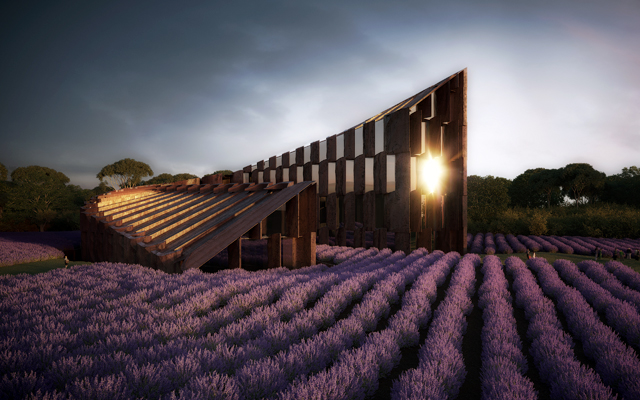
Lavender farm, gin distillery and more available on-site; artist impression of the new voco property
One of Australia’s best-known wine regions will have its first globally-branded upscale hotel come 2021, with entrepreneur Martyn Barnes badging his Yarra Valley property as voco, a new upscale brand by the InterContinental Hotels Group (IHG).
The 170-room new-build voco Yarra Valley will boast touches not typical of hotels including an on-site gin distillery, lavender farm, mirrored maze, amphitheatre cut from natural ground, and provedore that serves and sells local Yarra Valley produce.
Lavender farm, gin distillery and more available on-site; artist impression of the new voco property
The property will also feature 20 cabins that offer a more intimate Yarra Valley experience.
It is said the building will sport a quirky, eye-catching design, rising to six storeys at one end and tapering to one storey at the opposite end.
Other features include conference and meeting facilities, a gym, bars, an on-site family restaurant and kids’ entertainment facilities.
Abhijay Sandilya, IHG’s senior director of development – Australasia, said this will be the brand’s second signing since its launch in June.
“The signing of voco Yarra Valley continues IHG’s ambition to take our brands into regional markets, including suburban micro-markets close to Australian capital cities,” he added.
The hotel is situated at the gateway to the Yarra Valley of Maroondah Highway, less than an hour’s drive from Melbourne’s CBD, with prominent visibility to motorists and parking facilities to welcome road trippers from the capital. Lilydale is the closest train station, and Coldstream & Lilydale airports are nearby.
Victoria’s Yarra Valley is known as one of Australia’s premier wine regions, famous for its Chardonnay and Pinot Noir, as well as for bringing big-name artists like Robbie Williams, Stevie Nicks and John Farnham to perform at Rochford Wines’ annual Day on the Green concert series.
Beyond wineries, Yarra Valley offers walking trails at Dandenong Ranges National Park, the Tarrawarra Museum of Art, the Healesville Sanctuary animal attraction, as well as skydiving and hot air ballooning. It’s also the first stop en-route to Mount Buller, Melbourne’s most popular ski field.
Myanmar is shaking off its reputation as a destination with high-priced hotels as accommodation options increase and room rates fall.
After Myanmar opened up, the country witnessed a sudden boom in tourists between 2011 and 2013, but the hotels were in short supply, according to Su Su Tin, managing director of Sanctum Inle Resort and Yangon Excelsior Hotel, which will open in July.
Sedona Yangon’s Inya wing lobby
She added: “Hotel prices went up and this affected tourism a lot.”
However, recent years have seen developers flock to fill the gap, with a series of local and international hotels opening their doors in the country.
Figures from the Ministry of Hotels and Tourism show there are 1,648 licensed hotels and guesthouses, offering a total of 66,065 rooms. Most are concentrated in the tourist hubs of Yangon, Bagan, Mandalay and Inle Lake. In Yangon, the number of hotels increased from 370 in 2017 to today’s 397.
Chu Chee Seng, general manager, Keppel Land Hospitality Management, which manages Sedona Yangon, said: “Unlike in the past, when Yangon’s upper-scale room stock remained unchanged for more than a decade, the market is now seeing many new developments. About 16 upper-scale hotel projects are estimated to be completed within the next three years, translating to about 3,300 new rooms.”
He added that Colliers International expects the completion of just over 1,300 new units to cater to the rising needs of tourists.
However, Greg Allan, vice-president, operations (ASEAN) at Pan Pacific Hotels Group, predicts many projects under construction may delay operations due to various challenges, such as a shortage of skilled labour.
The sudden rise in accommodation, coupled with slowing arrival rates as the European and American markets become hesitant over the Rohingya situation in Rakhine State, has led to a drop in room rates, bringing them in line with other South-east Asian countries.
Edwin Briels, managing director of Khiri Travel Myanmar, said: “There was a lot of investment in hotels from budget guesthouses to five-star hotels. Now, there is a lot of availability, but we still see tour operators worrying about this. (Rooms are) plenty, and prices are very fair.”
Bertie Lawson, managing director of Sampan Travel, said the industry is still battling against its reputation for being costly.
He said: “Prices have gone down, but I don’t think the word has gotten out yet. The Lonely Planet and Rough Guide books published last year are still talking about Myanmar as pretty expensive, but that’s not the case.”
Despite this, Keppel’s Chu remains optimistic. In 2023, phase two of Yangon’s Junction City development will house the country’s first Sedona Suites, comprising 260 serviced apartments.
He said: “We believe that Myanmar’s hotel landscape will continue to evolve, catering to more diverse markets. There is growing potential for the mid-tier hotel segment in Yangon, which include bed and breakfasts, as well as boutique hotels.”
Correction: An earlier version of the story stated that Keppel Land Hospitality Management owns Sedona Hotel Yangon. The hotel is actually owned by Keppel Land, the parent company of Keppel Land Hospitality Management. The story has been corrected.
Myla Caceres has been appointed as Radisson Blu Resort Phu Quoc’s director of commercial.
In her new role, Caceres will oversee sales, marketing, reservations and revenue at the soon-to-open resort on Phu Quoc’s north-west coast.
A seasoned hospitality professional with over 25 years of experience, Caceres worked as Ascott International Group’s cluster director of sales and marketing in Thailand, overseeing 11 properties.
The Filipina has also held director of sales and marketing roles at several hotels in Thailand, including the Dusit Thani and the Crowne Plaza in Bangkok, as well as two upscale resorts in Vietnam, including a Swiss-Belhotel.
The Hollywood movie was filmed in several locations in Singapore
The Singapore Tourism Board (STB) is riding on the Hollywood hype surrounding print-to-screen romantic comedy, Crazy Rich Asians, by partnering Warner Bros to roll out destination promotion activities in the US.
Coming to theatres on August 22, the movie is based on the New York Times best-selling book by Singapore-born author Kevin Kwan.
The movie is one of the first Hollywood films in decades to feature a predominantly Asian cast including Constance Wu, Henry Golding, Awkwafina and Michelle Yeoh, and the first to star numerous Singaporean actors, albeit not in leading roles, namely Pierre Png, Janice Lee, Koh Chieng Mun, Fiona Xie, Tan Kheng Hua, Selena Tan, among others.
Screengrab from the movie trailer
Crazy Rich Asians was also primarily filmed in Singapore, with locations including icons such as Newton Food Centre, the Merlion Park, Marina Bay Sands SkyPark, CHIJMES as well as neighbourhoods like Chinatown, Bukit Pasoh and Tanjong Pagar.
In collaboration with Warner Bros, STB and the Tao Group will launch the Crazy Rich Singapore Week at The Highlight Room in Los Angeles.
The pop-up event running from August 9-11 invites guests to “feast, drink and dance like you’re in the movie”.
It will present Singaporean cuisine, such as turmeric coconut curry of crab, calamansi and kaffir lime as well as beef short rib rendang (braised meat stewed in coconut milk and spices) by guest chef Malcolm Lee of Candlenut, the only Michelin-star Peranakan restaurant in the world.
Peter Chua, head bartender of the 10-seater Junior pocket-bar, will also serve up concoctions inspired by Singapore-style coffee and pandan leaf.
Singapore’s DJ KoFlow will spin hip-hop tunes to keep energies high into the night, while mural art by artist Jahan Loh will also be featured at the Tao precinct.
Meanwhile, STB and Warner Bros are giving away trips to Singapore. Each prize includes two round-trip economy flights aboard Singapore Airlines, and four nights’ accommodation at a four or five-star hotel.
STB is also plugging a Crazy Rich Asians theme tour package by Indus Travel, where guests are shown locations featured in the film including Merlion Park, cultural enclaves and Gardens by the Bay.
“We hope that the film will inspire more visitors to discover the multitude of experiences in Singapore and ignite their passions for culture, food, entertainment and nightlife,” said Kershing Goh, regional director, STB Americas.
Lombok is beginning to see trip cancellations from visitors following the devastating earthquake last Sunday, but the travel trade is adamant to push out the message that most parts of the destination remain unaffected and safe for travel.
Dewantoro Umbu Joka, chairman of the Association of The Indonesian Tours and Travel Agencies (ASITA) West Nusa Tenggara, said: “(The first earthquake on July 29) did not have too much impact, and visitors continue to come. But with the (second one measuring) a magnitude of seven on Richter Scale, it’s become a concern (for visitors). ASITA members reported receiving many cancellations.”
Kuta Mandalika Beach in Lombok is one of the unaffected destinations on the island
He was particularly concerned about the Gili Islands, as some 80 per cent of international travellers to Lombok also visit the trio of islands.
Estimating a loss of around 100,000 direct arrivals to Lombok due to the recent earthquakes, Indonesia minister of tourism Arief Yahya had announced that the government would try to keep up with its international arrival target to Indonesia by accelerating recovery in disaster-affected areas.
Lalu Abdul Hadi Faishal, chairman of Indonesia Hotel & Restaurant Association (IHRA) West Nusa Tenggara, is confident that Lombok bookings will recover in two months.
He asserted: “I think it’s normal to have lots of cancellations for a few days. This is a force majeure, everyone panics. But this condition will not last long. In fact, it can be faster than expected because the central government is involved directly in handling the situation.
“This is not the first time Lombok has been hit by a disaster. The experience of handling disasters, including the quick response to make sure clients are safe, makes Lombok tourism recover quickly,” he added.
To assist with the recovery, IHRA has immediate plans to launch promotions to key source markets such as Malaysia, South Korea, Japan, Australia and Europe in September.
“We need tell the market that Lombok is big and only a small portion is affected by the earthquake,” stated Hadi.
Hadi stressed that the market needs to be educated about other destinations not impacted by the earthquake, such as Mandalika and Mataram City on Lombok, and Dompu and Bima on Sumbawa.
“Tourism stakeholders in West Nusa Tenggara have agreed that we highlight the destinations which are not impacted, rather than just saying, ‘Lombok is safe’.”
Klook's executive team comprising (from left) David Liu, Bernie Xiong, Anita Ngai, Eric Gnock Fah and Ethan Lin
Travel activities and services booking platform Klook has secured an additional US$200 million funding from investors to accelerate its global expansion to Europe and the US this year.
This also marks the biggest round of funds raised, bringing its total financing to date to US$300 million. The expansion will take place in two ways – geographical expansion and category growth.
According to COO and co-founder, Eric Gnock Fah, the company closed a US$60 million Series C funding last October, which enabled it to make its foray into Europe by opening offices in London and Amsterdam early this year.
Klook’s executive team comprising (from left) David Liu, Bernie Xiong, Anita Ngai, Eric Gnock Fah and Ethan Lin
Gnock Fah added: “We see potential in the US and Europe (markets), especially with outbound travellers coming to Asia as there are a lot of things happening in the region, for instance the Tokyo Olympics and the (recently concluded) World Cup in Russia.”
He remarked that while the last funding helped Klook to expand globally, the additional US$200 million funding now enables the company to beef up its growth plans.
“We are in the process of setting up offices on the US’ east coast now, (and they will be) most likely in Boston and New York. This global expansion not only targets travellers heading to Asia, but also Asia’s outbound travellers to longhaul destinations, for instance Europe, where we’ve received many enquires,” Gnock Fah shared.
As such, Klook is aiming to work with local merchants to design some itineraries and services that cater specifically to Asian travellers.
Aside from the global expansion, Fah pointed out that “more resources will be deployed to Asia for sure”, as there is still room to grow.
For example, Klook recently launched the Japan Rail (JR) Pass, with all JR passes consolidated into one redesigned page to make the booking experience more seamless. The company will also be making its debut in Japan soon.
More resources will also be allocated towards its back-end systems. Currently, the 200-strong innovation hub in Shenzhen houses the engineering data team, and Klook is on the lookout for another location in Asia to build an R&D hub. This is to support the growth of digital devices, where over 70 per cent of bookings happen on mobiles.
Gnock Fah opined: “I personally think that artificial intelligence such as voice search will be used to build businesses. If this trend takes off, there will be no need to (type or click) anymore. That is why the data team was formed, to research on this perspective.”
What does it take to win a millennial's heart, mind, and wallet?
The recently released publication, New Horizons IV: A global study of the youth and student traveller, has revealed six trends for the under-30 travel market, the millennials and Generation Zs.
The report is based on the New Horizons Survey, which is conducted by WYSE Travel Confederation every five years. In 2017, the survey had more than 57,000 responses from 188 countries and territories.
Travel splurging
When the New Horizons Survey asked millennial and Gen Z travellers what they were willing to splurge on during their trips, they were clear about their preference for experiential purchases.
Thirty-seven percent of respondents were willing to shell out extra cash for food and drink experiences. Traditional travel luxuries, such as airfare upgrades, were favoured least.
The 2017 New Horizons Survey also revealed a 26% jump from 2012 in the level of activities young travellers undertake while in a destination. As such, adding unique, one-of-a-kind experiential elements to the basic travel journey might be more productive than trying to develop premium travel products aimed at millennials.
Those who journey beyond their home region reported being happier than those travelling within
Growing information intensity and utilisation of OTAs
The number of different information sources used to research the main trip has climbed steadily, from three in 2002 to more than 10 in 2017. Friends and family were still the most used information sources in 2017, but the importance of social media and comparison or referral websites grew significantly from 2012.
A decade ago, physical travel agent offices took over 70% of youth travel bookings – in 2017 much of this business had shifted online, either directly to suppliers or via OTAs.
Hence, new media and booking platforms will be crucial travel planning resources for the next generation of youth travellers, Gen Z. These digital natives have grown up with smartphones and Wi-Fi and are significantly less likely to use tourist information offices or tour operator brochures. Nearly 75% of Gen Z respondents made at least one booking via smartphone in 2017.
Top destinations for young travellers
Although the top destinations remain largely the same as in 2012 and 2007, a few noteworthy shifts are revealed in the survey. While the US remains the top destination for young travellers, it lost some of its share from 2012. Also, Australia came back into the top 10 for the first time in a decade.
Young people are still interested to visit the US, but they are also deciding to explore other less-visited destinations. Given the slight decline in long trips of 120-plus days and an increase in shorter trips, longhaul destinations will need to rethink how to attract young travellers undertaking longer stays for study, working holidays, au pairing and other cultural exchanges.
Rise of digital nomadism
In 2017, only 0.6% of millennial and Gen Z travellers labelled their travel style as ‘digital nomad’ over more traditional labels such as ‘backpacker’ or ‘traveller’. However, 0.6% of all youth travel represents 1.8 million trips.
Digital nomads manage their location independence by making extensive use of Airbnb (56% used on their last main trip). They are the most likely group to book their air travel via computer, smartphone or tablet (85%) and they often use OTAs to book accommodation (55%). Digital nomads are thrice as likely to use a co-working space than other travellers.
The digital nomad is beginning to transform some destinations. More co-working spaces are springing up and high-speed Wi-Fi is a given. Although still small in numbers, digital nomads have an influence on other young travellers through blogging travel and lifestyle advice.
The three keys to millennial and gen Z traveller happiness
Millennial and Gen Z travellers indicated three significant factors in their travel happiness: destination, trip length and activities.
Traveller happiness hits fever pitch at one month, however, travellers also reported an uptick in happiness on trips from three to six months’ duration. The 2017 New Horizons Survey found that the more in-destination activities and experiences people have while travelling, the happier they are. Trips to Mexico, Japan, Indonesia and Peru make millennial and Gen Z travellers the happiest.
Travelling to a different world region and for a longer period seems to lead to greater levels of happiness for young travellers. In general, those travelling outside of their home region reported being happier than travellers on journeys within their home region.
Generation Z is the future of youth travel
Gen Z is already on track to become the largest generation of consumers by the year 2020. These digital natives are bringing their own flavour to the youth travel market. For example, Gen Z is just as likely as Gen Y to make online bookings. However, they use OTAs and third-party websites less. Gen Z travellers are also more social than millennials and more likely to want to connect with locals.
Gen Z already seem to be more activity-focused than millennials. The use of social media for information searching and booking is also likely to increase and morph as new channels emerge.
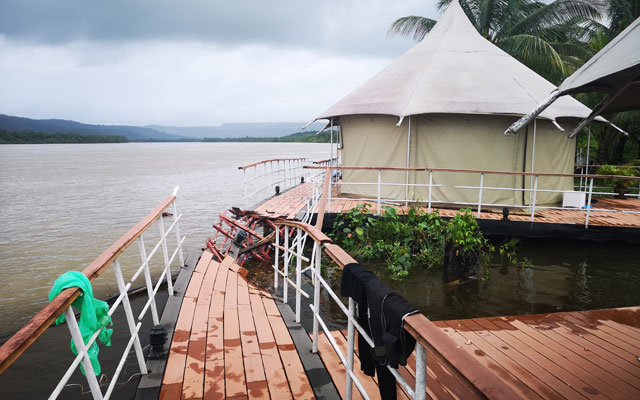
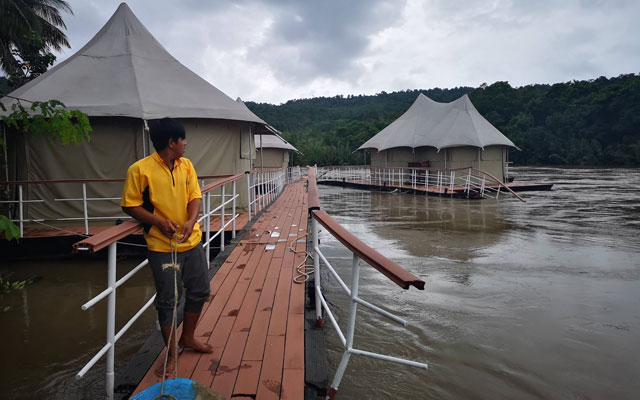
Work is set to start on rebuilding an iconic floating resort in Cambodia that was recently devastated by heavy monsoon rains.
4 Rivers Floating Lodge – a luxury floating resort on Tatai River in Koh Kong province – was damaged last month when unusually heavy monsoon rains combined with excess water released from a nearby dam washed it away.
Repair works on the damaged floating resort have begun
Rising water levels of more than 1.5m caused currents to rip through the resort, with parts of the hotel, along with 40 staff, adults and children, carried eight kilometres downstream on drifting platforms.
No one was reported injured and initial assessments put the damage at several hundreds of thousands of US dollars. All of the resort’s floating platforms including 12 tents were torn, and water and electricity systems completely damaged.
Managing partner Valentin Pawlik said reconstruction work will start this week, with six units expected to reopen on November 1. The new resort will be redesigned to cope with excess flooding.
The resort will also be future-proofed against heavy floods
Pawlik, who built the original structure, said: “When we built the resort nine years ago, there wasn’t this much rainfall and we didn’t think there was this much potential for flooding.”
Several days after 4 Rivers Floating Lodge was destroyed by water, a dam in neighbouring Laos’ Attapeu Province failed, killing an estimated 30 people, with hundreds reported missing and thousands left homeless.
Stefan Scheerer, general manager of Khiri Travel Laos, said the disaster has not impacted the tourism industry, describing the region as “a sleeping beauty in the south” and not yet a well-known tourism destination.
Malacca is expected to welcome a RM200 million (US$49.2 million) water theme park spanning 4.6ha, the largest in the Malaysian UNESCO World Heritage city.
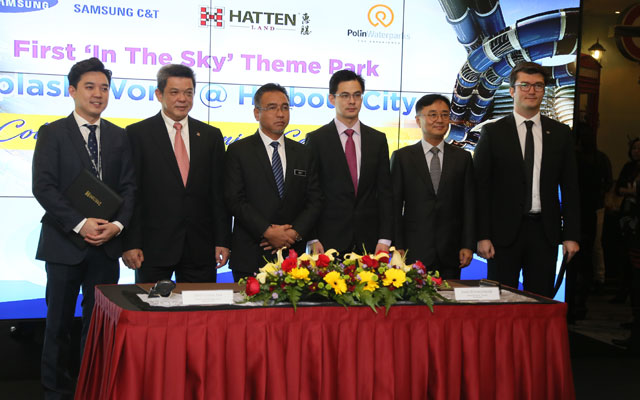
A collaboration between Singapore’s Hatten Land, Samsung C&T Corporation – which also operates South Korea’s Everland Resort – and water slides designer Polin Waterparks, Splash World @ Harbour City is due for completion by end-2019 and expected to be opened to the public in 1H2020.
Hatten Land’s Colin Tan; Hatten Group’s Eric Tan; chief minister of Melaka Adly Bin Zahari; Hatten Land’s Edwin Tan; Everland Resort’s Tommy Byungsuk Jeong; and Polin Waterparks’ Emre Büyükgüngör
The partners said in a joint statement that the water park, located 14 floors above ground, will be “the world’s first ‘sky’ theme park”. Nestled between two 30-storey towers on the 14th floor deck of Harbour City @ Melaka, a mixed development shaped like a ship, the four-storey park will offer indoor and outdoor areas and more than one kilometre of water slides.
A man-made river will meander over two floors to intertwine more than 50 attractions, including 11 extreme slides for thrill-seekers, a Sky Beach and a dedicated children’s water play park. After dark, the Cosmic Waters light show will illuminate the park, accompanied by a water circus, trapeze stunts and other entertainment in an amphitheatre.
Splash World @ Harbour City hopes to attract 850,000 to one million visitors annually after the first year of operation. Malacca hosts nearly 17 million visitors a year.
Melaka chief minister Adly Bin Zahari commented: “Splash World @ Harbour City will bring a transformational new dimension to our travel and leisure landscape, and make Melaka an even more compelling international attraction.”