TTG Asia
Asia/Singapore Monday, 15th December 2025
Page 1083

Thai Airways, TAT mark 60th anniversaries with new campaigns

0

The Tourism Authority of Thailand (TAT) has partnered Thai Airways International (THAI) to push out campaigns aimed at promoting tourism to the country, as part of both organisations’ 60th anniversary celebrations in 2020.

The partnership was announced by TAT governor Yuthasak Supasorn and THAI president Sumeth Damrongchaitham at a joint press conference last week.

TAT’s Yuthasak Supasorn and Thai Airways’ Sumeth Damrongchaitham mark the partnership between both companies on new campaigns to boost Thailand’s inbound tourism

Yuthasak said that TAT is very pleased to cooperate with THAI as they both share the same goal to boost inbound tourist arrivals and encourage Thai people to travel locally to generate national income.

Promotional campaigns will be targeted at diverse age groups, namely, silver tourists, millennials, and Gen X to boost inbound travel to Thailand, which will generate more national revenue throughout next year.

TAT will also support marketing activities by providing in-depth information on tourism activities conducted, especially those that attract foreign tourists, so that THAI can include them as part of their tourism packages to sell to tourists.

Some of these activities include the Amazing Thailand Marathon Bangkok (February 2, 2020), the annual World Wai Kru Muay Thai (March 17), the Great Mekong Bike Ride, and international sports events such as women’s professional golf tournament LPGA and the MotoGP.

THAI and TAT will also synchronise their activities to boost inbound tourism. For instance, during wet season of the annual Amazing Thailand Grand Sale, the airline will offer a THAI Pass Plus to boost inbound tourism. Both parties will also publicise information on THAI’s campaigns to attract more tourists to Thailand.

THAI will also join in TAT’s efforts to promote responsible tourism, such as the tourism authority’s Thailand Reduce Waste campaign which aims to reduce the generation of trash and single-use plastic by travellers.

Yuthasak added that TAT’s marketing goals for 2020 include keeping Thailand in the world’s top six countries with highest tourism revenue by generating a 10 per cent increase in revenue or approximately 3.7 trillion baht (US$122 billion), and increasing sustainability in tourism.

Joint projects of TAT and THAI in 2020 include the THAI Pass Plus campaign which lets passengers use their THAI or THAI Smile boarding pass to obtain discounts or souvenirs at stores participating in TAT’s Amazing Thailand Grand Sale nationwide. TAT will also collaborate with THAI overseas offices to offer privileges and special price air tickets for passengers visiting Thailand.

THAI will also roll out the 60th Still Flying special campaign on its 60th anniversary for senior tourists who are still eager to travel. Other packages and activities will also be launched on this occasion.

JW Marriott Singapore South Beach

0
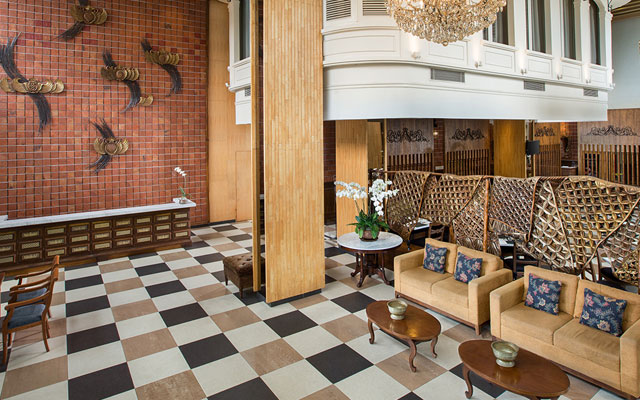
Exterior

Location
Situated across from Suntec City and just two train stops from the Marina Bay entertainment and business district, the 634-key hotel is located conveniently above the Esplanade MRT station.

Attractions such as the National Gallery Singapore, Civilian War Memorial, Gardens by the Bay, and Esplanade – Theatres on the Bay, as well as popular shopping malls Marina Square and Raffles City, are within walking distance.

Rooms
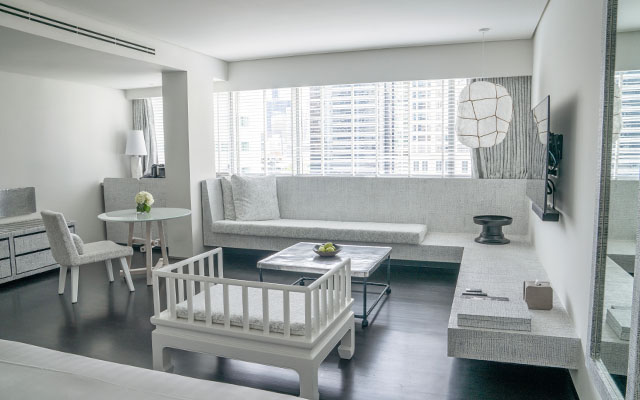
The rooms are beautiful and modern, with a tad of quirkiness. There is even an aluminium rocking chair, designed by Philippe Starck, that sits in rather charmingly quaint incongruity to the modern decor.

The in-room IPTV enables guests to easily control their curtains and blinds with the push of a button. Room service can also be ordered via the IPTV.

We stayed at the hotel’s Club Deluxe Room which is furnished with a king-sized bed, sofa bed, and a mirrored wardrobe.

As Club Deluxe Room guests, we enjoyed exclusive access to the Executive Lounge to enjoy breakfast, afternoon tea, evening hors d’oeuvre and evening cocktails. We only stayed at the hotel for a night, and could only experience the evening cocktails. Still, we were impressed by the wide selection of hot and cold drinks and desserts.

F&B
Of the hotel’s eight F&B options, the NCO Club is its latest addition. It opened in April 2018 with four eclectic concepts. Madame Fan serves traditional Cantonese cuisine from wok to cuisine, and has an intimate, classy atmosphere. Fish Pool is a champagne, caviar and oyster bar. And to top it off, the diving pool centrepiece comes alive on Friday and Saturday nights with mermaid performances. Stags’ Room is an intimate wine room and lounge featuring a private reserve of vintage and exclusive wines from Americas and Australia, offering well-heeled guests an authentic private estate experience, while Cool Cats is a cocktail bar with live music performances.

Breakfast at Beach Road Kitchen serves up an international buffet, including Indian, Chinese, Japanese and Singaporean favourites. I was especially impressed with the noodle station as it featured a wide selection of noodles of different colours and textures, alongside an equally impressive variety of vegetables and meat selection, on top of two soup flavours, tom yam and fish. The roti prata was equally memorable as the bread was soft and not oily, accompanied by thick and creamy dhal curry.

Another restaurant is Akira Back, a contemporary Japanese restaurant which offers an extensive menu with modern twists.

Facilities
The hotel has two Sky Gardens, the Ebb6 and Flow18, offering aerial views of the city. The Ebb6, an open air area with a swimming pool on Level 6 is a vantage spot to view the F1 Race, while Flow 18 at the top of the hotel offers a spectacular view of Singapore’s skyline.

Besides a fitness centre and spa, the hotel also features a total of 1664m2 meeting and event space. The ballroom, located within a restored 1930s heritage building adjacent to the hotel, can accommodate up to 280 people, banquet style with a mezzanine to cater for 50 seats banquet style. There are 15 rooms located at Assembly, one event venue at The NCO Club and one outdoor venue at Ebb6.

Service
Superb. Upon arrival, the concierge greeted us by our names before escorting us to the front desk. The check-in process was speedy and the fruit basket and snacks in the room made us feel more welcomed.

When we went to the Executive Lounge with our laptops to work, the receptionist offered to find us a port where we could plug our wire in. She also asked if we needed an adaptor and offered us a drink.

Verdict
A luxury business hotel with a resort feel. Its enviable address, within the city’s business hub and close proximity to key tourist attractions, makes it ideal for both leisure and business travellers.

Rates From S$568 (S$416)

Contact jwmarriottsingapore.com

– Additional reporting by S Puvaneswary

Resignation of Sri Lanka’s tourism chief prompts fear of further delays to tourism recovery efforts

0

Sri Lanka Tourism Promotion Bureau’s (SLTPB) chairman Kishu Gomes resigned on Thursday after just nine months on the job, a move that is likely to further delay key global marketing campaigns in the country’s crisis-hit tourism sector.

Gomes, who told TTG Asia that his resignation is effective from Friday, November 15, said that he was stepping down to enable a new administration to appoint a newcomer to the post, in line with traditional practice as Sri Lankan voters head to the polls on Saturday to elect a new executive president.

Sri Lanka Tourism Promotion Bureau’s chairman Kishu Gomes resigns

The former tourism chief underwent a tumultuous period dealing with the crisis in tourism after arrivals nosedived following the Easter Sunday attacks on three churches and three luxury hotels. “Arrivals have recovered from a drop of 80 per cent in the immediate aftermath of the April bombings,” he said.

Gomes was confronted with a drawn-out bureaucratic processes which heavily delayed the launch of key global public relations and marketing campaigns that were designed to aid tourism recovery.

The sudden departure of Gomes is set to further delay the global campaigns, according to The Hotels Association of Sri Lanka’s president Sanath Ukwatte. “We have been struggling to launch the global public relations and marketing campaigns in key markets. (Gomes’) resignation means further delays and going backwards,” said a worried Ukwatte.

The crisis in management has been exacerbated by the appointment of six chairmen in the past 4.5 years to this position. The SLTPB chief is appointed by the Tourism Minister and is normally a political appointee.

New infrastructure developments to lift status of South Kalimantan as tourism destination

0

South Kalimantan has upgraded facilities at Syamsudin Noor airport in Banjarmasin to raise its status from a domestic to an international airport, as the local government looks to boost foreign and domestic arrivals.

President Joko Widodo is expected to inaugurate the Syamsudin Noor International Airport on November 20, according to Dahnial Kifli, the head of the province’s tourism agency in Jakarta.

A series of infrastructure enhancement projects across South Kalimantan is aimed at increasing the destination attractiveness; Menara Pandang Banjarmasin in Banjarmasin City pictured

The expanded 77,569m² terminal will be able to accommodate seven million passengers a year – five times more the capacity of the old terminal – featuring eco-friendly design with plenty of open-air spaces.

Eyeing inbound growth, Dahnial believes that the airport will start serving international routes after it officially becomes an international airport, on the back of an enlarged runway and bigger apron in the new terminal to accommodate larger aircraft.

“We have approached AirAsia to talk about the opportunity to open a direct flight from neighbouring countries to South Kalimantan,” he said, adding that the international routes would benefit foreign tourists as they did not need to transit in Jakarta or other major cities in Java en-route to South Kalimantan.

Dahnial said that the local government would also construct Samudra port in Tanah Bambu regency to improve accessibility to North Penajem Paser and Kutai Kartanegara, two regencies in East Kalimantan that the president has named as potential sites of Indonesia’s new capital. He added that the new port would have the capacity to accommodate cruise ships and big vessels.

Furthermore, the infrastructure development projects launched across the province is part of the regional government’s efforts to develop tourism to reduce reliance on the mining sector, said South Kalimantan vice governor Rudy Resnawan.

The mining sector currently contributes 31 per cent of total regional revenue (PAD) while tourism makes up around 20 per cent. The regional government has set an ambitious target for tourism to contribute to almost 60 per cent of PAD in the coming years.

Rudy added that South Kalimantan will focus on creating more tourist attractions. “We will turn former mining sites into tourist spots,” he said, citing Pengaron Blue Lake in Banjar Regency as an example.

Rudy said he would step up promotion efforts to woo foreign tourists as well as provide incentives and ease licensing processes to lure investors. “Our major goal is to make South Kalimantan a national major tourist destination,” he said.

Fachrul Rezani, owner of Putera Mandiri Wisata Tour, said that the vice governor’s idea to transform former mining sites into tourist destinations sounded promising. For example, Seran Lake and Galuh Cempaka Lake, which were previously mining company Galuh Cempaka’s open-pit diamond mine, are popular tourist attractions today.

After becoming an international airport, Fachrul expects Syamsudin Noor to have direct routes that connect the province with neighbouring countries, especially Malaysia, Brunei, and Thailand. He believes that the routes will further grow inbound traffic from these countries, which are currently major source markets for South Kalimantan.

“Tourists from Malaysia and Southern Thailand usually come to South Kalimantan on pilgrimages. They like to visit the cemeteries of Muslim figures, such as Syekh Muhammad Arsyad al-Banjari who wrote Sabilal Muhtadin. This book is taught at schools and universities in Malaysia and Southern Thailand,” he said.

Fachrul also expects South Kalimantan to build a convention centre soon because the province recently hosted multiple large-scale business events, including City Sanitation Summit in September.

He hoped that facilities and amenities in South Kalimantan would be fully ready by the time North Penajem Pasar and Kutai Kertanegara in East Kalimantan officially becomes the country’s administration centre.

“Now there is already a new road that connects Batulicin in South Kalimantan and North Penajem Paser in East Kalimantan. This road cuts travel time from 10 hours to about four hours,” he said.

Vietnam’s booming domestic tourism a growing market force

0

Vietnam’s industry players should look to tap into the rapidly growing segment of high-spending domestic tourists which remains a key driver of growth in the country’s travel sector, claim hoteliers.

As Vietnam’s middle-class continues to grow and rising levels of disposable income are spent on travel, domestic travel is rapidly on the rise.

Domestic tourism remains key driver of Vietnam’s tourism sector; Ti Top Island at Halong Bay, Vietnam pictured

According to figures from Vietnam National Administration of Tourism, domestic tourists increased by 6.8 million to more than 80 million in 2018.

In 2018, out of Ho Chi Minh’s 36.5 million visitors, 29 million were domestic tourists. Hanoi welcomed 28 million visitors, of which 22.5 million were locals. Meanwhile, 4.7 million out of Danang’s total 7.7 million arrivals were Vietnamese, and 7.2 million of the 12.5 million tourists who visited Quang Ninh were locals.

As a swathe of new destinations emerge and leading hospitality brands spread their reach to outlying areas, hoteliers say that the domestic market holds huge potential.

Andrew Langston, senior vice president – business development at Centara Hotels and Resorts, said: “One of Vietnam’s major strengths is its very robust domestic travel sector, which is at an all-time high. Many Vietnamese choose to travel and spend within the country, even more so as new resorts create new experiences and locations. This is a market that hotel operators should not underestimate.”

The Thai brand recently unveiled an ambitious plan to open more than 20 properties in Vietnam by 2024.

Local travellers are also playing a key role in driving business growth for hotels opening in lesser-known areas.

Best Western Hotels and Resorts is gearing up to open a property in emerging Vung Tau, which has been on the radar of investors and developers due to undergoing and imminent development and the construction of a new airport in neighbouring Dong Nai province.

Olivier Berrivin, managing director, international operations, Asia, said: “This is a popular seaside resort that already draws many local visitors from Ho Chi Minh City.”

This year, Anantara opened a property in the emerging coastal destination of Quy Nhon. Regional general manager IndoChina, Pieter van der Hoeven, said that currently the significant majority of tourism in the area is domestic.

He added: “We must remember the rapidly-growing Vietnamese middle-class who has a thirst to explore their own country, which drives significant demand, even more so for relatively new destinations such as Quy Nhon.”

AirAsia X flies into deeper loss in 3Q but higher passenger load factor

0

AirAsia X in its latest 3Q2019 financial results report revealed that the carrier suffered a deeper net loss of RM230 million (US$55 million), up from a net loss of RM198 million in 3Q2018.

But AirAsia X Group’s CEO Nadda Buranasiri claimed that the carrier has put up “a commendable performance”, in view of “irrational pricing from competitors and overall yield which was affected by the introduction of exit tax”.

AirAsia X suffered a deeper net loss of RM230 million (US$55 million) in 3Q2019

“AirAsia X Malaysia’s network optimisation strategy is gaining momentum over the past few quarters as the company has focused primarily on its core markets supported by a healthy passenger load factor,” he added.

“With the addition of two aircraft year-on-year and the introduction of new routes in Greater China and Japan, as well as capacity reconciliation exercised post the termination of Auckland, the company has made a commendable effort in improving passenger load factor.”

AirAsia X reported revenue of RM1.01 billion – a decline of six per cent year-on-year from the previous year’s RM1.08 billion on the back of a total of 1.5 million passengers in 3Q2019, two per cent marginally lower year-on-year.

However, it also delivered a stronger operating performance as net operating loss in 3Q2019 reduced by 68 per cent year-on-year to RM69.5 million.

Furthermore, passenger load factor improved by one percentage point year-on-year to 81 per cent despite an increase in fleet size, with two additional aircraft deployed and the launch of five new routes.

On AirAsia X Group’s outlook for the remainder of the year, Buranasiri said: “The company has seen moderate passenger growth when compared to the previous year due to global economic and geopolitical challenges. That being said, the appetite for air travel in the region has remained robust and as a group, we have exercised capacity discipline and embarked on a sustainable fleet and network growth program in line with consumer demand, particularly in emerging and developing Asian destinations where demand for value-driven air travel remains strongest.”

In light of recent news that Malaysia had its air safety rating downgraded by the US Federal Aviation Administration (FAA) to a Category 2, AirAsia X said that it is confident that Malaysia will restore its Category 1 safety rating soon by keeping the lines of communication open.

AirAsia X Malaysia’s CEO Benyamin Ismail shared that even though the FAA’s downgrade of Malaysia’s air safety rating was disappointing, the airline remained committed to supporting the Civil Aviation Authority of Malaysia (CAAM) and industry colleagues in developing and maintaining the highest safety standards.

“AirAsia X has achieved IATA’s IOSA accreditation, which is a global benchmark for upholding the highest safety standards, and will continue to maintain current daily operations to Honolulu in the US via Osaka, Japan,” he said in a statement. AirAsia X is currently the only Malaysian airline that has flights to the US.

Following the downgrade, the CAAM has vowed to regain its status as a Category 1 regulator within 24 months.

Bali tops expanding villa rental market in APAC

0

The overall villa rental market in the Asia-Pacific region grew by 12% in the past two years, reaching a value of US$440 million, with an increase in villa supply across various destinations, a recent study has found.

According to the Asia Pacific Villa Rental Market Research 2019 report by Villa Finder, Bali remains the biggest market with over 4,000 villas, and has grown by 18% since 2017, reaching US$162.5 million. The Bali market is also getting increasingly competitive with a 34% increase in the number of villas being built, despite an oversaturated market. Consequently, the average price for a villa stay in Bali decreased by 10% to US$220/night.

Asia-Pacific’s villa rental market grew by 12% in the past two years, with Bali remaining the biggest market; luxurious villa in Ubud, Bali pictured

China (23%) forms the top inbound market for Bali, overtaking Australia (19%), which the study boils down to a weak Australian dollar and the property market crisis in the country. Other main markets for vacation villas are Europe, Singapore and Hong Kong.

The study also noted that every single market in its study has more villas from two years ago as more investors look to tap into the ever-growing vacation rental market.

Meanwhile, villa rentals in Goa saw a growth of 23%, and is expected to continue growing till early 2020. With more villas on the market, the competition is higher, with occupancy rates at 60% to 70%, with Europeans and Americans making up the bulk of customers.

Australia’s villa rental market is also developing, with a rise in the number of villas in Byron Bay (30%) and Sydney (33%). While villa renters are mostly families, there has been an increase in Gen Z customers (aged 18-24) and corporate clients. However, the average occupancy in these destinations has dipped due to an oversupplied market.

Over in Sri Lanka, the number of villas rose by 25%, and the market grew by 20%, reaching US$4.6 million. However, occupancy rates went down. following the terrorist attacks in April.

Besides Goa, Australia, and Sri Lanka, other up and coming markets are Japan, New Zealand, Vietnam, and Malaysia.

Demand in Thailand’s villa rental markets have gone down, despite growing supply. The villa occupancy rate went down across various destinations, including Hua Hin (-54%), Pattaya (-21%), Phuket (-18%) and Samui (-11.5%).

The Phuket boat accident in July 2018, which affected Chinese arrivals, as well as a weak exchange rate against a strong baht and the impending world recession have contributed to the shrinking of the tourism market. The villa market in Hua Hin went down by 38%, Samui by 15%, Pattaya by 1.5% and Phuket by 2%.

New hotels: Park Hyatt Kyoto, Pullman Melbourne and more

0
Park Hyatt Kyoto, Japan

Park Hyatt Kyoto, Japan
Hyatt Hotels Corporation has launched Park Hyatt Kyoto, the second Park Hyatt hotel in Japan. The luxury hotel features 70 guestrooms, including nine suites. There are four F&B options: Kyoto Bistro, a street-side café serving international and Japanese comfort food; The Living Room which offers an authentic Japanese breakfast; Yasaka which specialises in teppanyaki dishes, and Kohaku bar which features rare and craft spirits. Other facilities include a spa, wellness centre, a ballroom offering 200m2 of event space and multi-functional meeting facilities, a show kitchen, and foyer.

Pullman Melbourne, Australia
The Pullman Melbourne on Swanston has launched, following a complete rebuild and rebrand of the property formerly known as The Swanston Hotel Grand Mercure. The hotel, which comprises 204 guestrooms and suites, sits on Swanston Street at the gateway to the Little Bourke Street shopping and dining precinct. Hotel facilities include the Eva’s Restaurant & Bar which offers all-day dining and drinks; and the exclusive Club Lounge, a Pullman brand signature.

JW Marriott Maldives Resort & Spa
Situated on the island of Vagaru in the secluded Shaviyani Atoll, JW Marriott Maldives Resort & Spa features 60 villas, which include private pools and wooden sunbathing decks. There are four villa categories to choose from: Duplex Overwater Pool Villas, Overwater Pool Villas, Beach Pool Villas and Duplex Beach Pool Villa.

Facilities include an overwater gym, open-air pavilion, daily workout classes, and yoga sessions, a spa, a kid’s club, an adults-only infinity pool, as well as a clubhouse complete with a cigar room, shisha room and billiards table. The resort’s five restaurants offer an array of fine-dining choices, including classic Maldivian seafood, Thai cuisine, wood-fired pizzas and Japanese teppanyaki. Guests also have the option of dining at one of the three full-service bars, or enjoy 24-hour in-villa dining services.

Ibis Styles Jakarta Tanah Abang, Indonesia
The 201-key hotel houses a restaurant and bar, eight meeting rooms, and a fitness centre. The property is located within walking distance to Pasar Tanah Abang, the biggest textile market in South-east Asia. It also offers easy access to the Sudirman Thamrin CBD, Grand Indonesia and Plaza Indonesia shopping malls, Gambir train station, Monas, Istiqlal Mosque as well as the culinary district of Jalan Sabang.

Hilton Haikou, China
Hilton has opened 224 full-service residences in Hilton Haikou, part of a 630-room hotel that provides easy access to the city’s downtown recreational and cultural attractions. All studios and apartments come with facilities like a microwave, washing machine, refrigerator, and a dining table.

As part of the standard room offerings, all residences are outfitted with Hilton Serenity beds, a desk, wireless Internet access, a 48″ LCD TV with international channels, a bathroom with a separate shower and bathtub, as well as Crabtree & Evelyn toiletries.

Hilton Haikou offers five F&B options, including Yuxi Chinese Restaurant serving Cantonese and Hainan cuisine; Senses, an all-day-dining restaurant, Grill@33 Restaurant specialising in Western-style seafood; Blu Bar which serves craft rum and whiskey; and Cha Tea Lounge which offers a selection of Chinese teas or Hilton’s signature afternoon tea.

The hotel also features a total of 2,000m2 of meeting space, including 15 meeting rooms and a pillar-less, Grand Ballroom, spanning 814m2. Other facilities include a 24-hour fitness centre, as well as a heated indoor pool and Jacuzzi.

Thailand’s Unicorn Hospitality steps up expansion plans

0

Thai hotel management company Unicorn Hospitality is planning a significant expansion of its global portfolio, with the aim of tripling its collection from four to 12 operating hotels and resorts by early 2021.

At present, the group operates a series of hotels and resorts in Thailand and Vietnam, including The Silver Palm Rama 9 in Bangkok, Zazz Urban Bangkok, Zazz Urban Ho Chi Minh and The Cove Phi Phi.

More Asian hoteliers seeking personal connections which boutique or smaller operators can provide: Gouriou

Most recently in October 2019, the 53-room Daraya Boutique Hotel opened its doors in Bangkok, kickstarting a period of rapid expansion for Unicorn Hospitality.

Villa De Pranakorn will open its doors in mid-December 2019, providing 47 rooms and suites on Mahachai Road in Bangkok’s old city, while the 44-key Hangout By Kly Phuket will also start welcoming guests in December when it opens on Patong Beach.

In 2020, The Chandler, a 55-key artisan hotel will open in the province of Pranburi, while the 80-room Hotel Casa 17 will launch in mid-March in the historic district of Bangkok Noi. Also in 2Q2020, Unicorn Hospitality’s largest project to-date, Live by Kly, will add 373 rooms and residences to Kamala, on Phuket’s west coast.

Going into early 2021, Unicorn Hospitality will make its debut in the Maldives with the Zazz Escapes Maldives Resort which is currently under construction.

The company said in a statement that its growth is being driven by an increasing appetite among hotel owners, especially in Asia, to move away from the large international chains and work with a local hospitality provider who understands their culture and can more accurately help them deliver their vision. Unicorn Hospitality also seeks to cater to the growing segment of customers who are “seeking more intimate experiences that reflect the essence of their destination”.

“For many Asian hoteliers, partnerships with big chains can be fraught with difficulties. Management contracts are often extremely rigid, making ‘divorces’ almost impossible or very expensive. Many owners we have spoken to complain that their relationships lack the personal warmth and intuition that a boutique or smaller operator can provide. Moreover, guests feel that these ‘cookie cutter’ brands don’t have a strong connection with their locale,” said Yann Gouriou, founder and CEO of Unicorn Hospitality.

“Big chains compensate for this by promising extensive global sales and distribution, but with more direct channels available than ever before, independent and small-chain hotels can now compete on a more equal footing. Unicorn Hospitality enables Asian hoteliers to enjoy professional and fully bespoke management services, and importantly, retain a product that matches their original vision and demonstrates a unique charm and personality,” he added.

Unicorn Hospitality currently operates six brands and white label management concepts: Unicorn Hotels & Resorts, Kly Hotels & Resorts, Hangout By Kly, Live By Kly, Zazz Hotels and The Unchained Collection.

Qantas to cut carbon emissions

0

Qantas Airways has vowed to cut its carbon emissions to net zero by 2050, amid growing eco-consciousness among travellers and increasing scrutiny of airline companies’ carbon footprint.

Starting from November 11, 2019, the national carrier will immediately double the number of flights being offset, and cap net emissions from 2020 onwards.

Qantas pledges to reach net zero emissions by 2050

Qantas is the only airline group to commit to capping its net emissions at 2020 levels, and the second after IAG to commit to net zero emissions by 2050.

The group said that Qantas, Jetstar, QantasLink and Qantas Freight will offset all growth in emissions from domestic and international operations from 2020.

This includes offsetting all net emissions from Project Sunrise, the carrier’s plan to operate non-stop flights from the east coast of Australia to London and New York, should the project proceed. This will also extend to domestic flying, meaning that growth on key routes like Melbourne-Sydney will be carbon neutral.

From November 11, Qantas and Jetstar will double the number of flights offset by matching every dollar spent by customers who tick the box to fly carbon neutral.

Qantas claims that it currently operates the largest carbon offset program in the aviation industry, with around 10 per cent of customers booking flights on Qantas.com choosing to offset their flights.

This additional investment will see Qantas Future Planet, the airline’s website which allows travellers to buy carbon offsets, support more conservation and environmental projects in Australia and around the world.

Existing projects include protecting the Great Barrier Reef, working with Indigenous communities to reduce wildfires in Western Australia and securing over 7000ha of native Tasmanian forest.

Qantas said that it will also invest A$50 million (US$36 million) over the next 10 years to help develop a sustainable aviation fuel industry.

Sustainable aviation fuel can reduce carbon emissions by 80 per cent compared to traditional jet fuel, but are currently almost double the price, said the airline.

Qantas said that it will work with governments and private sector partners to support the development of sustainable aviation fuel in Australia and overseas “to make it more viable and increase demand throughout the industry”.

The airline will also continue to reduce its emissions through continued investment in more fuel efficient aircraft, more efficient operations such as single-engine taxiing, and smarter flight planning to reduce fuel burn.

Qantas will replace its Boeing 747 fleet by end 2020 with the Boeing 787 Dreamliners, which burn 20 per cent less fuel than a similar-sized aircraft. Jetstar’s A321neo LR aircraft, which begin arriving next year, use 15 per cent less fuel than the aircraft they are replacing.

Qantas Group’s CEO Alan Joyce said: “We’re doing this because it’s the responsible thing”, adding that these commitments are “ambitious, but achievable”.

“Concerns about emissions and climate change are real, but we can’t lose sight of the contribution that air travel makes to society and the economy. The industry has already come a long way in cutting its footprint and the solution from here isn’t to simply ‘fly less’ but to make it more sustainable.”