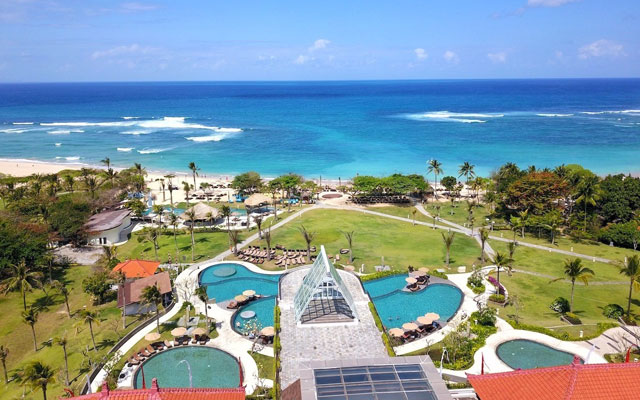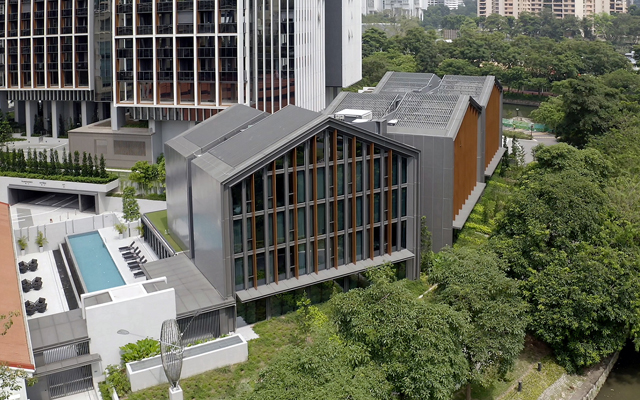
InterContinental Hotels Group has entered a management agreement with Wijaya Karya Realty to open Holiday Inn Balikpapan in 2021.
The 300-room hotel will form part of a mixed-use development called Tamansari Skylounge Balikpapan, which also comprises a residential tower. Guests will have access to shared facilities such as the outdoor swimming pool and deck.
IHG signs deal with Wijaya Karya Realty to open Holiday Inn Balikpapan come 2021
Five function rooms form a total of 610m2 of meeting space. Three of these rooms merge to create the hotel’s largest venue for a 260 pax banquet.
The hotel will be situated about 2km, or seven minutes’ drive, from the Sultan Aji Muhammad Sulaiman Sepinggan International Airport.
Home-sharing giant Airbnb is on the search for the most unique home ideas, and has launched the US$1 million Unique Airbnb fund to help make the top 10 ideas a reality.
Ideas will be assessed on creativity, feasibility, sustainability and social good. Global architectural firm MVRDV, Airbnb superhost Kristie Wolfe of the famed Big Idaho Potato Hotel – a recycled six-ton potato on Idaho farmland, where guests have the chance to befriend a jersey cow – and actor Billy Porter will be the judges.
1 of 4
Boot
Spaceship
Potato
Apollo
Airbnb conceived the contest after it noticed that some of the most booked listings as of this February were unique properties like domes, treehouses and yurts. Additionally, searches for unconventional spaces such as windmills, tiny houses and shepherd’s huts rose by almost 70 per cent year-on-year in February.
Applicants can draw inspiration from one-of-a-kind Airbnb offerings, such as accommodation housed within a wooden elephant – the oldest roadside attraction in the US – as well as a fairytale-themed house in New Zealand shaped like a boot, reminiscent of The Old Woman in the Shoe.
Submissions are open until April 16, 2020 at 10.59 (Thai time, GMT+7). Winners will be announced on May 15, 2020.
Scoot has promoted Kirsty Lucas to country manager Australia, sales and partnerships, after almost two years with the airline.
Her new designation will involve growing Scoot’s Australian market through strategic partnerships, including trade opportunities. She takes over from former Scoot general manager, Jared Simcox.
With over a decade of travel and tourism industry experience, Lucas was most recently regional manager, Australia at TravMedia and has previously held positions in a variety of tourism-based businesses.
The Indonesian government is stepping up its emergency response to contain the spread of Covid-19, including forming a fast-response team for contact tracing, shutting select tourist attractions, and implementing more stringent checks at airports.
These latest measures come as the government declared the Covid-19 outbreak an “unnatural national disaster”, in response to five fatalities and 117 confirmed cases in the country, one of whom is Indonesian transportation minister Budi Karya Sumadi.
Indonesia ramps up screening of tourists at airports in the country; travellers at Soekarno-Hatta International Airport Terminal 3 pictured
The growing number of cases prompted president Jokowi to form a fast-response team – led by National Disaster Mitigation Agency head Doni Monardo – tasked with tracing the movement of Covid-19 patients and those who had come in contact with them as part of efforts to prevent wider contagion of the virus.
Meanwhile, Jakarta governor Anies Baswedan declared 17 tourist attractions in the capital closed, including the National Monument, Ancol Dreamland Park, Ragunan Zoo and a number of museums, for two weeks for thorough sterilisation, as well as suspended schools, with companies to allow staff to work from home.
At airports, two additional lanes have been opened by the central government for visitors arriving from countries that are under the purview of the government.
“Passengers from China, Italy, South Korea, and Iran will be checked three times. Those who are not from those countries will be checked twice through a thermal scanner and thermal gun,” said Jokowi.
Jokowi added the government has prepared 132 referral hospitals, up from 100, and would add another 227 hospitals, owned by the national army, police and state-owned enterprises. In addition, the government is also in the midst of constructing a large-scale observation facility on Galang Island, scheduled for completion next week.
Meanwhile, Achmad Yurianto, the government’s spokesperson for all coronavirus-related matters, said on Saturday that locking down the country was not on the cards, but that a ministerial meeting will soon be held to review Indonesia’s free-visa policy, which some have criticised for the growing number of illegal foreign workers in the country.
For Eddy Sunyoto, owner of Terimakasih Indonesia, the most crucial thing the government should do right now is to implement tighter border control measures so that infected travellers would not enter the country.
Indonesia’s credibility is at stake if the government fails to conduct proper screenings, he added.
Eddy added that although the government’s declaration of the virus as a “national disaster” will reduce inbound arrivals, it will enhance Indonesia’s image as it proves that the government is handling the Covid-19 outbreak seriously and there will be stronger confidence in the country.
Hasiyanna Ashadi, managing director of Marintur Indonesia and head of the Association of the Indonesian Tours and Travel Agencies (ASITA) Jakarta chapter, was in favour of the government rolling back its free-visa policy, as long as the measure is temporary and restricted to countries hit hard by the virus.
She, however, questioned the necessity of revoking the free-visa policy for those countries given that travel mobility from those regions to Indonesia was already restricted by flight cuts by several airlines, such as Singapore Airlines and Emirates, to numerous cities across Asia.
“I hope that the government (seeks) inputs from various parties before coming to a decision,” she said.
Hasiyanna also hopes that the central and local governments will carefully consider whether or not to close off affected cities, especially Jakarta, amid mounting calls for a lockdown.
She said that the government should ensure that all preventive measures were fully implemented, so that Jakarta, which serves as the country’s commercial and financial centre, would not need to go into lockdown.
She said that members of ASITA Jakarta, who are still serving guests at Jakarta’s attractions that are still operating, have also been taking precautions, such as providing hand sanitisers and masks for guests, and practicing social distancing.
“The National Monument, for example, is closed now but (tourists) can still view it from outside, while National Museum and Bank Indonesia Museum, remain open, so we bring tourists to visit those places,” she said.
Metro Manila’s month-long lockdown, which began yesterday as the government attempts to contain Covid-19, has brought about a domino effect on 41 other destinations in the Philippines.
Among the 41 that have imposed community quarantine in varying degrees and length of time are the provinces of Cebu, Bohol, Iloilo, Batanes and Ilocos Norte; Puerto Princesa, Coron and El Nido in Palawan; and Siargao in Surigao. The province of Aklan, which includes top tourist draw Boracay, will also impose quarantine.
Philippine capital Manila enters month-long lockdown
This effectively halts both international and domestic tourism, with international tourists now left stranded in areas like Palawan as domestic flights have been suspended.
The Department of Tourism is making arrangements to help stranded tourists return home with military planes, while several airlines will also be mounting special flights to and from Puerto Princesa. Air Swift will fly via Clark to Puerto Princesa today and tomorrow; Philippine Airlines will operate flights to Puerto Princesa until March 18; while Air Asia Philippines will operate recovery flights to and from Puerto Princessa over the next few days.
Meanwhile, in Manila, gaming operations have been suspended starting today, leading to City of Dreams Manila halting hotel, restaurant and spa bookings, as well as temporarily closing some restaurants.
Tourist destinations in the city including Sagada, The Walled City of Intramuros, Fort Santiago, Casa Manila, Baluarte de San Diego and Museo de Intramuros are also all closed till further notice.
Singapore residents have been advised to defer all non-essential travel abroad, while border restrictions have been expanded to include all South-east Asian countries, as the island nation ramps up measures to curb the risk of imported Covid-19 cases.
The travel advisory for Singapore residents will apply for 30 days, and is subject to further review, said the Ministry of Health (MOH) in a press statement released yesterday (March 15).
Singapore steps up border control measures to guard against imported Covid-19 cases to the country
From 23.59 today (March 16), all travellers, including Singapore residents, long-term pass holders, and short-term visitors, entering Singapore with recent travel history to South-east Asian countries, Japan, Switzerland, or the UK within the last 14 days will be issued a 14-day stay-home notice (SHN).
This will exclude travellers from Malaysia who arrive by land and sea, as large numbers cross the borders daily, said national development minister Lawrence Wong at a press conference on Sunday, reported The Straits Times.
The report also quoted Wong, who co-chairs a Singapore multi-ministry task force to fight the Covid-19, as saying that separate arrangements are being made by a bilateral joint working group.
All other travellers affected by the new border restrictions will also have to provide proof of the place where they will serve the 14-day SHN, for example, a hotel booking covering the entire period, or a place of residence they or their family members own.
They may also be swabbed for testing for Covid-19, even if asymptomatic, due to the risk of community transmission in these countries and evidence of cases that have been imported from these countries into Singapore, said MOH.
In addition to the SHN requirement, from 23.59 today (March 16), all short-term visitors who are nationals of any South-east Asian country will have to submit requisite information on their health to the Singapore Overseas Mission in their country of residence before their intended date of travel.
The submission will have to be approved by Singapore’s MOH before they travel to Singapore, and the approval will be verified by the Immigration and Checkpoints Authority (ICA) officers at the Singapore checkpoints.
Short-term visitors who arrive in Singapore without the necessary approval will be denied entry into Singapore.
The extra measures come as Singapore has seen an increase of 25 new Covid-19 cases in the past three days, said MOH in its statement.
Of these, more than three-quarters were imported cases, of which close to 90 per cent were Singapore residents and long-term pass holders who had returned to Singapore from overseas.
During the same period, more than one-quarter of imported cases were from South-east Asian countries, the ministry added.
The MOH also said that it has seen a number of these cases entering Singapore for the purpose of seeking medical care, adding that it imposes a significant burden on Singapore’s healthcare resources during this critical period when they are focused on containing the situation within Singapore.
The latest restrictions follow a range of sweeping measures announced by the government last Friday to curb the spread of the virus in the country, including more border restrictions and social distancing measures.
The World Travel & Tourism Council (WTTC) will be rolling out a host of monetary-easing measures to blunt the economic impact sustained by the travel and tourism industry from the ongoing Covid-19 pandemic once the virus is brought under control.
The council’s announcement comes amid its latest projections that the virus is putting up to 50 million jobs in the industry globally at risk.
WTTC projects that the Covid-19 is putting up to 50 million jobs in the industry globally at risk; travellers at Kuala Lumpur International Airport wearing masks to prevent infection from the virus
Gloria Guevara, WTTC president & CEO, said: “When the time is right, WTTC and the global private sector will be ready to help and support the government and countries to recover.”
Global travel could be adversely impacted by up to 25 per cent this year, equivalent to a loss of three months of global travel, according to latest figures from WTTC, which represents the global travel & tourism private sector. This could lead to a corresponding reduction in jobs of between 12 and 14 per cent.
Guevara said: “The Covid-19 outbreak clearly presents a significant threat to the industry as a whole, to those employed within it, and those wishing to continue travelling.
“Travel & tourism has the strength to overcome this challenge and will emerge stronger and more robust by taking all necessary measures to tackle Covid-19 and the understandable concern which surrounds it.”
Following extensive consultation with other travel & tourism organisations, WTTC is also calling for a series of measures to be taken, to enable the swift recovery of the sector once Covid-19 is under control.
WTTC will offer its support to all governments, particularly those which are implementing strong policies for a prompt recovery such as improving travel facilitation by removing or simplifying visas, reducing the cost and improving processing times, accepting other visas, and introducing more efficient technologies for seamless and secure travel.
The council will also work to ensure that unnecessary barriers are removed or relaxed to alleviate pressure at ports and airports, including temporarily lifting of the 80-20 slot policy rule, ports assignments and implementing flexible working visa for the industry in some countries with existing limitations, especially in hospitality and tour operation.
As well, WTTC will ease fiscal policies by reducing and removing travellers’ taxes which increases the cost of travel, e.g. air passenger duty and similar airport, port and hospitality taxes around the world.
It will also introduce relief and incentives to support business continuity for companies which have been most negatively impacted by the virus, particularly SMEs, which will take longer to recover.
In addition, the council will support destinations by increasing budgets and assigning resources for promotion, marketing and product development purposes in destinations when they are ready to welcome visitors again.
Meanwhile, WTTC reinforces the importance of strong public-private partnerships and greater international cooperation in order to respond and overcome the challenges faced by its members during the management and recovery from Covid-19.
The travel & tourism sector has a proven track record of resilience in the face of crises and this ability to bounce back has improved significantly in recent years, said WTTC.
Costa Cruises and Princess Cruises, subsidiaries of Carnival Corporation, will be suspending operations in light of the global Covid-19 pandemic.
The move comes amid speculations that the economic toll of the virus may sink the US$45 billion cruise industry, which has been weighed down by cancelled sailings, quarantines, travel restrictions and fears of infection.
Costa Cruises suspends cruise operations worldwide
Costa said on Friday (March 13) that it will be cancelling all of its cruises around the world until April 3, marking a broader retreat as the Italian cruise line had previously suspended operations in China and trips departing from its Italian ports.
Several of the company’s liners have been blocked in recent weeks over suspected or confirmed cases of the Covid-19, and it has halted cruises in the Mediterranean.
Costa said that cruises underway will complete to allow passengers to return home, adding that affected customers will be refunded.
A day prior, Princess Cruises said that it will suspend operations of its 18 cruise ships for two months, after it faced quarantines on two coronavirus-stricken ships.
The Grand Princess cruise ship, which had 21 people on board who were infected with the virus, had been quarantined in the San Francisco Bay for days before docking in Oakland on Monday.
Last month, more than 700 passengers on board the Diamond Princess cruise ship tested positive for the virus in what was then the biggest coronavirus cluster outside China. Six of those passengers died.
Princess Cruises said in a statement that it will continue to sail its planned itineraries, while voyages underway that extend beyond March 17 will end at “the most convenient location” for guests to disembark.
The company also said it will provide ticket holders cash refunds or vouchers for future cruises if their voyages are cancelled.
The Philippine Department of Tourism (DoT) has signed an MoU with Turkish Airlines that aims to boost the country’s tourism from the European, Mediterranean and other international markets served by the airline.
The signing of the MOU was held at the Turkish Airlines’ headquarters in Istanbul, Turkey recently, in conjunction with the Turkey Tourism Roadshow organised by the DoT and the department’s participation at the Uzakrota Travel Summit, one of Turkey’s largest tourism events.
Turkish Airlines’ Ilker Ayci inks pact with DOT undersecretary Benito Bengzon Jr to boost inbound arrivals from Europe and other markets to the Philippines
Under the new collaboration, the DoT and Turkish Airlines will conduct various projects this year to promote tourism in the country, with the goal of boosting inbound arrivals to the Philippines.
Under the partnership, both the DoT and Turkish Airlines will jointly work on brand advertising, promotional and tactical marketing campaigns, digital and e-marketing, familiarisation tours for airline executives, media, travel trade partners, roadshow presentations, among other activities.
The partnership was signed by DOT undersecretary Benito Bengzon Jr and Ilker Ayci, chairman of the board of Turkish Airlines, after successful discussions of possible avenues to increase air connectivity between Turkey and the Philippines, as well as various parts of Europe via Istanbul.
Bengzon said the sustained air connectivity from those areas “would definitely be pivotal in boosting our ability to grow, and make packages to the Philippines more competitive”.
European arrivals to the Philippines rose by 9.13 per cent in 2019 to 772,098 – from 707,525 the previous year – accounting for 9.34 per cent of the total international visitorship to the Philippines.
Meanwhile, arrivals from the Mediterranean markets, Israel and Turkey have doubled in the last five years, with an average growth rate of 16 per cent.
Singapore is on the cusp of resurgence as a family destination, as the country shapes up with a slate of new and upcoming developments aimed at drawing younger families.
Preceding the opening and announcements of these fresh developments was the Singapore Tourism Board (STB)’s Action Seekers marketing push.
Launched in January last year, the initiative targeted adventure- and sports-minded travellers, including children, youth and of course, by extension, families.
Then, in April last year, the island of Sentosa welcomed three new hotels under the Far East Hospitality group. Of the three, the 606-room Village Hotel at Sentosa is a family-friendly option featuring themed pools and a range of activities for all ages.
Besides playing host to new hotels, Sentosa will be rolling out major transformations such as an expansion of Pulau Brani, beach enhancements, new attractions, and nature zones.
On top of all this, Resorts World Sentosa (RWS) is undergoing a S$4.5 billion overhaul, which is set to increase the gross floor area of the integrated resort by about 50 per cent.
As part of RWS’ transformation into RWS 2.0, new experiences will be delivered in phases until 2025. The first will be a pirate-themed dining playhouse, which is slated for end-2020.
Coming down the line are a public seafront attraction with free evening light shows, expansions and two new sections for Universal Studios Singapore and an enlarged S.E.A. Aquarium, which will be renamed Singapore Oceanarium.
All of these enhancements are expected to entice visitors to extend their stay in Sentosa and Singapore.
Guy Allison, then-director of procurement, Tour East Holdings and now co-founder and chief talent officer, G & P Recruitment – a Bangkok-based hospitality company – commented: “Sentosa’s becoming quite a family destination. It’s starting to attract people to stay in Singapore for not just a few nights, but three or four – maybe even a week. With the new developments, it might even become a destination in itself.”
On Singapore’s mainland, NERF Action Xperience, with its high-octane offerings, opened in September last year. To continue pulling in more family visitors, the centre will host the inaugural NERF Agility League for children and youths from seven to 16 years old this year.
Returning in October this year is the HSBC Singapore Rugby Sevens 2020, which is shaping up to be one of Singapore’s tent-pole extravaganzas for families. A third of the crowd at last year’s event had purchased family packages, said Steven Rodaway, general manager of HSBC Singapore Rugby Sevens.
Billing itself as a family-focused edition of the global event, this year’s Singapore leg will feature carnival activities, a children’s FunZone with stage performances, live shows, art activities and face painting, as well as a line-up of new family-friendly activities that will be announced.