Hawaii is set to loosen entry restrictions for Japanese visitors in the hope that Japan, a critical inbound market, can support the island chain’s ailing tourism industry.
Under the plan, Japanese travellers can bypass a 14-day quarantine upon landing in Hawaii if they pass a body temperature test and submit a negative Covid-19 test result. This test must be carried out at a medical institution in Japan recognised by Japan’s Ministry of Health, Labour and Welfare within 72 hours of departure.
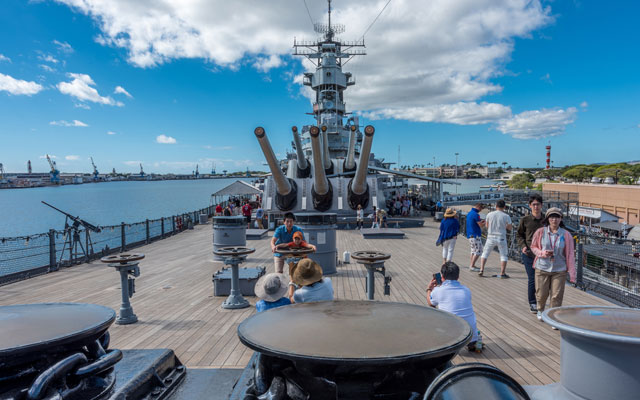
Hawaii’s plans to lift Covid restrictions for Japan travellers will provide much-needed lifeline for the US state’s battered tourism sector; tourists visiting the Battleship Missouri Memorial at Pearl Harbour, Hawaii pictured
On October 15, Hawaii began the plan for arrivals from continental US, as well as the Hawaiian counties of Honolulu, Kauai and Maui, but arrangements for Japan are still being worked out.
Hawaii’s Department of Health is in discussion with Japanese medical institutions to secure a list of trusted testing partners in Japan to offer Covid-19 tests. A department representative said it “looks forward to working collaboratively with all levels of the Japanese government to identify trusted testing partners and to make this pre-travel testing programme a success”.
Hawaii governor David Ige hopes for the US state to be open to Japanese tourists by the end of the year. The move is expected to provide a lifeline to travel-related businesses in Hawaii, which has long been a popular destination for Japanese travellers.
In 2019, Japan was Hawaii’s largest inbound market in visitor terms of spending, visitor days and arrivals. It ranked third overall, behind only the US West and US East coasts, according to the Hawaii Tourism Authority.
Moreover, Japan’s importance has been growing in recent years. Japanese visitors’ spending increased 4.8 per cent to US$2.25 billion in 2019, boosted by growth in visitor arrivals, which were up 5.8 per cent, and visitor days, up 4.7 per cent. In shopping, their average spending was surpassed only by visitors from “other parts of Asia”.
Japanese travellers also tend to be repeat visitors to Hawaii; 68 per cent of Japanese visitors in 2019 had been to Hawaii before.
Under Hawaii’s “pre-travel testing programme”, Japanese travellers returning to Japan from Hawaii must undergo a 14-day quarantine. In the meantime, Japan’s borders remain closed to leisure visitors from the US.
Aman founder Adrian Zecha has teamed up with Japanese hospitality group Naru Developments to launch a new hospitality brand, Azumi, that aims to offer a fresh take on the Japanese ryokan by combining the personable service typical of the traditional inn with global hotel standards.
The first Azumi property is slated to open on one of the islands in the Setouchi Region of Japan come spring 2021.
Each Azumi property will serve as a medium of expression for each locale and its climate
Zecha said that he was first acquainted with ryokans while living in Japan back in the 1950s as the Asia correspondent of TIME magazine. “My favourite ryokan was a retreat from the hustle and bustle of the city. It was owned and operated by one family and they were deeply rooted into the local community,” he said.
“The hospitality was just right – I was treated as something in between a guest and a dear family friend. This relationship with the family who owned the ryokan made the place an extension of my own home in Tokyo.”
Azumi aims to infuse the “time-honoured customs and hospitality” observed at ryokans into “a quality offering that appeals to the modern, global traveller”.
This balance between tradition and innovation will be integrated into all parts of the brand, from design and service, to wellness and cultural programming. For example, the team has worked closely over the past four years with Shiro Miura, a Kyoto architect, to find the right harmony between traditional design and modernised comfort for the brand.
The largest-ever tourism push to promote the Gold Coast urges Aussies to Come Back and Play, as part of Destination Gold Coast’s (DGC) latest campaign launched to further springboard economic recovery.
The A$3.5 million (US$2.5 million) promotion is the second iteration of DGC’s Come Back and Play campaign, which first launched in June encouraging Queenslanders to explore their own backyard.
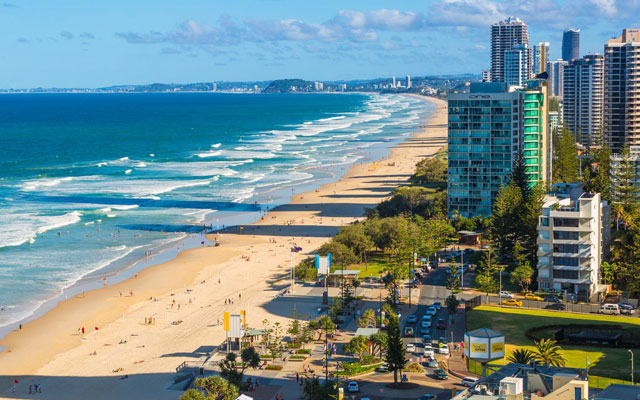
Recovery beckons for Gold Coast tourism as mammoth campaign debuts across Australia; Surfers Paradise in Gold Coast pictured
DGC chairman Paul Donovan said that the campaign aims to inspire Aussies to turn their holiday dreams into reality, ahead of the reopening of Queensland’s border slated for November.
“Come Back and Play represents the largest multimillion-dollar investment in the domestic market to entice high-spending travellers to indulge in a well-deserved holiday in Australia’s favourite playground,” he said.
Donovan added: “As restrictions are further relaxed and travel confidence continues to grow, we are investing responsibly in markets that we can dial up or down to ensure maximum benefit for every tourism dollar spent.
“The addition of interstate holidaymakers from key markets is anticipated to deliver a much-needed boost to revive Gold Coast’s A$6 billion tourism economy. We know many people will be looking to reconnect with family, friends and loved ones after what has been an incredibly challenging year.”
The eight-week campaign will be rolled out in bursts throughout Brisbane, regional Queensland, ACT and South Australia, followed by New South Wales (November 8), on free-to-air and subscription TV, radio, outdoor digital billboards, cinema placements, as well as digital and social media.
Featuring experiences from poolside relaxation to visiting iconic theme parks and nature-based experiences, the campaign aims to drive visitation through to summer.
Accor has rolled out 42 accommodation deals across 23 of its properties on the Gold Coast, as part of a partnership with DGC under the campaign.
The Come Back and Play campaign will be supported by a 32-page printed supplement to be included in metro publications across Brisbane, Sydney and Adelaide from November 8.
The Sentosa Development Corporation (SDC) has launched a campaign to encourage locals to Make Time for a Holiday, with over 50 diverse new offerings to be rolled out progressively.
Themed around Island Life, Heritage Discovery, Wellness Escape, and Nature Adventure, the offerings feature hybrid leisure experiences that integrate onsite and virtual elements, insider tours to hidden gems, alongside a slew of S$100 (US$74) holiday packages.
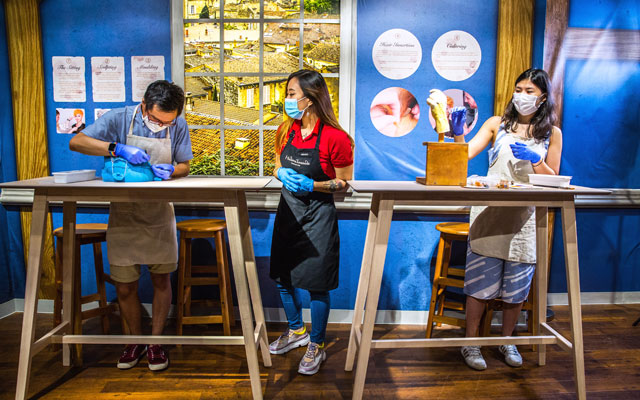
Visitors to the Madame Tussauds Singapore can now try their hand at wax painting and hair insertion
The launch comes after SDC commissioned a survey in August 2020 to examine how the Covid-19 pandemic has impacted Singaporeans’ views and attitudes towards leisure time, as part of efforts to understand and anticipate the needs of Sentosa’s guests.
Polling 1,061 Singapore citizens and permanent residents, the survey found that the majority (56 per cent) have not seen the need to take leave from work while working from home, despite the large majority (90 per cent) understanding that taking regular breaks increase productivity.
To encourage Singaporeans to take a break, SDC has teamed up with its tenants to launch a series of Sentosa Insider Tours. Designed to showcase a different side of Sentosa, the tours will offer insights into the workings of Sentosa’s attractions, as well as hands-on experiences that will bring guests closer to the island’s nature and heritage.
Among the Sentosa Insider Tours on offer is Behind the Magic (by Madame Tussauds Singapore), a 1.5-hour insider experience where guests can learn wax painting and how to do hair insertions from industry experts; as well as How we Defy Gravity (by AJ Hackett Sentosa), a two-hour interactive programme with a behind-the-scenes tour, showcasing the technical, educational and thrill aspects of the attraction, such as the construction of bungy cords and the science behind the Bungy Jump and Giant Swing.
Nature lovers can take part in the Marine ConservAction (by SDC), a one-hour programme where guests will understand the effects of litter on marine life and how we can do our part to protect the environment, while contributing to marine conservation through the hands-on experience of litter-picking along Sentosa’s beaches.
The various Sentosa Insider Tours will progressively be rolled out from October 2020 and over the coming months.
As part of a tie-up with the National Association of Travel Agents Singapore, SDC, together with five local travel agents, have also curated 10 guided tours featuring Sentosa’s array of leisure offerings, including attractions, nature and heritage experiences, as well as various dining options.
Guests on these guided tours can enjoy free transportation from their doorstep to the various offerings across Sentosa. Those who prefer to explore the island on their own can also choose from a range of free experiences such as the new Sentosa Geology Gallery at Sentosa Nature Discovery, which offers insights into Sentosa’s rock and geological formations, as well as various nature and heritage trails, among others.
Meanwhile, SDC, together with its tenants, have also rolled out a range of holiday packages priced at S$100, bundling various leisure experiences, with discounts of up to 50 per cent. For example, one can opt for a package inclusive of rides at HeadRock VR Sentosa and a 5-in-1 Madame Tussauds Singapore experience, complete with a complimentary treat at Co+Nut+Ink; or another featuring a 2.5-hour guided yacht tour to the Southern Islands, and a cable car ride.
In December, SDC will also launch its first sustainability-themed tour that enables guests to experience behind-the-scenes efforts on conservation and sustainability, and encourages them to embrace sustainable actions through experiencing Island Life at Sentosa. The tour will be the first of an upcoming series of sustainability-themed tours, as part of the progressive roll-out of Sentosa’s S$100 Getaway Deals.
Food and wine enthusiasts can now attend Masterclasses offered by SDC’s tenants where they can learn how to make the signature cocktails at Tanjong Beach Club (S$88 nett/per person), or garner insights on how to whip up a Risotto & Gnocchi Dish for free at Trapizza, the beachside casual Italian restaurant at Shangri-La’s Rasa Sentosa Resort & Spa.
Meanwhile, foodies can look forward to the return of the signature Sentosa GrillFest in its inaugural Home Edition. From October 29 to November 22, 2020, guests will be able to indulge in grilled treats from various dining establishments in Sentosa, as well as delights from local chefs as part of SDC’s partnership with the Singapore Chef Association for the event.
Guests can choose to enjoy these tasty treats through islandwide delivery, or make reservations to dine-in at participating dining establishments in Sentosa.
SDC said that more initiatives under the Make Time for a Holiday campaign will be rolled out “in the coming months”.
The pandemic has made it more urgent for event venues to evolve their existence, by playing a direct role in supporting the transaction of business and knowledge through events as well as be regarded by clients as more than just a passive real estate supplier.
In this new episode of TTG Conversations: Five Questions, we speak to Ong Wee Min, vice president of MICE, Marina Bay Sands on the future of event venue suppliers when face-to-face meetings are limited, innovations in venues, the balance between contractual flexibility and business sense, and more.
Tourism suppliers should employ a strong focus on promoting domestic and near-domestic travel instead of plotting their longhaul strategies during this period, urged speakers at the ITB Asia 2020 Virtual last week.
Timothy Hughes, vice president, corporate development, Agoda, expressed that while longhaul travel will eventually return, it will not come as “a surprise”, and the industry will receive ample “warnings” to plan their next move.
Location-based marketing help travel suppliers curb costs, while improving ROI of their marketing spend: Shibata
“Don’t get distracted by conversations about green lanes, corridors and vaccines. Just focus on what is right here in front of us: domestic travel. Save the thinking about longhaul (for) when we start to get signals that it’s coming back,” he advised.
Among the characteristics of domestic travel that Hughes reported is the pattern of “near-domestic” travel, where residents of major cities like Bangkok, Seoul and Tokyo have expanded their vacation radius to 200km around the city.
These “drive markets” have short lead times, with Agoda seeing many same- or next-day bookings, and are “on the hunt for a deal” on “high-category hotels, villas and houses”. Observing that consumers are looking for flexibility, he also advised the industry to “put ‘non-refund’ on hold for a while”.
In Japan, local tourism authorities have pivoted their strategies that were once geared towards the international market. Prefectures are now providing discount coupons and promotions to local residents, shared Kei Shibata, co-founder and CEO, Line Travel jp and Trip101.
He observed: “We have started to see a great amount of demand through location-based marketing. This is working well to avoid overtourism, and it helps destinations and hoteliers save costs while increasing their ROI on marketing. Last-minute booking is also a big thing now, and our mobile push notifications are working extremely well to capture this demand.”
As companies feel the crunch on cost amid the pandemic, Hughes continued to stress that travel businesses should heavily consider investing in fintech solutions.
He asserted: “If you are not a fintech company in travel, you are giving money away. You’d need either teams of people – or if (one) cannot afford teams, then really smart partners – who can help manage complexity of payments in (the) most cost-effective way. If you’re a travel company, you’d better have fintech solutions.”
Travel suppliers in the South-east Asia region can now register their interest to participate in The Great 2021 ASEAN Travel Fest, a year-long B2B and B2C virtual travel festival designed to help regional hospitality suppliers source new business opportunities.
Organised by TTG Asia Media, the festival will spotlight one or more of the ten South-east Asian countries each month, starting from February through November; alongside an All ASEAN showcase in the month of June.
Each monthly destination showcase will take place over three days, comprising of two components: B2B Tradeshow and B2C Live Selling.
During the two-day B2B Tradeshow, which will take place on Thursday and Friday, participating sellers will be able to engage with travel trade buyers from Asia-Pacific and international markets, through a 24/7 virtual exhibition, walk-in business meetings, as well as interactive giveaways and games.
This will be followed by the B2C Live Selling on Saturday, where suppliers can connect with local and regional consumers through a virtual broadcasting event capped at two hours, and sell attractive deals and offers direct to them.
Leveraging on the popularity of live broadcast shopping, production of this segment promises to be hassle-free, with suppliers having to provide only their product information and inventory. The rest will be managed by TTG Asia Media, which will handle aspects from programming and production, to event hosting, live-stream platforms, and an online transaction medium.
Suppliers can also tap into TTG Asia Media’s vast network of travel professionals and enthusiasts to market their event to a wider audience.
Companies can get two showcases for the price of one, with the ROI-driven packages starting at US$2,500, which includes B2B participation with virtual booth and business meeting tools at one destination showcase, plus one All ASEAN showcase.
Other benefits include eight pre-scheduled appointments during the All ASEAN showcase, unlimited walk-in meetings for both showcases, alongside the opportunity to sponsor prizes for interactive games and giveaways.
The price excludes an additional US$2,000 participation fee per B2C Live Selling event, and a 20 per cent commission for inventory sold.
Singapore-based budget hotel operator RedDoorz has launched a new economy lifestyle hotel brand, SANS, as part of its strategy to build the largest new-age hospitality company in South-east Asia.
SANS, which is derived from the Indonesian word “santai” which means to “chill”, aims to provide a vibrant and cosy stay experience at a low cost, with properties to feature trendy furnishings and amenities.
The launch of SANS signals RedDoorz’s new vision to become “an ecosystem of various accommodation products”
The brand will debut in Indonesia next month, with five new properties targeted by year-end.
RedDoorz will also embark on a major rebranding exercise in 2021 to reposition the company as a multi-brand accommodation platform. The company said that it plans to add new accommodation products to its platform across economy lifestyle, mid-scale and extended stay segments, in addition to its existing budget hotel brand and co-living service KoolKost.
As part of the rebranding, the company will also roll out a new redesigned app and rebranding campaign in 1Q2021. The new app will allow users to browse the company’s portfolio of accommodation brands, and will also be complemented by a new loyalty programme, which can be used to earn and redeem discounts and access exclusive partner offers and benefits.
Amit Saberwal, founder and CEO, RedDoorz, said: “We are now getting ready for our next phase of growth and despite Covid-19, we remain deeply committed to South-east Asia’s hospitality potential. Once the pandemic gets behind us, we will be the first hospitality company in our part of the world to spring back into full growth mode again, thanks to everything we’ve done during this challenging year.”
The Singapore Tourism Board (STB) will roll out three programmes by end-2020 to give local tourism businesses a boost in their data transformation journeys, announced the board’s acting chief technology officer, Poh Chi Chuan.
Poh shared that the first initiative is an aggressive push for augmented reality (AR) technology. The board aims to build a bank of some 1,000 “high-quality” AR resources on its Tourism Industry Hub, test prototypes to showcase AR applications, launch a set of recommended standards, and introduce AR training courses on its Tech College.
Data transformation critical for survival in the post-Covid landscape: Poh
This strategy follows the successes of local attractions, Singapore Zoo and nightclub Zouk, which adopted AR marketing and events to engage with consumers during the pandemic.
Poh said: “We decided to focus on AR as it is an accessible technology that we believe will be mainstream in the next couple months.”
The second initiative will see the full-scale launch of the board’s Tourism Transformation Index (TXI), which has been in limited pilot phase since June.
Once fully launched, tourism businesses in Singapore will be able to assess their current state of transformation against a holistic set of metrics, as well as access a new dynamic industry benchmark to measure against other companies and gauge the growth of the industry.
Finally, STB plans to enhance its Singapore Tourism Analytics Network by introducing new data domains and features, resources such as the Data College, as well as a governance playbook for companies to guide them on proper handling of data privacy.
“Covid-19 has led a paradigm shift that has accelerated data transformation from something that is good to have to something that is a must-have for survival,” expressed Poh.
He added that STB is also launching a white paper, Beyond Covid-19 – Tourism Transformed, detailing its recovery predictions.
As countries cautiously restart their tourism engines and airplanes return to the skies, Asia-Pacific is set to be the first region in the world to rebound, which will provide a blueprint for post-Covid recovery.
“If we look at which regions are going to be at the forefront of (the) recovery momentum, Asia-Pacific is ahead of the race. Reason being, firstly, (it has) a great deal of regional travel. There is a lot of hopping within countries, and across regional countries,” said Anita Mendiratta, special advisor to secretary general, The UN World Tourism Organization.
UNWTO advisor urges continued safety protocol, clear messages, tourist dispersion
“And, Asia-Pacific was the first to experience the pandemic. (It is) getting through it first, (showing) the rest of the world what recovery will look like.”
Speaking at the ITB Asia 2020 Virtual session, titled The Future of Travel Post-Covid-19, Mendiratta quashed any notions of a return to normalcy, instead dubbing the new world of travel as the “next normal”, where uncertainty abounds in light of recurring waves, and the many questions surrounding a Covid-19 vaccine.
In this climate of uncertainty, destinations have to adapt to new ways of working and connecting with travellers for tourism recovery to gather pace.
Noting that at the height of the pandemic, 16,000 aircraft were grounded around the world, Mendiratta said that airlines now need to determine route profitability and where the demand lies, while also accessing stability risks in terms of the virus to prevent future groundings.
She also cautioned destinations against growing lax with safety protocols. “The protocols are critical; they are part of the experience that we must now accept as the future of travel, particularly, in a post-Covid-19 world,” she stressed.
Noting that the need for space will sway future travel decisions, she said destination marketers need to “(unlock) areas in destinations that have really not been discovered before – places that are more remote, less densely populated, allowing dispersion”.
With trust hailed as the new currency for tourism marketing, she also reiterated the critical importance of communication in managing traveller expectations and giving them peace of mind.
“Now is the time for communication, not campaigns. Destinations, airlines, airports, attractions can all speak to travellers, but speak to them as equals, focusing on why – not where – they are travelling.
“Create that connection now, so that when they are ready to travel, they know that there is a place and there are people looking forward to seeing them,” concluded Mendiratta.














Aman founder Adrian Zecha has teamed up with Japanese hospitality group Naru Developments to launch a new hospitality brand, Azumi, that aims to offer a fresh take on the Japanese ryokan by combining the personable service typical of the traditional inn with global hotel standards.
The first Azumi property is slated to open on one of the islands in the Setouchi Region of Japan come spring 2021.
Zecha said that he was first acquainted with ryokans while living in Japan back in the 1950s as the Asia correspondent of TIME magazine. “My favourite ryokan was a retreat from the hustle and bustle of the city. It was owned and operated by one family and they were deeply rooted into the local community,” he said.
“The hospitality was just right – I was treated as something in between a guest and a dear family friend. This relationship with the family who owned the ryokan made the place an extension of my own home in Tokyo.”
Azumi aims to infuse the “time-honoured customs and hospitality” observed at ryokans into “a quality offering that appeals to the modern, global traveller”.
This balance between tradition and innovation will be integrated into all parts of the brand, from design and service, to wellness and cultural programming. For example, the team has worked closely over the past four years with Shiro Miura, a Kyoto architect, to find the right harmony between traditional design and modernised comfort for the brand.