TTG Asia
Asia/Singapore Thursday, 15th January 2026
Page 1002

Elephants starve as tourism comes to a standstill

0

The World Elephant Foundation (WEF) has launched the Save the Asian Elephant campaign to raise funds and awareness of the mammals’ plight amid lockdowns, as elephants in shelters and parks throughout Thailand, Myanmar, Cambodia and Laos face starvation as tourism dries up.

The crux of the matter lies in the fact that the elephant shelters and parks rely on tourism for revenue. WEF intends to set up a registry for rescue organisations and sanctuaries to indicate their numbers and needs. This will allow the organisation to embark on a coordinated approach to help the animals across the Greater Mekong region.
WEF launches campaign to save Thai elephants from starvation as tourism collapses

In a press statement, Nudplee Hamundee, director, WEF, called on those concerned for the welfare of the animals to sponsor an individual elephant. He explained that no government support is provided for the mammals, who may then be “sold for illegal logging or hard labour” or have no option but to starve to death. Pregnant female elephants may also be smuggled.

He added that the situation has been made more dire as it is the dry season and there is a lack of jungle remaining. Instead of giving the animals fresh plants or vegetation, elephant carers have had to purchase food from farms. However, they are running out of cash, said Hamundee.

Hamundee expressed hope that concerned tourists who have visited the region will show solidarity by contributing to the campaign’s initiatives.

The plight of the elephants is the latest warning sign of the risks faced by tourism-reliant economies and communities. As visitor arrivals began to fall in mid-January, the elephant owners and herders were not spared from the financial distress that gripped most individuals and businesses in the tourism sector, said Hamundee in the statement.

Besides being used to feed the animals, funds raised at elephant camps and sanctuaries were also used to “further animal welfare, combat smuggling and encourage conservation and habitat restoration”, he added.

The livelihoods of Kui hill tribes in Surin, Thailand as well as Cambodia and Laos have been severely impacted as they have been breeding elephants to be sold to sanctuaries so tourists could interact with the mammals.
Indonesian zoos cry for gov’t aid as food, funds run dry

0

Temporarily-shuttered Indonesian zoos are struggling to afford animal feed, as well as ensure business continuity, as the coronavirus lockdown keeps visitors away.

For now, Jawa Timur Park Group in East Java is still able to continue feeding their animals at three spots – Batu Secret Zoo, Eco Green Park, and Predator Fun Park – according to its marketing & PR manager, Titik Ariyanto.

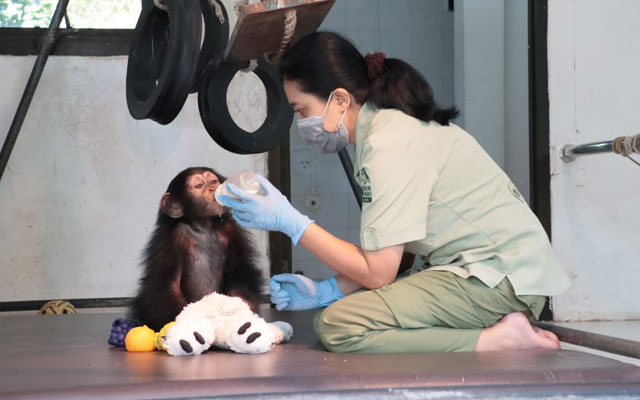
A zookeeper feeds a monkey at Taman Safari Park, which is among several zoos in Indonesia facing depleting food supplies

However, she said, such capacity might last only until June. After which, the zoo would face difficulty feeding their animals, without the income generated from visitors since its closure on March 20.

“Batu Secret Zoo poses the hardest challenge because just for feeding wild animals alone, we have to prepare at least 500 million rupiah (US$32,600) a month. In total, we need nearly one billion rupiah a month (to feed all the animals in the zoo),” Titik said.

To ensure that the animals continue getting fed during this crisis, Jawa Timur Park Group has resorted to layoffs and pay cuts.

Titik said that her office had sent letters to the Health Care and Social Security Agency to defer insurance premium payments, as well as to the state-owned electricity firm PLN to get a discount for their electricity bills.

“Although we are closed, we still use electricity to maintain our rides and fun attractions. We are afraid that they will break down if we don’t turn them on (during the closure),” she said.

The Indonesian Zoo Association (PKBSI), which represents 57 conservation bodies that take care of a combined 4,912 species and 68,933 animals, has sent a letter to president Joko Widodo last week to ask for financial assistance from the government, ranging from tax relaxation to cash transfer from state budget or city budget, according to its chairman, Rahmat Shah.

The cash transfer that PKBSI proposed amounts to 38.5 billion rupiah a month, comprising 23 billion for zoo workers, 14.5 billion for animal feed, and nearly one billion for animal medication, in addition to temporary exemptions from paying salary taxes, as well as land and building taxes.

“Although all zoos have shut down, we cannot stop feeding animals (during the closure). All animals in the conservation bodies are owned by the state and we (conservation institutions) are like day-care centres. So we have to get the government’s permission if we want to transfer or exchange animals,” Rahmat said.

Amid this crisis, he said, conservation bodies show varying degrees of financial strengths. Some 23.7 per cent stated that they have no financial capacity at all; while 23 per cent can survive less than one month; 34 per cent, one to three months; and 18.4 per cent, more than three months.

Zoos lacking the financial capability are now being helped by other members of PKBSI to feed their animals, according to Rahmat. “So far, all animals in conservation bodies across Indonesia are safe,” he added.

Both Ketut Widarsana, spokesperson of Ragunan Zoo in Jakarta, and Yulius Suprihardo, spokesperson of Taman Safari Indonesia in Bogor, West Java, said that their zookeepers are still working as per normal and they were doing their best to provide company and nurture for animals, but they now wear masks, gloves and other protective gear to prevent virus transmission from humans to animals.

Although the two sites have closed their doors to the public, animal care, cleaning and feeding continues, according to Ketut and Yulius. The sites and cages are also disinfected regularly to keep the animals safe.

PKBSI hopes that the government will provide immediate aid to zoos across the country as the sector employs 22,000 workers, attracts more than 50 million visitors annually, and contributes 500 billion rupiah a year to the country’s GDP.

Malaysian budget hotels refused rental waivers by landlords

0

The Malaysia Budget Hotel Association (MyBHA) has called on the government to draft an act to protect hoteliers amid the pandemic.

Its national deputy president, Sri Ganesh Michiel, said in a statement that the association had received negative feedback from its members that the Special Relief Fund (SRF) rolled out by the government was “not friendly” to the industry.

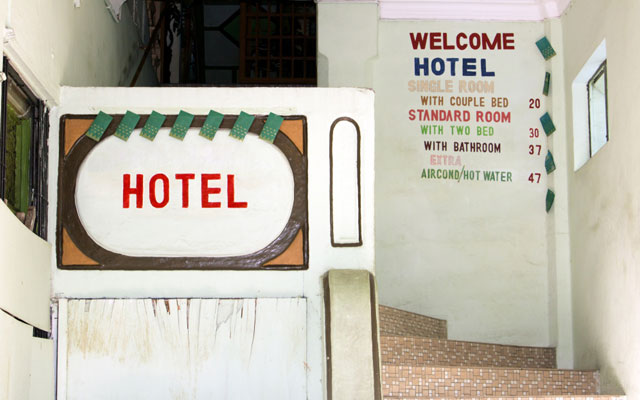
Malaysia Budget Hotel Association urge government to pass law to protect hoteliers; a budget hotel in Penang pictured

“The banking and financial institutions (have been) avoiding the hotel industry as they misunderstood (it to be) a high-risk industry,” he said.

The government has set aside RM5 billion (US$1.1 billion) under the SRF to provide financial relief for SMEs affected by Covid-19.

Sri Ganesh, who is also MyBHA’s national legal and information and communications technology bureau chairman, said: “Most of the hotels are on a rented property where the government had announced that all the property owners shall give a discount for the rental of their properties.”

However, he alleged that the property owners were taking advantage of the situation by refusing or being reluctant to waive or reduce rent for their tenants who had invested in converting the property into a hotel.

He also noted that the owners are currently enjoying the moratorium periods in their property loan facility, adding that it wasn’t fair to its members who are making losses. He opined that tenants risked losing possession of their hotels, as they were unable to pay rent to the landlord.

Sri Ganesh added that this situation could result in hotel closures, and the rise of legal cases, as well as bankruptcies and retrenchments.

TTG Asia takes Labour Day break

0

TTG Asia will be taking a break on Friday, May 1, as it is Labour Day in Singapore.

News will resume on Monday, May 4.

Former Philippine tourism secretary Ramon Jimenez, Jr passes on

0

The former tourism secretary of the Philippine Department of Tourism (DOT), Ramon “Mon” Jimenez, Jr has passed away this week at the age of 64.

The DOT’s present chief, Bernadette Romulo Puyat, has issued a statement, paying tribute to the “immeasurable contributions of secretary Jimenez who laid down the foundation for the country’s most famous tourism campaign, It’s More Fun in the Philippines”.

Puyat added that he was also behind many DOT policies that helped shape the National Tourism Development Program (NTDP) for 2016-2022.

“Today, we mourn the loss of Mon Jimenez but we will be forever grateful to him for the growth of the tourism sector, and for promoting the Philippines as a place that is wonderful, joyous and fun,” said Puyat.

With metro Manila still on lockdown, friends and former colleagues from the Hotel Sales and Marketing Association as well as other tourism sectors have arranged for a virtual eulogy in remembrance of Jimenez.

The virtual eulogy will be held on Facebook on April 29, 19.30 local time, right after the virtual mass on Jimenez’s Facebook account.

Expo 2020 Dubai likely to shift to 2021

0

The United Arab Emirates (UAE) has made an official request to postpone the Expo 2020 Dubai until next October due to the coronavirus, announced The Bureau International des Expositions (BIE) on Saturday (April 4).

The Paris-based organisation said in a statement that the decision was made following consultations with the BIE, participating countries and key stakeholders. UAE’s proposed opening dates of Expo 2020 Dubai are from October 1, 2021 to March 31, 2022.

UAE proposes one-year delay for Expo 2020 Dubai

The UAE has also requested to continue using the name Expo 2020 Dubai for the event, despite the change in dates.

The BIE said that the Executive Committee will hold a virtual meeting on April 21 to discuss the options for a change of dates. For the proposal to be green-lit, it requires the approval of two-thirds majority of BIE member states, with the final decision expected in June.

The Executive Committee of the BIE is formed by delegates from 12 member states. They were elected by the BIE’s General Assembly.

Expo 2020 Dubai was expected to attract about 25 million visitors to the six-month event, which was slated to launch this October.

Thailand extends emergency decree, may adopt coding system for businesses

0

Although there had been talks of lifting the state of emergency at the end of this month, Thailand’s Centre for Covid-19 Situation Administration (CCSA) on April 27 announced it will extend its emergency decree until the end of May.

Amid low numbers of new coronavirus cases, CCSA considered the measures effective in flattening the curve.

A proposed colour-coded venue-categorising system will indicate when businesses and public areas could reopen

Therefore, under the executive order, the six-hour curfew from 22.00 to 04.00, prohibition of mass gatherings, inter-provincial travel restrictions and ban on travel into Thailand will continue for another month, while the Civil Aviation Authority of Thailand (CAAT) also announced incoming non-essential international flights will be suspended until May 31.

The cabinet is also in talks about whether to postpone all public holidays in May and move them to a later date, including Labour Day, Coronation Day, Visakha Puja Day and the Royal Ploughing Ceremony, a decision which is expected to be announced today.

Meanwhile, Suvarnabhumi Airport, which used the past month’s hiatus to repair and renovate, is prepared for the gradual resumption of domestic flights. Thai AirAsia and Thai Lion Air have announced they will resume flights on May 1, and will enforce compulsory measures from the CAAT such as social distancing between seats, and no drinks or food served on flights.

The CCSA has also floated a potential venue-categorising system that would see businesses and public areas divided under white, green, yellow, and red codes based on associated risks. Under the proposed coding system, Thai businesses shut down since March 22 will reopen in stages, starting with the White category – those deemed low-risk and essential to everyday life, and situated in the open air, including street hawkers and vendors – in the first week of May.

These would be followed by public parks, exercise facilities in the open air and small shops, both air-conditioned and non-air conditioned, under the Green category in mid-May.

Mid-risk venues with more crowding are categorised Yellow and could reopen beginning of June – fresh markets, street markets, food centres, malls, salons, dental and beauty clinics and swimming pools.

Red “high-risk” businesses would only be able to resume mid-June. These include pubs, gyms, movie theatres, massage parlours, stadiums, exhibition halls and meeting facilities.

Social distancing and hygiene measures would continue to be enforced in all situations. Hotels are not on the list as their closures were ordered on a provincial basis; provinces such as Bangkok and Chiang Mai do not have hotel closure orders.

Airbnb to launch cleaning protocol

0

Airbnb will roll out in May the Enhanced Cleaning Initiative — the first standardised protocol for sanitisation and cleaning in the home-sharing industry.

Guests will be able to search for homes certified under the programme, which have met expert-backed guidelines and cleaning procedures.

Homes of hosts who adhere to and perform the recommended level of cleaning will be listed under a special collection on the Airbnb website

Experts contributing to the programme include Vivek Murthy, former surgeon-general of the US, who helmed the country’s responses to the Ebola and Zika outbreaks, and employees from hospitality and medical hygiene companies, including Ecolab.

The programme will also incorporate published standards of the Centers for Diseases Control and Prevention (CDC) in the US.

As part of the programme, hosts will receive detailed cleaning guidelines that recommend the use of disinfectants approved by authorities and protective gear. Hosts are required to enforce a 24-hour buffer between guest stays.

All hosts will be encouraged to adhere with detailed guidelines on cleaning each room in their homes. Those who adhere to and perform the recommended level of cleaning will have their homes placed under a special collection on the Airbnb website.

Hosts who are not able to commit to the enhanced cleaning protocol can opt into a separate Booking Buffer feature, also backed by experts. This feature stipulates that homes must be kept empty for a buffer period between stays. Currently, the default buffer period is set at 72 hours.

Even under this separate label, hosts are urged to follow cleanliness guidelines from local governments and the CDC.

The initiative reflects the home-sharing company’s recognition that the future of travel will be tied very much to health, safety and prevention, said the company in a press statement on April 27.

Airbnb also hopes the cleanliness standards can provide reassurance to governments as they weigh whether to reopen their destinations to travellers.

Reservation trends have led the home-sharing giant to believe in the recovery of the home-sharing industry and travel as a whole. A recent Airbnb survey showed that 92 per cent of hosts wanted to host as often as before Covid-19, or more often, after the pandemic wanes.

As at late-March 2020, the number of bookings on the home-sharing platform with an arrival date of at least six months later were found to be higher compared to the same period last year, noted Airbnb.

The home-sharing giant also said that most guests have been satisfied with the cleanliness of the Airbnb homes they stayed in, and this cleaning initiative is a continuation of that. As of March 31, 94 per cent of reviews showed a cleanliness rating of four to five stars, said Airbnb.

Singapore’s retail, tourism SMEs to benefit from expanded​ training programme

0

Google and Singapore-headquartered United Overseas Bank have come together to expand the capacity of the ​SME Leadership Academy ​training programme and revise the online curriculum to help small- and medium-sized enterprises (SMEs) tackle immediate business challenges during this crisis.

The programme supports SME business leaders from the retail, tourism and F&B sectors.

The SME Leadership Academy courses are now online, with new curriculum to help business owners be more digitally-savvy

Given the pressing need for SMEs across different industries to be able to transform their businesses digitally, the SME Leadership Academy will expand its capacity to help 4,000 SMEs by end 2021, a ten-fold increase from the initially projected 400 SMEs.

In collaboration with the Economic Development Board and with the support of the Singapore Tourism Board (STB) Marketing College, Enterprise Singapore and Singapore Retailers Association, the training programme for retail and tourism SMEs will be conducted online through six to eight webinars, each lasting an hour, starting on April 28.

Previous training sessions were conducted through in-person seminars.

The revised and online curriculum now teaches SMEs how to use digital solutions, including online collaboration tools, to be more effective when managing their businesses from home. SMEs will also gain insights into effective people and business management during crises, which can then be turned into practical steps they can take to tackle their own immediate challenges.

UOB will guide SMEs on how to apply for Covid-19 financial relief assistance to help tide them over the difficult period.

The bank, through its innovation accelerator The FinLab, will also connect SMEs with suitable technology solution providers that can help implement digital solutions that will see them through the current situation and ensure they are well-positioned for better times.

On Google’s part, the company has introduced a more streamlined path to learning for SMEs under ​Grow with Google to promote digital transformation and upskilling on an organisational level. Grow with Google provides free training, tools such as Google My Business and ​Market Finder, and events to support businesses in their digital upskilling journey.

Ben King, country director of Google Singapore, said: “The considerable disruptions of Covid-19 has made this a tough time for businesses at all levels – doubly so for SMEs who need to accelerate digital adoption and quickly move their business online to adapt to the evolving situation. It is critical that we support them in whatever way we can.”

Lawrence Loh, head of group business banking, UOB, said: “At UOB, we have been helping SMEs overcome their business challenges and deepen their capabilities for more than 80 years. We understand that during these especially challenging times, the priority for SMEs, especially those in the retail, tourism and F&B sectors, is to keep their business afloat.

“Through the customised curriculum and online webinars, we want to make it easier for SMEs to address the business constraints resulting from the pandemic and to be ready for recovery. They can do so by gaining relevant market insights and learning how they can make use of digital solutions to create new revenue streams and to manage their costs more effectively.”

Tripadvisor’s Hotels for Health to help house healthcare providers

0

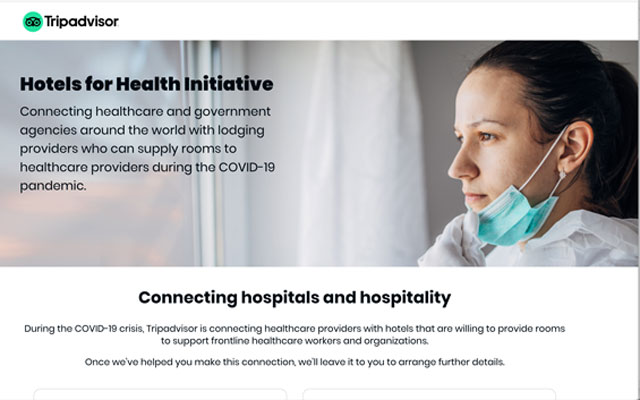
Following a trial in England, Tripadvisor will now launch its Hotels for Health programme globally to connect healthcare and government agencies with lodging providers that can supply rooms during the Covid-19 pandemic.

Tripadvisor explained that many frontline healthcare providers have been unable to return to their homes after their shift due to a variety of reasons, such as close interaction with positive Covid-19 patients, and therefore needed accommodation elsewhere.

Hotels for Health programme helps connect healthcare professionals with accommodation providers anywhere in the world

The Hotels for Health site allows healthcare providers to advise that they need rooms, and hotels to advise that they have spare rooms available. The teams at Tripadvisor will then connect the hotels and healthcare providers.

“At this challenging time, we know  can play a unique role in helping to support the accommodation needs of frontline medical workers who seek out temporary housing, and we’re pleased to ask our hotel partners to do the same,” said Kanika Soni, chief commercial officer, Tripadvisor.

“We know so many frontline medical workers can’t simply return home after work because they live with someone with a compromised immune system, so Tripadvisor is proud to offer help where possible.”

Tripadvisor will use its extensive database of over two million accommodation properties worldwide to help target bespoke lists in specific areas where there is an urgent need for beds.

Tripadvisor connects healthcare institutions with willing accommodation partners. After making this connection, the logistics and details of the lodging experience are then managed directly by those two parties (excluding Tripadvisor).

The trial was conducted with the UK’s National Health Service and select hotels in the south of England.