Bintan and Batam, the two main draws of the Riau Islands in Indonesia, are ready to restart, with safety and cleanliness protocols firmly in place, and are awaiting state authorities to lift the international travel ban.
Speaking at the Riau Island – Keeping Up and Ready for New Normal webinar, organised by Indonesia’s Ministry of Tourism and Creative Economy, Bintan Resort Cakrawala group general manager Abdul Wahab shared that there is a dedicated Covid-19 task force in Riau Islands province to ensure good hygiene and safety practices.
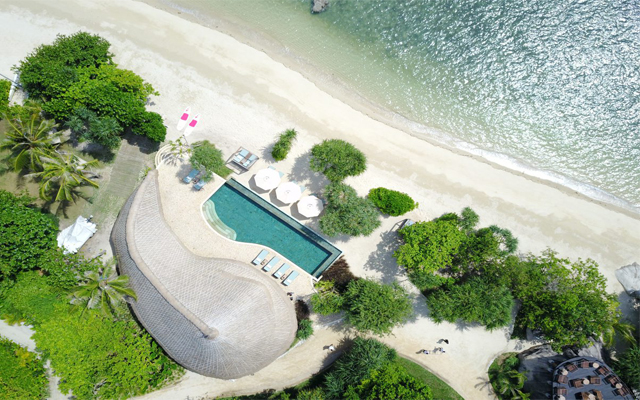
Bintan resorts scrub up in preparation for the return of tourists; Cempedak Private Island pictured
Each resort on the island has dedicated quarantine rooms, and guests will be given emergency contact numbers that will be operational 24/7, he said.
He also shared that the sea transfers to Bintan and Batam as well as all public transportations are limited to 50 per cent capacity, for social distancing purposes.
Other safety precautions include physical distancing markings at all public areas, mandatory wearing of face masks, and temperature checks at all public areas.
Andika Lim, chairman of the Association of the Indonesian Tours & Travel Agencies (ASITA) Riau Islands chapter, added: “ASITA had also organised several inspections to resorts, hotels, restaurants, shopping malls and tourist destinations to make sure all the properties had implemented cleanliness, health and safety protocols.”
When leading tours, its members have also agreed to do temperature checks, wear face coverings and use hand sanitisers, with guests expected to do the same.
Last year, the top four tourism source markets for Riau Islands were Singapore, Malaysia, China and South Korea. He expected these four markets to continue being major contributors to the province’s tourism post-Covid.
Similarly, when Bintan Resorts reopens to international holidaymakers, Abdul expected the main markets will continue to be neighbouring Singapore and Malaysia FIT tourists including families, couples and honeymooners.
According to Riau Islands’ Covid-19 report, from March to June, Bintan and Batam recorded eight and 219 Covid-19 cases, respectively.
Maldives reopened its borders to global tourists on Wednesday, welcoming its first international visitors in more than three months, comprising a group of 103 tourists from Europe and other parts of the world.
The island nation is among the first in the region to lift border restrictions, with no entry requirements. The first group of visitors arrived via Qatar Airways, among 11 carriers including SriLankan Airlines, Emirates and Etihad resuming flights to the country.
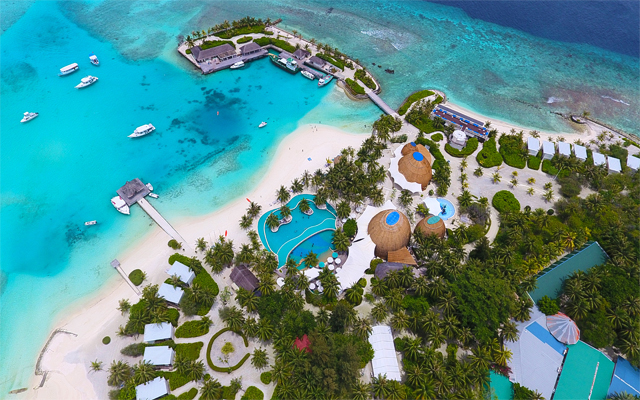
The Maldives reopens to international travellers, even as it battles a rise in Covid-19 cases
Speaking at a virtual media briefing on Wednesday, foreign minister Abdulla Shahid; health minister Abdulla Ameen; and Thoyyib Mohamed, managing director of the state-run Maldives Marketing and Public Relations Corporation; addressed the health and safety measures in place at the airport and resort islands to an audience of nearly 300, mostly journalists from Asia and Europe.
The trio noted that even if there is an increase in Covid-19 cases, it would be confined to the capital city of Male and a few other locally-populated islands.
Unlike other destinations, the over 150 resorts in the Maldives is spread in isolation across 1,190 islands, spanning 90,000km2 of Indian Ocean. Only staff and tourists are accommodated on each of the resort islands, while travel between islands is banned.
Visitors are given a 30-day free visa-on-arrival, while asymptomatic arriving passengers are not subject to any Covid-19 tests, and will be whisked straight to their resort from the airport.
All resorts will adhere to sanitation guidelines set by the Health Ministry, including having designated isolation rooms for quarantining of staff and guests if needed, social distancing measures, and use of sanitisers and face masks when necessary.
Ameen said Covid-19 testing facilities are available across the country in different locations, while a transportation system is in place between resorts and health facilities in the event a foreign guest has to be tested.
Responding to a query from TTG Asia on the bookings trend in July, Mohamed said that since at least seven international airlines are restarting flights to the Maldives from Wednesday and over the next few days, “we are assured of bookings from (July 15)”.
He added: “We see positive growth in the pattern of bookings on some (online) platforms for the upcoming months and the latter part of the year.”
As at Tuesday, the Maldives has reported 2,762 Covid-19 cases, with 2,290 recoveries and 13 deaths.
• Bali’s recovery from pandemic projected to take longer than any other crises the island has tided over
• Supply outstripping demand spells fiercer competition for the domestic market among hotels and OTAs in Bali
• Travel bubbles eyed to kickstart recovery
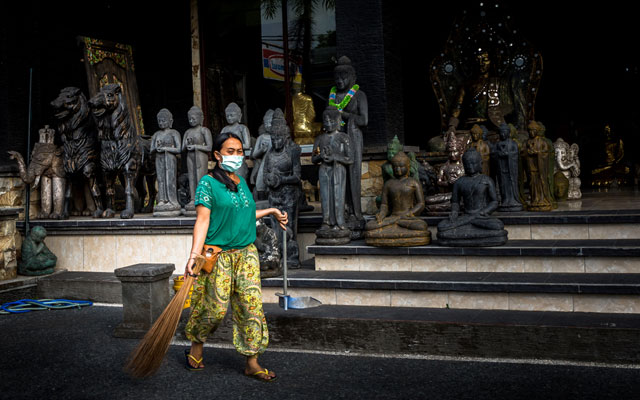
Bali’s status as a popular tourist destination comes under threat amid the pandemic; a Balinese female wearing face mask outside a store selling religious buddha statues in Bali, Indonesia pictured
Bali is no stranger to adversity, having bounced back from bombings and natural disasters. But while coronavirus hasn’t stripped the Indonesian island of its lustre among international travellers, it is bracing for a long road to recovery from the rampaging crisis, according to experts.
Speaking at the recent webinar, Bali Tourism – The Way Back, organised by Delivering Asia Communications and C9 Hotelworks, Emily Subrata, director of Sudamala Resorts, said: “Bali is fortunate to be a well-known destination across all markets. I am in Australia at the moment and Australians are missing Bali (a lot), so they will return as soon as it is permitted. I know that the first flight to Bali will be glorious.”
Similarly, Visit Indonesia Tourism Officers (VITO) in France and Germany reported in early May that major tour operators revealed that clients were still holding on to their flight tickets to Bali which they had booked before the pandemic, in hopes of spending summer in Bali should the borders reopen by then.
Skyscanner’s report on the search demand to Denpasar over a 50-day period beginning first week of March showed that search results were relatively constant, at about 26,000 per day, with a recent increase of about 2,000 to 3,000 searches daily.
Skyscanner data also pointed to a rise in redirect customers, with more users leaving the site to complete the booking with an OTA or an airline, starting the last week of May, with the highest redirects recorded in mid-June at about 1,600.
While believing that Bali retains its strong appeal among global travellers, Jasper Palmqvist, STR area director for Asia Pacific, projected the island would take longer to recover from Covid-19, as compared to past crises.
Recounting Bali’s experience with past calamities, Palmqvist said the recovery period following the two Bali bombings in the early 2000s and SARS outbreak in 2002 took between 12 and 18 months, while the impact from Mount Gunung Agung eruption in 2017 lasted only a few months.
This year, with Covid-19, Bali is in the red. “This is nothing like any other crises,” Palmqvist said.
Looking at the international market, he explained: “Australia and China (Bali’s top source markets) have said they are highly unlikely to travel outside their countries in 2020.”
Stiff competition for domestic pie
While Bali’s reopening to domestic travellers in mid-July brings hope for the island’s hospitality industry, it will likely be found wanting to plug the gap left by foreign tourists’ absence.
Palmqvist said: “The domestic market to Bali (traditionally) flocks to the south. The upscale hotels in the Kuta Legian Seminyak areas have enjoyed some 80 to 90 per cent (occupancy from the) domestic market (in the past) and might expect the return of business in Q3 or Q4. However, Ubud and Sanur traditionally are not popular domestically. The high-end international brands usually take international travellers.
“The new situation will shift competition. The larger and international brands with muscles will potentially market domestically. They will need that because the return time frame of the overwhelming part of their client bases is still unknown.”
He also projected the risk of a price war breaking out among the properties and that OTAs would be grabbing for consumer attention.
“This is not easy with the new protocols requiring social distancing and all, although this might be a selling point for some hotels, like villas, which will attract more demand,” he said.
Sudamala’s Emily also opined that the domestic market alone will not be able to sustain the sector. She said: “Those properties which traditionally do well with the domestic market will still suffer because the size of the overall pie has shrunk tremendously, yet the number of businesses wanting and needing that pie has largely increased.”
For the 34-key Sudamala Sanur Suites & Villas, which is situated in Sanur, a seaside town dominated by international travellers, making the domestic switch is no easy task, said Emily. It will require stakeholders in the area to devise programmes to attract the domestic market to the area.
The increasing supply of rooms in Bali will also affect recovery, according to Palmqvist.
“There will be about five per cent increase in supply up to end of 2021. Some projects may be delayed, but still, it will slow down the recovery even more,” he said.
“If Bali’s occupancy reaches over 30 per cent (in 2020), it will be a surprise. In 2021, if it is over 50 per cent, I will be very impressed. That will be a new normal level in the next couple of years.”
As such, he advised hoteliers not to use previous crises as a benchmark, and to prepare a new game plan in anticipation of changes in demand.
Echoing that thought is Norbert Vas, vice president business development & operations of Archipelago International Hotels, Resorts & Residences, who said that among all the regions in Indonesia the group is operating in, Bali’s performance by far has been the weakest this time round.
“The occupancy of hotels in Bali has been far below 10 per cent, many are even below five per cent. Of the 17 hotels we operate on the island, we have had to close six,” Vas said.
He added that in some other suburbs of Jakarta like Bogor and Anyer, occupancy have recently surged to between 25 and 35 per cent in June. However, occupancy at the group’s hotels in Bali stalled at three to five per cent, sustained by airline crew and government business.
Vas elaborated: “We do not see (the situation in Bali) getting better anytime soon (or) the international market coming back soon. And with the confusion among domestic travellers on the different regulations, such as the different kind of tests (they must take) when travelling by air or sea, travellers are likely to postpone their trips until (they get the all-clear).”
In the meantime, Archipelago is managing its cash flows by reviewing operations at each property, renegotiating contracts with suppliers, and asking hotel owners to postpone fee payments until later in the year.
Travel bubbles eyed to revive tourism
Some efforts by the regional and central governments to speed up the recovery process are underway.
The Coordinating Ministry of Maritime and Investment Affairs recently announced that the government is working on creating travel bubbles with China, South Korea, Japan and Australia, targeting business and investment opportunities.
Commenting on the move, Fransiska Handoko, government relations director of Bali Hotels Association, said: “Bali and Indonesia are ready for travel bubbles. However, the rest of the world still sees Indonesia as a high-risk country, so these plans are still in the discussion stage. It may be more logical to form travel bubbles within South-east Asia because of the shorter travel times. But we are still observing how the situation will evolve.”
The idea to create travel corridors has also been mooted by Indonesian ambassador to Germany, Arif Havas Oegroseno.
Speaking at the Road Map to Bali’s Next Normal webinar, organised by Bali Tourism Board, Havas said: “(To kick off travel movements), we can create a travel corridor between Germany and Bali, focusing perhaps on Nusa Dua Area with a chartered flight.”
He added that to facilitate that move, travellers have to present a negative Covid-19 test, and there has to be an immigration officer on board to check documents. Travellers should also get a guided, seamless service through the airport, a direct transfer to the hotel, and in-room check in.
TTG Asia understands this proposal is under study at press time.
Bali governor on July 5 announced the destination would be ready to reopen to international travellers from September 11, but at press time, the trade is still waiting for the central government to announce the border reopening dates and policies to start sales.
Hotels signed up with Agoda under TAT's TTogether initiative will be promoted on its dedicated platform
The Tourism Authority of Thailand has partnered Agoda to leverage the latter’s technology and marketing expertise to streamline the booking and payment process for participants in the government’s 20 billion baht (US$482 billion) TTogether domestic tourism stimulus programme.
The partnership is also supported by Ministry of Tourism and Sports, Fiscal Policy Office, Ministry of Finance, and Krungthai Bank.
Hotels signed up with Agoda under TAT’s TTogether initiative will be promoted on its dedicated platform
As part of the initiative, the government will subsidise five million room nights at participating hotels by 40 per cent of room rates, limited to 3,000 baht per night, for up to five nights per person. From July 15, 2020, travellers can register to join the TTogether programme on the official website. Once registered, they can book via Agoda mobile app from July 18, 2020, 06.00.
For hoteliers, Agoda’s automation of processes will allow them to manage bookings more efficiently. Agoda’s technology simplifies participation in this initiative by making it easier to receive payment quickly for the room, and reducing manual steps in the eligibility verification process.
Hotels signing up with Agoda will be marketed and supported via Agoda’s dedicated platform, www.agoda.com/ttogether, which can help distribute tourism spend into destinations outside of major tourist hotspots to benefit the wider Thai tourism market.
With border restrictions keeping foreign tourists at bay, Singapore operator Monster Day Tours is aiming to keep tour guiding alive by launching a double whammy of products targeting the domestic market.
This comes after Singapore opened applications for small local tours to resume, provided they meet a set of health and safety guidelines and limit their groups to five guests.
Homebound travellers on Virtual Bingo Tours get to traipse around Singapore, while playing games to win prizes
From July 25 to August 31, 2020, Monster Day Tours will run a series of SG55 Walking Tours, in conjunction with the country’s 55th National Day. Aimed at helping local guides who have lost their income during the pandemic, these tours will be conducted in places of interests such as Chinatown, Little India and Marina Bay Sands, alongside a separate arrangement for food tours. Each group tour will cost a flat S$55 (US$40) for up to five guests, with all proceeds going towards the guides.
“Our guides have essentially seen their entire income stream disappear, and we were worried that many of our excellent guides were reconsidering guiding as a viable career option. We hope this initiative will help to raise awareness for their situation among the local community. Mentally, we also want to generate a positive attitude towards the recovery of travel, and encourage the guides to start honing their skills again,” said TY Suen, founder & CEO of Woopa Travels, the parent company of Monster Day Tours.
The agency is in discussions with hotels to include the SG55 tours as part of their staycation packages. To encourage sign-ups, the company will also sponsor a S$10 Grab voucher for each booking, and two free tickets to its new Virtual Bingo Tours.
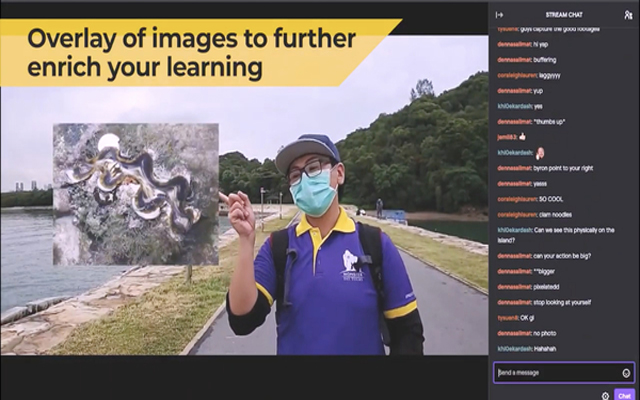
The Virtual Bingo Tours, launched this week, targets consumers who wish to explore Singapore from the comfort of home. On these tours, which are hosted on Zoom, participants will follow a guide on livestream through a unique part of Singapore, while playing games to win prizes.
Each ticket is priced at S$10, and participants stand to win a variety of prizes, including the grand prize of S$1,000. The first tour, covering the one-north district, will be held on July 18 and 25; the second will visit Gardens by the Bay, with dates to be announced. More attractions, including a Changi Airport and Jewel tour as well as behind-the-scenes visits, are being developed.
Suen shared: “Many of the existing virtual tours we tried did not feel engaging enough as they were either pre-recorded or self-guided tours. To stay true to the ‘live’ nature of tours, we decided to launch a new type of experience and gamify the tour – something we’ve always wanted to do as well.”
While the virtual tours are primarily aimed at the local market, Monster Day Tours will also engage the overseas market through paid marketing, digital ads as well as the Singapore Tourism Board.
Delivering Group, which provides strategic consulting services to the hospitality and tourism industries around the world, has launched a suite of customised services that will help organisations in Asia-Pacific plan and manage their recovery from the ongoing impacts of the pandemic.
Aptly named Good to Go, the initiative offers a wide range of services, including planning, marketing, Artificial Intelligence and chatbot solutions, sales, and resourcing.
From left: Mark Simmons and Michael Yates
Delivering Group’s co-founder Mark Simmons said Good to Go was developed in response to sector requests for assistance with recovery plans.
“We can help identify emerging market opportunities and segments. Then, when the timing is right, develop and execute specific actionable, deliverable plans to leverage those opportunities. This will include a mix of integrated online and offline campaigns, traditional and social media engagement and resourcing, and senior account sales management in the leisure and corporate sectors with the clients. Plans are customised to suit the needs of clients with tiered levels of investment,” Simmons detailed.
He noted that business opportunities are starting to emerge in Asia-Pacific, where there has been “a gradual reopening of domestic travel in Asia-Pacific markets such as China, South Korea, Japan, Taiwan, Malaysia, Vietnam, Thailand and New Zealand, as well as limited intra-regional travel which will increase”.
As the same time, Europe had opened its borders to 14 countries, including several in Asia-Pacific, and that governments in the region were engaging in bilateral discussions about safely resuming two-way travel.
“Singapore has established a green lane with China and is looking to do the same with others in the region. South Korea and China initiated a fast-track plan for business travel between designated cities and Australia and New Zealand are considering options for a Trans-Tasman bubble,” Simmons said.
Although the pandemic is likely to continue in the short to medium term, Simmons believes that it is important for destinations, airlines, hotels, cruise operators, attractions and other industry players to have recovery strategies in place so they can pivot quickly as opportunities emerge across the region.
“They need to be ready to act, as and when it is safe to do so. We have the knowledge and connections to help,” he stated.
Fellow co-founder Michael Yates, a central player in the successful Project Phoenix campaign with PATA which revitalised travel to the region following the SARS outbreak in 2002 and 2003, said China would be a crucial part of any recovery strategy for organisations in Asia-Pacific, in addition to other key source markets in the region.
“We are fortunate to have a very strong team based in Beijing, which is already working on recovery plans for travel clients, such as Celebrity Cruises, and has the expertise and connections to design and execute campaigns that deliver results,” Yates said.
Delivering Group is represented in Hong Kong, Singapore, Bangkok, Beijing and New York, with other founders being Ming Yue who leads in China and Joe Cauchi in North America.
A host of online travel companies, including Agoda, Airbnb, Booking.com and Expedia Group, have come together to form the Asia Travel Technology Industry Association (ATTIA), which aims to encourage closer cooperation between governments and the industry to create consistent cross-border travel protocols for Asia-Pacific’s tourism recovery.
ATTIA chair, Ang Choo Pin, said in a statement: “Movement of people is important to kick-start tourism and regional economies. The Asia region is prepared to lead the way globally in rejuvenating the travel economy post-Covid-19 pandemic.
“Currently, there is uncertainty and inconsistency around pre-travel and arrival protocols, as well as health and hygiene expectations across borders. This makes it hard for the industry to plan forward and ramp up quickly. A framework that articulates agreed criteria for cross border travel-flow in the region could help simplify a complex challenge for governments, industry and travellers.”
Prior to Covid-19, Asia-Pacific was the fastest growing region for travel, according to 2019 data. Travel and tourism is a key pillar of Asia’s economic recovery. Travel and tourism generated US$2,971 billion towards Asia-Pacific’s collective GDP, representing 10 per cent of the region’s economy, and growing by more than five per cent year-on-year.
As such, ATTIA believed that governments should work multilaterally and in close collaboration with each other and industry players to agree on a framework to facilitate tourism recovery in the region.
This could include a set of internationally recommended health and hygiene guidelines for the accommodation sector to set expectations for governments, bring clarity to industry and allow for implementation at scale, in order to build consumer trust and confidence in travel.
ATTIA also called for agreed and transparent criteria between governments and the industry when considering or planning for open borders and intra-regional ‘travel bubbles’, including a set of simple steps offering clear information, and which endorse rigorous pre-travel Covid-19 testing, and over time, agree on traveller vaccination evidence requirements.
While applauding early steps towards ‘travel bubble’ and ‘green/clean route’ creation by some nations and states, ATTIA championed further collaboration and transparency of health and hygiene requirements to enable governments and industry to plan forward with greater confidence.
In addition, ATTIA also urged a re-visit to visa facilitation and visa-waiver progress lost during the Covid-19 pandemic, noting prior to the crisis, the combination of visa facilitation and improved online connectivity helped spur travel demand in the region.
ATTIA also encouraged governments to leverage the ability of its members to coordinate conversations and as a resource for accessing consumer insights in the region and from global learnings, to inform and guide forward planning, and ultimately champion agreements to industry and a world of travellers.
Ang concluded: “If we work together, we can present a unified post-pandemic position on rigorous travel criteria for Asian nations on the global stage, unlock access to much-needed revenue and employment in the region, and ensure Asia’s digital tourism economy continues to grow and thrive for the benefit and well-being of its citizens.”
PATA, with the support of the Asian Development Bank, has launched the expanded PATA Crisis Resource Center (CRC) to aid in the recovery of Asia-Pacific’s travel and tourism industry.
PATA chief of staff Trevor Weltman said: “The tools, expertise and resources kits now available on the CRC will assist all tourism actors in the Asia-Pacific region to better understand where they currently are in their recovery journey from Covid-19, and ultimately help them prepare the important next steps they will need to advance their recovery efforts.”
The CRC is a digital resource that was launched by PATA earlier this year in response to its members’ urgent need for crisis leadership and trusted information during the initial stages of the Covid-19 outbreak.
PATA said in a statement that the long-term vision of the CRC “is to lead, coordinate and sustain a comprehensive world-class digital resource for crisis response, management, and recovery for the Asia-Pacific travel industry”.
The CRC provides action-oriented interactive multimedia content that is focused on crisis preparedness, management, and recovery for destinations and other tourism enterprises across the Asia-Pacific. While the site was designed for DMCs in mind, the content is directly applicable to businesses of all types and sizes across the tourism supply chain.
Among the resource’s features is the PATA Recovery Planner, a guidance tool that allows tourism organisations to create a personalised Covid-19 recovery plan. Using information fed by users about their destination’s current Covid-19 situation, the tool will create a destination specific recovery plan and highlight the available resources that can assist the organisation and its stakeholders at this time.
Flight Centre Travel Group has teamed up with Sydney-based technology firm Livn to introduce a world-first booking process for the tours and activities sector.
The move to connect Flight Centre to its supplier base using a single application programming interface (API) will bring the sector in line with the real-time booking capabilities that have been available in the aviation and hotel industry for many years.
Flight Centre partners technology platform Livn to streamline the booking process for tours and activities
Breaking the news first to TTG Asia, Livn CEO Mark Rizzuto said the development is expected to significantly change operations for one of the world’s largest travel agency groups and its partners to provide automated efficiencies and increase sales.
“Up till now, the industry has struggled to gain access to live inventory,” said Rizzuto. “Travel agents still have had to make phone calls or go on their suppliers’ websites to make the booking.”
“(With the API), Flight Centre is able to book the Sydney Bridge Climb within a few hours of departure. This functionality is not always apparent on other platforms like Viator, where the product can disappear in the last 48 hours before consumption,” he added, pointing out that 53 per cent of day activities were booked 72 hours before usage by the consumer.
Automation to give Flight Centre “a massive shot in the arm” against rivals: Rizutto
Rizzuto envisions a ripple effect that would see cheaper experiences increase their bookings.
He elaborated: “Generally speaking, in the past, when consultants were approached with a budget, they would have probably gone for a high-ticket item like a cruise down the Nile for US$2,500 rather than a camel ride around the pyramids costing US$150 because the lower ticket item was too hard to book. But now, I’m going to argue the consultants will be able to offer and book these experiences as easy as the high-ticket items.”
“Also, we believe that while tourism recovery will be led by aviation with some brilliant fares, the tours and activities sector will be next, as cruises and extended (group) touring will experience a slower return. This automation will give Flight Centre a massive shot in the arm against its competitors and Flight Centre can expect a significant increase in volume of sales.”
He further stressed that unlike its competitors, Livn is an open connectivity hub that does not interfere with the existing commercial equation between agencies and their suppliers, making it an industry solution.
Flight Centre will complete transferring its tours and activities inventory online by 1Q2021, making the API operational in the group’s operations with more than 2,000 leisure, corporate and wholesale businesses in 11 countries including several in Asia.
Correction: This interview has been edited for clarity. In the original post, we wrote that Flight Centre is able to book the Sydney Bridge Climb at an hour’s notice. This is incorrect, and Flight Centre can instead make the booking within a few hours of departure. We also incorrectly stated that this can’t be done via other platforms like Viator; it can, but this functionality isn’t always apparent on other platforms.
Melvyn Yap is now the director of Thread Asia, a new boutique sales and marketing representation agency for DMCs, bespoke hotels and resorts, and destinations in the region.
He is a co-founder of the company, along with industry veterans Connie Lai and Emileen Yeo. Lai holds the role of director while Yeo is advisor.
Yap boasts more than two decades of experience in the luxury end of the tourism industry, and is regarded as one of the pioneers in building up the cruise industry in Asia. He spearheaded Silversea Cruises, Regent Seven Seas Cruises, Carnival Cruise Line and Costa Cruises’ entry into Asia.