Tourism is such a wonderful industry. As a reporter working in and writing about this industry, I have had many first-hand opportunities to see how this industry has shaped the lives of many around the world, whether it’s improving livelihoods, preserving traditions or opening borders and minds alike.
But if there’s one nagging thought, it’s that I’m one of the 1.8 billion travelling masses who are complicit in enjoying the spoils of tourism and stretching infrastructure to breaking point.
McKinsey & Company’s senior partner Alex Dichter, at the recent WTTC Global Summit in Bangkok, drove home the point when he pointed out that the fault doesn’t lie in the number of tourists around the world. Rather, it’s that “tourists come from everywhere but they don’t go everywhere”.
When tourism to a destination booms, crowds soar and often the crush of visitors disrupts local residents’ lives – including wildlife. Famous cases in point: Venice and Machu Picchu. Nearer home, there’s Koh Phi Phi, Beijing’s Forbidden Palace, Angkor Wat and the list goes on.
The downside of tourism boom became more apparent to me during a recent trip to Penang to visit my maternal uncle and his family. In the two decades that I’ve been visiting him, the latest trip was the first time I heard him grousing about tourists in his hometown.
When we were stuck in traffic behind tourist buses at Gurney Drive, he lamented that the famed seaside promenade had become a tourist trap offering street food at inflated prices. When we craved for cendol on a sweltering afternoon in Georgetown, we were dismayed by the snaking queue outside a particular stall. My uncle assured me the stall next door was just as good but saw fewer tourists because it wasn’t propelled to social media fame by bloggers and foreign websites. (True enough, he was back in the car with eight packs of cendol minutes later.)
While overcrowding is not yet a dire issue for Penang’s tourism, the fear that visitors who once kept the local traditions and livelihoods alive are also now slowly destroying them is becoming a valid one. And when that happens, the soul of a destination will be lost.
The challenge – and hard work – thus lies in finding the balance. City officials or tourism authorities must not blindly chase the economic benefits of tourism without proper management plans or guidelines drawn up to manage visitor numbers. Sustainability and responsible stewardship must be at the forefront of any tourism management policy to deliver smart and strategic growth.
What can we do to travel sustainably? I’ll adopt my uncle’s cendol mantra – don’t follow the crowds. Also, why not give popular destinations a break during their high-season months and visit during their off-peak periods to disperse visitation more evenly over the year? Share the love, spread the money and spare the footfalls.
Booming tourism worldwide has sparked a debate if its undoubted benefits are now outweighed by less quantifiable downsides. Xinyi Liang-Pholsena takes stock of the dilemma and sees what needs to be done
Bali’s Tanah Lot, also known as the Temple of Sea, encounters a daily surfeit of tourists
Can tourism be too much of a good thing? The answer is yes if its stakeholders aren’t careful. A whole session was devoted to this question at the 17th WTTC Global Summit in Bangkok in April, which had a strong focus on sustainability. UNWTO has designated 2017 as International Year of Sustainable Tourism for Development. In support, WTTC has launched a campaign, ‘Is it too much to ask?’, urging industry players to think about how they could transform their business and make a difference.
Balancing unprecedented tourism growth and protecting vulnerable destinations and valuable tourism goods is an old debate that has become more pressing. Just look at anti-tourism sentiments in Barcelona, or question marks over cruises’ impact on sinking cities like Venice, or countless examples of how arrival increases have outpaced infrastructure growth.
The consensus among panelists and speakers during the session was that a greater emphasis must be placed on the management of tourist destinations to prevent them from becoming a victim of their own success.
Alex Dichter, senior partner at McKinsey & Company and who’s currently working on a report assessing tourism’s impacts on destinations, remarked: “First of all, the 1.8 billion tourists are not going to be a problem per se if the everyone just agrees to swap cities when they travel – we’ll be fine. The issue is that tourists come from everywhere but they don’t go everywhere.”
The effects of over-tourism, whether it’s at historic sites like Angkor Wat and Machu Picchu or popular destinations such as Barcelona and Venice, are all too apparent, he pointed out, causing enormous strain on the attractions themselves and the infrastructure and public transport, creating resentment among the locals.
The “tragedy of commons” is hence an issue the tourism sector has to worry about, added Dichter, underscoring the importance of destinations to manage their carrying capacities as only 96 of 229 natural UNESCO sites in the world have tourism management plans.
In South-east Asia, huge inbound tourist numbers have clearly outpaced the development of eco-friendly infrastructure in many places. Halong Bay is a prime example, observed TP Singh, deputy regional director, Asia, International Union for Conservation.
Jamaica’s minister of tourism Edmund Bartlett thinks that “greediness and ignorance” had in the past clouded many governments’ vision as they pursued the economic benefits of tourism without exercising proper judgement and management.
“We just wanted ships to come in, planes to arrive and hotels to be built, but we didn’t pay much attention to carrying capacity and key sustainable issues that will make tourism last,” he said, commenting on the earlier days of Jamaica’s tourism development.
Silver lining
A silver lining in recent years is that more countries are giving recognition to the industry by structuring tourism as a stand-alone ministry or appointing cabinet ministers to lead development and tackle related issues, he noted. At the same time, guidelines, EIAs (Environment Impact Assessments) and legislation have to be developed and put in place, he elaborated.
The onus also lies with governments and corporate companies alike to take responsibility for growth and industry development, said Christine Duffy, president of Carnival Cruise Line, citing public-private “partnerships” as an example of a positive tourism driver in areas like new cruise terminal development.
While cruise lines have often been portrayed as villains in the tourism landscape with their ever-growing portfolio of bigger ships, Duffy insisted that Carnival has been a responsible corporate player by voluntarily bringing a stop to ships exceeding 96,000 tonnes to Venice as it seeks measures to limit tourist numbers.
Cruise lines have also played a part in shifting visitor footfalls to diverse as well as lesser-known spots, such as Bari in southern Italy, which are often included together with marquee destinations like Venice on cruise itineraries, she added.
This view is also supported by Dichter, who agrees that cruise tourism takes pressure off existing ports and introduce travellers to new destinations. As well, the growing quest for “experiences” among travellers, say, through walking food tours organised by small entrepreneurs, will help to spread tourism and wealth from beyond key sites, he added.
Beyond talk, more actions
What’s heartening for Maria Damanaki, global managing director, oceans, The Nature Conservancy, is the greater dialogue and emphasis given to sustainable tourism. “Sustainability was not (considered) a challenge in tourism sector events like this (WTTC Global Summit) 10 years ago. It’s easy to put the blame on politicians and say governments are not doing their job.
“We – and I mean the private sector and citizens – can do our own part and bring the value of nature inside our thoughts. I’d challenge the tourism sector to be the leader and incorporate the value of nature into your investment plans,” she urged.
Damanki suggests that beachfront hotels, for example, could do more to protect the coral reefs fronting their properties not just for attracting guests with diving activities but also an avenue to maintain biodiversity and protect the shoreline.
“Climate change is the biggest challenge to Venice, not tourism. If sea levels go up by two cm, there’s no Venice!” she exclaimed, pointing to the bigger elephant in the room.
Borrowing a line from Charles Dickens’ A Tale of Two Cities, the outgoing secretary-general of UNTWO, Taleb Rifai, said that although “we live the worst of times and the best of times”, tourism can be transformative and make the world a better place.
“We all need to ensure that, as our sector grows, it contributes to the wellbeing of the world and not to its peril. Tourism must fulfil its responsibility to contribute to all 17 universal Sustainable Development Goals,” he said at the opening ceremony of ITB Berlin this year.
“Unlike many problems where we are observers, people in this room have the power to effect change,” surmised Dichter, urging travel industry members to become positive forces of change.
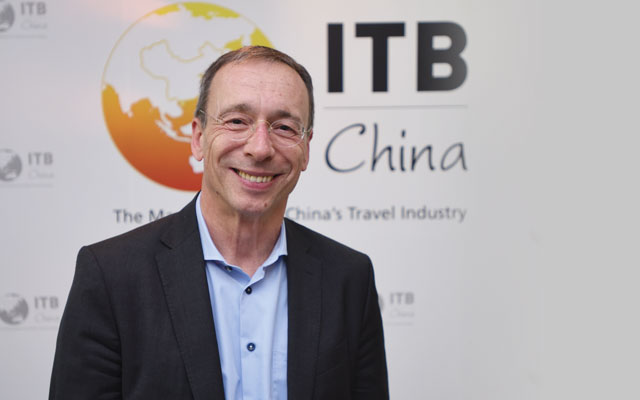
Easy to grow an established brand like ITB that has 51 years of history behind it? Trust the Germans to be prudent and never taking anything for granted. Messe Berlin’s senior vice president travel & logistics, Martin Buck, tells Raini Hamdi about ITB’s brand strategy following the successful staging of the first ITB China recently
Were you surprised that ITB China sold out ahead of the event?
Actually no, because that was reason we started the project at all. We saw that the Chinese market had incredible potential on the one hand, but on the other hand the shows that were already available in China left some room for improvement. So based on the analysis of the competition, we decided to bring the ITB brand to China and, from the response, it was obviously a success.
(The three-day show occupied 12,000m2 of space in the Shanghai World Expo Exhibition and Convention Centre. Some 600 exhibiting companies from nearly 70 countries participated. There were around 600 Chinese buyers, almost all hosted, and an additional 100 international buyers who joined on their own accord. Source: ITB China)
In that analysis of the competition, what major gaps did you see?
Particularly the availability of professional buyers.
The right buyers are the ingredients to make a show work. There are many shows that have the suppliers, but a significant lack of the demand side. And since launching (ITB Asia) in Singapore we have developed a certain proficiency in bringing the two (buyers and sellers) together, so we said, why not go to China and try it there as well, since China is such a big market and there is demand, especially for outbound travel products. As you know, the outbound market has been rising and will continue to rise.
How easy was it for you to get the right Chinese buyers?
Not easy at all, and that’s probably the reason why the others don’t have so many buyers. This again has to do with having the expertise in drilling a hole into the market, so to speak, to understand how it actually works. It also has to do with the network you have, and the partnerships you manage to develop. Certainly what contributed to our success (in getting the right buyers) is our partnership with Travel Daily China, because they are extremely well connected in this market.
Would this mean then that there would not be Chinese buyers at ITB Asia in Singapore?
Not at all. You see a growing number of Chinese buyers due to the rapid development of whole industry. Some of them can easily go to Singapore; others just cannot, due to reasons such as time and budget. Another important factor is what they want to buy.
We are a marketplace. You sell your tomatoes at the place where there are people who want to eat those tomatoes. There are different exhibitors (i.e. different tomatoes). And our mission certainly is to cater to the different needs of our customers. You could say ITB Asia is one option, ITB Berlin is another and now we finally have managed to create the third option.
There are two directions we take. One is to improve the existing shows by continuing to deliver the right services, etc, and the other is to establish a new show the moment we see there is a big part of demand that isn’t covered yet. ITB China is one further step in our brand strategy to add or establish a new marketplace where one is needed, according to our view and judgement. We are happy it wasn’t just our imagination, that indeed we’ve filled a gap.
This first show spanned some 12,000m2. What do you foresee for next year?
We have early feedback from several exhibitors who want to expand their participation, but it remains to be seen how much additional space we will put into the game. It also depends what the venue provider can offer. This is a good venue (Shanghai Expo). We are happy with them, we hope they are happy with us. But if you just walk up to upper floor, you can see the jewellery fair… they obviously have high demand from other shows, which also makes it kind of difficult to say at the moment what space will be available for us. We will define this more precisely in the months to come, but based on early feedback we can be hopeful to grow ITB China significantly.
How huge can ITB China get to, given that China is such a huge market?
It’s a continent and there is an incredible number of dramatically growing cities but I’m a little hesitant (to predict how large ITB China can be one day). Our industry is a vulnerable business. We have to be optimistic, but we’re also living in times that are more insecure than they were three, five or 10 years ago.
I remember when we did our first interviews, we talked about stuff like the tsunami, or an isolated assault in Tunisia or Spain. But it was always isolated and an incident would happen over a period of 12 months. Now we have such a dramatic increase in frequency of incidents. We now talk about the geopolitical landscape, how certain destinations can easily fall out of the picture, etc. The world is changing. We have to stay flexible; we have to be cautious with capacity and space.
Secondly, many sectors of the industry, especially hospitality, have seen consolidation. So even if you have two or three exhibitors who have registered to come to our show, if they are being bought, it is not likely they will take three stands just to make us happy; rather, we may end up with only one.
What lessons did you take from the first ITB China?
The Chinese market works differently from the market in Europe. China is a world in its own right. It is also extremely innovative, especially with communications. Look at the degree of penetration WeChat has.
Here, there’s no Google, Amazon, Facebook. Will we end up in a world where there’s Google on the one hand and Baidu on the other? Will we see one ‘winner’, a fusion or a co-existence (of players)? No one knows yet.
We had Ctrip’s CEO (Jane Jie Sun) speaking at the conference. In the Western world, you have Expedia, Booking.com, etc. In some ways, they are both trying to be active in the market of the other. We also had TUI’s CEO Fritz Joussen as a speaker. TUI and Ctrip are two different galaxies in the way they define and distribute products! Not that one is right or the other is wrong.
So it’s all fascinating and exciting and if we manage to continue this way of presenting current developments, if we are the platform where these developments become visible, then we can be happy. Content is important, which is a success factor for ITB, but it works only if we manage to bring in the right people who can speak in front of an audience.
How can ITB China strengthen ITB Asia and ITB Berlin?
The basic idea for us is a brand-based strategy. It’s a nice surprise to see the ITB name has actually grown in reputation and it helps us to become credible to players here. ITB China is like a window to the other ITBs for the Chinese. It might be the first step for many of them to be aware of ITB and, bearing how fast their industry is growing, they can also participate in Singapore and Berlin.
Will you be launching ITB India next?
No. It’s difficult to find the right partner, that’s the most important reason. I believe India, like China, bears huge potential, it should never be underrated. We’ve been trying for some time. For us we have to safeguard certain quality standards. We haven’t found the place in India yet where this can be come true. We would be one of the first to take the opportunity if it were available, but it’s still not available.
A group of 44 Thai OTAs and attractions have banded together to set up the Online Tourism Club (Thailand) to beat back online competitors in China that are undercutting prices to attract customers.
According to the club’s president, Nipon Boonmasuwaran, some Chinese OTAs were reselling tourism products in Thailand at prices 15 per cent below costs, which significantly affected Thai OTAs’ competitiveness and price structures.
TAT’s Yuthasak Supasorn and Srisuda with Online Tourism Club’s (Thailand) Nipon (upper row, centre three) and members
Chinese OTAs were undercharging prices to increase their bargaining power and building customer databases, with some even manipulating financial statements to the stock markets, he said.
“Setting aside the zero-dollar tour problem, we think this issue will have impacts on Thai tourism in the future,” Nipon said, who led the club’s members to meet with the Tourism Authority of Thailand (TAT) representatives yesterday to discuss solutions.
Srisuda Wanapinyosak, TAT deputy governor for international marketing, said the NTO was keen to solve the problem for the sustainable growth of tourism in Thailand.
Late last year, the Thai government had introduced measures to ban zero-fee tours that affected the Chinese group tour market to Thailand. The emergence of price undercutting now hits the Chinese FIT market.
The number of FITs from China to Thailand accounts for 60-70 per cent of total Chinese arrivals (8.7 million visitors in 2016) to the country. It is also a market segment that both Chinese and Thai OTAs are targeting as more Chinese travellers seek out travel and hotel bookings via online channels.
To address this issue, Srisuda said TAT and local OTAs are planning roadshows in China’s three main cities, namely Shanghai, Beijing and Guangzhou, to meet with their Chinese counterparts and convince the latter to abolish undercutting policies.
An MoU will also be proposed to five major Chinese OTAs, she revealed.
The Singapore Tourism Board (STB) has served a notice to revoke the travel agent licence of MISA Travel for “(ceasing) to carry on the business of a travel agent and being unable to fulfil its obligations towards customers”.In a statement, STB advised affected consumers to contact MISA Travel regarding the status of their booking or seek a refund. In the event that the agency cannot be reached or fails to provide the relevant service or refund, consumers with applicable travel insurance should approach their insurance providers.
Those not covered by travel insurance can approach the Consumers Association of Singapore or the Small Claims Tribunal, STB said.
STB also stressed that consumers should take precautionary measures such as purchasing travel insurance that covers unforeseen events such as travel agent insolvency and making instalment payments.
The Singapore Tourism Board (STB) has served a notice to revoke the travel agent licence of MISA Travel for “(ceasing) to carry on the business of a travel agent and being unable to fulfil its obligations towards customers”.In a statement, STB advised affected consumers to contact MISA Travel regarding the status of their booking or seek a refund. In the event that the agency cannot be reached or fails to provide the relevant service or refund, consumers with applicable travel insurance should approach their insurance providers.
Those not covered by travel insurance can approach the Consumers Association of Singapore or the Small Claims Tribunal, STB said.
STB also stressed that consumers should take precautionary measures such as purchasing travel insurance that covers unforeseen events such as travel agent insolvency and making instalment payments.
Hotelbeds Group has announced its intention to step up commitment to China, now its fastest-growing source market and fifth biggest globally, up from 22nd place just five years ago.
Speaking at the recent MarketHub Asia event in Bangkok, global sales director at Hotelbeds Group, Sam Turner, commented: “China is our fastest growing source market and a top priority for growth over the next few years – the potential is huge, by many measures the Chinese are already the number one traveller globally and yet only six per cent of them hold a passport.”
Besides sourcing and contracting accommodation, Hotelbeds has also recognised the need localise payment solutions through social media platforms like WeChat to match the rising demand and sophistication of Chinese travellers, Turner observed.
The global bedbank has also rolled out technology solutions for a market that is deemed “one of the most advanced” in the world, he added, citing its APItude Cloud as an example.
Turner commented: “But it is no longer just outbound international bookings, we are seeing increasing demand internationally for China as a destination and therefore we are looking to significantly increase our hotel offerings in the country over the next 12 months.”
From its current 200 employees across China, the group is also looking to increase its staff strength in the country across its various brands, including both Hotelbeds and Bedsonline, as well as its destination management brands such as Pacific World and Destination Services.
On the back of a strong first quarter, Marriott International says 2017 will be marked by continued growth momentum with nearly 80 hotels targeted to open in Asia-Pacific, bringing 19,000 new rooms to the region.
Among the new Asia-Pacific hotels coming online are 16 new resorts, including The Ritz-Carlton Langkawi, Courtyard by Marriott Siem Reap and the Fiji Marriott Resort Momi Bay.
Bangkok Marriott Marquis Queen’s Park
This year will also see the debut of two Marriott brands in Asia-Pacific with the opening of Moxy Tokyo and Delta Hotels by Marriott Shanghai Baoshan, which will bring its total number of brands in the region to 23.
Craig Smith, president and managing director for Marriott International Asia Pacific, said: “This is already shaping up to be a great year for Marriott across Asia-Pacific. We are looking at nearly 80 new properties slated to open their doors this year, which means an average of two hotels a week from now till the end of the year.”
As well, Marriott expects to create over 20,000 jobs and employ over 140,000 associates at its company-operated and franchised hotels in Asia-Pacific by end-2017.
In China, Marriott is working closely with over 150 hospitality schools and colleges through internship programmes to help youth launch their careers in Asia’s booming hospitality industry. It will also look to foster a partnership with the Asian University for Women in Bangladesh, with plans to be laid out in mid-2017.
Following a landmark merger with Starwood last year, Marriott now has over 550 operating hotels and more than 170,000 rooms in Asia-Pacific, with an additional 500-plus properties expected to open by 2021.
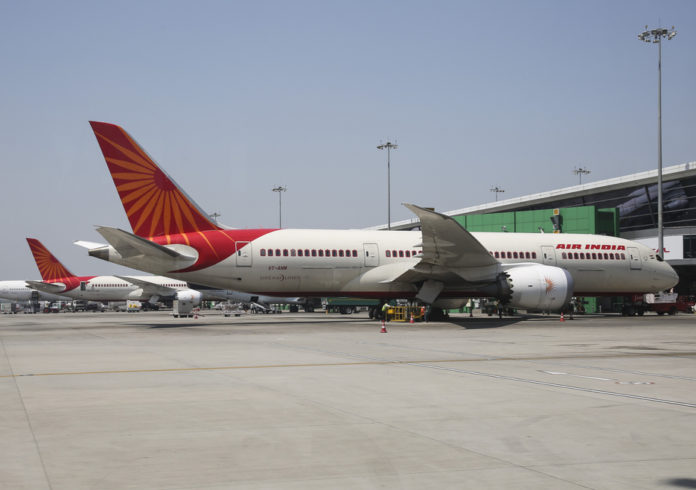
India’s Central Bureau of Investigation (CIB) has filed cases against unidentified persons from the Ministry of Civil Aviation, Air India and others for suspect decisions made under an earlier government regime that resulted in heavy losses for the state-run airline.
One case relates to the slashing of profit-making Air India routes in favour of national and international private airlines.
Other allegations concern the purchase of 111 aircraft for national airlines costing about Rs700 billion (US$10.9 billion) to benefit foreign aircraft manufacturers; and the leasing of large number of aircraft without due consideration, proper route study and marketing or price strategy. It was also alleged that the aircrafts were leased even while aircraft acquisition was ongoing.
The CIB is also investigating the merger of Air India and Indian Airlines, which caused losses to the national exchequer.
Meanwhile, the Narendra Modi government is mulling divesting government stake in the loss-making Air India, which is surviving on a nine-year bailout package approved by an earlier administration in 2012.
InterContinental Hotels Group (IHG) has appointed Serena Lim as vice president, development, in South-east Asia and South Korea.
Based in Singapore, Lim will oversee the group’s expansion in South-east Asia and South Korea by identifying and orchestrating strategic growth opportunities.
The hospitality veteran has more than 20 years’ experience in hotel development, strategic planning and feasibility. Prior to joining IHG, she was most recently regional vice-president at Marriott International and earlier vice-president in development and strategic planning at Starwood.



 Tourism is such a wonderful industry. As a reporter working in and writing about this industry, I have had many first-hand opportunities to see how this industry has shaped the lives of many around the world, whether it’s improving livelihoods, preserving traditions or opening borders and minds alike.


 Were you surprised that ITB China sold out ahead of the event?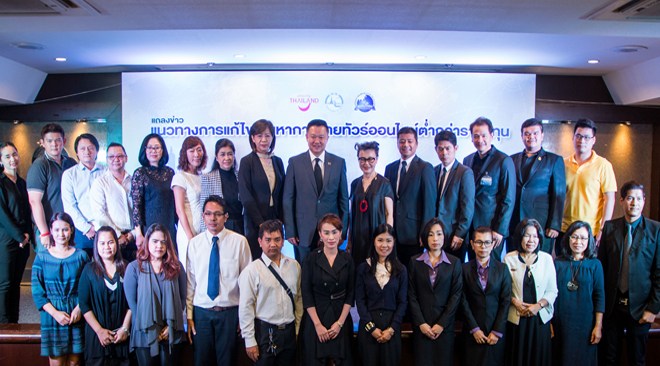
 TAT’s Yuthasak Supasorn and Srisuda with Online Tourism Club’s (Thailand) Nipon (upper row, centre three) and members
 In a statement, STB advised affected consumers to contact MISA Travel regarding the status of their booking or seek a refund. In the event that the agency cannot be reached or fails to provide the relevant service or refund, consumers with applicable travel insurance should approach their insurance providers.

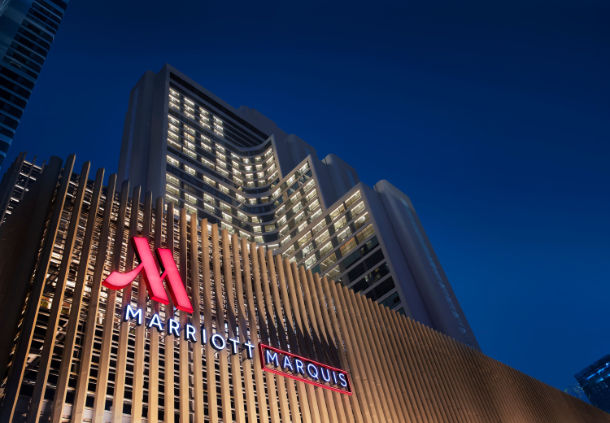
 Bangkok Marriott Marquis Queen’s Park