Cebu Pacific Air has opened its first branch office in Japan to serve as the hub for all its activities and business transactions in the country.
Heading the office in Chou-ku Tokyo is Tomohiko Matsumoto, who was appointed country manager for Japan in December 2017. A veteran in the travel and aviation industries with over 25 years’ experience, he served as country manager and international air cargo manager for Qatar Airways and more recently, as sales and marketing manager for Japan for Tigerair Taiwan.
The airline’s first Japan branch office has an address in Chuo-ku, Tokyo
Mike Szcus, chief executive adviser at Cebu Pacific Air, commented that the airline’s new branch office in Japan will bring the airline into the “next stage of growth” in the market, which is today “one of the most important across our network”.
“In 2017, we flew over 435,000 passengers between the Philippines and Japan. Compared to the (size of the Japan outbound market), there is much room to grow,” noted Alex Reyes, vice president for cargo at Cebu Pacific Air.
Now on its 10th year of operations in Japan, Cebu Pacific Air operates a total of 70 flights a week between Japan and the Philippines. Cebu Pacific Air flies between Manila and Narita, Osaka, Nagoya and Fukuoka, as well as between Cebu and Narita, utilising its fleet of Airbus A330 and A320 aircraft for these routes.
Aside from B2B and B2C transactions such as group reservation services, ticket sales and customer support, the Japan brance office will also drive marketing strategies and promotional activities of Cebu Pacific Air in the country.
Halong Bay’s pristine environment comes under threat from more visitors and cruises
As Vietnam’s tourism industry continues to boom, it is essential measures are put in place to preserve the country’s rich heritage and bounty of natural beauty, tourism leaders warn.
Halong Bay’s pristine environment comes under threat from more visitors and cruises
According to figures from Vietnam National Administration of Tourism (VNAT), the country welcomed more than 12.9 million international arrivals in 2017 – a 29.1 per cent year-on-year increase. More than 73 million domestic visitors were also recorded in 2017. Revenue from tourism rose by 25.2 per cent in 2017 to US$23 billion, accounting for seven percent of GDP.
Dinh Ngoc Duc, head of VNAT’s marketing department, predicted the number of foreign tourists in 2018 will increase to between 15 and 17 million.
Tour operators claim the rise in part is connected with a major marketing push from the government in 2017, which saw an action plan to develop tourism as an economic pillar issued. This includes creating more favourable conditions for travel operators, said Pham Ha, CEO of Luxury Travel Vietnam.
Nguyen Duc Quynh, deputy director general of Furama Resort Da Nang, added the central shift of focus on the tourism sector has also triggered a sense of urgency to preserve what tourists flock to the country for its “natural beauty and heritage”.
Added Nguyen: “The acknowledgement helps the government pay more attention to the preservation of Vietnam’s nature and heritage by introducing laws on the conservation of these issues.”
For example, the government has halted controversial development that threatened the environment at Son Tra Nature Reserve area, and plans are being mooted to introduce building regulations that promote sustainable development and encourage design to be in keeping with its surroundings.
Last year, the traditional musical performance of Bai Choi, from Central Vietnam, was recognised by UNESCO as the country’s 12th non-material heritage. A swathe of EU-funded training programmes have also been rolled out to raise service standards in the industry, and a new Tourism Law, addressing issues such as regulations on star rating, accommodation and tourism products, was introduced.
Anton Jurgens, general manager of Exo Travel Vietnam, said: “With increased footfall, the country needs to promote everything that makes it stand out, be it natural beauty, heritage, culture or food. This can have a damaging effect on the environment and society’s perception of heritage, for example. But if managed well, it can enhance a country’s sense of pride. In general, Vietnam is doing a good job.”
Despite these steps, the industry claims it is imperative more efforts are pumped into preserving Vietnam’s natural and cultural charm in both the short- and long-term.
Luxury Travel’s Ha said: “Among the challenges is the importance of adapting tourism growth without losing sight of the environment and the locals. It is important to develop tourism in a sustainable manner, conserving and promoting cultural heritage and values of the people, protecting the environment and nature, and maintaining security and safety.”
He added the UNESCO site of Halong Bay is “suffering” under the tourism influx, with hundreds of cruises taking their toll on resources daily.
“The rapid increase in the number of visitors to Vietnam in the short-term is putting the industry under pressure, and attention should be paid to the upgrade of transport infrastructure, including seaports in the context of increasing demand for cruise tourism,” he said.
Jurgens added that one of the major issues Vietnam faces is the unchecked development, especially along the coast. He cited the proposed construction of a cable car at Phong Nha – home to Son Doong Cave, the world’s largest – as another example.
Said Jurgens: “Vietnam is still emerging and relatively new to tourism. With enormous potential to become the go-to destination in Southeast Asia, it is imperative VNAT is adequately funded and supported in order to promote and steer the industry in a sustainable and responsible direction.”
Association working towards the gradual implementation of standards for the whole industry (photo credit: Airbnb)
China’s homesharing space is coming under more concerted regulation and standardisation with the establishment of the House-Sharing Association by the country’s leading online homesharing marketplace Xiaozhu.com, Airbnb China, and the State Information Center of China National Development and Reform Commission.
Established on May 15, the association is calling on house-sharing companies to work with the Chinese government for legal regulation; make trust and safety a core industry value; and create a “fair and benign competition atmosphere”, such as by rejecting “money-burning” practices.
Association working towards the gradual implementation of standards for the whole industry (photo credit: Airbnb)
Over time, the association would also like to see the industry promote the standardisation of service process, quality control and dispute processing, working with government agencies to delineate responsibility and relationships among vendors, landlords and tenants.
The association has also initiated the development of China’s first house-sharing industry standards. Referring to what’s been practised by Xiaozhu.com and Airbnb in data security, trading rules, credit system and risk control, the team will work with experts to produce a standard document regulating house-sharing companies.
The standard is expected to be released by the end of 2018.
Xu Changming, deputy director of the State Information Center, said he hopes the association would play a role in driving Chinese government’s regulation of house-sharing industry and become a platform for all stake holders in the industry to exchange thoughts and ideas.
The freedom and flexibility to discover and explore a destination at one’s own pace; the excitement and delights of driving through a kaleidoscope of landscapes… a classic road trip is one of the best ways to travel and to experience the sights and sounds; the people and places of a country.
To help you plan your customers’ next self-drive holiday with Avis, here are mini-guides to some of the most beautiful stretches of roads in Europe, on journeys through some of the region’s most scenic spots.
Austrian Romantic Route from Salzburg to Vienna, one of the most popular and best-known scenic routes in the country.
The German Fairy Tale Route takes on a nostalgic journey with the Brothers Grimm, in search of the spirit of Sleeping Beauty, the Pied Piper and the Bremen Town Musicians!
With its own language and unique local customs, the region of Catalonia is more than just Barcelona and brings on an unbeatable Spanish allure for a drive holiday from fishing villages and secretive beaches to dramatic mountain peaks, gentle rolling hills and miles of stunning coastline.
And as one of the last areas of the United Kingdom where there are truly open roads, surrounded by soaring mountains and icy lochs, a drive into Scotland’s Highlands will uncover the country’s many treasures beyond the Aberdeen Angus beef and Scottish salmon!
These are but only a handful of great drives with Avis. To uncover more breath-taking sceneries and cultural wonders of Europe, set off here!
About Avis
Avis Car Rental and its subsidiaries operate one of the world’s best-known car rental brands with approximately 5,500 locations in more than 170 countries. Avis has a long history of innovation in the car rental industry and is one of the world’s top brands for customer loyalty.
A year into its three-year transformation programme, Singapore Airlines (SIA) has announced that its regional wing SilkAir will be merged under SIA after undergoing cabin upgrades amounting to about S$100 million (US$74.5 million).
To ensure closer product and service consistency across the SIA Group’s full-service network, SilkAir will have its cabins upgraded to include new lie-flat seats in Business Class, and seat-back in-flight entertainment systems in both Business Class and Economy Class.
The move is part of the SIA group’s optimisation efforts
Aircraft cabin upgrades are expected to start in 2020, with SIA citing “lead times” required by seat suppliers.
SIA said the merger will take place after “a sufficient number of aircraft” have been fitted with the new cabin products.
Consistent with ongoing efforts to optimise the group’s network, there will also be transfers of routes and aircraft between the different airlines in the portfolio.
The development is expected to “provide more growth opportunities and prepare the group for an even stronger future”, according to SIA CEO, Goh Choon Phong.
SilkAir is the regional wing of Singapore Airlines, operating a fleet of 11 Airbus A320-family aircraft and 22 Boeing 737-800 and 737 MAX 8 aircraft. It is currently transitioning to an all-737 fleet, and serves 49 destinations in 16 countries.
The airline launched in 1989 as Tradewinds the Airline, initially focusing on holiday destinations in South-east Asia, before being renamed SilkAir in 1992. It expanded across Asia in subsequent years, evolving from a holiday resort airline to a full-fledged, full-service regional carrier.
Focus on dispersing Chinese tourists to lesser-travelled European destinations such as Lithuania (pictured)
A global tourism force to reckon with, China is now the second top source market for Europe after the US as Chinese inbound numbers to the continent surged in recent years and are expected to continue in 2018, which marks the EU-China Tourism Year (ECTY).
“We are expecting Chinese numbers to grow by another 700,000 this year – and that’s a conservative figure,” said Eduardo Santander, executive director of the European Travel Commission, speaking at the keynote session on the ECTY during the opening of ITB China 2018 on Wednesday.
Focus on dispersing Chinese tourists to lesser-travelled European destinations such as Lithuania (pictured)
However, the opportunities as well as challenges of a booming Chinese inbound market are not lost on Santander. When enquired if the still-rising wave of Chinese travellers to Europe would add to mass tourism issues in over-popular cities like Barcelona and Vencie, Santander thinks the key lies in visitor dispersal.
“We bring them to Europe and move them around,” he added. “More Chinese travellers are also seeking exclusivity, and they don’t want to see other Chinese (at tourist destinations).”
One of the aims of the ECTY, officially launched in Venice earlier this year in January, aims to sell Europe’s diversity and bring more Chinese visitors to the secondary and lesser-known destinations in the continent.
“The perception of Europe (among Chinese) is very fragmented,” said Santander. “The diversity of Europe makes it hard to market (the continent), but it’s much more than Paris, London or Barcelona. There are still many hidden destinations.”
The visitor dispersal push is welcomed by many smaller nations like Lithuania, which recorded a seven per cent increase in Chinese tourist arrivals last year, according to Gabriel Orentas, marketing director of Baltic Vitalis.
The DMC, specialising in the Baltic States of Lithuania, Latvia and Estonia, has already stepped up its efforts to attract more Asian visitors by participating in the region’s tradeshows like PATA Travel Mart and ITB Asia last year, and is now “reaping the efforts of increased promotion” in the east after seeing marked rise in demand from new markets such as China, the Philippines, Malaysia and Australia.
For Latvia, which started its courtship of the Chinese market three years ago, China growth rates has been high and is expected to remain so this year, commented Raimonds Aleksejenko, deputy state secretary ministry of economics of the Republic of Latvia.
The Chinese inbound market is also a similar growth story for Slovakia, climbing 40 per cent in 2016 and 60 per cent in 2017. “Based on growth trajectory, we could be looking at 80 per cent this year,” remarked Igor Paule, chief state advisor at the Ministry of Transport and Construction, which oversees tourism.
Recognising that Slovakia is not yet the top-of-mind destination in Europe for Chinese tourists, Paule shared that the strategy of the country’s tourism authorities is to leverage the names of established neighbouring destinations like Germany and Vienna to sell the country as part of multi-country itineraries and encourage Chinese visitors to spend a couple of days in the country.
However, limited awareness of these smaller nations in Europe as well as their product offerings pose challenges for sellers in these destinations. “Bulgaria is still not a mainstream destination, and we don’t do enough promotion yet, said Kostadin Djatev, commercial consul at the Consulate General of the Republic of Bulgaria in Shanghai.
Visa issues as well as the lack of direct flights linking China to Europe’s third- and fourth-tier cities are some challenges to grapple with meanwhile, acknowledged Santander.
Marriott Moments now includes celebrity recommendations and travel categories
Marriott is rolling out local-area expert recommendations, bespoke categories and curated activities on the substantially expanded Marriott Moments.
Last month, Marriott announced the expansion of its experiences ecosystem, which now includes over 110,000 new attractions and activities for all, and 8,000 exclusive Moments for members of Marriott Rewards and Starwood Preferred Guest programmes that can only be redeemed with points.
Marriott has also tapped into the its network of local-area experts – including its hotel associates, as well as global partners and celebrities that number in the thousands – to recommend their favourite sites to see and must-do activities.
Marriott Moments now includes celebrity recommendations and travel categories
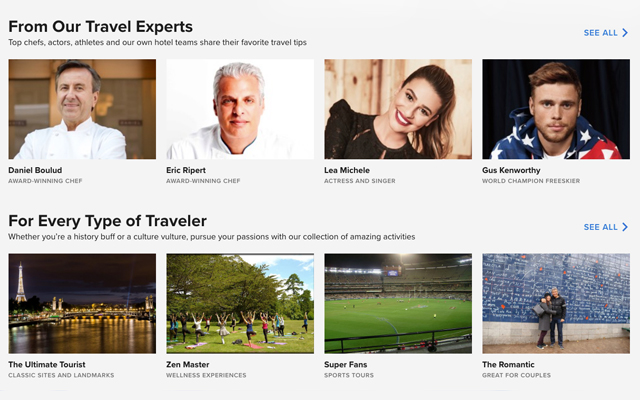
Marriott Moments currently features over 100 expert recommendations – from food market visits to cultural experiences – made by hotel general managers, chefs and mixologists, luminary partners chefs Daniel Boulud, Eric Ripert and Stephanie Izard, as well as actress and singer Lea Michele, world champion freestyle skier Gus Kenworthy and sports broadcaster Michele Tafoya.
More expertise from Marriott hotel associates will be added regularly.
As a complement to the recommendations, Marriott Moments will offer bespoke categories based on passion points, types of travel companions, and personality traits including Pop-Culture Vulture, Exhaust Your Kids and Be the Family Hero, and Young, Broke & Fabulous.
All recommendations and categories will feature hand-curated lists of the best things to do from around the world, available for purchase with any major credit card.
Additionally, as an answer to the age-old question “what should we do now,” Marriott has brought the ability to find and book experiences to Facebook Messenger. Now, in addition to visiting the website directly, anyone can chat with Marriott Rewards or SPG on Facebook Messenger to get location-based recommendations of close-by Marriott Moments they can purchase on their phone.
Moreover, Marriott Moments has added several new partnerships, including a partnership with Eatwith, an online community to find and book culinary experiences with locals in over 130 countries.
Marriott Moments has also introduced newly developed on-property activities, starting with experiences in Miami like the private Champagne Sabering or Mediterranean Cooking Class at The St. Regis Bal Harbour, with plans to grow these unique hotel experiences globally in the future.
Marriott Moments was created in partnership with PlacePass, a provider of travel technology solutions offering travellers an online meta-search platform for in-destination experiences.
Mandarin Oriental, Saigon in Union Square (pictured)
The hotel will be located on the upper floors of Union Square Saigon(pictured)
Mandarin Oriental Hotel Group will manage a new hotel in Ho Chi Minh City in Vietnam, scheduled to open in 2020.
Mandarin Oriental, Saigon will occupy the upper floors of the Union Square Saigon mixed-use complex, which will also house international luxury retail outlets.
With 227 guestrooms and suites, the hotel will also feature six restaurants and bars, a range of meeting and banqueting spaces, a fitness centre, a spa, and an outdoor swimming pool.
The hotel is located adjacent to the Saigon Opera House and the People’s Committee Building and within walking distance of key landmarks in the city.
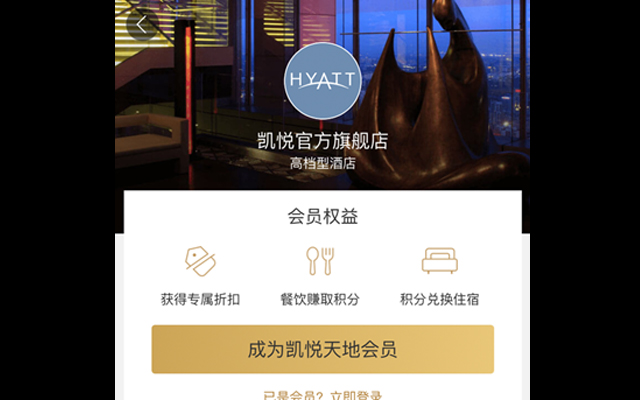
Major Chinese OTA Ctrip Group is linking arms with Hyatt to open its first flagship store on its website and mobile application, which will allow over 300 million Ctrip members to access Hyatt hotels in the Greater China region and Hyatt properties worldwide in the near future.
Ctrip members who log on to the flagship store will be able to join World of Hyatt, Hyatt’s global loyalty programme, and have access to special rates to more than 700 hotels and resorts worldwide.
Hyatt’s store on the Ctrip app
The collaboration marks a step in Ctrip’s efforts to become “a one-stop travel shop” to provide seamless travel experiences across its various platforms, while Hyatt hotels are set to benefit from increased exposure on Ctrip platforms to grow revenue and business from Chinese travellers.
“The collaboration presents a win-win setting for both companies and represents a milestone in the travel industry distribution archetype,” said Ray Chen, Ctrip’s Hotel business unit CEO.
Through this flagship store, Hyatt wants to be “top of mind for travellers” however they choose to book,” said Stephen Ho, president – Greater China, global operations, Hyatt.
“Ctrip has a huge consumer base in China, and it’s an important priority for Hyatt to cater to the growing number of Chinese travellers who are crossing countries and continents more than ever before,” added Ho.
The Hyatt portfolio includes various high-end hotel brands, including the luxury Park Hyatt brand; premium Grand Hyatt and Hyatt Regency brands; lifestyle Andaz, Hyatt Centric and The Unbound Collection by Hyatt brands; and modern essential Hyatt Place and Hyatt House brands.
Cebu Pacific Air has opened its first branch office in Japan to serve as the hub for all its activities and business transactions in the country.
Heading the office in Chou-ku Tokyo is Tomohiko Matsumoto, who was appointed country manager for Japan in December 2017. A veteran in the travel and aviation industries with over 25 years’ experience, he served as country manager and international air cargo manager for Qatar Airways and more recently, as sales and marketing manager for Japan for Tigerair Taiwan.
Cebu Pacific is finally getting its own branch office in Japan after 10 years of operating in the country
Mike Szcus, chief executive adviser at Cebu Pacific Air, commented that the airline’s new branch office in Japan will bring the airline into the “next stage of growth” in the market, which is today “one of the most important across our network”.
“In 2017, we flew over 435,000 passengers between the Philippines and Japan. Compared to the (size of the Japan outbound market), there is much room to grow,” noted Alex Reyes, vice president for cargo at Cebu Pacific Air.
Now on its 10th year of operations in Japan, Cebu Pacific Air operates a total of 70 flights a week between Japan and the Philippines. Cebu Pacific Air flies between Manila and Narita, Osaka, Nagoya and Fukuoka, as well as between Cebu and Narita, utilising its fleet of Airbus A330 and A320 aircraft for these routes.
Aside from B2B and B2C transactions such as group reservation services, ticket sales and customer support, the Japan brance office will also drive marketing strategies and promotional activities of Cebu Pacific Air in the country.