Grand Hyatt Hong Kong has appointed Charis Yim as executive assistant manager – sales and marketing.
In her new position, Yim will oversee and develop the sales & marketing division of the 542-room hotel, Hyatt’s first flagship Grand Hyatt hotel in Asia.
She joins Grand Hyatt from JW Marriott Hotel Hong Kong, where she held the position of director of marketing.
A seasoned hotelier with over 20 years of experience, Yim has held senior management roles at multiple luxury hotels in Hong Kong and Macau, including The Peninsula, InterContinental and Mandarin Oriental.
While there is no dearth of sustainable tourism initiatives, the overarching question is whether travel consumers and industry players are engaged enough to meet responsible travel in this age of mass tourism.
After all, awareness about responsible tourism, while growing, is still at a nascent stage. “We’re far from achieving the goals. A lot of work needs to be done,” PATA CEO Mario Hardy said at the sidelines of the PATA Annual Summit 2019 in Cebu.
Swimming with a whale shark
“We have to get together and get this fixed once and for all. We cannot continue to damage this beautiful planet,” Hardy pointed out.
Various organisations have been rolling out initiatives to address sustainability, one of the biggest challenges in travel and tourism. The UN has Sustainable Development Goals (SDG); WTTC recognises best tourism practices, among other projects; and last May, PATA published a report on how food waste and excess in tourism can be halved as part of its BUFFET Campaign.
American nonprofit Planet Happiness has initiated an online survey metric that measures the wellbeing of residents and communities in world heritage sites, including Ayutthaya and Sukhothai in Thailand; Bali, Borobudur and Komodo National Park in Indonesia; Hoi An in Vietnam; and Luang Prabang in Laos.
Planet Happiness co-founder and director Paul Rogers told TTG Asia that the objectives are to raise awareness about the need to identify alternative measures of development – apart from GDP – and to address overtourism through responsible and sustainable forms.
As more destinations worldwide grapple with overtourism, an industry refocus on destination management – rather then destination promotion – has emerged. This move is exemplified by Slovenia which is aligning its tourism branding along dimensions of sustainable development.
Brands should have a strong, authentic story hinged on the values of the destination, and be able to communicate the story well by creating products that are in line with the brand vision. “Branding is all about perception, which is something that will continue to change overtime,” emphasised Maja Pak, director general, Slovenian Tourist Board.
Arnel Yaptinchay, Kirschner Travel Manila general manager and Marine Wildlife Watch founder, said: “There are ways to manage a destination to achieve sustainability goals, starting with a sustainability frame work and criteria (e.g. Global Sustainable Tourism Standards), the appropriate policy and then its implementation.
“It becomes a bit tricky in sensitive natural sites, but that can be fully addressed with proper regulations to meet the goals of a conservation site, e.g. by limiting the visitor numbers.”
Curtailing visitor numbers and closing destinations to let them breathe from mass tourism are being carried out in certain key attractions in Thailand and the Philippines.
However, there are still quarters that equate sustainability only to the natural environment, neglecting other equally important aspects such as the locals’ wellbeing, sourcing of water and food, investing in learning, exploitation, etc.
Yaptinchay emphasised: “Sustainability in tourism is not only for natural sites – now mostly referred to as ecotourism – but is also much needed and relevant across all destinations or facilities, be it large cities, hotel chains, or cultural sites.
“Sustainability has to be built and grown from within so it inherently makes investments in local communities, the environment, people’s wellbeing, education of tourists, etc. relevant,” he stressed.
In fact, Asia Pacific Projects founder Narzalina Lim said that the SDGs are “very comprehensive and complex and not just focused on environmental sustainability, but also on ending poverty and inequality, reducing food waste, promoting responsible consumption and creating partnerships to achieve the SDGs, to name a few”.
“Hotels, resorts and other tourist facilities should be retrofitted to use renewable energy and rain water catchment facilities should be installed as water is getting scarcer. These may be expensive now but it will save owners a lot in energy and water consumption. New laws that require new buildings to conform with sustainable principles should be enacted,” Lim added.
She lamented the impact of neglecting other aspects of sustainability.
“While the environment is important, people are equally important too. As long as they remain poor and ignorant, excluded from the profits that big tourism players earn, they will continue to damage the environment and create social problems.”
Boracay is a clear example, said Lim. While the island’s 2017 tourism revenues hit 56.2 billion pesos (US$1.1 billion), 22.9 per cent of its residents and 21.2 per cent of residents in mainland Malay were poor. “This is unacceptable,” she stressed.
Lim is also unimpressed by Boracay’s six-month closure last year for rehabilitation, calling the move “just for show” and “not sustainable”.
Alluding to certain jerrybuilt structures and flooding in certain parts of Boracay after a four-hour downpour last May, Lim said: “One can see the results now. When the life of the inter-agency task force ends next year, what next? The re-elected mayor has vowed to go back to business as usual.”
PATA’s Hardy underscored the importance of educating both residents and tourists alike. Recalling his visit to western Samoa last year, he noted during a 45-minute ride from the airport that the country was “extremely clean, with not even a cigarette butt” on the streets.
The taxi driver told Hardy that over 20 years ago, an elderly widow took it upon herself to pick up the trash on the streets during her daily morning walks. Other adults and children in the village soon followed suit. The practice swiftly spread to other villages and this trash-picking tradition is still followed today.
It’s the same story with Yap Island, Hardy said. “It’s about educating the people to do this. People are proud of their land and environment so they clean up,” Hardy explained, adding that there’s no reason why that habit cannot be replicated in congested cities. “It is your responsibility to clean up your own mess. If you see someone throwing trash, tell him off. Others will follow your lead, and eventually, it will spread,” he said.
Lim wants due punishment for misbehaving tourists: “We should strictly enforce our rules and regulations. Those who don’t comply should be fined, arrested, or imposed with whatever sanctions so they know we mean business.”
Education is key for Yaptinchay,. “It is important for tourists to understand what they are visiting. This can be reinforced by making information available online in different languages, orienting and arming tour operators with the understanding, and putting up signages at the site itself.”
He added: “Most visitors want to make better choices when they travel. They just need to be presented with the ‘what’ and ‘how’ information. Of course, strict regulations that are enforced in an attraction or site (e.g. penalties for littering, proper attire in religious sites, ‘do not touch’ policy for wildlife) are part of the awareness raising process. Demand respect!”
Lim warned though that too many tourists in a fragile environment will never be sustainable, citing as an example the Philippines whose “attractions are in fragile islands or forests which cannot stand the impact of mass tourism.”
What can be done, Lim said, is to develop more beach destinations in mainland, as opposed to islands, to cater to mass tourism.
“The beaches may not be as beautiful as Boracay, etc. but the resorts can be designed in such a way that there are several pools, entertainment areas, shopping and dining that tourists need not look for a Boracay, Panglao, or Northern Palawan experience. These island destinations should have more upmarket, luxury accommodations – low volume, high yield.”
Tourism sustainability is a challenge in any sector and it still has a long way to go. But hopefully, it will become the norm in the near future.
Mövenpick Resort & Spa Jimbaran Bali has appointed Chanelle Rose Garvey and Shelly Darcy to the positions of executive assistant manager and director of sales & marketing respectively.
From left: Chanelle Rose Garvey and Shelly Darcy
Hailing from Australia, Garvey comes to the resort with an extensive hospitality background, specifically in sales and marketing. She began her career working for branded hotels in Sydney and Melbourne, Australia. In 2006, Garvey joined Accor where she was tasked to head sales and marketing departments for a succession of Sofitel and Novotel properties in South-east Asia.
Meanwhile, Darcy is no stranger to Bali an she has worked exclusively in the island’s luxury hotel sector for almost a decade in the area of sales. Her career with Accor began in 2013 where she handled Sofitel Bali for six years.
For Thailand to remain an attractive destination and reap greater revenue from the lucrative tourism industry in the next decade, it has to adopt and execute smart city strategies to digitally transform its travel infrastructure and systems for the future.
As Thailand’s travel and tourism sector posted six per cent growth to see a record 38.4 million tourists in 2018, a number of the country’s airports are approaching capacity and popular destinations are starting to show the impact of overtourism, both of which could limit the rate of future tourism growth if not urgently addressed, according to the Thailand Towards 2030: Future of Travel & Tourism report released by Amadeus in collaboration with Thailand’s Digital Economy Promotion Agency (DEPA) and PATA.
Thailand needs to adopt smart technologies to maintain its competitiveness as a tourist destination
In particular, airports – typically the first point of contact for foreign tourists into the country – should figure high up on Thailand’s national agenda, stated Simon Akeroyd, vice president corporate strategy & business development, Amadeus, sharing the findings of the collaborative report in Bangkok earlier this week.
“Thailand needs to fundamentally change how its airports function,” he stressed, pointing to the frequent bottlenecks observed at the immigrations at Bangkok Suvarnabhumi Airport.
However, such traffic congestion usually affects a small part of the terminal while other areas of the airport remain underused, Akeroyd said, resulting in missed opportunities on the operators’ part to divert passenger flows and derive greater revenue from passenger spending on F&B or duty free shopping.
The adoption of smart technology at Thailand’s airports, besides the physical expansion of the facilities, will help to ease some of the strain as the country struggles with visitor influx.
Akeroyd recommends that self-serve check-in kiosks, automated bag-drop and use of biometrics for passenger identification, technologies which Amadeus has respectively deployed in Hong Kong International Airport (HKIA), Singapore Changi Airport and Los Angeles International Airport, could significantly increase the efficiency of passenger movements at Thailand’s airports.
To fully tap Thailand’s potential as a MICE destination and accelerate the sector’s growth, Akeroyd also critical attention to improving inter-model air-to-city links to support a seamless travel experience, pointing to Heathrow Express in London, Hong Kong’s Airport Express and Shanghai Maglev as fine examples of transport solutions that allow people to move back and forth with ease between the airport and the city.
“Ease and speed of travel will become major differentiators amongst the region’s MICE hotspots in the near future, so these cities need to invest in technologies that are designed for convenience – such as having off-airport check-in and bag-drop facilities at conference venues themselves. The technology needs to be best-in-class because Thailand is competing with MICE destinations across the region, not just domestically,” he said.
“Airports are not the end of a long line,” he remarked, underlining the need to rethink Thailand’s airports as a hub-and-spoke operation. “Airports are still seen as a separate entity (connected by) a long line into the city, but instead airports should be conceived as a hub that leads to other parts of the city.”
The report also identifies increased public-private partnerships to scale up smart mobility – where data and technology are integrated to improve the efficiency of population movements around a city – as another key area of opportunity for Thailand’s cities to curb congestion and pollution.
“Smart mobility is still in its infancy in Thailand, but its potential to improve inner-city travel is enormous,” said Akeroyd. “Using transport data to inform travel management systems like traffic lights in real-time, or to inform how ‘sharing economy’ services like Grab and Get are deployed, are just two significant applications. But this won’t be possible without greater public-private sector partnerships.”
According to the report, one major challenge is that Thailand’s public sector doesn’t currently know which companies to partner with, whilst private firms, especially smaller businesses, start-ups and overseas investors, often don’t know how to engage, so third-party advisers may be important in bringing key players together.
DEPA’s Pracha Asawateera and Amadeus’ Simon Akeroyd stressed on the importance of adopting smart technologies for the growth of Thailand’s tourism industry
Meanwhile, DEPA identifies access to capital as another barrier in Thailand and recommends that cities will need to form ‘City Development Companies’ with private sector partners in the future – to better bid for funding and to formalise the nature of their partnership.
“Right now, we’re only just scratching the surface of what’s possible with smart mobility. More provinces need to follow the City Development Company model being piloted by Phuket, Chiang Mai and Khon Kaen to access vital funding and plan for the long term,” said Pracha Asawateera, vice president southern district office, DEPA.
Phuket, which is largely reliant on tourism as an economic generator, commenced the Smart City Project four years ago to use data in tourism management and development in the city, according to Pracha.
Finally, the report also identifies the need for more action to be taken to protect Thailand’s tourist hotspots from the risks of overtourism.
As the Phuket Smart City Project has shown, data can be used for real-time analysis and predictive modelling to manage tourism more sustainably, said Akeroyd,
The “enormous amount of data” that Amadeus has of travel booking patterns and correlations around the world will be a valuable tool for tourism boards, local authorities and hospitality businesses in managing visitor flow and the promotion of second-tier cities, e.g. driving travellers to less crowded places at the right time.
On its part, Amadeus has stepped up its focus on Thai and Asian start-ups and initiatives that tackle sustainable tourism issues, including supporting enterprises such as Syngerera, which is developing enterprise applications in carbon offsetting and sustainable jet fuel, in its Amadeus Next initiative.
A full copy of the Thailand Towards 2030: Future of Travel & Tourism report can be downloaded here.
India’s Ministry of Tourism will be rolling out a flexible e-tourist visa regime for over 160 countries based on peak and lean tourist seasons, as part of the government’s push to attract more travellers to the country.
Under the new regime, the e-visa fee with a validity of 30 days will be US$25 during the peak season of July to March, and US$10 during the lean period of April to June. This is a steep drop from the current e-visa fee of about US$80 to US$100.
India’s Ministry of Tourism will be rolling out flexible e-visas based on tourist footfall
Additionally, tourists can fork out US$40 for a one-year e-visa or US$80 for an e-visa with a five-year validity.
“We expect that the plan will help to draw more international tourists to India,” said India’s tourism minister Prahlad Patel at the recent National Conference of Tourism Ministers in New Delhi.
Tourism stakeholders in India have hailed the move, claiming that the current high e-visa fee has stymied the growth of inbound tourism, especially in the face of stiff competition with neighbouring markets.
Ravi Gosain, managing director, Erco Travels, called the new e-visa regime “great news” for India’s tourism sector which has been experiencing turbulence. “The industry has been demanding this for a long time because we were not well-placed within Asian destinations when it comes to the visa fee. Our overseas tour operator partners have been complaining about the high e-visa fees. But now, they will be happy and push tours to India,” he said.
Sanjeev Nayar, general manager, WelcomHeritage Group, said: “The government has been making efforts to boost inbound tourism by announcing measures like the (ongoing) development of 17 iconic sites. The new e-visa fee structure would help increase India’s attractiveness as an international tourist destination. We are hopeful that if the government continues to support the industry like this, we will be able to achieve our target of 20 million international tourist arrivals very soon.”
Dipak Deva, managing director, Travel Corporation India, said that the new e-visa free structure would most benefit the country’s beach destinations and also attract more visitors during the low season. “(The revised e-visa fees) will directly impact the number of inbound leisure tourist arrivals in India. Most tourists travel to India for less than 30 days,” he said.
He added: “The biggest beneficiary will be beach destinations like Goa which tourists visit for 10-day long holidays. Goa has to compete with markets like Sri Lanka and Turkey because of the price competitiveness. None of our competitors, be it Thailand or Vietnam, charges an e-visa fee of US$100. Also, the lean period visa fee of US$10 would help generate demand in a month like April when there are Easter holidays in Europe.”
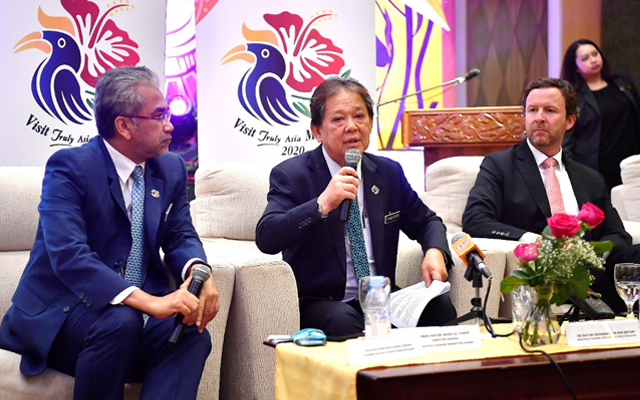
Tourism Malaysia has joined forces with Expedia Group on two tourism collaborative pacts to attract more tourists to Malaysia.
Aligned with Tourism Malaysia’s promotion strategies, the first agreement is a Memorandum of Collaboration to promote Malaysia as an outstanding tourist destination by showcasing the country’s unique wonders, attractions and cultures, as well as support tourism industry digital innovation.
Tourism Malaysia has inked an MoC with Expedia Group to promote tourism to Malaysia. In attendance at the signing were (from left) Tourism Malaysia’s director general, Musa Yusof; Ministry of Tourism, Arts and Culture Malaysia’s Mohamaddin Ketapi and Expedia Group’s Greg Schulze
In the second agreement, both parties would embark on an Expedia Media Solutions global campaign to promote inbound travel from Australia, Japan and the US to Malaysia. These three markets are the biggest points of sales for the Expedia Group, shared Greg Schulze, senior vice president, commercial strategy and services of the OTA.
Tourism Malaysia’s director general, Musa Yusof, explained that the NTO is looking to grow arrivals from Australia, Japan and the US, as visitors from this market trio are longer-staying and higher-spending. Tourism Malaysia is targeting 220,500 tourists from the three countries during the six-month campaign, due to begin this month.
Minister of tourism, arts and culture Malaysia, Mohamaddin Ketapi, said: “We believe the collaboration initiated by us, alongside all our marketing and promotional activities lined up, will firmly put Malaysia on the map of travellers everywhere and inspire them to experience the great diversity that Malaysia offers.”
The joint campaign will spotlight Malaysia’s hidden and unique tourist attractions, as well as promote a variety of accommodation to Expedia Group’s more than 750 million monthly visitors globally.
This strategic collaboration will support Malaysia’s target of achieving 30 million tourist arrivals and RM100 billion (US$24 billion) in tourist spending for the Visit Malaysia 2020 campaign.
“The joint collaboration will allow Expedia Group and Tourism Malaysia to seek and exchange traveller insights to build information gaps, deepen the understanding of tourist behaviour and strengthen tourism strategies in line with the implementation of the Visit Malaysia tourism vision,” Mohamaddin said.
As part of the overall collaboration, Tourism Malaysia and Expedia Group will also launch a series of key workshops in Malaysia to foster tourism industry digital innovation. Workshops for local hotel partners will include ways to leverage the Expedia Group’s Partner Central platform to accelerate skills development and build revenue and hotel management capabilities among local SME hotels.
Expedia Group will also tap its Partner Solutions network and technology to help both large and SME travel retailers in the offline travel industry to improve their technology capabilities and to become digital economy ready.
Travelport is working with IBM Services and BCD Travel, as well as a number of major hotel chains, to develop a blockchain solution to enhance the hotel commission reconciliation process.
The blockchain technology solution aims to optimise hotel commission processing on a distributed ledger by managing reconciliation, tracking and accounting for commission payments owed from hotel chains for services purchased by travellers via booking agencies. By creating an accurate and shared view of the booking status and commissions, all parties stand to win, according to Travelport.
Travelport has teamed up with IBM and BCD Travel to develop a blockchain solution to improve the hotel commission reconciliation process
Blockchain technology behaves like an online ledger with the ability to collect data, build upon that data in real-time, and then independently and securely report information to any number of parties based on permission.
Following an IBM Garage engagement, Travelport and IBM Services, together with partner BCD Travel, developed an MVP solution using distributed ledger technology to streamline commission reconciliation between BCD and three high profile hotel chains. Hotel commission reconciliation processes include a range of challenges from the operational lack of audit trails driving escalations and manual data mapping, to the financial impairment of revenue forecasting, to the more commercial impact on commission flexibility and duty of care.
Solving for this current friction is critical to ensure all stakeholders in a hotel transaction are duly compensated and ultimately to ensure customers receive an optimal travel experience; and, blockchain is an ideal solution to address this. Travelport and IBM are currently working in partnership with industry stakeholders to evolve the solution into an active pilot program.
Travelport’s senior product director, Ross Vinograd, said: “Blockchain technology applied to commission reconciliation has the potential to deliver real ROI to both a travel agency and the hotel. Traveller modifications at property, no shows, and complimentary room nights are just a few examples that drive commission discrepancies which in turn generate escalations, cost and revenue loss. Our aim is to put the lifecycle of a booking on the blockchain and we believe doing so will drive transparency, trust, and ultimately, booking volume.”
Kurt Wedgwood, IBM blockchain leader – travel added: “Global distribution companies and providers would benefit from this use of blockchain technology to remove their never-ending work of reconciliation to spend that time adding new experiences and insights for the traveller. Eliminating the hours spent addressing dollars in dispute or the timeliness and accuracy of information allows all participants to focus on what matters most: the traveller.”
Vietjet adds more connections between Vietnam and India
This coming December, Vietjet will fly from Ho Chi Minh City and Hanoi to New Delhi.
The Ho Chi Minh City-New Delhi route will operate four return flights per week (every Monday, Wednesday, Friday and Sunday) starting from December 6. Flights depart from Ho Chi Minh City at 19.00 and arrive in New Delhi at 22:50. Return flights take off from New Delhi at 23.50 and land in Ho Chi Minh City at 06.10.
Meanwhile, the Hanoi-New Delhi route will operate three return flights per week (every Tuesday, Thursday, and Saturday) starting from December 7. Flights depart from Hanoi at 19.10 and arrive in New Delhi at 22.50. Return flights take off from New Delhi at 23.50 and land in Hanoi at 05.20.
Flying time for both flights is around five hours per leg.
JC International Airlines connects Phnom Penh and Yangon
JC (Cambodia) International Airlines’ inaugural flight between Yangon and Phnom Penh took off on August 17.
The airline will continue to operate thrice-weekly direct flights on Mondays, Thursdays and Saturdays. The route will utilise a Airbus A320 aircraft, which can accommodate 180 passengers per service.
QD602 will depart Phnom Penh at 09.00 and arrive in Yangon at 10.30, while return flight QD603 will depart Yangon at 11.30 and land in Phnom Penh at 14.00.
Anupama Pathirana, the airline’s COO and chief pilot further revealed that JC Airlines is currently operating between Phnom Penh and Mandalay via Macau, but are planning to launch direct flights at the end of this year. The airline also has plans to extend routes from Siem Reap to Yangon, as well as Mandalay.
Korean Air cuts frequency on Japan services
Due to decreasing demand of Japanese routes amid South Korea-Japan tensions, Korean Air has announced plans to adjust the frequency of some of its routes to the country, as well as increase the frequency of routes in South-east Asia, Oceania, and Chinese markets.
Korean Air will suspend the Busan-Osaka route (14 flights a week) from September 16, as well as Jeju-Narita (three flights a week) and Jeju-Osaka (four flights a week) from November 1.
The airline will also temporarily suspend some of its other routes. Incheon-Komatsu (three flights a week) and Incheon-Kagoshima (three flights a week) will be suspended from September 29 to November 16 respectively, while Incheon-Asahikawa (five flights a week) will be suspended from September 29 to October 26.
For Incheon-Osaka/Fukuoka routes, its frequency will be decreased to 21 (from 28) flights a week between October 27 and November 16. The frequency of Incheon-Okinawa will be reduced from seven to four flights a week, and Busan-Narita/Fukuoka from 14 to seven flights a week, between September 29 and November 16.
In the meantime, Korean Air plans to focus on other markets, such as South-east Asia, Oceania and China in the winter season.
To begin with, Korean Air will launch a new daily route to Clark, Philippines, starting from October 27. The airline will also add four more operations a week for Incheon-Chiang Mai/Bali, increasing the number of flights per week to 11. In Oceania, the frequency of the Incheon-Brisbane route will be increased from five to seven flights a week.
Korean Air is also planning to expand its network to China with the launch of new direct services. The airline plans to start direct flights from Incheon to Zhangjiajie and Hangzhou three times a week each, and Incheon-Nanjing four times a week. The service between Incheon and Beijing will be operated 17 times a week, up from the previous 14 a week.
In other changes, Korean Air will also boost the frequency on some domestic routes. It will launch a new service between Pohang and Jeju seven times a week, and the Ulsan-Jeju flight will be operated seven times a week, an increase of two flights a week.
United Airlines makes changes to its Japan schedule
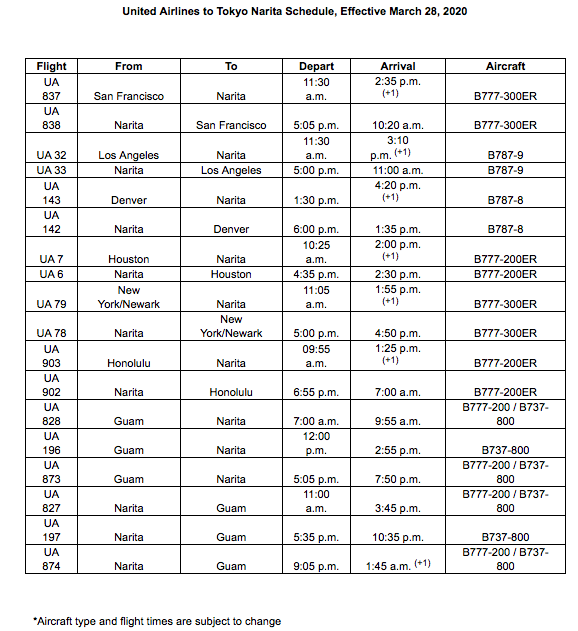
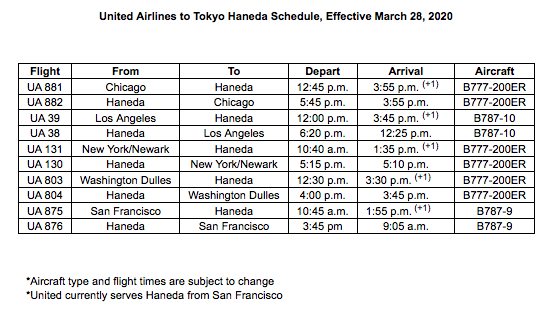
United Airlines has announced that it will begin service between four of its US hubs and Tokyo’s Haneda Airport, as well as reduce services to Narita International Airport.
United will begin operating a non-stop service between Chicago, Los Angeles, New York/Newark and Washington, DC and Haneda on March 28, 2020, subject to government approval. The airline currently offers daily non-stop service between San Francisco and Haneda.
In addition to United’s new Haneda flights, Tokyo’s Narita International airport will continue to be a hub for United with non-stop daily service between Narita and Denver, Guam, Honolulu, Houston, Los Angeles, New York/Newark and San Francisco.
With the start of these new routes, United will no longer serve Narita from its Chicago and Washington DC hubs, and will shift these flights from Narita to Haneda.
HK Express increases frequency to Takamatsu
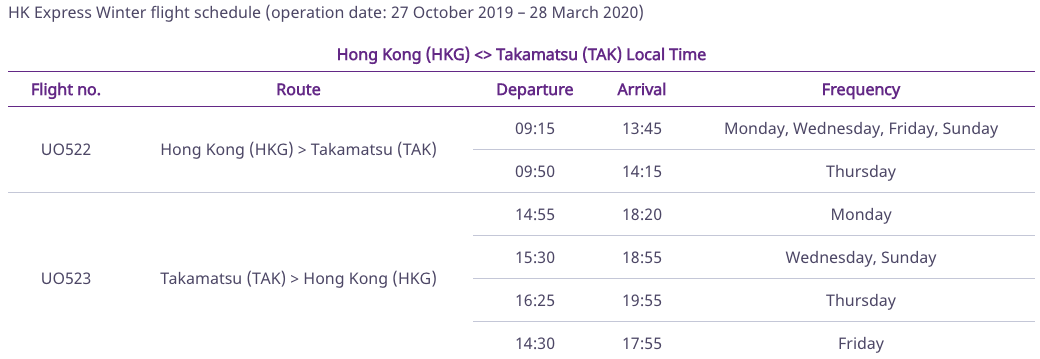
Hong Kong-headquartered LCC HK Express has announced an additional frequency to Takamatsu, a port city on Japan’s Shikoku Island.
The additional frequency is scheduled to operate every Thursday starting from October 31. This will bring the total number of flights to Takamatsu to five weekly.
Avianca Brasil exits Star Alliance
Brazilian airline Ocean Air Linhas Aéreas S/A, headquartered in São Paulo and formerly doing business as Avianca Brasil, will formally leave Star Alliance with effect from September 1.
Ocean Air’s withdrawal follows several months of bankruptcy protection and the withdrawal of its Air Operator Certificate by Brazilian regulator ANAC.
Eleven of the Star Alliance member airlines offer direct services to and from Brazil: Air Canada, Avianca, Air China, Copa Airlines, Ethiopian Airlines, Lufthansa, SWISS, South African Airways, TAP Air Portugal, Turkish Airlines and United.
Taken together, Star Alliance member airlines operate 588 weekly flights from 11 domestic points in Brazil to 17 Star Alliance hubs, offering connections to a further 738 international destinations. As of September 1, 2019, the Alliance will number 27 member airlines.
Cinnamon Hotels & Resorts has launched a Bring A Friend Home (BAFH) campaign, encouraging Sri Lankans to become the country’s “brand ambassadors” and nominate foreign friends to visit the teardrop-shaped island with its latest tourism recovery initiative.
Sri Lankans living in Sri Lanka or overseas, as well as expats living in Sri Lanka with a resident visa, are eligible to nominate foreign friends to participate in this campaign.
Cinnamon Hotels & Resorts launched their Bring A Friend Home campaign to encourage people to visit the country. In attendance at the campaign’s announcement were (from left) Sri Lankan Airlines’ Gayan Peiris, Walkers Tours’ Nalaka Amaratunga, Minister of Tourism Development and Christian Religious Affairs’ John Amaratunga, UN Resident Coordinator Hanaa Singer, Sri Lankan Airlines’ Dimuthu Tennakoon and John Keells Holdings’ Hishan Singhawansa
Applicants have to enter their name, email and contact number on www.bringafriendhome.com, and invite one or more friends living overseas via email, WhatsApp, Facebook or Twitter. Invitations can be sent from July 30, 2019 to December 15, 2019, for stays within the same period.
The invitee – any foreign passport holder or Sri Lankan expat – can accept the invitation by purchasing one or more packages listed on the campaign website at www.cinnamonboxoffice.com. The invitee must travel to Sri Lanka between August 1, 2019 and December 15, 2019, and register on the campaign website to enter the raffle draw, which will take place in January 2020. All travel and registrations should be completed by or before December 15, 2019.
The first prize for the visiting foreign friend is a five-night stay at a Cinnamon property located in the Maldives for up to two individuals including airport transfers and a Sapphire stone ring worth Rs1 million (US$5,621) from Colombo Jewellery Stores. The second prize will also be a five-night stay at a Cinnamon property located in the Maldives for up to two individuals including airport transfers.
There will also be monthly giveaways by Lovi Sarong and Siyath Gavin Photography with each company offering Rs99,000 worth of prizes, while the Wax Museum and Tiesh jewellery emporium, will offer Rs25,000 and Rs15,000 worth of giveaways respectively.
In addition, original applicants will also be eligible for a separate raffle draw. The first prize here for Sri Lankan referees is a choice between a one-year stay at a Cinnamon Life apartment or a seven-day stay for two individuals, valid at two Cinnamon’s properties for three consecutive years. Additionally, they will be gifted a voucher worth Rs499,999 from Colombo Jewellery Stores.
This category’s second prize will include a seven-night stay at two Cinnamon properties located in Sri Lanka valid for two consecutive years for up to two individuals, while the third prize includes a five-night stay at a Cinnamon property in the Maldives for up to two individuals including airport transfers.
The campaign is aimed at expediting the tourism arrivals to the country by spreading the word that the country is safe to visit, and is part of Cinnamon’s contribution towards the recovery process of the tourism industry, the company said in a statement.
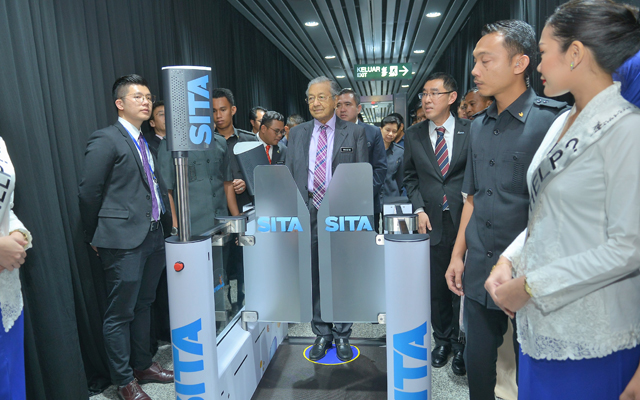
Malaysian prime minister Mahathir Mohamad tested new biometric passenger processing at the KLIA main terminal, as part of the airport’s recent 21st anniversary celebration.
SITA and Malaysia Airports have signed a MoU for exploring joint opportunities and collaborative innovation for Malaysia Airports’ digital initiatives that will ensure a more seamless passenger journey.
Malaysian prime minister Mahathir Mohamad tries out the SITA Smart Path at KLIA’s 21st anniversary celebration
The new system, SITA Smart Path, uses facial biometric ID management technology to automate the travel journey from check-in to boarding. Once registered, travellers need only to have their faces scanned without having to produce documents at every stage of their journey.
The technology is designed to easily integrate into existing airport and airline infrastructure, including standard common-use systems, check-in kiosks, self-service gates for secure access, and boarding.