Shama Serviced Apartments by Bangkok-based Onyx Hospitality Group will be doubling its presence in the Thai capital with the addition of Phrom Phong and Yen Akat to its portfolio in 2020.
The two new properties – Shama Sukhumvit 39 Bangkok and Shama Yen Akat Bangkok – will complement the existing Shama Sukhumvit Bangkok in Ploenchit and Shama Lakeview Asoke Bangkok.
A rendering of Shama Yen Akat
Developed by Walton Asset and managed by Onyx Hospitality Group, Shama Sukhumvit 39 Bangkok in Phrom Phong is scheduled to open in February 2020 as an extended stay residence with 52 apartments in five different one- and two-bedroom layouts. The property will feature a pool and terrace, gym and kid’s playroom.
Shama Yen Akat Bangkok, developed by SP Plus Property Company and managed by Onyx Hospitality Group, is scheduled to open in September 2020 with 136 units, welcoming both short stay as well as extended stay guests. The property will offer a restaurant, gym and a rooftop pool terrace with barbeque pit.
Shama currently has a portfolio of 11 properties in China, Hong Kong and Thailand, with upcoming openings in Johor, Malaysia and additional locations within mainland China.
Onyx Hospitality Group has a growing regional portfolio of 50 operating properties across three core brands in eight markets. It has a robust development pipeline of 25 new properties in markets such as China, Malaysia and Laos, and has set a target of having 99 hotels open by 2024.
KLIA trials facial recognition technology as it seeks to improve the passenger experience
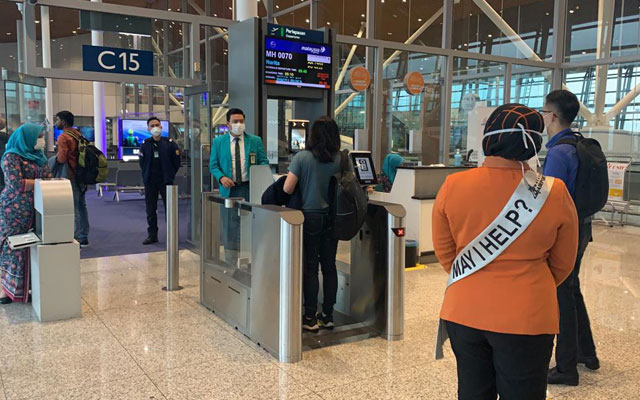
Select visitors to the Kuala Lumpur International Airport (KLIA) will now be able to take advantage of its Single Token Journey concept which leverages facial recognition technology to provide passengers with a single identification verification at all airport touchpoints, from check-in to the boarding gate.
Launched by Malaysia Airports (MAHB), in collaboration with Malaysia Airlines and IT firm SITA, the concept is part of the Airports 4.0 initiative that aims to transform KLIA into a smart airport through the use of big data analytics.
KLIA trials facial recognition technology as it seeks to improve the passenger experience
During the three-month pilot period, passengers on two daily Malaysia Airlines flights to Narita International Airport, Tokyo and Kansai International Airport, Osaka will get to enjoy this convenience.
Facial recognition scanners have been installed at check-in counters H5 to H8, while e-gates have been placed at the security screening touchpoints and boarding gates.
Passengers on these flights will only need to scan their faces to verify their “token” at all the touchpoints. They no longer need to present their passports or boarding passes when going through these checkpoints.
Malaysia Aviation Group CEO Izham Ismail said that the new concept will allow passengers to enjoy reduced check-in time as well as manage the queue at the airport’s check-in counters, especially during peak periods. The company hopes to fully adopt this system by 4Q2020, he added.
Why
Despite being the world’s largest floating village and having been in existence for more than a millennial, Kampong Ayer in Brunei’s capital has flown largely under the tourism radar. To educate visitors about Brunei’s historic settlement, the tourism board launched a Kampong Ayer walking trail last May, giving visitors access to designated abodes across five villages in the overwater city.
Once home to about 30,000 inhabitants, that number has since dwindled to about 9,000 as residents flock to the mainland. Unlike my last trip here more than five years ago, where I admired Kampong Ayer from a distance via water taxi, this time round, I decided to explore the Floating City on foot.
What
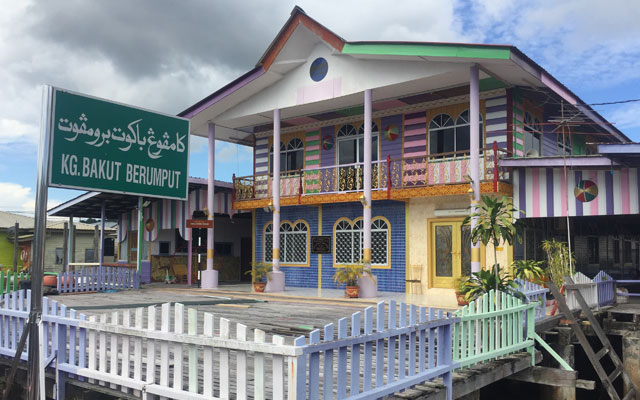
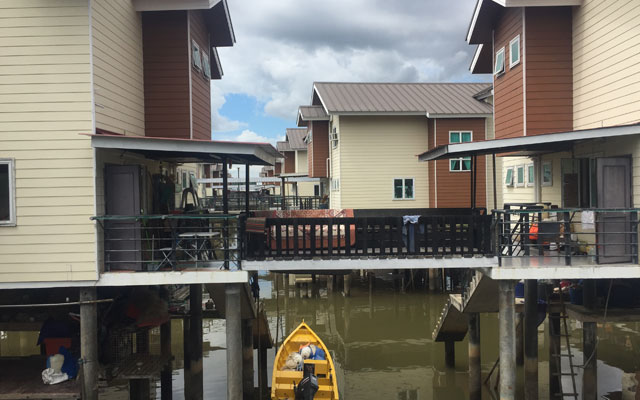
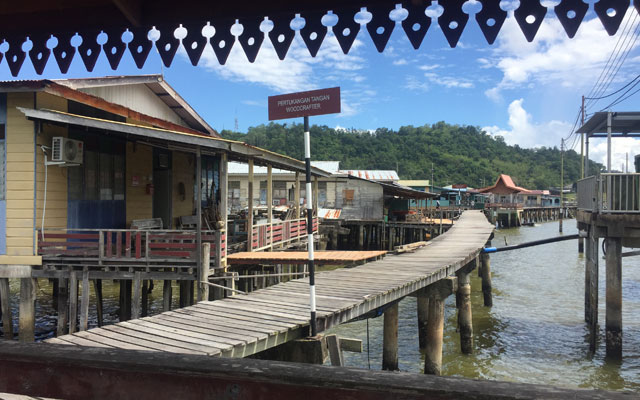
Crooked wooden walkways spanning 30km connect the 30 villages that collectively make up Kampong Ayer. Timber homes wrapped in sun-bleached pastel hues sit next to mosques, schools, restaurants, clinics and gas stations.
The 2km Kampong Ayer walking trail, which takes about two hours at a leisurely pace, led me from the souped-up Gallery Awang Haji Ahmad Bin Haji Bujang (home of the village head), to the Pottery House, before I descended on the turfs of the prawn cracker maker, woodcrafter and boat maker. For a taste of local life, Kunyit 7 Lodge beckons homestay guests with its freshly renovated unit boasting a large patio with expansive views of the city.
How
A motorised canoe zips visitors across the Brunei River to the mini-metropolis where old-world charm flourishes. Led by Freme Travel’s senior tour coordinator, Min Salazar, my trip began at the Kampong Ayer Cultural and Tourism Gallery, which exhibits the traditions, arts and history of Kampong Ayer’s long and storied past.
In recent years, the water village has been equipped with amenities like electricity, running water, Wi-Fi, and even satellite TV. But beneath its modern-day trappings, the traditional way of life lingers, as local fishermen and craftsfolk continue to ply their trade. I caught glimpses of daily life in the 1,300-year-old Floating City: an old man fishing from his veranda, schoolchildren heading home from classes, and the sight of salted fish and clothes being hung out to dry.
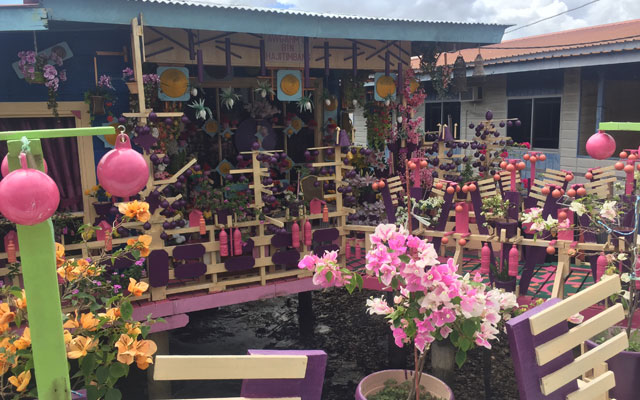
Perhaps the most flamboyant of the lot, the Pottery House stood out for me with its decorative knick-knacks and bold array of coloured blooms. Elsewhere, several rattan trays of sunbathing keropok udang slices greeted me at the prawn cracker maker’s house, where a 300g pack of prawn crackers goes for B$5.00 (US$3.70).
Further down the route, a cluster of boats-in-the-making ushered me into the boat maker’s abode. Aided by my group’s tour guide-slash-translator, we shoot the breeze with the boat maker’s helper, a wisp of a girl, who told us that it takes about a week to cobble together a boat, which is then sold for about B$30,000. As one-third of a boat-making trio and the only registered boat makers in the entire village, she called it “easy money” as compared to eking out a living on land.
My tour wrapped up with a visit to one of the locals’ houses, one of the most lavishly done up in the village, where we enjoyed local snacks like kuih cincin and kuih bahulu, paired with hot tea.
Verdict
An engaging history lesson and scenic jaunt rolled into one tranquil walking trail. With its storied past and picturesque surrounds, this tour will not only appeal to the trigger-happy millennial, but also the cultural buff keen to visit a national landmark with remnants of a bygone era.
Duration: Approximately two hours Rate: S$30 (US$22) Contact
Website: freme.com
Email: fremekub@brunet.bn
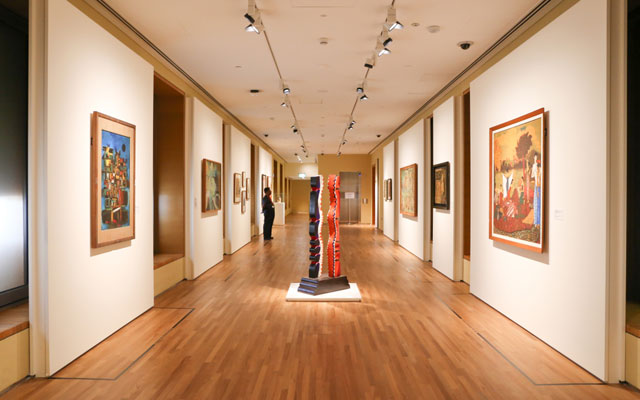
A previous exhibition on show at the National Gallery Singapore
Visitors to National Gallery Singapore (NGS) will be able to catch the works of some of the world’s most renowned artists, such as Pablo Picasso, Henri Matisse and Nam June Paik, at four international special art exhibitions slated to take place over the next four years.
Held in partnership with the Singapore Tourism Board and major art institutions around the world, the exhibitions are part of NGS’ efforts to introduce global art movements and artistic pioneers to Singapore and the region.
A previous exhibition on show at the National Gallery Singapore
First in the line-up is the three-month Matisse & Picasso exhibition, which will open in May 2020 as the only stop outside of Australia. Organised in partnership with the National Gallery of Australia, it tells the story of the duo’s artistic relationship and will feature works from around the world.
Slated to open in October 2021 is an exhibition featuring more than 200 works of Korean-American artist Nam June Paik, widely touted as the godfather of video art.
Organised in partnership with Tate Modern and San Francisco Museum of Modern Art, Singapore will be the only stop in Asia for the exhibition.
NGS director Eugene Tan said in a statement: “These exhibitions play a key role in opening visitors’ minds to important artists and artworks that have had a deep influence not only on the global art scene but also the development of modern art in Singapore and South-east Asia.
“They also continue our ongoing partnerships with international museums such as Centre Pompidou, Musée d’Orsay, and the Museum of Modern and Contemporary Art, Korea since the museum’s opening.”
Details about the other two exhibitions will be unveiled at a later date. All four exhibitions will be held at the Singtel Special Exhibition Gallery.
As the coronavirus continues to spread rapidly, airlines around the world are suspending flights to and from China, with some carriers extending the cancellation of all China flights until end-March.
Among the airlines cutting or cancelling flights to China are British Airways, Lufthansa, American Airlines, Finnair, Vietjet, United Airlines, KLM Royal Dutch Airlines, Delta Airlines, Air Asia, and AirSeoul.
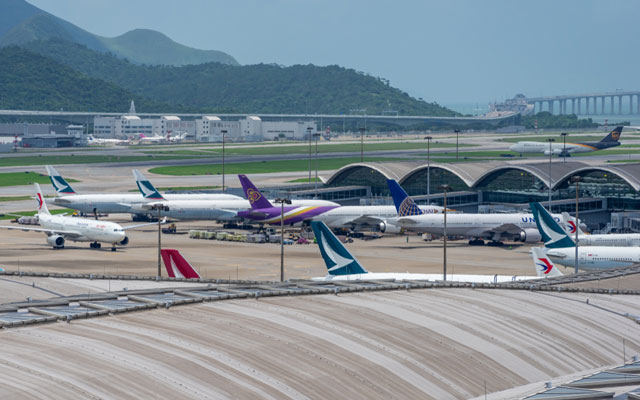
THAI Airways is the latest airline to cut flights to China in the wake of the coronavirus outbreak
On Saturday, the Philippines and Australia joined a growing list of countries that are imposing full or limited China travel bans.
Australia’s Qantas Airways and Air New Zealand (Air NZ) said that they were suspending direct flights from their countries to mainland China due to travel restrictions and a decline in forward bookings.
The Australian flag carrier will be halting flights from Sydney to Beijing and Sydney to Shanghai from February 9 until March 29. As well, Air NZ will be suspending its Auckland-Shanghai service over the same period.
Meanwhile, three Philippine airlines cancelled flights to China, following the authorities’ confirmation of the Philippines’ first case of coronavirus.
Philippine Airlines said it would cut the number of flights between Manila and China by more than 50 per cent, starting this month. It would continue to serve Filipinos and Chinese nationals returning from the Lunar New Year holidays, said the airline in a statement.
Cebu Pacific said it would also be cancelling all flights between the Philippines and mainland China from February 2 to March 29. Fellow LCC, Philippines AirAsia, said its flights to and from China, including Hong Kong and Macau, would be suspended until March 1.
Elsewhere, Hong Kong’s Cathay Pacific Airways is reducing the capacity of its flights to and from mainland China by 50 per cent or more, from January 30 to the end of March.
Indonesia’s Lion Air Group said on January 29 it would suspend all flights to China from February. The airline has suspended six flights from several Indonesian cities to China so far and will suspend the rest next month.
Two days later, Singapore Airlines announced reduced capacity on some of its routes to mainland China in February. The cuts include flights to Beijing, Shanghai, Guangzhou, Shenzhen, Chengdu, Xiamen and Chongqing, some of which are flown by regional arm SilkAir.
Scoot, SIA’s low-cost subsidiary, said it was suspending all flights between Singapore and China from February 8, according to media reports.
Jetstar has decided to temporarily suspend services to Hefei, Guiyang, Xuzhou, Shantou and Haikou until March 31, 2020. All scheduled services from Haikou to Singapore will operate from February 1, with the final flight scheduled for February 8, 2020. A reduced number of services from Shantou to Singapore will operate on February 1, 5 and 7 with the final flight on February 7, 2020.
Over in Malaysia, Sabah has temporarily suspended all scheduled and chartered flights from China to the state with immediate effect until further notice. However, the federal government has no plans yet to suspend all flights from China to Malaysia, according to media reports.
Malaysia has ordered a temporary suspension of incoming flights from Wuhan and Hubei province until the situation returns to normal.
As well, Vietnam has suspended all air travel to China, with national flag carrier Vietnam Airlines and budget carrier Vietjet suspending all flights to and from China from February 1. The airline continues to operate services to and from Hong Kong and Taiwan.
Earlier, Air India said it was cancelling its Mumbai-Delhi-Shanghai flight from January 31 to February 14.
Garuda Indonesia will also be temporarily halting all its flights to and from China as of February 5.
The airline has a total of 30 frequencies to China and the halted flights include those to Beijing, Shanghai, Guangzhou, Zhengzhou and Xi’an.
THAI Airways (THAI) said today it has adjusted its flight frequencies to China in order to match with current changes to flight demand.
Its Bangkok-Beijing-Bangkok route has been cut from twice a day to one daily flight, from February 8 to 29; while its Bangkok-Shanghai-Bangkok route has been reduced from two flights per day to once daily, from February 10 to 29.
Meanwhile, the carrier’s Bangkok-Guangzhou-Bangkok route has been slashed from two daily flights to one flight per day, from February 8 to 29. Its Bangkok-Chengdu-Bangkok route has been cut from seven flights per day to five flights per day, from February 6 to 27.
As well, THAI has reduced its Bangkok-Kunming-Bangkok route from seven flights per day to three flights per day, from February 6 to 29. On the Bangkok-Xiamen-Bangkok route, services have been reduced from four flights per day to two flights per day, from February 6 to 27.
China is facing deepening isolation from widening travel bans and flight suspensions, as total fatalities from coronavirus reach 304 as of Sunday, with the Philippines reporting the first case of death from the virus outside China.
Business devastation hardest in New South Wales, Victoria and Queensland – regions popular with the Chinese
Queensland state braces for losses of about A$1.3 billion (US$869 million) in annual income
Tourism dent expected to lead to wider economy and community issues
Australia’s tourism sector is facing a double whammy, with the coronavirus dealing a second blow and causing further disruption to an industry that’s still reeling from the damage caused by the bushfires.
China’s ban on outbound group travel led to about a quarter of all Chinese tourists to Australia cancelling their travel plans. This was followed by the Australian government’s decision over the weekend to ban all travellers from China, except for its own citizens and permanent residents. As well, Qantas Airways has suspended its two direct flights to China from February 9 to March 29.
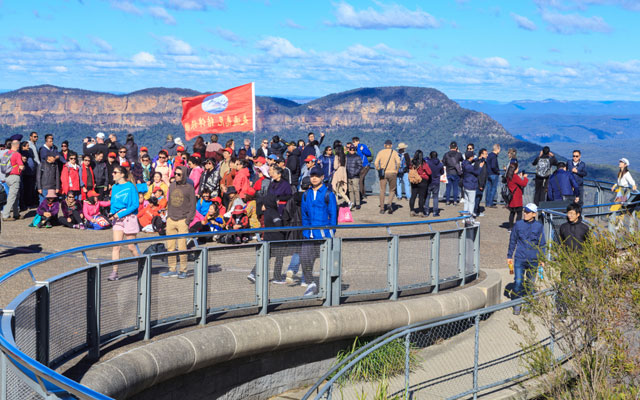
Australia’s tourism takes another hit from the economic fallout from coronavirus; group of Chinese tourists at Echo Point lookout in the Blue Mountains, Australia pictured
These latest developments could mean that things may take a turn for the worse before the situation improves for local tour operators.
Tourism businesses across the country are telling a tale of financial devastation and warn of wider impacts on businesses and communities. Unsurprisingly, the impact is being felt the keenest in locations that have been most popular among Chinese tourists, such as New South Wales, Victoria and Queensland.
Daniel Gschwind, CEO of the Queensland Tourism Industry Council, said: “We’re getting reports of mass cancellations and significant loss of revenue. I’m talking hundreds of thousands of dollars for individual businesses, and many millions of dollars for the state.”
“The (Chinese) market is very significant for Queensland, particularly for destinations like the Gold Coast, Brisbane and Cairns, where the overall Chinese market is about 500,000 visitors annually. A good portion of that is through January and February because of the Chinese New Year (holidays),” he added.
Gschwind believes the loss accounts for at least a quarter of about A$1.3 billion (US$869 million) in annual income to the state. “On the back of the bushfires, which also affected Queensland, (the Chinese travel restrictions) are pushing many businesses to the limit.
“We’re already hearing of staff layoffs in some businesses and significant concern over the revenue loss, not only revenue looking forward, but also the expectations for the (travel agents and tour guides) to refund pre-payments for any travel at the moment. So it is a very, very heavy blow to the tourism industry, obviously nationally, but particularly in Queensland.”
China is currently Australia’s largest source country, with short-term arrivals of 1.5 million up to June 2019, and spending to the tune of almost A$12 billion. Arrivals grew at a compound growth rate of 15 per cent a year since 2009, causing many tourism businesses to shift their focus to the country known as the world’s most significant tourism source.
“Australian tourism has become very reliant on China,” said director of the Griffith Institute for Tourism, Sarah Gardiner. “We probably haven’t seen the full impact of the current events (yet) … so we’re going to need some really strategic thinking and strategic actions to try to assist tourism businesses to navigate this very difficult period.”
Gardiner, who is based on the Gold Coast, said her anecdotal observations of tourism operators still paint a positive outlook for the Chinese market. “But I think we’ll see the full implications of this come through over the next few weeks,” she said.
“Interestingly, even before all of this happened, the (Australian) tourism industry was aware that it was becoming too reliant on China and so it was starting to shift towards other international markets such as the US and the UK. I just think this has probably added further weight to the idea that we need to diversify our mix of markets to make sure that we’re not overly reliant on one particular market,” she added.
But both Gardiner and Gschwind are upbeat that the tourism industry will bounce back swiftly from the coronavirus epidemic, citing the industry’s resilience during the post-SARS recovery phase in 2003. “In fact, there was even a bit of pent-up demand (during that period),” Gschwind said.
However, he added, in order to seize the opportunity when it comes, businesses need to be kept fully staffed and running. “But that is a big challenge because unlike other disasters, including the bushfires, where people can point at damaged infrastructure, we can’t see the physical damage (the coronavirus) has done to businesses. How we can directly support and make sure these businesses stay afloat is a big challenge.”
Gschwind also noted wider implications beyond tourism. “When income goes down, the whole community suffers (as) many of these regions are so heavily dependent on tourism. We may be on the frontline, but this is not just a tourism issue; it is an economy and community-wide issue,” he said.
The coronavirus’ impact on travel has also prompted a response from Australia’s tourism minister Simon Birmingham, who noted that the country’s seafood export sector and other high quality product suppliers that usually go to China as part of the Lunar New Year celebrations have also been hard hit.
“That’s why it’s more important than ever that we continue to pursue new trade opportunities, whether it’s with Indonesia, the European Union, India, or elsewhere,” he said.
Already, the Australian government has pledged A$76 million in funding for the tourism industry in response to the bushfire crisis. Birmingham said his department will now consult again to recalibrate investments where necessary in the wake of the coronavirus.
The twin impacts of the bushfires and coronavirus mean Australia is looking at “a pretty tough year in 2020,” said Gardiner. “But I’m confident that Tourism Australia and the industry are working quite hard to ensure Australia is high on the must-see tourist destination list. So I think moving forward, we’ll see some good recovery out of these visitor numbers.”
Singapore hotels can expect financial assistance for their environmental cleaning and disinfection costs, while hotels, travel agents and tourist guides will have their licence fees waived off this year, as part of the government’s effort to help tourism players cope with business challenges brought on by the ongoing flu outbreak.
As part of this initial package, hotels that provided accommodation to suspected and confirmed cases of Novel Coronavirus infections will get up to 50 per cent of third-party professional cleaning fees covered by STB, capped at S$20,000 (US$14,638) per establishment for hotels with confirmed cases; and S$10,000 per establishment for hotels with suspected cases.
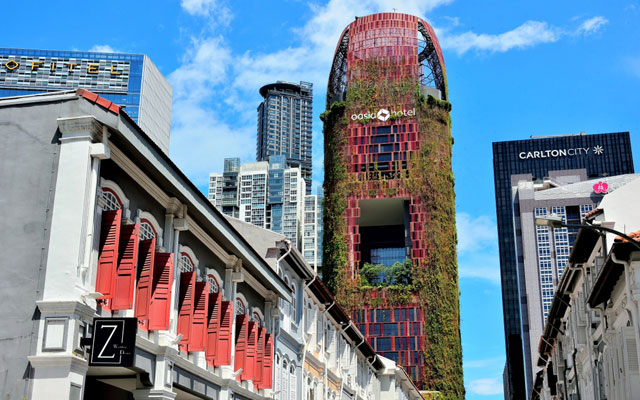
STB will subsidise cleaning costs of local hotels which housed suspected and confirmed cases of the coronavirus infections, including Oasia Hotel Downtown (above)
This will be backdated to January 23, when the first case of Novel Coronavirus infection in Singapore was detected.
Applications will open between February 10 and April 30, following which STB will assess the situation to see if further support is required. Hotels can email STB_Incentives@stb.gov.sg for more information.
In addition, the Hotels Licensing Board will waive licence fees for hotels for the rest of 2020. Applicants can email HLB_Secretariat@hlb.gov.sg.
Similarly, travel agents and tourist guides whose licenses are due for renewal in 2020 will not need to pay to renew their licence fees.
Full details of the overall package of relief measures will be announced at Budget 2020 on February 18.
The tourism sector has been directly affected by Novel Coronavirus, due to a decline in visitor arrivals, especially from China. Chinese tourists account for around 20 per cent of Singapore’s total international visitor arrivals, with about 3.6 million visitors to Singapore in 2019.
Keith Tan, CEO of STB, said in a statement: “Over the past week, STB has been in close contact with our tourism partners to understand their difficulties and to assess the impact. We know the situation is likely to persist, and recognise we need to move quickly to support the industry and build confidence. STB will continue to identify targeted and effective ways to support the tourism industry so that they are well-positioned to grow swiftly once we start to recover.”
As a firm demonstration of her health surveillance systems for disease control and confidence that activities can carry on as usual amid Novel Coronavirus incidents, Thailand will carry on with tourism events and activities that have been planned for this month and the next.
According to a statement from the Tourism Authority of Thailand (TAT), the event line-up includes Amazing Thailand Marathon Bangkok 2020 on February 2; GSB Thailand Open 2020 presented by EA from February 10-16 in Hua Hin; Honda LPGA Thailand 2020 from February 22-23 in Pattaya; and PTT Thailand Grand Prix 2020 MotoGP from March 20-22 in Buri Ram.
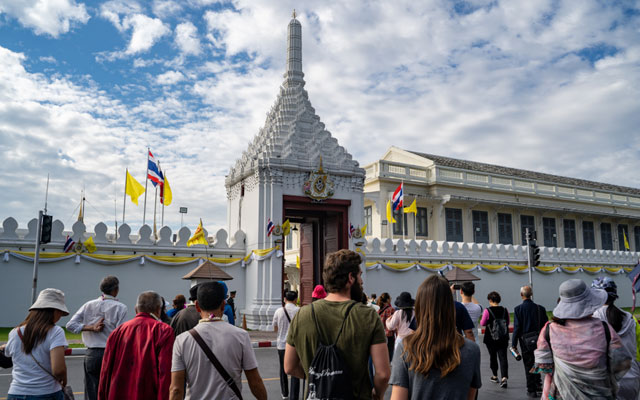
Thailand to march on with tourism events and activities as planned amid the coronavirus; tourists throng the Royal Grand Palace in Bangkok
While there hasn’t been a Novel Coronavirus outbreak in Thailand, TAT emphasises that Thailand is working with the World Health Organisation and other countries to further understand infections and to ensure that they are prevented and controlled.
To-date, the Ministry of Public Health has confirmed 14 cases in Thailand (13 Chinese and a Thai). Five of them (four Chinese and a Thai) have recovered and returned home. The other nine Chinese patients remain at medical facilities.
Thailand is implementing an intensive and unremitting screening and surveillance for the Novel Coronavirus, especially at international points of entry, including Suvarnabhumi, Don Mueang, Chiang Mai, Chiang Rai, Phuket and Krabi International Airports. The screening covers passengers and air crew on all flights from China. Nationwide medical labs have the ability to generate blood test results within three hours.
Supporting efforts taken by the health and immigration authorities, Thai public and private sectors have also stepped up hygiene measures. Airports, mass public transport, malls, hotels, and public areas have scheduled extra cleaning and disinfection and are providing hand sanitisers. Airlines are also conducting passenger screening, ground service measures and inflight service measures.
The Spanish city of Cáceres and Nepal’s Lumbini, the birthplace of Lord Buddha, will be supporting the building of a huge Buddhist statue and temple in Spain that is meant to serve as a symbol of world peace.
The project, which was presented on the opening day of Madrid’s Fitur tourism trade fair on January 22, is expected to be a big draw for Cáceres, especially among Asian tourists.
A huge Buddhist statue and temple will soon rise in Spain; Gran Via shopping street in Madrid, Spain pictured
Funded by the privately-owned Lumbini Garden Foundation, the project’s centrepiece will be a 40m-tall statue of a seated Buddha.
Planned for the outskirts of the city – some 290km southwest of Madrid – the site will also feature gardens, a library, relics of the Buddha, and a residence for 20 monks, according to the mayor of Cáceres, Luis Salaya.
While the city will provide the site, the Lumbini Garden Foundation is planning to cover the construction costs of the project, pegged at an estimated 25 million euros (US$27.5 million), through funding from various countries and private donors.
In an email interview, Lumbini Sanskritik Municipality mayor Manmohan Chaudhary said the project’s aim was “to broadcast the philosophy of peace, which is the message of the Buddha, throughout the world”.
The mayors of the two cities have already signed a twinning agreement, ahead of the project which is expected to get underway later this year.
Salaya opined that the project will be a chance for more Asian travellers to become acquainted with Cáceres. “It’s an important international business leap for the region, establishing direct relations with the Asian market, one that is so relevant today,” he said.
Accor has vowed to remove all single-use plastic items from its hotels by end-2022, as it joins the Global Tourism Plastics Initiative led by the United Nations Environment Programme (UNEP) and the World Tourism Organization, in collaboration with the Ellen MacArthur Foundation.
The move is part of the hotel group’s efforts towards reducing environmental impacts and strengthening efforts to combat plastic pollution of the world’s oceans and other natural environments.
Accor pledges to ban all single-use plastics from its hotels by end-2022
“Plastic pollution is one of the major environmental challenges of our time, and tourism has an important role to play in contributing to the solution,” said UNEP economy division director, Ligia Noronha.
“Through the Global Tourism Plastics Initiative, tourism companies and destinations are supported to innovate, eliminate, and circulate the way they use plastics, to advance circularity in our economies and reduce plastics pollution globally.”
In addition to Accor’s previous commitment to eliminate all plastic straws, stirrers and cotton buds, the company has also committed to the removal of individual plastic toiletry amenities and cups by the end of 2020, as well as the elimination of all remaining single-use plastic items in guestrooms, meeting areas, restaurants and all leisure activities areas (spas, fitness centres, etc.) by the end of 2022.
Relevant alternatives to plastic will be proposed for each specific item, considering Life Cycle Assessments to ensure better environmental performance for the solution proposed to its hotels, said Accor in a statement.
In addition, several Accor hotels within the group’s portfolio of brands – including Novotel Yangon Max, Myanmar; Sofitel Bogota; many hotels in Bali and Lombok, Indonesia; Ibis Styles São Paulo Anhem – have already taken steps individually to be plastic-free and are advancing towards a 100 per cent single-use plastic free objective.