WorldHotels announced the expansion of its leadership team with the appointment of Gregory Habeeb as president, North America.
For the past six years, Habeeb served as global vice president, hotel & hospitality, for British luxury fragrance brand Molton Brown.
From left: Gergory Habeeb, Melissa Gan
Prior to that, Habeeb held a number of positions in luxury hospitality organisations, before being appointed as the vice president of hotel development for WorldHotels.

Meanwhile, Melissa Gan has been promoted to managing director, Asia-Pacific, rounding out a team that continues to be supported by Asia-Pacific president Roland Jegge.
Gan joined WorldHotels in November 2005 and has been influential in growing the brand across the region.
Douglas Glen has joined Carlton City Hotel Singapore as general manager.
With over 30 years of extensive leadership and global luxury hospitality experience, Glen will be responsible for driving all key operations and strategic initiatives for the 386-room upscale business hotel’s continued growth in revenue and brand reputation.
Glen has successfully managed high-profile, five-star international chain hotels in the UK and South-east Asia. For over two decades, the Scotland-born hotelier held various management positions with The Landmark Lancaster Hotel Group.
During his stint as the general manager of The Landmark Bangkok from 2013 to 2018, he played a pivotal role in the overall growth and profit of the five-star hotel, effectively developing a cross-functional culture for continuous improvement.
Prior to joining Carlton City Hotel Singapore in April 2019, Glen was most recently pre-opening general manager for the Steigenberger Hotel Riverside in Bangkok.
Operations have restarted at Hong Kong International Airport (HKIA) early Tuesday morning, a day after a massive pro-democracy protest forced its abrupt closure yesterday and stranded thousands of passengers at one of the world’s busiest transportation hubs.
Check-ins had resumed early today at the departures hall and information boards showed several flights were boarding soon or about to depart, according to a AFP report. Only a number of demonstrators remained in the airport, though protestors have said they plan to resume their demonstrations at the airport later today, the report added.
A mass protest led to the forced shutdown of HKIA on Monday evening
According to a South China Morning Post (SCMP) report, the Hong Kong Airport Authority announced the cancellation of all flights after 18:00 local time yesterday due to the mass protest. About 180 outbound flights and 45 inbound flights were cancelled, said the SCMP report, but a lack of information from airlines resulted in many passengers continuing to arrive at the airport unaware of the cancellations.
The sudden closure of HKIA also left Asian airlines grappling with the fallout, with Singapore Airlines and its subsidiary Scoot, as well as the Philippines’ Cebu Pacific and Malaysia Airlines among carriers forced to re-route or turn their flights back to their country of origin, SCMP reported.
HK Express had yesterday issued a travel advisory on the disruption of airport operations at HKIA due to the public protest, resulting in the cancellation of some HK Express flights between August 12 and 13.
The airport closure was the latest in Hong Kong’s ongoing anti-government protests, which show no signs of abating more than two months after they were sparked by a controversial extradition bill but has since morphed into wider resistance against encroaching control from Beijing.
Although Hong Kong tourism authorities insist it is safe to travel to the city and many attractions remain open, many governments have increased their safety alerts for Hong Kong in recent weeks.
A travel advisory issued by Singapore’s Ministry of Foreign Affairs advised Singaporeans “to avoid any reported locations of upcoming protest rallies and other large public gatherings”.
The US State Department has issued a level two travel advisory for Hong Kong, warning travellers to “exercise increased caution in Hong Kong due to civil unrest.”
Destination Asia Hong Kong has issued a newsletter to clients that it is monitoring the situation closely and is in close contact with all agents with guests on the ground or scheduled to arrive in coming days.
AirAsia has since last Thursday started collecting the increased passenger service charge (PSC) of RM73 (US$17) levied by Malaysia Airports Holdings Berhad (MAHB), following a recent court ruling.
In a statement, the airline said that it will be doing so “under protest”, after losing a lawsuit against MAHB.
AirAsia has begun collecting the increased passenger service charge (PSC) of RM73 (US$17)
In July, the Kuala Lumpur High Court had dismissed AirAsia and AirAsia X’s striking out application in relation to the payment for outstanding PSC to Malaysia Airports (Sepang) (MASSB), a subsidiary of MAHB. The airline subsequently appealed against the order to pay RM41.5 million (US$9.9 million) of arrears to MAHB.
PSC, or airport tax, is charged by MAHB on all departing passengers for the use of airport facilities, and is collected by airlines such as AirAsia on behalf of the airport operator.
MAHB had imposed a higher PSC of RM73 on passengers using klia2 to destinations beyond South-east Asia, stating that it was implementing the same charges as at the full-service terminal KLIA, effective July 2018.
The new PSC was higher than the previous rate of RM50, and AirAsia had refused to collect the additional RM23 from its guests, saying that it was ensuring air travel remains affordable for all, and also that the inferior service and facilities at klia2 could not match up to those at the KLIA.
In February, AirAsia had sued MASSB for almost RM480 million (US$117 million) for supposed losses incurred from operating at klia2.
Following this latest development, AirAsia will now collect the additional RM23 in PSC, and the differential amount will be clearly indicated in the itemised fare as “PSC (Under Protest)”.
AirAsia Malaysia CEO, Riad Asmat, said: “We will collect the full RM73 PSC but we do so under strong protest. Itemising the additional PSC will allow our 5.5 million guests departing from klia2 for non-ASEAN destinations annually to see how much they’re paying for inferior facilities. I believe many will agree with us that they’re not getting their money’s worth, especially when compared to the far superior facilities at KLIA.”
AirAsia X Malaysia CEO, Benyamin Ismail, added: “We really don’t want to be (collecting the PSC), and we sympathise with our guests. PSC for passengers flying beyond ASEAN has more than doubled in less than two years, from RM32 to RM73.”
He added: “This is an arbitrary hike and we will continue to oppose it until all our legal options are exhausted. However, we are forced to collect the additional RM23 as we cannot afford to continue subsidising our guests in the event our appeal falls through. We hope our guests will understand.”
This new ruling culminates the months-long contentious dispute between AirAsia and MAHB over the PSC.
Advanced flight bookings to airports around the holy city of Mecca ahead of this year’s Hajj have rose from Asia, Europe and Oceania, according to a Travelport report, even as bookings from North America are flat on last year and travel from South America and Africa is slightly down on 2018 numbers.
As part of its study, Travelport analysed bookings made through all GDSs to King Abdulaziz International Airport, Ta’if Regional Airport and Prince Mohammed Bin Abdulaziz International Airport, as of July 21, 2019, arriving from July 9, 2019 to August 8, 2019. The company then ran comparable data for last year’s Hajj, so trends could be identified.
According to Travelport data, Asia recorded the greatest growth in flight bookings made through GDS to airports around Mecca this year in terms of volume, with bookings up by 11,284 (+5 per cent).
Overall, bookings made in Asia represented 64 per cent of total bookings globally.
On a country level, the greatest growth came from Bangladesh, with bookings up by 13,906 (+171 per cent). The South Asian country is one of five countries (Bangladesh, Indonesia, Pakistan, Malaysia and Tunisia) benefiting from the Mecca Route initiative, a new service offering immigration pre-clearance for pilgrims at their points of embarkation.
The UAE recorded the second highest rise, up 3,981 (+17 per cent); followed by Qatar, up 3,278 (+217 per cent), a country where pilgrims can now register for their Hajj using dedicated “electronic gates”.
The greatest number of flight bookings made through GDS in Asia were made in India (44,611).
Damian Hickey, global vice president and global head of air travel partners at Travelport, said: “There are many things that influence the decision to travel, especially when it comes to something as personal as performing the Hajj. For some, economic conditions and increased allocations from the government in Saudi Arabia could make this year the ideal time for this once-in-a-lifetime opportunity. Others may be looking at their situation and thinking that it might be better to wait. This diversity of push and pull factors was certainly evident in the travel trends that we’ve seen around the globe.”
Hickey added: “In recent years, we have seen an increase in efforts to introduce policies and technologies that make the Hajj, which has often been compared to hosting an Olympics Games each year, a more convenient experience for the global Islamic community. Our analysis suggests that these initiatives may well be having a tangible impact, which is encouraging from a technological standpoint.”
Every year, more than one million people from all over the world fly into western Saudi Arabia to perform Hajj, making it one of the largest annual spikes in global air traffic. To manage numbers from overseas, Saudi Arabia sets quotas for countries based on their Muslim population. Local governments and licensed private travel companies then begin allocating places for citizens.
UK operator Healing Holidays (HH) has planted its first overseas office in Singapore, as it seeks to fill the gap in Asia’s lack of specialist wellness travel companies.
The new Singapore branch offers wellness solutions to consumers from across Asia, Australia and the west coast of the US, making wellness holidays more accessible to these local markets. The branch will also work at sourcing and securing new wellness properties in this region, ensuring that they meet the standards required to join HH’s portfolio.
Healing Holidays opens its first overseas office in Singapore
The Singapore office will be headed by Claire Bostock, previously chief business officer at the Absolute Sanctuary resort in Thailand, who will work closely with the head office in the UK.
“Wellness is rooted deeply in Asian tradition and lifestyle, and in the last few years, there has been an increasing interest from the region in Wellness travel,” said Bostock, adding that the company “is very well placed to cater to this growing demand”.
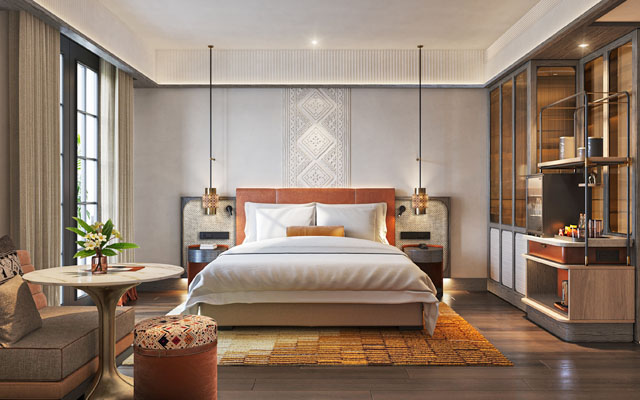
Cambodia will welcome its first property under the Autograph Collection Hotels, Marriott International’s portfolio of more than 170 independent hotels around the world, when The KHŌM Hotel opens in Phnom Penh come early 2022.
Centrally located in Phnom Penh on Oknha Suor Srun Street off Preah Suramarit Boulevard, the 130-key property will bring in a selection of culinary options, including a themed specialty restaurant, a casual café and an all-day dining restaurant featuring a semi-open kitchen and flexible buffet set-up. There will also be a Sky Lounge and Bar overlooking the Royal Palace, Independence Monument and Mekong River in the east.
Autograph Collection will be making its Cambodia debut with The KHŌM Hotel in Phnom Penh
The hotel will also boast an outdoor pool with a sun deck and bar, as well as a fully-equipped fitness centre. A full menu of spa treatments will also be available at The Spa’s curated private treatment rooms, while meeting facilities will include intimate, flexible-layout function spaces.
Marriott will be partnering with Wywaza Investment to introduce The KHŌM Hotel into Cambodia.
A free online service now allows guests at any hotel in the world to snag room upgrades at possibly a fraction of its original cost. Upgradus, which has launched in Asia, works with hotels to offer upgrades on empty premium rooms and suites at last-minute discounts.
Most hotels currently do not offer a paid upgrade for various reasons, whether it’s the lack of communication between guests and front desk staff, concerns over that offering room upgrades to guests may impede on the hotel’s efficiency and slow down the check-in process, or that the front desk staff are also generally not trained, authorised or incentivised to offer upgrades, according to Upgradus.
Upgradus allows hotel guests to score room upgrades at heavily-discounted prices
With its service, Upgradus allows hotels to directly offer upgrades to their guests in advance, during the period after booking and before arrival. Users simply log on to the company’s website, enter their hotel booking details and wait for Upgradus to get back with a discounted upgrade offer. Guests can then choose to claim the offer and make payment upon arrival at the hotel.
Guy Ratcliffe, CEO and founder of Upgradus, said: “Globally, hotel occupancy is around 67 per cent. Occupancy for premium rooms and suites is generally much lower, with some suites having occupancy rates of less than 25 per cent. This means that most hotels have empty premium rooms for most of the year.”
With Upgradus, Ratcliffe said hoteliers can better tap the revenue potential of offering room upgrades to guests.
He added: “Selling discounted upgrades to these rooms could easily add more than US$1 billion to the US$570 billion hotel market. So I thought resolving this problem is surely a ‘win-win’ (situation).”
Radisson Hotel Group has announced the signing of a new Radisson property in Thailand, located on Phuket’s sunset coast, in partnership with Thai-Chinese Property Holdings.
Set to open in 1Q2023, Radisson Phuket Mai Khao Beach will feature 222 rooms and suites. A collection of ground floor rooms will offer direct access to the property’s outdoor pool, and more than 20 of the rooms and suites will feature private pools.
Radisson Hotel Group has signed a new agreement with Thai-Chinese Property Holdings for a new Radisson property on Phuket’s Mai Khao Beach
The hotel will also feature a large outdoor lagoon pool, a fitness centre, a kid’s club and dining options, including an all-day dining destination, a specialty restaurant and a lobby lounge. The property will also be able to host events, with two meeting rooms and a business centre.
Under a sale and leaseback arrangement, investors will be able to purchase units at Radisson Phuket Mai Khao Beach. The units will be put into a mandatory rental programme, while the operations of the property will be managed by Radisson Hotel Group.
Currently, the group operates four hotels in Bangkok: Radisson Blu Plaza Bangkok, Radisson Suites Bangkok Sukhumvit, Park Plaza Bangkok Soi 18 and Park Plaza Sukhumvit Hotel.
With the Chinese outbound travel market continuing its upward growth trajectory, major tourism boards around the world will be targeting China’s high-end travel agents at ILTM China 2019, taking place in Shanghai from October 30 to November 1, 2019.
According to Agility Research, travel is the most popular item to spend money on among the affluent Chinese who are travelling more luxuriously, and further and further away from the mainland and Hong Kong. ILTM China 2019 will once again be the platform for their luxury travel agents to research these opportunities on behalf of their clients.
More NTOs will be targeting Chinese luxury travellers at ILTM China 2019
According to the UNWTO, Chinese tourists overseas spent $277.3 billion in 2018, up from $10 billion in 2000. Over the same period, US’s travellers parted with $144.2 billion.
The China Outbound Tourism Research Institute (COTRI) predicts that the total number of Chinese outbound trips will reach more than 400 million by 2030, a significant increase from 149.7 million in 2018.
In a similar vein, the 149.7 million overseas trips made by Chinese residents in 2018 was a 1,326 per cent rise from 2001 when the figure was 10.5 million. By 2030, this figure is projected to reach 400 million – a surge of almost 4,000 per cent – and will account for a quarter of international tourism.
Andy Ventris, event manager, ILTM China, said: “The proven growth in Chinese outbound travel is there for all to see, but we also realise that just nine per cent of Chinese travellers (120 million people) own a passport compared to 40 per cent of Americans and 76 per cent of Britons. Clearly the potential for further growth – China’s population is 1.42 billion – is staggering and ILTM China has been created to support today’s Chinese luxury traveller by introducing their travel agents to a new world of international travel.”
ILTM China said its first edition in 2018 saw a demand from hosted Chinese luxury agents for Australasia, South-east Asia, Northern Europe and North America. Thailand, Japan, Vietnam, Sri Lanka and Singapore are also among the top 10 destinations for Chinese tourists, with the US and Italy completing the list.
Since 2013, Sri Lanka has seen steady growth from the high-end Chinese market. John Amaratunaga, minister of tourism for Sri Lanka, who will be taking part in ILTM China again, said: “As a country, we have worked to add luxurious boutique properties with personalised DMC services, as well as bespoke shopping experiences, to specifically attract high-end tourists from China.”
Similarly, many other tourist boards are taking proactive measures in wooing China’s expanding army of high-end travellers. With this focus in mind, Berlin, Canada, Greece, Vienna, Berlin, Monaco, Dubai, Italy, New York and Spain have signed up to attend ILTM China.
Christina Freisleben of the Vienna Tourist Board, said: “At ILTM China, we know we will connect with travel designers and concierge services who design tailor-made itineraries rather than packages.”
Yannis Plexousakis, director of the Greek National Tourism Association in China, said: “Greece’s inbound tourist arrivals from China increased by 35 per cent in 2017 and 25 per cent in 2018 – in fact, almost 400 per cent in total since 2012. The Chinese luxury traveller is a key focus for us due to their high spending, their ability to travel all year round and the fact that they often combine tourism with other investments. ILTM China is therefore essential in our marketing strategy.”