TTG Asia
Asia/Singapore Tuesday, 20th January 2026
Page 1063

Amadeus, Egencia representatives round up NDC panel at 2nd SG Tourism Leaders Engagement Series

0

Frederic Saunier, director, airline distribution, Asia Pacific, Amadeus and Charles Wong, director, supplier relations, Egencia, Expedia Group have confirmed their commitment to the New Distribution Capability (NDC) panel at the upcoming second SG Tourism Leaders Engagement Series, where they will connect with an intimate-sized audience to discuss updates on NDC development and airline retailing.

The fireside chat will be moderated by Bineetha Mohanan, International Air Transport Association’s (IATA) Asia-Pacific head of customer services.

From left: Amadeus’ Frederic Saunier and Egencia’s Charles Wong will be part of the NDC panel at the second SG Tourism Leaders Engagement Series

The NDC panel makes up part two of the second SG Tourism Leaders Engagement Series, which takes an aviation focus. It is organised by PATA Singapore Chapter and co-presented by TTG Asia Media, with IATA as programme partner.

The first panel will provide an Asia-Pacific aviation outlook through the eyes of panelists Vinoop Goel, IATA’s Asia-Pacific regional director of airports & external relations; Lim Ching Kiat, Changi Airport Group’s managing director, air hub development; Chang Chee Pey, Singapore Tourism Board’s assistant chief executive, international group; and Wong Soon-Hwa, PATA Singapore Chapter chair and PATA vice chair.

Wong said: “We are delighted to have such a distinguished group of thought leaders to share their valuable insights on these two very important topics.”

In line with its theme, the second SG Tourism Leaders Engagement Series will be held on February 11, 2020 at Changi Experience Studio @ Jewel from 15.00 to 18.00. The event will kick off with a valuable hour-long networking reception.

Registration for the event is now open.

This is a complimentary event with limited capacity. Confirmation of registration is on a first-come-first-served basis, and successful registrants will be notified by email.

Sabah Tourism Board gets a new Enchanting look

0

Sabah Tourism Board (STB) has launched its new brand, Enchanting Sabah, which has been featured in promotional collateral conceptualised by STB’s communication and digital division since January 1, 2020.

STB’s chairman Ken Pan said: “Sabah has always been known as an eco-destination way before the term ‘eco’ became popularised and I believe we have achieved maturity in this sense. The conservation efforts in Sabah should be commended from having the Sepilok Orang Utan Rehabilitation Center which has been in operation since 1964, Selingan Island Turtle Hatchery since 1977 and, of course, in the recent years, the Bornean Sun Bear Conservation Center and soon to come, a Pangolin Sanctuary.”

“Consistent branding helps with visibility in the sphere of marketing and advertising. Sabah Tourism constantly finds cost-effective yet impactful marketing activities in order to achieve our destination promotion. The move to create brand sentiment will help the public recognise a Sabah advert when placed either in mainstream media or online. It’s now time to showcase and highlight the Enchanting elements of Sabah,” added Noredah Othman, general manager of STB.

As part of its marketing efforts, STB plans to roll out new promotional collateral throughout the year.

Garuda gets new CEO in leadership shake-up

0

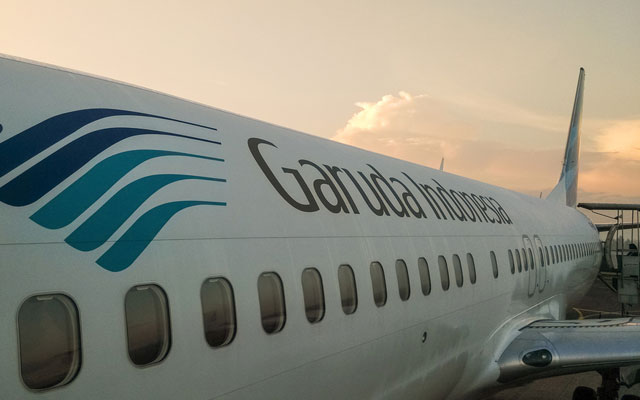
Garuda Indonesia has appointed former telecom executive Irfan Setiaputra as its new president director, after the airline’s previous chief executive was fired over allegedly smuggling a Harley Davidson motorcycle on a Jakarta-bound flight.

Irfan was formerly the CEO of Sigfox Indonesia, an Internet of Things network management company, and has also served as chief of state-owned Industri Telekomunikasi Indonesia.

Garuda names new chief following firing of previous CEO over smuggling scandal

At an extraordinary general meeting held in Jakarta on Wednesday (January 22), shareholders of Indonesia’s flag carrier also decided on a major shake-up of the management team in a bid to repair its reputation.

Garuda’s board of directors now comprises Irfan as president director, Dony Oskaria as deputy chief executive; Rizal Pahlevi as commerce and cargo director; Tumpal Manumpak Hutapea as operations director; Rahmat Hanafi as technical director; Ade Susardi as services, business development and IT director; and Aryaperwira Adileksana as human capital director. Fuad Rizal, who was appointed interim managing director, remains as finance chief.

Aviation roundup: Shanghai Airlines, Qatar and more

0

JAL inks codeshare deal with Shanghai Airlines

Japan Airlines (JAL) has signed a codeshare agreement with Shanghai Airlines to expand the carrier’s international network in China.

The partnership will add two routes to JAL’s international network, which includes flights between Shanghai Pudong and Osaka Kansai airport, as well as Toyama airport. Both codeshare flights will be operated by Shanghai Airlines.

LOT flies to Beijing

LOT Polish Airlines has started four-times-weekly flights between Beijing Daxing International Airport and Warsaw Chopin Airport.

The route is operated using a Boeing 787 Dreamliner, with a flight time of less than nine hours.

LO89 departs Warsaw at 22.40 on Mondays, Wednesdays, Fridays and Saturdays, and arrives in Beijing at 14.20 the following day. The return flight LO91 leaves Warsaw at 14.55 on Tuesdays, Thursdays and Sundays, and touches down in Beijing at 06.35.

LO90 departs Beijing at 16.00 on Tuesdays, Thursdays, Saturdays and Sundays, and arrives in Warsaw at 18.45 the following day. The return flight LO92 departs Beijing at 08.45 to land in Warsaw at 11.30.

Qatar adds eight destinations to network

Qatar Airways will be adding eight new destinations to its network from Doha this year.

The Middle Eastern carrier will begin twice-weekly flights to Kazakhstan’s capital Nur-Sultan, starting March 30, followed by twice-weekly flights to Almaty, also in Kazakhstan, starting April 1. The latter will be increased to four-times-weekly flights from May 25.

Thrice-weekly flights to Cebu in the Philippines will start April 8, followed by daily flights to Accra, capital of Ghana, beginning April 15. As well, thrice-weekly flights to Trabzon in Turkey will begin May 20, while flights to Lyon in France will be operated five times per week, starting June 23.

Qatar will also operate a four-times-weekly service to Luanda, capital of Angola, starting October 14; followed by a five-times-weekly service to Siem Reap in Cambodia from November 16.

AirAsia takes off for Chengdu

AirAsia will be starting thrice-weekly flights between Penang and Chengdu, the capital city of Sichuan Province, China, from March 8, 2020.

Besides Chengdu, AirAsia currently flies to 12 destinations from its Penang hub, namely, Bangkok, Ho Chi Minh City, Surabaya, Jakarta, Medan, Singapore, Kuala Lumpur, Johor Bahru, Langkawi, Melaka, Kota Kinabalu and Kuching.

Vietjet connects Da Lat to Seoul

Vietjet has launched Da Lat-Seoul flights, further expanding its network to North-east Asia.

The Da Lat-Seoul (Incheon) route will operate four-times-weekly starting January 15, 2020. The flight departs Da Lat at 17.10 and arrives in Incheon at 23.55, while the return flight takes off from Incheon at 14.30 and lands in Da Lat at 17.50.

TTG Asia goes on Lunar New Year break

0

TTG Asia e-daily will be taking a break from January 24-28, 2020 for the Lunar New Year holidays. News will resume on Wednesday, January 29, 2020.

From all of us at TTG Asia Media, we wish all of our readers a happy and prosperous Year of the Rat!

Hotel deals tapering off in Thailand: JLL

0

The hotel deal market in Thailand is expected to cool off after some very productive years, as the appreciating baht puts foreign investors off combined with the limited number of stock available on the market.

This and more were revealed during the Thailand Tourism Forum 2020, as part of a hotel investment markets analysis presented by Chakkrit Paul Chakrabandhu Na Ayudhya, executive vice president – investment sales, Asia, JLL Hotels & Hospitality Group.

JLL Hotels & Hospitality Group’s Chakkrit Paul Chakrabandhu Na Ayudhya addresses the audience at Thailand Tourism Forum 2020

“Last year was a very big year for hotel transactions. It was the biggest year ever, and we (JLL) recorded US$12 billion in hotel transactions (in Asia). Thailand had two very good years in 2017-2018; the latter was a record year. But in 2019, Thailand only accounted for about one per cent (equivalent to US$120 million) of overall transactions in Asia,” stated Chakkrit.

Chakkrit said 2019’s performance was the lowest for Thai markets since 2009.

He attributed the baht appreciation sidelining some foreign investors, alongside a limited number of options, as reasons for the drop in activity and trading performance.

Despite a drop in transactions, Chakkrit noted there was continued demand from domestic investors, as well as numerous enquiries on Bangkok in 2019. Residential developers are entering into hotels as well, while foreign buyers are currently monitoring the market cap.

Furthermore, several Thailand deals that were signed in 2019 will be closed in 2020, with JLL anticipating 10 to 12 billion baht in Thai transactions this year. There were also 23.2 per cent leasehold transactions in 2019, which JLL anticipates more of such to occur as Bangkok hotels become more expensive.

In terms of current demand, JLL still sees Bangkok is still the number one most sought-after market in Thailand.

Chakkrit elaborated: “It’s still an attractive destination from a price-to-key perspective; we’ve done a comparison within the upscale segment, and Bangkok is still two to four times less expensive than other major Asian markets. Overall, Bangkok, Phuket and Samui will remain the top three most sought-after destinations, although we do anticipate a hunt for higher yields outside the top three markets – for example, Chiang Mai, Phang Nga and Krabi.”

Compared to the rest of the region, Bangkok’s indicative yield is about 5.5 to 6.25 per cent. When compared to other major Asian cities, Bangkok provides about two per cent higher yield.

“However, if you look at onshore borrowings in some of those countries, especially Japan, you would actually have a higher spread between yield and cost of borrowing, which is why Japan has been very, very active. Japan remains the most liquid market given the robust fundamentals ahead of the Tokyo Olympics,” Chakkrit added.

Indonesia undergoes infrastructure facelift; targets high-end travellers

0
Wishnutama: sharper focus on quality instead of quantity in tourism sector

Indonesia’s Ministry of Tourism and Creative Economy (MoTCE) is focusing on attracting high-end travellers by targeting business events and special interest tourists such as sports tourism, ecotourism and cruise tourism.

The government will also work to create and attract international quality events such as musical performances in the country.

Wishnutama: sharper focus on quality instead of quantity in tourism sector

Wishnutama Kusubandio, Indonesia’s minister of tourism and creative economy and head of Tourism and Creative Economy Board, said: “Indonesia’s tourism industry is undertaking a transformation from quantity to quality. We will no longer focus on the number of travellers but on the revenue generated by tourists.”

Based on president Joko Widodo’s direction, each of the five super priority destinations – Lake Toba (North Sumatera), Labuan Bajo (East Nusa Tenggara), Borobudur (Central Java), Mandalika (Lombok) and Likupang (North Sulawesi) – are being developed to cater for different market segments, like super-premium, premium, middle and budget.

“The president’s direction for Labuan Bajo, for example, is to develop it into a super premium destination,” Wishnutama said.

Apart from developing the infrastructure, the MoTCE will start promoting the super-priority destinations creatively.

“I want the five destinations to have quality events on an international scale, with (an element) of creativity that involves the local community, so as to uplift the image of the destinations and (boost) Indonesia’s reputation,” he added.

Now that the creative economy sector is part of his portfolio, both the tourism and creative sectors can support each others’ growth, the minister said.

“The ministry is developing the creative industries, (including cultural villages). We are also creating creative hubs at the five destinations to explore and develop each destination’s creative and economic potential,” he added.

Working with the Ministry of Public Works and Housing, the tourism authority will be establishing the creative hub in Pusat Waringin, Labuan Bajo, and East Nusa Tenggara, with more to follow in other destinations.

The government has targeted for arrivals to hit 17.3 million and revenue to reach US$21 billion for 2020, and by 2024, 22.3 million arrivals, and revenue of US$30 billion.

Brunei’s natural wonders beckon tourists

0
Tourists boating in Ulu Temburong National Park

Brunei’s offerings of nature and adventure are whetting the appetite of agents seeking new destinations for clients.

Heldur Allese, chairman of the board for Fiesta Reisid in Estonia, is looking for new spots in South-east Asia that will appeal to clients who have tired of Thailand, Singapore, Malaysia and Indonesia.

Tourists boating in Ulu Temburong National Park

“Brunei is a good alternative. It is blessed with a lot of natural attractions like forests, and has nice beach areas,” Allese said.

Dubbed the green jewel of Brunei, the Temburong district boasts pristine rainforest teeming with tropical flora and fauna, the protected Peradayan Forest Reserve, Ulu Temburong National Park and Sumbiling Eco Village.

Gay Solidum, business development manager at Travelpeople in the Philippines, said this natural beauty relatively untainted by tourism will appeal to clients. She plans to sell Brunei as a new destination to corporate groups seeking alternatives to traditional South-east Asian hotspots like Thailand.

Solidum said the country’s bounty of nature and adventure offerings makes it ideal for the company’s target market of incentive travellers aged between 25 and 30.

Likewise, Kyaw Pyay Oo, managing director of Asian Tour in Myanmar, said that his company will push Brunei to feed clients’ demand for undiscovered gems, as the country’s outbound market continues to grow exponentially.

“Brunei is a new destination for us. Here, they can see amazing greenery and explore the natural rainforest,” he said.

Also eyeing more outbound traffic to Brunei is Pattanee Sthitirata, managing director of Thailand-based Trail of Asia. She noted: “Brunei is interesting for specific groups. Apart from Muslim groups, it may appeal to groups looking for a nature-based trip.”

Longhaul multigenerational groups on the rise in SE Asia

0
Multigenerational trips

Multigenerational families from longhaul markets are holidaying in South-east Asia with evolved requirements, observed travel specialists at ATF 2020, with clients now prioritising experiences and activities that can be enjoyed together.

In the past, family groups from the Western markets tended to favour separate activities, often with parents and grandparents happy to leave their young with the resort’s kids’ club.

A multigenerational family having a splash of a time together

Mohammad Zaki, president of RZ Travels US, said: “We have seen a growing number of multigenerational travellers taking bonding trips. Ten to 12 family members will travel together, after having saved their money over a period of time, with the intention of creating a lifetime memory.”

Cruises, safari tours and theme parks are on the top of these travellers’ list, and Zaki named Singapore, Bangkok and Malaysia as destinations with the richest multigeneration family offerings.

While some theme park rides may not be suitable for aged travellers, Mohammad Zaki shared that “grandparents find joy in seeing their grandchildren having fun”.

Direct services between the US and Singapore by Singapore Airlines and United Airlines have contributed to the rise in such business opportunities, he added.

Seeing the same trend is Andi Rusli, director of business development with Panorama Destination Indonesia. His company has handled several family groups from the Netherlands, France and Switzerland.

Multigenerational family tours from the Netherlands were largely led by grandparents who used to live as children in Indonesia, Andi explained.

“They wanted to show both their children and grandchildren the places they used to live in and explore when they were little,” he said.

From France and Switzerland, multigenerational family tours tended to be in celebration of wedding anniversaries or birthdays.

“There is usually one appointed coordinator in the family who will create a loose itinerary to suit everyone in the family, and to liaise with the local tour guide,” said Andi. Such groups tended to confirm accommodation and general destinations ahead of time, but allowed flexibility in daily activities.

APAC set to welcome one billion international arrivals: PATA

0

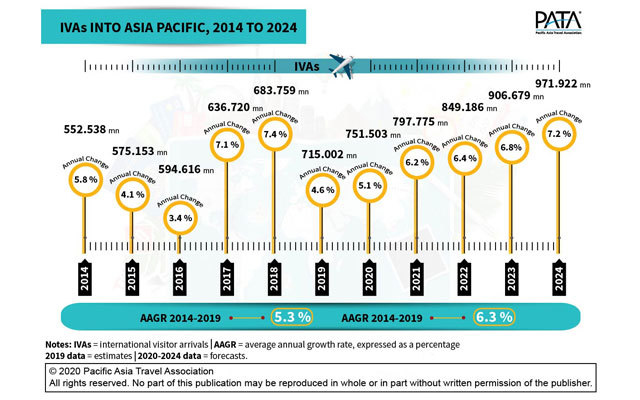
Asia-Pacific remains solidly on the path to welcome close to one billion international visitor arrivals (IVAs) over the next five years. This was one of the key predictions from the Executive Summary of the Asia Pacific Visitor Forecasts 2020-2024, released yesterday by the Pacific Asia Travel Association (PATA). Covering the years 2019 to 2024 and 39 destinations within the region, these forecasts anticipate a volume of over 971 million international visitor arrivals into Asia-Pacific, by 2024.
The strong increase in IVAs has been driven by the average annual growth rate (AAGR) of 5.3% between 2014 and 2019, and that momentum is expected to increase even further over the next five years, to average 6.3% per annum between 2019 and 2024.

This will result in an acceleration of more than 256 million additional IVAs into the region between 2019 and 2024, a significant increase over the additional volume of 162 million added between 2014 and 2019.

The distribution of these IVAs in Asia-Pacific is expected to change only marginally from 2019, with the Asia and Pacific regions expected to show some relative, as well as absolute increases in arrival numbers.

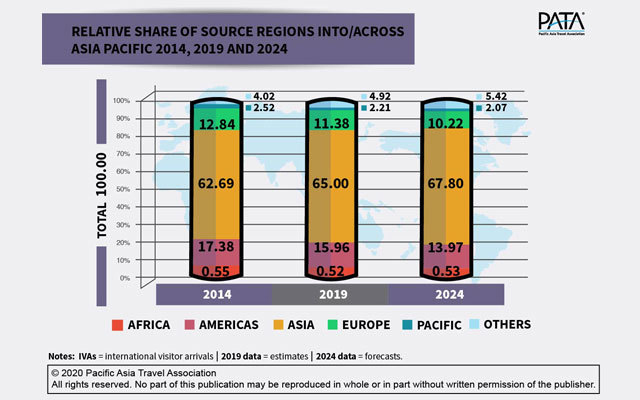
Asia is forecast to remain as the dominant destination region and is likely to improve its relative share to over 77% by 2024. The Americas will come in second, although its share is expected to reduce slightly over the period between 2019 and 2024.
As a generator of IVAs into and across Asia-Pacific however, Asia is predicted to continue growing in relative share, accounting for almost 68% of all IVAs into the region in 2024. This is likely to be at the expense of both the Americas and Europe, both of which are predicted to wane, at least in terms of their respective shares as source regions for Asia-Pacific, between 2014 and 2024.
Eleven Asia-Pacific destinations are predicted to each receive more than 10 million additional IVAs between 2019 and 2024, with China leading the way, expecting to add around 38.2 million more arrivals to its inbound count and raising the aggregate volume to almost 208 million in 2024.

Japan is ranked next, followed by Macau, China and then Mexico, with all of these destinations expected to receive more than 20 million additional foreign arrivals each, over the forecast period to 2024.
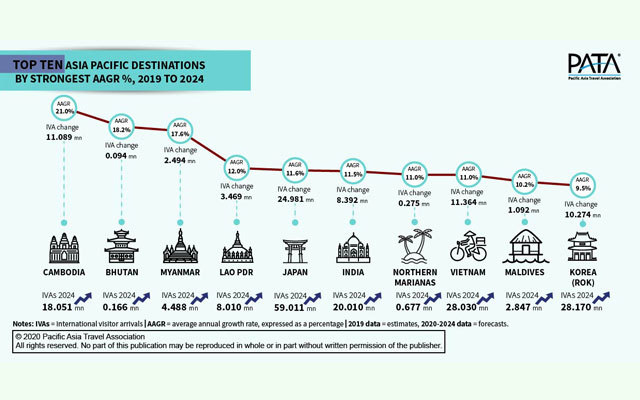
The top group of 11 destinations, as shown in Exhibit 4, is likely to account for 77% of the IVA volume into Asia-Pacific in 2024 and more than three-quarters of the additional arrivals over that same period.

In addition, it is predicted that nine out of 10 destinations will have AAGRs between 2019 and 2024 in excess of 10%, ranging from 10.2% for the Maldives to 21% for Cambodia. The volume bases for each of these destinations vary widely, however these very strong average rates of growth are certainly worth closely watching over the forecast period.

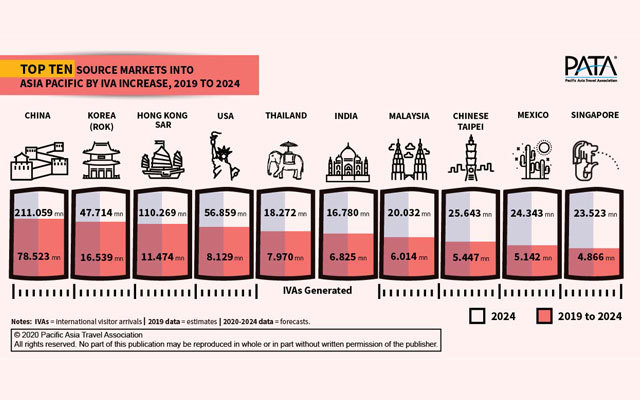
The top 10 strongest source markets into Asia-Pacific between 2019 and 2024 are forecast to include China, the Republic of Korea and Hong Kong SAR in the top three positions, generating a collective volume of more than 369 million IVAs over that period. These three source markets alone are also predicted to generate an additional volume of more than 106 million IVAs into Asia-Pacific over the same period.
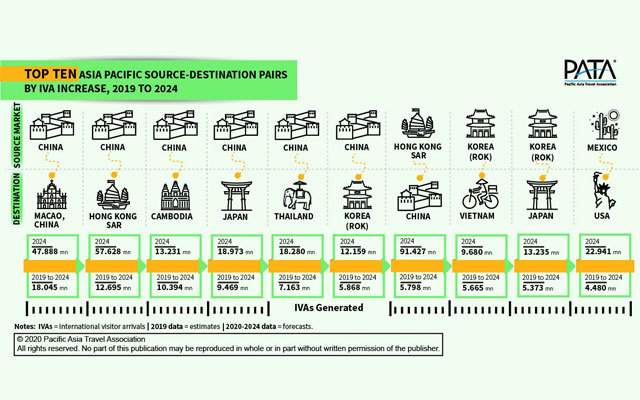
Much of that volume is, of course, generated by internal Greater China flows, especially from China into Macau, China and Hong Kong SAR and to a lesser degree vice-versa as can be seen from the top source-destination pairs as shown in Exhibit 7.

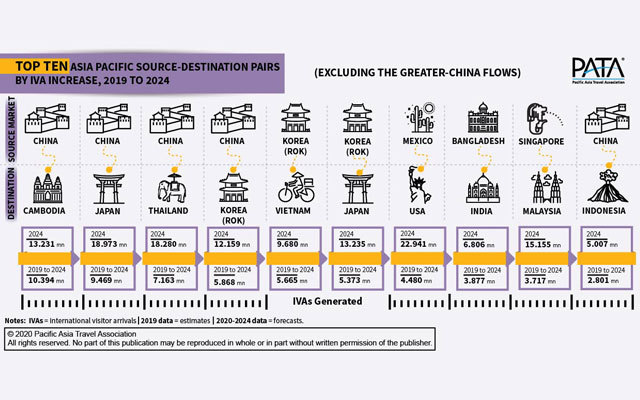
Adjusting for the Greater China source-destination pairs, the importance of China for a number of other Asia Pacific destinations becomes obvious, with China appearing five out of the possible ten times, as a major source market.
The relative strength of the close intra-regional flows also becomes evident in the top ten cluster of source-destination pairs as illustrated in Exhibit 8.

PATA CEO’s Mario Hardy commented on these forecasts: “For many destinations, there is now an immediate and necessary shift from generating arrivals to properly managing those visitors. It is no longer enough to think and talk about this, the time to put into action such management practices that ensure that visitors into and across the Asia Pacific region receive a superlative and memorable experience is now.”

“The tourism juggernaut is a reality, and this means that, as a socio-economic sector, travel and tourism needs to ensure that it has the necessary mindset and infrastructure – both hard and soft – to enable the growth of this magnitude to be properly managed. It is incumbent upon us all to deliver both memorable experiences and positive outcomes for visitors, residents and the environment in equal measure.”