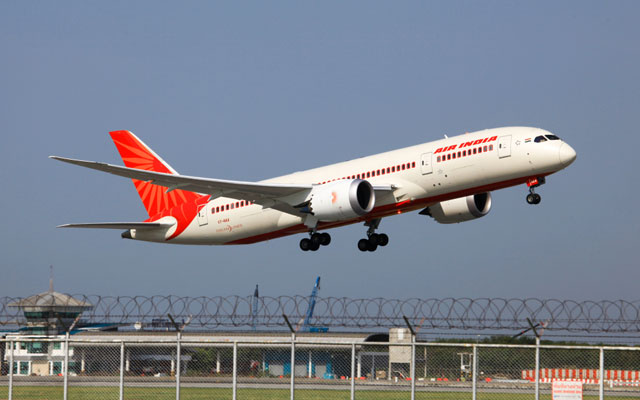
India’s national carrier, Air India’s proposed disinvestment is lurking for a long time now. The heavily debt-ridden airline is finding no buyers, with its debt burden of about Rs 80,000 crore (US$11.2 billion) likely the disincentive for investors.
Air India, once the pride of the Indian aviation sector and referred to as ‘Maharaja’, has today been reduced to a loss-making entity.
Debt-laden Air India has been making a loss since 2007
While addressing parliamentarians, Hardeep Singh Puri, minister for civil aviation informed that Air India posted a provisional net loss of Rs 8,556.35 crore in 2018-19 while the net loss stood at Rs 5,348.18 crore in the previous financial year.
In fact, surviving on taxpayers’ money, the carrier has never seen a profit since its merger with Indian Airlines in 2007/2008.
There are many factors that can be held responsible for the airline’s current fate, including stiff competition in the aviation market, high taxation, red tape, and poor management that failed to match the branding and service standards of private carriers.
There was a time more than a decade back when Air India was profitable. However, the emergence of a new low-cost carrier, which today has become one of the leading airlines in India, marked the beginning of Air India’s fall. The carrier in question was speculated to have business interest from a minister of the ruling party, and on his behest Air India was forced to pull back from profit-making routes.
The national carrier also made a significant investment in procuring aircraft, a move that didn’t yield any results. The losses accumulated since then and Air India has today landed in a sorry state.
Despite persistent challenges, the Indian government is pushing on with the impossible mission of trying to keep Air India afloat. Every other day there is some announcement from the government that it is trying to privatise the airline, but to no avail.
So, why can’t the government just shut it down? Why should Indian taxpayers continue to funnel hard-earned money into running Air India?
Some have argued that doing so will result in the loss of employment for many. However, the Indian government was not concerned about job losses when Indian carriers, Jet Airways and Kingfisher Airlines, perished.
It is also saddening to see that in a democratic country like India where people are ready to protest and demonstrate against various issues, no one has dared to question the government’s vain decision to continue operating Air India, especially when the national economy is also going through a challenging time.
StarLux Airlines takes to the skies
After almost three years of preparation, StarLux Airlines launched three inaugural flights on January 23, 2020 to three destinations – Macau (thrice-daily), Danang (twice-daily) and Penang (daily).
The brand-new carrier, operating out of Taiwan Taoyuan International Airport, will operate the A321neo aircraft on three routes. The aircraft has 188 seats, including eight in business class and 180 in economy class.
Beginning April 6, 2020, Starlux will also start flying daily between Taipei and Cebu. This is the airline’s fourth destination. JX781 will depart from Taipei at 15.15, and arrive in Cebu at 18.10. The return leg will depart Cebu at 19.15, and arrive in Taipei at 22.00.
Starlux Airlines will initially fly routes in South-east Asia and North-east Asia, gradually developing its trans-oceanic routes to North America starting in 2022.
PAL to reintroduce US route
Flag carrier Philippine Airlines (PAL) will reintroduce a non-stop Cebu-Los Angeles service starting from May 2, 2020, restoring the only direct air link between the Visayas and the US.
PAL’s Cebu-Los Angeles flights will depart three-times-weekly for Los Angeles from Terminal 2 of the Mactan Cebu International Airport, utilising the 370-seater Boeing 777-300ER.
PR152 will depart Cebu at 21.00 every Tuesday, Thursday and Saturday and arrive in Los Angeles at 19.30 on the same days. The return flight PR153 will leave Los Angeles at 23.00 every Tuesday, Thursday and Saturday, touching down two days later in Cebu at 05.00 after 14 hours.
The service marks PAL’s comeback to the Cebu-Los Angeles route. The flag carrier previously operated Cebu-Los Angeles flights from March 2016 up to May 2017.
PAL also recently announced the inauguration of several international routes, including the first-ever non-nstop flights between Manila and Perth (starting March 30); Zamboanga and Kota Kinabalu (from March 29); and between Davao and Manado (from March 29).
LOT Polish Airlines ups New Delhi-Warsaw frequency
After the launch of its New Delhi-Warsaw operations in September last year, LOT Polish Airlines will increase its frequency from five-times-weekly to daily, effective September 14, 2020.
Flights will depart Delhi at 11.05, and arrive in Warsaw at 15.20. On the other leg, flights will depart Warsaw at 22.45 and arrive in Delhi at 09.15 the following day.
On its Delhi-Warsaw route, LOT Polish Airlines features Indian meals in all three cabins (LOT Business Class, LOT Premium Economy Class, LOT Economy Class), as well as inflight entertainment system including the latest Bollywood releases in Hindi.
Emirates connect Singapore and Penang
From April 9, Emirates will start a new daily service from Singapore to Penang.
EK 348 will arrive in Singapore from Dubai at 14.05 before departing again at 15.35 and arriving into Penang at 17.15 on the same day. The return flight EK 349 will depart Penang at 22.20, arriving in Singapore at 23.50. The flight from Singapore will then depart at 01.40 the following day, bound for Dubai where it will arrive at 04.55.
The fifth-freedom route will be operated by a Boeing 777-300ER aircraft in a three-class configuration.
Penang will become Emirates’ second destination in Malaysia after its capital, Kuala Lumpur, which the airline currently serves with three flights a day, and is a route that has been operating since 1996.
Jetstar ceases flights to Hong Kong
Jetstar Asia’s last service between Singapore and Hong Kong will operate on March 28, 2020.
This decision was made in response to ongoing falling demand. The aircraft will be redeployed to growth markets where there is strong demand such as Yangon, Clark, Manila and Osaka.
Best Western Hotels & Resorts in Asia is offering a 30 per cent discount for stays at its properties across Asia.
Guests who book between now and February 29, 2020, for stays taken between April 1 and November 30, 2020, will enjoy 30 per cent off the Best Available Rate at Best Western’s hotels and resorts in eight countries, namely, Japan, Thailand, Myanmar, the Philippines, Malaysia, Vietnam, Laos and Indonesia.
Best Western offers slashed room rates for its properties in Asia; Best Western Plus The Beachfront Phuket pictured
Apply the promotional code EPIC30 to enjoy the offer. Terms and conditions apply.
The spread of the Wuhan Novel Coronavirus and resulting tough measures taken by the Chinese government to stem the outbreak – locking down Hubei province where Wuhan is the capital city and suspending the sale of tours, flights and accommodation – are impacting tourism businesses elsewhere in Asia.
People wearing face masks in China to curb the spread of the virus
The Philippines
Philippine tourism players have been inundated by travel cancellations from China as flights from Wuhan are temporarily banned.
Boracay is particularly impacted, noted Queenspoint Travel and Tours Corp. president, Marlene Dado Jante, who explained that the Chinese government’s ban on the eight weekly charter flights from Wuhan to Kalibo – the gateway to Boracay – meant cancellations of other flights, hotels and tours, as well as numerous requests for refunds.
Yesterday, two Manila-based travel agencies said they were busy coping with “lots of travel cancellations” not just from Wuhan but also from other points in China.
While the outbreak of the new strain of coronavirus is a force majeure, travel wholesalers are uncertain if they can get refunds from airlines, hotels and resorts, and tour operators particularly as most Chinese travellers are big groups on charter flights.
The situation that is unfolding has a “domino effect”, warned Angel Ramos Bognot, managing director of Afro Asian Travel and Tours, as China is the Philippines’ second biggest tourism source market and the second biggest generator of tourism receipts after South Korea.
The damage to tourism business extends to Philippine outbound to China and Hong Kong, said Jante, who noted that some groups are considering axing their trip to Hong Kong following the closure of Hong Kong Disneyland, Ocean Park Hong Kong as well as the train route connecting Hong Kong with southern China.
There are calls from some industry quarters to impose a temporary ban on all tourists from China, which Bognot supports for everyone’s safety.
Joey Bondoc, senior manager research with Colliers International Philippines, predicts that a full ban imposed on Chinese outbound by the Chinese government will hit Philippine tourism hard, plunging Chinese arrival numbers to the Philippines and bringing about an impact more immediate than that of Taal Volcano’s eruption.
Bondoc said: “If China further tightens control on outbound travel, it will have a multiplier impact on the economy.”
He said retail and gaming will be affected, and for the latter staffing will be an issue as Chinese employees coming to Manila will be restricted.
Bondoc recalled that during the SARS outbreak, Chinese arrivals into the Philippines dropped 9.64 per cent to 1.8 million in 2001 from 1.992 million in 2000. – Reporting by Rosa Ocampo
Malaysia
As Malaysian inbound tourism players reel from about 80 per cent cancellations of groups and FITs from China, as of January 28, private sector players have come together to form a special committee to look into the impact of the Novel Coronavirus outbreak on tourism business in the country.
The Tourism Recovery Action Committee will be coordinated by Malaysian Inbound Tourism Association (MITA) president, Uzaidi Udanis, along with representatives from airlines, hotels and tour operators. The move was agreed upon at a meeting on January 28 chaired by Tourism, Arts and Culture minister, Mohammadin Ketapi at his office on Tuesday morning.
Also present at the meeting were the Health Minister, Dzulkefly Ahmad and the deputy minister of Tourism, Arts and Culture Muhammad Bakhtiar Wan Chik, as well as industry players representing airlines, hotels and tour operators involved in the China inbound market.
Uzaidi told TTG Asia that the first priority of the committee was to look at ways to minimise the negative impact of the outbreak on the tourism industry. He said: “We have to come out with a plan to propose to the government on how to assist tourism players. It could be a campaign to revitalise the domestic market to make up for the sudden shortfall of Chinese tourists.
“The committee will also coordinate with individual hotels to speed up the refund process to tour operators who have made prepayments for rooms ahead of the Chinese New Year period and were affected when the Chinese government gave its directive to cancel inbound and outbound tour groups amid the Novel Coronavirus outbreak.”
Describing the extent of the damage to tourism business in Malaysia caused by the flu outbreak, Uzaidi said: “Today (January 28) we should have received 500 tour buses from (Singapore’s) Changi Airport to Johor (the Southern Malaysian state across the border from Singapore), but there were only 30 buses. Based on information from MITA members involved in the China inbound market, from February 1 onwards, there will be zero groups from China. As of today, MITA has received about 80 per cent cancellations of groups and FITs from China.”
Yap Lip Seng, CEO of Malaysian Association of Hotels, shared that hotels in Langkawi and Kota Kinabalu are anticipating a 30 to 60 per cent drop in occupancy up to end February, while hotels in Ipoh, Kuala Lumpur, Port Dickson, Melaka and Penang were looking at a 10 to 50 per cent drop in occupancy up to end February.
Uzaidi stressed: “This outbreak has resulted in a big loss to hoteliers, tour operators, tour buses, restaurants and souvenir shops. I believe that even during this downtime, we have to prepare for good times ahead and start planning our destination promotions from now. This is also an area that the committee will be looking at.”
Malaysia moved to suspend all visa facilities for Chinese tourists from Wuhan and Hubei as part of measures to combat the outbreak on January 27. The visa facilities will be reinstated once conditions return to normal. – S Puvaneswary
The Maldives
Incoming Chinese tour groups have ground to a halt for the Maldives, revealed Thoyyib Mohamed, managing director of the Maldives Marketing & Public Relations Corporation, the government’s tourism agency, as travel restrictions by the Chinese government are imposed on Chinese cities infected with the Novel Coronavirus.
Shafraz Fazley, managing director of Viluxur Holidays, told TTG Asia that he has had some bookings postponed for up to six months.
“Some Chinese visitors wanted to cancel (their trip) but hotels in the Maldives did not allow that, permitting postponements instead. Since payment was made upfront with the bookings, they had no option but to postpone their visits,” he said.
Abdul Karam, who owns a small hotel in the Maldives, said two Chinese groups have cancelled visits because they were unable to leave China.
China was the Maldives largest source market in 2019, accounting for 284,029 arrivals out of a total of 1.7 million arrivals. – Reporting by Feizal Samath
Sri Lanka
Sri Lanka, which saw a 37 per cent drop in Chinese arrivals to 167,863 in 2019 due to negative publicity in the aftermath of the Easter terror attacks, is suffering yet another setback in the China market – this time by the flu bug which has led to 600 to 700 cancellations from China on January 28, according to Mahen Kariyawasam, president of the Sri Lanka Association of Inbound Travel Agents.
The country reported its first confirmed Novel Coronavirus case on Monday night (January 27) – a 47-year-old female Chinese national from Hubei Province, China. She has been admitted to the Infectious Diseases Hospital in Colombo.
Immediately after, the government suspended the issue of on-arrival visas to Chinese visitors. – Reporting by Feizal Samath
Singapore
With the number of confirmed Novel Coronavirus cases in Singapore currently standing at seven, travel players in the country are adopting a cautious approach and introducing precautionary measures.
This is a crucial measure for the country, which received almost 4.23 million visitor arrivals from Mainland China from January to November 2019. The market accounts for the largest portion of inbound travellers for Singapore.
To stem the spread of the virus, hotels in Singapore are stepping up internal measures for both guests and staff. For instance, Accor has instructed all of its properties to implement additional hygiene procedures, including cleaning and disinfection, and taught them how to identify and manage any suspected cases.
The group has also permitted guests from China to cancel a prepaid or guaranteed booking made for the period between now and February 29, 2020, at any Accor hotel globally.
With the well-being of staff and guests in mind, Royal Plaza on Scotts has implemented 14 days of compulsory paid leave of absence for employees returning from China and established temperature screening at the entrance. Sanitisers and masks have been made available for employees and guests since last week.
Patrick Fiat, general manager of Royal Plaza on Scotts, told TTG Asia that more than 900 room nights have been cancelled due to the virus outbreak, and more cancellations are expected to surface in February.
Currently, the hotel is waiving cancellation charges for guests from China till end of February.
Similarly, resort destination Sentosa is adopting “enhanced precautionary measures”, said a spokesperson of the island’s operator, Sentosa Development Corporation. These measures include increasing the frequency of cleaning at common areas and putting up advisories for guests around the island.
The spokesperson continued: “We are also in close communication with our stakeholders, such as Island Partners (tenants) and staff, to ensure that they are aware of the latest developments and are ready to provide assistance to guests who may appear unwell.
“While we expect some businesses on the island to be affected, it is premature to determine the full extent of the impact at this stage.”
Other companies in Singapore are also keeping their heads up, as travel business continues to stream in. Jane Goh, director of Xperience Singapore, said: “Travel to Singapore and throughout the world will be affected, but we have not had concerned (guests) yet.” – Reporting by Pamela Chow and Karen Yue
Cambodia
On January 27, Cambodian authorities confirmed the first case of Novel Coronavirus in Sihanoukville. The 60-year-old man had returned with three family members from Wuhan on January 23.
Despite the virus entering Cambodia, this week all 25 daily flights to and from China continue. However, airport authorities report an increasing drop in passengers from short-haul destinations – especially China, the country’s largest source market.
Steve Lidgey, general manager at Travel Asia a la Carte, said huge panic has broken out across the country, which will impact travel.
He said: “There is a lot of scaremongering and fake news circulating in Cambodia. This only has a negative effect on travel to the destination. There seems to be a social media frenzy which only scares both domestic and international travellers. Following WHO and governmental directives, we can say Cambodia is open for business as usual.” – Reporting by Marissa Carruthers
Vietnam
Vietnam’s Ministry of Culture, Sports and Tourism has asked tour companies to cancel trips to and from destinations infected with the Novel Coronavirus, as the country confirms two cases – a father and son from Wuhan who are being treated in Ho Chi Minh City now.
On January 22, Vinpearl and Vinpearl Land Nha Trang imposed a series of measures, including installing antiseptic hygiene points across Hon Tre Island, at the onset of the flu outbreak beyond China. Visitors are provided with health information and medical staff are on hand to lend assistance.
Linh Le, principal and co-founder of Luxperia, said the flu outbreak has already tourism business. “Hotels and tour operators have suffered last-minute cancellations, without prepayment. Unfortunately, the perception of potential risk and exposure to the virus will affect the advance planning from long-haul travellers to the entire of South-East Asia; a greater risk in my opinion.” – Reporting by Marissa Carruthers
Myanmar
Despite there being no reported cases to date in Myanmar, The Union of Myanmar Travel Association has reported cancellations of between 10 and 20 per cent.
Khiri Travel Myanmar has received a few postponements, but bookings are still coming in.
Melissa Tan, general manager of the agency, also added that there have been groups originally bound for China being re-routed to Myanmar.
China Eastern Airlines has suspended all flights between Myanmar and Wuhan until February 29, 2020. – Reporting by Marissa Carruthers
Thailand With 14 confirmed Novel Coronavirus cases, the second-most of any country outside of China, Thailand has started conducting checks on all people crossing over the land border from Cambodia into Thailand, as well as ramped up its screening efforts at major airports.
Infrared thermo scans at Suvarnabhumi, Don Mueang, Chiang Mai, Phuket and Krabi International Airport operate round-the-clock to screen all passengers, especially those arriving from Chinese cities.
As of today, mobile medical units from the army, navy and air force have been deployed to all 10 international airports to assist public health officials with the screening efforts.
Thailand’s health ministry has also issued a travel advisory for its citizens.
Meanwhile, Thailand’s inbound tour operators are bearing the brunt of the flu fallout. As one of the most popular destinations for Chinese tourists, Thailand’s tourism industry is facing a double whammy due to the Chinese government’s ban on group travel and change of travel plans by other travellers who fear exposure to the virus.
Nattapong Saengsirirattana, managing director of Thai Leisure, shared with TTG Asia that the company has seen a deluge of cancellations for their February-April bookings, especially those from Singapore, with incentive and student groups forming the bulk of it.
“The majority of inbound clients we have on hand at the moment are Singaporean incentive groups. At the moment, it looks like those who haven’t cancelled will postpone their trips. Some have already postponed, and we’re waiting to hear from the rest if they will also do so,” Nattapong said.
“These are companies that already had everything planned out – flights and accommodation – then the virus hit, and they can’t afford to take the risk, also due to their own company policies.”
European inbound markets appear to be the least impacted. “We had only one group from Russia that cancelled due to some small concerns regarding the outbreak. Our clients are mostly from Europe, and they’re not cancelling,” said Christian Stoeckli, general manager of Diethelm Travel Thailand.
Dave Chang, managing director of Asia Mice Planner, echoed similar findings. “I haven’t had any cancellations yet because our clients are world travellers – we have bookings in many countries – and none of them are from China. I believe the bigger impact is on those DMCs which are only focused on China inbound and outbound.” – Reporting by Anne Somanas
Japan
Japan has stepped up measures to halt the spread of Novel Coronavirus following a confirmed infection of a man in his 60s, who although did not travel to China recently, had driven buses in Nara Prefecture twice this month for tour groups from China’s Wuhan City, the epicentre of the outbreak.
Before the government-imposed lockdown of Wuhan, Japan was the second-most popular international destination for people from the Chinese city, coming only after Thailand.
Even with restricted travel from the epicentre, Japan continues to be on high alert, especially during the ongoing Chinese New Year holidays when an estimated 800,000 Chinese tourists are expected to arrive in Japan.
Japan is the most popular destination for the estimated seven million Chinese tourists who will travel abroad during the holidays, according to the China Outbound Tourism Research Institute.
Across Japan, stricter screenings and inspection measures of passengers are in place at airports and seaports, while airlines are distributing health declarations urging passengers arriving from China to report if they are feeling unwell. Japan Airlines has even introduced measures onboard aircraft arriving in Japan from other parts of Asia.
In the tourism sector, hotels, theme parks, restaurants and department stores are boosting their hygiene practices.
Tokyo Disneyland, Tokyo DisneySea and Universal Studios Japan in Osaka have placed alcohol-based disinfectants at restrooms for staff and visitors, while Tokyo Metropolitan Government is providing disinfectant at Toyosu fish market, another popular tourist site. Hotels are disinfecting elevator buttons and door handles. – Reporting by Kathryn Wortley
Indonesia
Indonesia has so far been spared from the Novel Coronavirus outbreak, but the government is taking no chances.
The Transportation Ministry has issued an order for Indonesian airlines to suspend flights to and from Wuhan to prevent the virus from reaching their shores, and airlines such as Lion Air and AirAsia have obeyed the order.
But with the Chinese government’s closure of Wuhan transportation, Chinese inbound groups to Indonesia have been affected.
Khairul Gumay, owner of South Tangerang-based Safa Tour, which is traditionally reliant on the Chinese market, told TTG Asia that he is estimating a 600 million rupiah loss as three inbound Chinese tour groups – including a small group of 10 people and a big group of 50 – were unable to fly to Indonesia following the closure of the Wuhan airport. His Chinese clients had declined to reschedule their travel plans, he added.
Wishnutama Kusbandio, minister of tourism, said that the government is not banning Chinese tourists from entering Indonesia, with the exception of those coming from Hubei, including its capital Wuhan.
Wishnutama urged travel agents to keep monitoring the situation and to follow the government’s advice regarding selling outbound packages to China and attracting Chinese travellers to Indonesia.
I Wayan Koster, governor of Bali, has issued a circular exhorting hotel and accommodation players in Bali to not impose cancellation fees for travel agents or Chinese travellers who have made cancellations as the outbreak can be categorised as force majeure.
The governor also asked that downpayment made to hotels to not be forfeited so that Chinese travellers could use it for their upcoming trips.
As a gesture of empathy in light of recent conditions in China, the Bali Kintamani Festival, which was originally slated to be held on February 8, has also been postponed by the Bali governor. – Reporting by Kurniawan Ulung
From left: AirAsia X's Fam Ee Lee and Benyamin Ismail; Okinawa Prefecture's governor Denny Tamaki; AirAsia X's Rafidah Aziz; Malaysia's deputy minister of Tourism, Arts and Culture, Muhammad Bakhtiar bin Wan Chik; Okinawa Convention & Visitors Bureau's Norihiro Mejima, flanked by cabin crew, at the launch of Air Asia X's new Kuala Lumpur-Okinawa service
AirAsia X’s launch of four-times-weekly services connecting Kuala Lumpur and Okinawa via Taipei is expected to boost demand for the destination, and outbound agents are planning to release more packages and promotions.
Vic-Aire Holiday managing director, Hazel Sian, shared: “We will develop more itineraries (around Okinawa) as we expect the destination to see higher demand with the new flights and cheaper airfares. Airfares play an important role in determining demand.”
From left: AirAsia X’s Fam Ee Lee and Benyamin Ismail; Okinawa Prefecture’s governor Denny Tamaki; AirAsia X’s Rafidah Aziz; Malaysia’s deputy minister of Tourism, Arts and Culture, Muhammad Bakhtiar bin Wan Chik; Okinawa Convention & Visitors Bureau’s Norihiro Mejima, flanked by cabin crew, at the launch of Air Asia X’s new Kuala Lumpur-Okinawa service
Likewise, Jasmine Lee, operation executive at Golden Tourworld Travel, said that the company plans to step up promotions on Okinawa with the launch of the new flights. “In the past, demand to Okinawa has not been so good,” she said.
Guests travelling on AirAsia X’s new Kuala Lumpur-Okinawa route are not required to obtain a visa during their hour-long stopover in Taipei and may return to their seats after clearing a quick security check of their carry-on bags and inflight belongings.
AirAsia has also partnered Malaysia’s Berjaya Hotels & Resorts to promote travel to Okinawa, following the hotel group’s recent launch of Ansa Okinawa Resort, a 123-room property located in Uruma City.
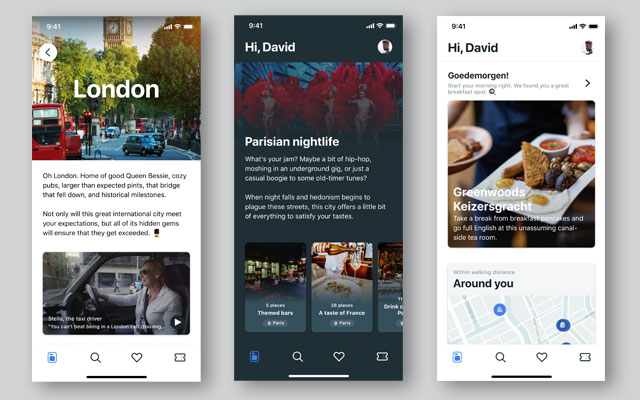
Several screenshots from how the app will display on phones
Booking.com has launched a new pilot app, CityBook, a responsive digital guide designed to help travellers navigate their destination by providing curated recommendations, showcasing local offers and discounts, and featuring content to help travellers get accustomed to the city.
Using machine learning, CityBook analyses the traveller’s location, makeup of their group (family, couple or solo), at which stage they are in their trip, as well as weather and real-time availability, to provide contextually-based recommendations.
Several screenshots from how the app will display on phones
The CityBook products, content and features will then be rolled into the core Booking.com app.
Ram Papatla, vice president of experiences at Booking.com, said: “With CityBook, we want to put all the best possibilities for experiencing a city in the palm of your hand. Bouncing between dozens of sites and apps to get the best information and then still having to book everything separately is not the most enjoyable or seamless process. We want to help people focus on the fun part of travel planning – inspiration – and make the booking and organisation for a trip a snap, with actionable content that’s all bookable in a couple of taps and all conveniently organised in one place.”
The app is available on Android and iOS devices, or users can log onto the web version of the CityBook site on a desktop or mobile.
Currently available in Amsterdam, London and Paris, CityBook is slated to launch in Tokyo, New York, Berlin, Barcelona and Rome in coming months.
Hong Kong’s Artyzen Hospitality Group, a subsidiary of Shun Tak Holdings, has signed a hotel management agreement with Chongqing Yuelai Liangjiang International Hotel and Convention Management to develop a hotel under the lifestyle hotel brand Artyzen Habitat in Yubei District, Chongqing.
Touted as a “lifestyle sanctuary” catering to the upscale market, the upcoming 363-key hotel spanning 31,500m2 will house a brand hallmark social space Townsquare that is designed to become the centre of work, play, dine and pop-up retail activities.
A rendering of the upcoming property
Artyzen Habitat Yuelai Chongqing will be situated in the core of Liangjiang New Area in Yubei District, close to Yuelai International Convention and Exhibition City. This area has been developed to integrate international business, exhibitions, conferences, leisure tourism and cultural creativity.
With the inclusion of this new project, the Artyzen Hospitality Group has eight hotels in the pipeline and six hotels operating in Beijing, Shanghai, Macau and Hawaii.
Data and analytics will continue to be one of the key drivers of the commercial aviation industry going into a new decade, predicted travel data and analytics expert Cirium, but it warned that analytics will have to become much more human-centric, with a significant focus on end-users.
David White, director, market development at Cirium, said: “The past decade’s biggest challenge for commercial aviation has been to safely keep up with a rate of passenger demand that is straining the systems’ capacity. The skies are crowded, the competition is fierce, and operational environment is extremely complex. Airlines and airports have had to get much smarter about how to use technology, data, and process to squeeze additional capacity out of limited resources.”
Aviation industry leverage big data analytics to facilitate predictions and forecast demand, but there needs to be greater focus on end-users: Cirium
Here are the top 5 aviation and travel trends to watch in 2020 and beyond, according to Cirium’s industry experts:
Human-centered data and analytics 2.0
While big data and analytics became popularised in the previous decade, there is still a lot of untapped potential. The race to extract meaningful and valuable information out of new data sources has only just begun.
Steve Wilson, data scientist at Cirium, said: “The amount of data being generated by aircraft, locations and devices is increasing. Getting this data wrangled and into decision makers should help make the industry more efficient. This mountain of data being created – something like 100 billion GB annually as estimated by Oliver Wyman – can be used for forecasting and predictions. Deep learning models, despite not being quite capable of general artificial intelligence, should prove really useful in reaching gains and improvements for the industry.”
If you think of data-driven intelligence as a series of phases, then 2020 will herald the human-centered phase of our data evolution. The previous phase was about using structured and unstructured data to answer questions after an event. The next phase will be a matter of anticipating behaviour and providing answers before questions need to be asked.
Predictive maintenance
Quality data is the foundation for any type of predictive capability. Now that the technology needed to collect, process, prepare and structure massive amounts of device data exists, there is a good chance machine learning could evolve enough in the next decade to monitor patterns and events in real-time.
“There is already a focus on data collection and analytics to drive aftermarket service revenue growth for aircraft manufacturers, MRO service providers and systems suppliers,” said Andrew Doyle, director, market development at Cirium.
“The next step is development and deployment of predictive maintenance algorithms enabling replacement of critical components prior to failure, leading to a significant reduction in aircraft technical delays.”
Airline revenue management
The power of predictive analytics doesn’t stop at the physical parts of an aircraft. Airlines and airports are getting better at predicting consumer demand and optimising price or inventory to maximise revenue growth. For example, airlines now have tools at their disposal to accurately forecast demand on a cabin level, thereby getting a look at their true profit in a market.
“If you look at the US domestic market, both American and Delta have come out with growth plans that are above the industry three to four per cent growth rates,” said Nathan Greer, sales engineer at Cirium. “Delta is managing this by upgrading to larger aircraft, while American is doing the same, in addition to reconfiguring aircraft with additional seats.”
Accommodating predicted demand isn’t something airlines will be able to do alone. It will take collaboration and connection across the industry to achieve new levels of revenue growth.
“Certain Asian markets are the fastest growing in the industry. The challenge for the 2020s will be to expand the ability of airlines, airports, and ANSPs to share data and collaborate across the region in order to keep traffic flowing, passengers safe, and to deliver a quality service. Tokyo’s 2020 Olympics will be a good test for the overall network,” White said.
A current barrier to increased collaboration among airlines and airports is the reluctance to share data. Trust and ownerships of data remain major issues in the industry. However, the key to making progress in maximising revenue in 2020 and beyond will be a less restricted exchange of data. The benefits of this exchange will mean a more seamless journey towards developing more sophisticated, enhanced analytics.
“In the decade to come, I think we can expect to see technology largely improving airline and airport operational efficiency,” said Joanna Lu, head of consultancy, Asia, at Cirium. “Data and information sharing among stakeholders in the industry shall be improved to face the headwinds.”
Dynamic personalisation
It’s widely known people buy experiences, not products. In the decade to come, each part of the trip experience will be impacted through personalisation powered by machine learning – from in-flight services to pre-trip planning and disruption recovery.
While the 2010s were an era for change in the way customer problems were addressed, the 2020s will be a time where brands get smarter about every single customer touchpoint. The next logical step after customer service is customer engagement. It’s no longer sufficient to quickly answer questions and resolve problems. The time has come to create ongoing interactions between customer and company, shaped by the customer profile.
“Airlines are stepping up their game to adapt and engage individual traveller types by analysing their preferences, behaviour and demographics,” said Charles Brossman, senior product manager at Cirium. “They’re launching new and exciting customer engagement strategies to interact with them. This makes customers feel noticed and appreciated, which is critical to building brand loyalty.”
Tailoring messages and services to individual travellers is the expectation right now, particularly among Millennials. Yet, most airlines and other travel service providers still don’t have the right mix of data, technology and people to achieve a personalised experience customers will remember. The opportunity to impress and win over travellers on an emotional level is still wide open.
Cirium’s marketing director Carrie Mamantov said: “Automated personalisation will finally be coming to travel. A few airlines are getting all their data organised and breaking down the siloes to better link up the different dimensions of customer information. Look for loyalty to build with the brands who can predict needs and behaviour based on the omni-channel experience finally becoming more actionable.”
Providers across the industry will endeavour to link their value to traveller data. From manufacturing to tech services, every part of the ecosystem has an opportunity to be valuable to airlines and travellers.
Eco-consciousness
The travel industry has been one of the major targets of environmental criticism in recent years. Air travel accounts for about 2.5 per cent of global carbon dioxide emissions, after all.
Airlines are already having to take stronger action to minimise their carbon footprint. In this new decade, they will also be expected to ensure fuel efficiency isn’t outstripped by growing demand.
“We are seeing the very early stage of electric aircraft now flying in Canada,” said Alistair Rivers, director, market development at Cirium. “There will be pressure to reduce operations of current fuel-operated aircraft. I live in hope of a coordinated single European sky from an air traffic control point of view as this has massive potential to save both fuel and time by allowing aircraft to fly more directly.”
Thai Airways International (THAI) and THAI Smile has launched Save Food Save the World, a food waste management project designed to minimise waste in food production, in collaboration with Food Innopolis, and the National Science and Technology Development Agency (NSTDA).
Under the programme initiated by the Ministry of Natural Resources and the Environment (MSDHS), THAI Catering will reduce its food waste and cabin waste as well as environmental impact, on top of enhancing effective resource management, said the airline in a statement.
From left: THAI Smile’s Charita Leelayudth, NSTDA’s Narong Sirilertworakul, and THAI’s Sumeth Damrongchaitham signed the MoU for the food waste management programme
In Thailand, food waste accounts for 33 to 50 per cent of all solid waste, according to recent studies. Reducing food wastage is one way of curbing greenhouse gas emissions. As such, the United Nations has set food waste reduction as one of its Sustainable Development Goals, aiming to halve per capita global food waste at the retail and consumer levels by 2030.
Under this project, THAI estimates that it will reduce 400kg of food waste per day, saving approximately 20 million baht (US$648,298) per year. In the first year of the project, THAI will focus on reassessing the food manufacturing process and supply chain, beginning from ingredient procurement, THAI Catering food production, menu planning, packing and loading, and cabin waste management.
The airline will also work towards cutting cabin waste from inflight meals by making available a pre-selected menu for passengers to select their meal preferences prior to the flight. This initiative, which is expected to reduce food waste from in-flight meals by 20 per cent, will be introduced on THAI’s Europe-bound flights in 2020 and on all flights in 2021.
In addition, MSDHS will be leveraging technology in its fight against food waste, for example, by studying ingredients used by the airline so as to identify the appropriate technology that will reduce food waste during the meal production process.
Through its various efforts, THAI expects to reduce food waste by approximately three per cent year-on-year.
Similarly, THAI Smile aims to improve efficiency and reduce waste that comes from inflight meals. Some 1.4 per cent of THAI Smile passengers refused their inflight meals last year, according to official data.
In 2020, THAI Smile expects to reduce food wastage by 16.5 tonnes per year: 5.7 tonnes from domestic flights and 10.8 tonnes from international flights, which is the equivalent of 100,000 meals per year.
THAI said that it has been operating with sustainable development as its top priority, with the goal of becoming a sustainable airline by 2023.
As Vietnam’s domestic tourism market continues its upwards trajectory, one local start-up is aiming to solidify the country’s fragmented industry.
Avid traveller Trịnh Dình Minh has relished visiting new destinations across his homeland while pursuing an engineering and IT degree. Trinh and his friends would visit then less-known areas, such as the northern mountainous provinces of Ha Giang, Moc Chau and Bac Kan.
Trịnh created Tago.vn to create a more seamless experience for travellers
Said Trinh: “Then, most tourism was focused on popular places, such as Halong Bay. We realised the potential of these (less-visited) destinations and decided to create scheduled tours, which were very popular.”
In 2011, Trinh launched PYS Travel, and organised private tours to more off-the-beaten-track spots that were geared mainly towards the domestic market, with some international arrivals.
Fast forward to 2016, Trinh noted a spike in demand for domestic travel. However, the booking process proved cumbersome, with tourists largely having to book transport, accommodation and activities separately.
Wanting to provide a one-stop online shop for domestic travellers while offering tourism players an additional platform to promote and sell their products, Trinh set about partnering with airlines and hotels to create Tago.vn, a subsidiary of PYS Travel. The company was launched in 2017, offering tourists a variety of options for holiday packages that included flights and accommodation.
Trinh said: “Tago.vn was born to help people make their holidays easier and happier. We wanted to provide a one-stop-shop solution for customers, so they can book and enjoy trips easily, which encourages more travelling. (Using the platform) is convenient, time-saving and gives customers better prices than booking each service separately.”
The average trip length for Vietnamese holidaymakers is four days, as compared to seven nights for other Asia-Pacific countries, according to a Visa Global Travel Intentions report.
Since its launch, Tago’s customer base has grown from 9,500 annually to more than 12,000 in 2018, putting it on track to hit nearly 18,000 this year, and expand to over 34,000 by 2021.
Gross merchandise value has also increased from US$1.2 million in 2017 to US$2.2 million last year. This is estimated to reach US$3.8 million this year, and grow to more than US$7.5 million by 2021.
Having secured partnerships with hospitality giants, including Vinpearl, FLC Hotels & Resorts, as well as Accor and Flamingo, Trinh said that Tago offers companies an easy and additional avenue to sell their products.
He added: “For suppliers, like hotels, they have more channels to sell. As Tago sells packages instead of just hotel rooms, the prices are hidden so hoteliers can (decrease) prices during the low season without creating any conflict with other selling channels.”



















The spread of the Wuhan Novel Coronavirus and resulting tough measures taken by the Chinese government to stem the outbreak – locking down Hubei province where Wuhan is the capital city and suspending the sale of tours, flights and accommodation – are impacting tourism businesses elsewhere in Asia.
The Philippines
Philippine tourism players have been inundated by travel cancellations from China as flights from Wuhan are temporarily banned.
Boracay is particularly impacted, noted Queenspoint Travel and Tours Corp. president, Marlene Dado Jante, who explained that the Chinese government’s ban on the eight weekly charter flights from Wuhan to Kalibo – the gateway to Boracay – meant cancellations of other flights, hotels and tours, as well as numerous requests for refunds.
Yesterday, two Manila-based travel agencies said they were busy coping with “lots of travel cancellations” not just from Wuhan but also from other points in China.
While the outbreak of the new strain of coronavirus is a force majeure, travel wholesalers are uncertain if they can get refunds from airlines, hotels and resorts, and tour operators particularly as most Chinese travellers are big groups on charter flights.
The situation that is unfolding has a “domino effect”, warned Angel Ramos Bognot, managing director of Afro Asian Travel and Tours, as China is the Philippines’ second biggest tourism source market and the second biggest generator of tourism receipts after South Korea.
The damage to tourism business extends to Philippine outbound to China and Hong Kong, said Jante, who noted that some groups are considering axing their trip to Hong Kong following the closure of Hong Kong Disneyland, Ocean Park Hong Kong as well as the train route connecting Hong Kong with southern China.
There are calls from some industry quarters to impose a temporary ban on all tourists from China, which Bognot supports for everyone’s safety.
Joey Bondoc, senior manager research with Colliers International Philippines, predicts that a full ban imposed on Chinese outbound by the Chinese government will hit Philippine tourism hard, plunging Chinese arrival numbers to the Philippines and bringing about an impact more immediate than that of Taal Volcano’s eruption.
Bondoc said: “If China further tightens control on outbound travel, it will have a multiplier impact on the economy.”
He said retail and gaming will be affected, and for the latter staffing will be an issue as Chinese employees coming to Manila will be restricted.
Bondoc recalled that during the SARS outbreak, Chinese arrivals into the Philippines dropped 9.64 per cent to 1.8 million in 2001 from 1.992 million in 2000. – Reporting by Rosa Ocampo
Malaysia
As Malaysian inbound tourism players reel from about 80 per cent cancellations of groups and FITs from China, as of January 28, private sector players have come together to form a special committee to look into the impact of the Novel Coronavirus outbreak on tourism business in the country.
The Tourism Recovery Action Committee will be coordinated by Malaysian Inbound Tourism Association (MITA) president, Uzaidi Udanis, along with representatives from airlines, hotels and tour operators. The move was agreed upon at a meeting on January 28 chaired by Tourism, Arts and Culture minister, Mohammadin Ketapi at his office on Tuesday morning.
Also present at the meeting were the Health Minister, Dzulkefly Ahmad and the deputy minister of Tourism, Arts and Culture Muhammad Bakhtiar Wan Chik, as well as industry players representing airlines, hotels and tour operators involved in the China inbound market.
Uzaidi told TTG Asia that the first priority of the committee was to look at ways to minimise the negative impact of the outbreak on the tourism industry. He said: “We have to come out with a plan to propose to the government on how to assist tourism players. It could be a campaign to revitalise the domestic market to make up for the sudden shortfall of Chinese tourists.
“The committee will also coordinate with individual hotels to speed up the refund process to tour operators who have made prepayments for rooms ahead of the Chinese New Year period and were affected when the Chinese government gave its directive to cancel inbound and outbound tour groups amid the Novel Coronavirus outbreak.”
Describing the extent of the damage to tourism business in Malaysia caused by the flu outbreak, Uzaidi said: “Today (January 28) we should have received 500 tour buses from (Singapore’s) Changi Airport to Johor (the Southern Malaysian state across the border from Singapore), but there were only 30 buses. Based on information from MITA members involved in the China inbound market, from February 1 onwards, there will be zero groups from China. As of today, MITA has received about 80 per cent cancellations of groups and FITs from China.”
Yap Lip Seng, CEO of Malaysian Association of Hotels, shared that hotels in Langkawi and Kota Kinabalu are anticipating a 30 to 60 per cent drop in occupancy up to end February, while hotels in Ipoh, Kuala Lumpur, Port Dickson, Melaka and Penang were looking at a 10 to 50 per cent drop in occupancy up to end February.
Uzaidi stressed: “This outbreak has resulted in a big loss to hoteliers, tour operators, tour buses, restaurants and souvenir shops. I believe that even during this downtime, we have to prepare for good times ahead and start planning our destination promotions from now. This is also an area that the committee will be looking at.”
Malaysia moved to suspend all visa facilities for Chinese tourists from Wuhan and Hubei as part of measures to combat the outbreak on January 27. The visa facilities will be reinstated once conditions return to normal. – S Puvaneswary
The Maldives
Incoming Chinese tour groups have ground to a halt for the Maldives, revealed Thoyyib Mohamed, managing director of the Maldives Marketing & Public Relations Corporation, the government’s tourism agency, as travel restrictions by the Chinese government are imposed on Chinese cities infected with the Novel Coronavirus.
Shafraz Fazley, managing director of Viluxur Holidays, told TTG Asia that he has had some bookings postponed for up to six months.
“Some Chinese visitors wanted to cancel (their trip) but hotels in the Maldives did not allow that, permitting postponements instead. Since payment was made upfront with the bookings, they had no option but to postpone their visits,” he said.
Abdul Karam, who owns a small hotel in the Maldives, said two Chinese groups have cancelled visits because they were unable to leave China.
China was the Maldives largest source market in 2019, accounting for 284,029 arrivals out of a total of 1.7 million arrivals. – Reporting by Feizal Samath
Sri Lanka
Sri Lanka, which saw a 37 per cent drop in Chinese arrivals to 167,863 in 2019 due to negative publicity in the aftermath of the Easter terror attacks, is suffering yet another setback in the China market – this time by the flu bug which has led to 600 to 700 cancellations from China on January 28, according to Mahen Kariyawasam, president of the Sri Lanka Association of Inbound Travel Agents.
The country reported its first confirmed Novel Coronavirus case on Monday night (January 27) – a 47-year-old female Chinese national from Hubei Province, China. She has been admitted to the Infectious Diseases Hospital in Colombo.
Immediately after, the government suspended the issue of on-arrival visas to Chinese visitors. – Reporting by Feizal Samath
Singapore
With the number of confirmed Novel Coronavirus cases in Singapore currently standing at seven, travel players in the country are adopting a cautious approach and introducing precautionary measures.
This is a crucial measure for the country, which received almost 4.23 million visitor arrivals from Mainland China from January to November 2019. The market accounts for the largest portion of inbound travellers for Singapore.
To stem the spread of the virus, hotels in Singapore are stepping up internal measures for both guests and staff. For instance, Accor has instructed all of its properties to implement additional hygiene procedures, including cleaning and disinfection, and taught them how to identify and manage any suspected cases.
The group has also permitted guests from China to cancel a prepaid or guaranteed booking made for the period between now and February 29, 2020, at any Accor hotel globally.
With the well-being of staff and guests in mind, Royal Plaza on Scotts has implemented 14 days of compulsory paid leave of absence for employees returning from China and established temperature screening at the entrance. Sanitisers and masks have been made available for employees and guests since last week.
Patrick Fiat, general manager of Royal Plaza on Scotts, told TTG Asia that more than 900 room nights have been cancelled due to the virus outbreak, and more cancellations are expected to surface in February.
Currently, the hotel is waiving cancellation charges for guests from China till end of February.
Similarly, resort destination Sentosa is adopting “enhanced precautionary measures”, said a spokesperson of the island’s operator, Sentosa Development Corporation. These measures include increasing the frequency of cleaning at common areas and putting up advisories for guests around the island.
The spokesperson continued: “We are also in close communication with our stakeholders, such as Island Partners (tenants) and staff, to ensure that they are aware of the latest developments and are ready to provide assistance to guests who may appear unwell.
“While we expect some businesses on the island to be affected, it is premature to determine the full extent of the impact at this stage.”
Other companies in Singapore are also keeping their heads up, as travel business continues to stream in. Jane Goh, director of Xperience Singapore, said: “Travel to Singapore and throughout the world will be affected, but we have not had concerned (guests) yet.” – Reporting by Pamela Chow and Karen Yue
Cambodia
On January 27, Cambodian authorities confirmed the first case of Novel Coronavirus in Sihanoukville. The 60-year-old man had returned with three family members from Wuhan on January 23.
Despite the virus entering Cambodia, this week all 25 daily flights to and from China continue. However, airport authorities report an increasing drop in passengers from short-haul destinations – especially China, the country’s largest source market.
Steve Lidgey, general manager at Travel Asia a la Carte, said huge panic has broken out across the country, which will impact travel.
He said: “There is a lot of scaremongering and fake news circulating in Cambodia. This only has a negative effect on travel to the destination. There seems to be a social media frenzy which only scares both domestic and international travellers. Following WHO and governmental directives, we can say Cambodia is open for business as usual.” – Reporting by Marissa Carruthers
Vietnam
Vietnam’s Ministry of Culture, Sports and Tourism has asked tour companies to cancel trips to and from destinations infected with the Novel Coronavirus, as the country confirms two cases – a father and son from Wuhan who are being treated in Ho Chi Minh City now.
On January 22, Vinpearl and Vinpearl Land Nha Trang imposed a series of measures, including installing antiseptic hygiene points across Hon Tre Island, at the onset of the flu outbreak beyond China. Visitors are provided with health information and medical staff are on hand to lend assistance.
Linh Le, principal and co-founder of Luxperia, said the flu outbreak has already tourism business. “Hotels and tour operators have suffered last-minute cancellations, without prepayment. Unfortunately, the perception of potential risk and exposure to the virus will affect the advance planning from long-haul travellers to the entire of South-East Asia; a greater risk in my opinion.” – Reporting by Marissa Carruthers
Myanmar
Despite there being no reported cases to date in Myanmar, The Union of Myanmar Travel Association has reported cancellations of between 10 and 20 per cent.
Khiri Travel Myanmar has received a few postponements, but bookings are still coming in.
Melissa Tan, general manager of the agency, also added that there have been groups originally bound for China being re-routed to Myanmar.
China Eastern Airlines has suspended all flights between Myanmar and Wuhan until February 29, 2020. – Reporting by Marissa Carruthers
Thailand
With 14 confirmed Novel Coronavirus cases, the second-most of any country outside of China, Thailand has started conducting checks on all people crossing over the land border from Cambodia into Thailand, as well as ramped up its screening efforts at major airports.
Infrared thermo scans at Suvarnabhumi, Don Mueang, Chiang Mai, Phuket and Krabi International Airport operate round-the-clock to screen all passengers, especially those arriving from Chinese cities.
As of today, mobile medical units from the army, navy and air force have been deployed to all 10 international airports to assist public health officials with the screening efforts.
Thailand’s health ministry has also issued a travel advisory for its citizens.
Meanwhile, Thailand’s inbound tour operators are bearing the brunt of the flu fallout. As one of the most popular destinations for Chinese tourists, Thailand’s tourism industry is facing a double whammy due to the Chinese government’s ban on group travel and change of travel plans by other travellers who fear exposure to the virus.
Nattapong Saengsirirattana, managing director of Thai Leisure, shared with TTG Asia that the company has seen a deluge of cancellations for their February-April bookings, especially those from Singapore, with incentive and student groups forming the bulk of it.
“The majority of inbound clients we have on hand at the moment are Singaporean incentive groups. At the moment, it looks like those who haven’t cancelled will postpone their trips. Some have already postponed, and we’re waiting to hear from the rest if they will also do so,” Nattapong said.
“These are companies that already had everything planned out – flights and accommodation – then the virus hit, and they can’t afford to take the risk, also due to their own company policies.”
European inbound markets appear to be the least impacted. “We had only one group from Russia that cancelled due to some small concerns regarding the outbreak. Our clients are mostly from Europe, and they’re not cancelling,” said Christian Stoeckli, general manager of Diethelm Travel Thailand.
Dave Chang, managing director of Asia Mice Planner, echoed similar findings. “I haven’t had any cancellations yet because our clients are world travellers – we have bookings in many countries – and none of them are from China. I believe the bigger impact is on those DMCs which are only focused on China inbound and outbound.” – Reporting by Anne Somanas
Japan
Japan has stepped up measures to halt the spread of Novel Coronavirus following a confirmed infection of a man in his 60s, who although did not travel to China recently, had driven buses in Nara Prefecture twice this month for tour groups from China’s Wuhan City, the epicentre of the outbreak.
Before the government-imposed lockdown of Wuhan, Japan was the second-most popular international destination for people from the Chinese city, coming only after Thailand.
Even with restricted travel from the epicentre, Japan continues to be on high alert, especially during the ongoing Chinese New Year holidays when an estimated 800,000 Chinese tourists are expected to arrive in Japan.
Japan is the most popular destination for the estimated seven million Chinese tourists who will travel abroad during the holidays, according to the China Outbound Tourism Research Institute.
Across Japan, stricter screenings and inspection measures of passengers are in place at airports and seaports, while airlines are distributing health declarations urging passengers arriving from China to report if they are feeling unwell. Japan Airlines has even introduced measures onboard aircraft arriving in Japan from other parts of Asia.
In the tourism sector, hotels, theme parks, restaurants and department stores are boosting their hygiene practices.
Tokyo Disneyland, Tokyo DisneySea and Universal Studios Japan in Osaka have placed alcohol-based disinfectants at restrooms for staff and visitors, while Tokyo Metropolitan Government is providing disinfectant at Toyosu fish market, another popular tourist site. Hotels are disinfecting elevator buttons and door handles. – Reporting by Kathryn Wortley
Indonesia
Indonesia has so far been spared from the Novel Coronavirus outbreak, but the government is taking no chances.
The Transportation Ministry has issued an order for Indonesian airlines to suspend flights to and from Wuhan to prevent the virus from reaching their shores, and airlines such as Lion Air and AirAsia have obeyed the order.
But with the Chinese government’s closure of Wuhan transportation, Chinese inbound groups to Indonesia have been affected.
Khairul Gumay, owner of South Tangerang-based Safa Tour, which is traditionally reliant on the Chinese market, told TTG Asia that he is estimating a 600 million rupiah loss as three inbound Chinese tour groups – including a small group of 10 people and a big group of 50 – were unable to fly to Indonesia following the closure of the Wuhan airport. His Chinese clients had declined to reschedule their travel plans, he added.
Wishnutama Kusbandio, minister of tourism, said that the government is not banning Chinese tourists from entering Indonesia, with the exception of those coming from Hubei, including its capital Wuhan.
Wishnutama urged travel agents to keep monitoring the situation and to follow the government’s advice regarding selling outbound packages to China and attracting Chinese travellers to Indonesia.
I Wayan Koster, governor of Bali, has issued a circular exhorting hotel and accommodation players in Bali to not impose cancellation fees for travel agents or Chinese travellers who have made cancellations as the outbreak can be categorised as force majeure.
The governor also asked that downpayment made to hotels to not be forfeited so that Chinese travellers could use it for their upcoming trips.
As a gesture of empathy in light of recent conditions in China, the Bali Kintamani Festival, which was originally slated to be held on February 8, has also been postponed by the Bali governor. – Reporting by Kurniawan Ulung