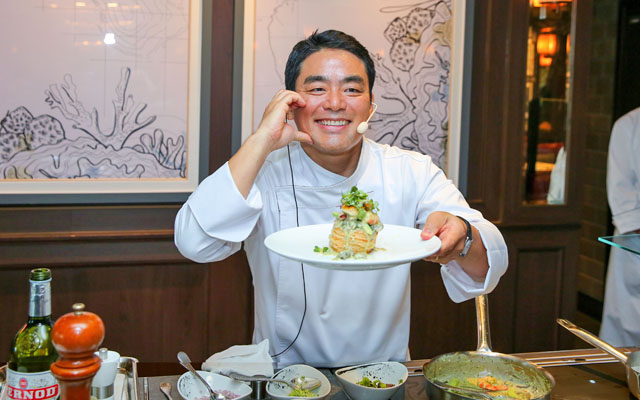
CapitaLand has appointed Kevin Goh as its CEO for lodging.
In his new role, Goh will oversee CapitaLand Group’s lodging business, which is one of the company’s three pillars for sustainable growth, alongside fund management and investment/development.
Goh will concurrently serve as the CEO of the property giant’s wholly owned lodging business unit, The Ascott Limited, a role he has held since 2018.
He is a key member of the senior leadership team responsible for managing and executing the group’s growth strategies.
Having been with the CapitaLand Group since May 2007, Goh has held various leadership positions in Ascott such as COO, managing director of North Asia, and regional general manager for East and South China.
Beijing-based boutique operator Bespoke Travel Company last week launched its live talk series, where experts and guides host seven broadcasts on Zoom for audiences around the world on topics ranging from true crime to tea appreciation and hand-pulled noodle classes.
Founder Sarah Keenlyside said The Bespoke Speaker Series kicked off with New York Times bestselling author Paul French in conversation with historian Jeremiah Jenne about the vibrant group of foreigners – known as the Peking Aesthetes – who lived and partied in Beijing during the 1930s.
Bespoke tea expert Tracy Lesh leads an online talk on Chinese tea appreciation on Zoom as part of the travel firm’s speaker series
The second was helmed by tea guru Tracy Lesh, an American and former mortgage lender, who moved to China in 2007.
Keenlyside said the speaker series would create a new revenue stream for the company, adding that self-guided programmes would also be rolled out as touring is still banned in the country.
“The (outcome of the) launch was better than I anticipated and that was a nice surprise. We had nearly 80 participants and about 50 people have signed up for the (discounted) all-access pass,” she said.
Buoyed by the initial success, and keen to reach a wider audience, Keenlyside is now looking at curating a series for the US market, a key client source, with a more user-friendly broadcast time.
“Paul (French) encouraged us (to do so) and because he is a big name, we knew that (his endorsement) would help us a lot and gave us the confidence to do it,” she said.
The concept took about three weeks to develop and Keenlyside believes that the company’s strength lies in its partnerships with experts and specialists who possess in-depth knowledge of Beijing and Shanghai.
Apart from generating income, Keenlyside said she and her team could continue their mission to promote cross-cultural understanding and enable people in lockdown situations learn more about Chinese culture.
Bespoke is turning to social media platforms such as Instagram and Facebook to market the speaker series. Prices range from about US$11 per talk or US$56 for the full access pass to all seven talks.
As commercial airlines melt under the pressure of the Covid-19 pandemic, experts assert that effective and innovative use of loyalty programmes, partnerships and client data will be their lifeline.
Speaking at an Aviation Festival Asia webinar last week, independent consultant Nik Laming of Urban Leopard Ventures said: “Loyalty programmes are probably the most valuable asset that airlines have at this moment. It will be a very quick recovery option for revenue.”
Airlines’ survival amid pandemic hinge on effective and innovative use of loyalty programmes, say experts
He explained: “Airlines have a database of highly engaged, valuable people. They have the ability to go to co-brand partners – especially banks – and give them a very good deal to pre-purchase miles to generate cash. It depends on how desperate the airline is, but at this point, nothing is off the table. It’s far more important for airlines to survive.”
New World Loyalty’s airline loyalty consultant Mark Ross-Smith agreed that airline loyalty will “play a big role” in recovery.
With air travel at a standstill, customers are now cashing out their miles through partner redemptions, such as supermarket and F&B gift cards, causing airlines to go into “cash preservation mode”, he described.
Despite this occurrence, it is important for companies to continue reassuring customers.
Ross-Smith said: “The best example is that the CEO would send a communication to reassure members that the airline is maintaining safety and keeping things clean. They should acknowledge the situation so that members feel confident about their miles, health and safety. It’s important to remove the uncertainty or anxiety, especially for elite members.”
However, this measure alone would not be enough to sustain customer loyalty and sentiment, as “members – and people in general – will remember how you treat them during a crisis”, he cautioned.
Instead, he advised airlines to heavily consider perks like extending members’ elite status or incentivising the collection of miles during this time, citing an example of an American airline that is offering 10 times the number of elite miles to its members.
These promotions can also be tweaked based on different markets and their price sensitivity, which may affect how quickly their travel demand will return once travel restrictions ease, said Laming.
He predicted that while business travellers are “highly likely to travel” and practise “very low discretion” to prices, young leisure travellers have shown to be “impulsive” and “highly price-sensitive”; the two main markets that are likely to start travelling first.
Laming concluded: “Airlines should be able to pick the promotions extended to each market to maximise cash yield and get people flying again. We will see a rebooting market that will hopefully reboot loyalty programmes to be bigger and better than before.”
The Malaysian Association of Tour and Travel Agents (MATTA) has urged the government to bail out the ailing Malaysia Airlines (MAS) amid the coronavirus crisis, in response to a possible merger between the national carrier and budget airline, AirAsia Group.
The possible merger was raised by senior minister of international trade and industry, Mohamed Azmin Ali, as an option to “save” the airlines as the pandemic continues to hammer the industry, reported several news media.
Malaysia’s government does not rule out the possibility of a merger between Malaysia Airlines and AirAsia
Azmin was quoted by those reports as saying that a possible merger has been on the cards since last year, but added that more discussions are underway “to see how best we can save those airlines”.
Since last year, the government has been looking for a strategic partner for MAB.
In a call for the government to give financial support to MAS, MATTA president, Tan Kok Liang, said in a statement: “The aviation industry sits at the core of the whole tourism ecosystem. Air connectivity is crucial to the nation’s tourism and economy recovery.”
He noted how countries worldwide have bailed out their national carriers, citing the case of the Singapore government arranging up to US$13.3 billion in funding to support Singapore Airlines through the crisis, and Hong Kong providing a US$258 million relief package to ease the liquidity pressure of airlines and aviation support services operators.
He added that the IATA has also strengthened its call for urgent action from governments worldwide to provide financial relief to airlines, as the pandemic will result in estimated losses for global airlines amounting up to US$314 billion, 25 per cent more than previously forecasted.
Tan pointed out that without airlines to bring in millions of tourists in and out of Malaysia, there will be no viable tourism industry. “They are the first in the long line of supply chain in the tourism industry that includes airports, road and rail transport, accommodation, food and beverage, entertainment and shopping plus business, education and health services,” he said.
Airports in Malaysia had registered a decline of 27.6 per cent with 18.4 million passenger movements, according to Tan. He added that international and domestic passenger movements had decreased by 32.4 per cent and 22.4 per cent, respectively.
He also said that aircraft movements had declined by 11.9 per cent in 1Q2020 over the same period last year, and international and domestic movements had declined by 17.5 per cent and 8.2 per cent, respectively, over 1Q2019.
“However, in 2Q2020, it will be worse off as more countries have closed their borders and most airlines have come to a standstill. The decline percentage will hit the high 90’s. 2Q2020 will be no better. If there is any hope of recovery, perhaps we can start to look at the final quarter (4Q2020),” he said.
However, he noted that steps need to be taken in making air travel palatable to the public again. “This may involve a new way of travel with changes for in-flight amenities, health kiosks and conducting rapid on site Covid-19 test certificates for passengers,” he said.
The Arabian Travel Market (ATM), the region’s biggest B2B travel event, has been postponed to 2021 due to the coronavirus outbreak, organiser Reed Travel Exhibitions (RTE) said on Sunday.
The next edition will be held from May 16 to 19 at the Dubai World Trade Centre, following the holy month of Ramadan and the Eid Al Fitr celebrations.
The Arabian Travel Market has been postponed to 2021 amid coronavirus fears
“Decisions like this are never taken lightly. Discussions took place at the highest level both internally and externally with local and federal government, partners, sponsors, exhibitors, and attendees who all endorsed our evaluation of the current situation and our decision to act once again, without delay,” said RTE in a statement.
RTE said it will be running an ATM Virtual Event from June 1 to 3, 2020 that includes webinars, live conference sessions, speed networking events, and one-on-one meetings.
With Chinese outbound travel forecasted to rebound in Q3/Q4, it may well serve as the springboard for Thailand’s tourism recovery, according to a recent study by C9 Hotelworks and DAC China Digital Services.
The study, which was conducted in mid-April this year, surveyed over one thousand respondents in first-tier cities within China and focused on sentiment towards outbound overseas travel, along with a deep dive into the metrics of Thailand’s travel potential post Covid-19 and looking at the impact on specific destinations within the country.
Chinese travellers’ positive outbound travel sentiment set to drive return of Thailand’s position as a global tourism destination; Chinese tourists in Wat Phra Kaew & Grand Palace in Bangkok pictured
Positive sentiment towards outbound travel from China highlights the survey results that reveal 53 per cent of respondents would like to travel in 2020, with the most popular months for trips abroad for the remainder of the year being August, October and December.
Getting inside the numbers, and focusing directly on sentiment towards Thailand as a destination, 71 per cent of those surveyed said they would like to travel to the country. One interesting shift in the data is that 83 per cent would choose independent travel over group tours.
Bangkok leads the charge among the most popular Thai destinations Chinese travellers want to visit, followed in order by Phuket, Chiang Mai, Koh Samui and Pattaya. Over 75 per cent of demand was pinpointed in the top three destinations.
Accommodation-wise, 72 per cent said they would prefer staying at a hotel or resort, as opposed to an Airbnb lodging; while the trip budget for 50 per cent of those surveyed was US$2,100 per person.
Among the top five preferred booking channels for hotels are Ctrip (61 per cent), Fliggy (16 per cent), hotel websites (nine per cent), Booking.com (five per cent) and WeChat (five per cent).
Commenting on the road to tourism recovery, C9 Hotelworks managing director Bill Barnett said: “We expect Thailand’s reopening trajectory to initially be dominated by the domestic storyline but move quickly into inter-regional travel punctuated by the outbound China sector who are ready and willing to visit the country as demonstrated by the survey results.”
While undoubtedly, there will be a lingering global fear factor for travellers in the wake of the pandemic, Thailand’s favourable door to door flying time and vast network of approved routes to the mainland supports lead indicator. Another is the appreciation of the Chinese yuan against the Thai baht in 2020, after reaching a low point in 4Q2019. Thailand’s policy of visa-on-arrival for Chinese travellers is also a strong driver of demand.
Furthermore, short-haul travel due to flight health concerns is expected to be a key mover in Asia’s travel recovery.
Meanwhile, resumption of domestic air travel in China in Q2 is bolstering LCCs’ financial liquidity.
Thailand is one of the most impacted travel markets by Covid-19 in Asia. The country hosted 39.8 million international visitors last year, with China accounting for nearly 11 million arrivals.
The expanded Thai tourism, hotel and travel sector contributes between 12-15 per cent of GDP to South-east Asia’s second largest economy.
The World Travel & Tourism Council (WTTC) has partnered marketing and communications firm MMGY Hills Balfour to launch a new social media campaign, #TogetherInTravel, aimed at galvanising the global travel and tourism community and inspiring future travel.
Going live at 11.00 BST on April 20, the campaign encourages travellers from around the world to share a pre-prepared video and their globetrotting experiences along with the hashtag #TogetherInTravel, which will then be hosted on microsite TogetherInTravel.com.
WTTC invites travellers worldwide to share their past travel experiences as part of its new social media campaign
Gloria Guevara, president & CEO of WTTC, said: “The concept for the #TogetherInTravel campaign was borne out of a desire to rally everyone who is passionate about travel, to unify those who are working hard to rebuild the sector and to spread a message of solidarity that we are one global community, and one where travel brings us closer, at the right time.
“Our message is that everyone can still stay inspired with future travel ideas and bookings – and in the meantime, be part of a virtual space for sharing, connecting, and collectively inspiring.”
International Luxury Travel Market (ILTM) has published a white paper that brings clarity to the economic value and impact of luxury travel on communities, individuals and businesses, as well as a podcast that details the findings.
Both the white paper and podcast are now available on ILTM’s website.
The global luxury travel universe has a value of US$2.05 trillion and is built on the travel spend of just 0.3 per cent of the world’s population
The white paper, produced by Barton Consulting under ILTM’s order, highlights several key discoveries. Valued at US$2.05 trillion, the global luxury travel universe would rank in the top 10 if it were a global economy; if it were a country, it would be bigger than Italy; and it is considerably larger than a number of other discretionary global goods and services industries, such as consumer electronics and fashion retail, according to the report.
The white paper also finds that 105.9 million people are directly employed within travel across the world and whose livelihood is dependent on High Net Worth (HNW) travellers, even though the latter comprise only 0.3 per cent of the global population.
The global luxury travel ecosystem of activities, valued at US$1.54 trillion, provides employment for an additional 62 million people globally.
The white paper also states that luxury travel is a vital component in the distribution of wealth across the globe: local economies are dependent on luxury travellers for arts, culture, restaurants, guides, sporting events, etc.
In the podcast entitled, Luxury Travel’s true impact on business and employment, Barton’s Winston Chesterfield explains how such a small community of HNW travellers can make such a big economic impact by spreading their wealth to benefit local economies, communities, individuals and businesses. He explores how these individuals will be the first to kick start the industry post-Covid-19, and why the wealth they control is vital to keep the world moving.
Explaining the move to commission the white paper and podcast, Alison Gilmore, ILTM portfolio director, said in a statement: “We wanted to contribute to our industry and provide some new insight, facts and figures that we hope will give comfort to those who have suffered as a result of the Covid-19 shutdown of this industry.
“When the time is right, a new future will emerge and ILTM is here as a catalyst, however long this journey takes”.
The Mekong Tourism Coordinating Office (MTCO) has launched the Mekong Heroes, an initiative operated by the public-private partnership framework Destination Mekong, to honour individuals who have made a difference in promoting and developing sustainable and responsible tourism in the Greater Mekong Subregion (GMS).
The MTCO is seeking nominations from anybody active in the travel and tourism industry in the region.
The Mekong Heroes initiative seeks to honour changemakers who have championed sustainable tourism in the Greater Mekong Subregion
The Mekong Heroes programme is co-chaired by Thailand’s former minister of tourism and sports, Weerasak Kowsurat, and Myanmar’s former minister of hotels and tourism Htay Aung, who will endorse and approve the Mekong Heroes, selected by the Mekong Tourism Advisory Group from the nominations received via MekongHeroes.org.
Jens Thraenhart, executive director of the MTCO, said in a statement: “The whole industry will benefit from our Mekong Heroes’ authenticity of vision, purpose, commitment, and determination, maintained over years of hard work. Recognised not only as builders, creators, and innovators, but also as mentors, teachers, and motivators, these individuals have made it their mission to bring out the best in people.”
Mekong Heroes could include innovative entrepreneurs, passionate managers, visionary executives, selfless officials or tireless field workers who have conceived new ways of bettering tourism.
The personal stories of each Mekong Hero will be told to inspire others via a special profile on an upcoming dedicated website, MekongHeroes.com, which will bring together all Mekong Heroes in the Mekong Heroes Gallery.
MTCO plans to announce one new Mekong Hero every quarter and recognise the Mekong Heroes of the year at the upcoming Mekong Tourism Forum.
All Mekong Heroes will be featured in the proposed Mekong Stories book and companion website, together with inspiring content of Experience Collection Members, as well as exiting photography shared via Mekong Moments.
TTG Asia Media is debuting TTG Conversations webinar series end of this month to connect industry peers whose ability to meet and discuss key business issues has been disrupted by the Covid-19 pandemic.
TTG Conversations joins the company’s stable of widely-read and established trade titles as well as at the many knowledge sessions of IT&CM Events and CTW Events that take place several times a year.
Panellists will discuss the stickiness of virtual events post-pandemic and share tips on how to execute an online meeting
The first webinar will take place on Wednesday, April 29, from 15.00 to 16.00 (GMT +8) with a topic designed for its TTGmice and TTGassociations audience.
The hour-long TTG Conversations: The end of events as we know it? calls on four panelists to debate the value of virtual meetings and determine how extensively companies and event organisers will utilise such event formats as the world recovers from the pandemic, as well as share their learnings in converting physical gatherings to online ones.
The panellists are: Iain Bitran, executive director, The International Society for Professional Innovation Management; Veemal Gungadin, CEO, GlobalSign.In; Joe Ciliberto, global director, sales and marketing, EventsAir, and Cheryl Tan, head of events, TTG Events.
The session will be moderated by Karen Yue, group editor of TTG Asia Media.
Registration for TTG Conversations: The end of events as we know it? is now open. Capacity is limited and registrations are on a first come, first served basis.
TTG Asia Media intends to maintain a flexible frequency for TTG Conversations, with new sessions surfacing every four to six weeks for now to tackle the latest developments and talking points.
There are plans to make TTG Conversations a part of the company’s physical events, facilitating a hybrid model that allows delegates to participate remotely from wherever they are and join in the discussion and conversations live.
From a solutions-offering perspective, TTG Conversations will further sharpen the company’s integrated communication and trade engagement capabilities.
With the continued support of advertisers and sponsors, TTG Asia Media hopes to keep TTG Conversations free for attendees.