


The pandemic has reinforced the need for destinations and tourism products to provide compelling reasons for consumers to brave tedious pre-trip procedures, opined Arthur Kiong, CEO of Far East Hospitality Management, whose company will open its latest luxury hotel in Singapore on March 1.
Speaking at a press conference on February 26, Kiong said tourism products today must offer a unique proposition and an experience that travellers cannot have at home.

He believes that his company’s soon-to-open The Clan Hotel Singapore satisfies these needs, adding that it as “not your typical hotel”.
Located within the Far East Square and Telok Ayer heritage precinct, the 324-key property offers guest touchpoints and services that tell the stories of the vicinity and local culture, all crafted by hotel associates with a passionate understanding of local history and with the support and contribution of local subject experts.
A prominent example of this arrangement is The Clan Collective, a network of local craftsmen, artists and influential figures who are widely regarded as keepers of culture and heritage in Singapore. Programme profiles currently include local hawker cuisine expert, Leslie Tay, who has curated the hotel’s The Clan Daily Special in-room dining menu; artist Grace Tan who is behind the lobby’s art installation, which comprises 150 painted aluminium panels suspended from the ceiling; and Ivan Yeo, whose family-run The 1925 Brewing Co. has crafted a white chrysanthemum lager just for the hotel.
Hotel guests also gain access to The Inner Circle Guide, a collection of recommendations across services, dining, nightlife and entertainment options. Their identity as guests of The Clan Hotel Singapore will earn them surprise perks and attention at participating merchants.

As a hotel located in the business district, Kiong noted that there are expectations that it has to be “an exclusive property with an international brand, it has to be functional, it has to be state-of-the-art, and it has to be exclusive”.
“But we decided we didn’t want another business hotel that is like every other. We wanted this hotel to serve an unmet need of the market (and that led us) to turn the product on its head. Instead of producing an exclusive hotel, we made this an inclusive product. Instead of having a state-of-the-art hotel, we made this nostalgic. Instead of an international hotel, we gave this hotel a very local flavour. Instead of a very functional hotel, we made this very experiential.”
“The pandemic has reinforced the ideas that we have for the hotel are down the right path,” Kiong stated.
While the hotel concept feeds the greater traveller desire for tailored, destination-specific experiences, some changes to the product had to be made to accommodate new health and safety considerations, he told TTG Asia.
Such changes included redesigning the hotel’s all-day dining restaurant to ensure greater space for social distancing as well as ditching a proposed cigar bar concept where patrons would have to “huddle” together. Technology has also been brought in to provide guests an option for self-check-ins, and sterilisation equipment for smart devices in guestrooms.
When asked about Singapore residents’ appetite for staycations – an alternative source of business in the absence of international tourist arrivals, Kiong revealed that a limited pre-opening offer that was “secretly” published on the hotel’s website on February 15 had garnered immense interest, with 200 bookings sold out swiftly.
“We are seeing a distinct demand from residents who want new hotels that are not a Stay Home Notice property (government appointed quarantine hotels). As long as border restrictions remain, there will always be an appetite for staycations. There are over 1,000 people taking staycations every day in Singapore, and we only need to capture a portion of that,” he replied.
However, he also acknowledged that the domestic staycation market will never be a replacement for international tourism business.
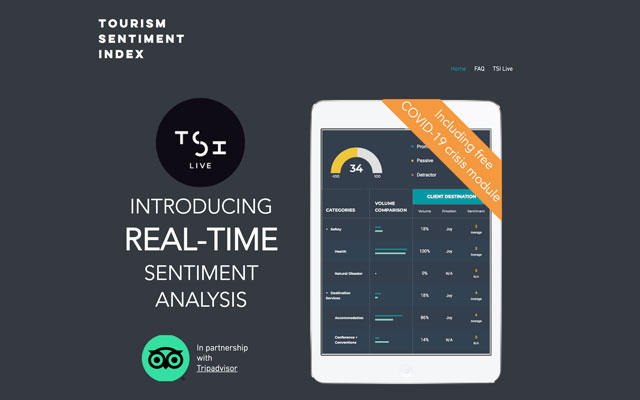








A new live data intelligence dashboard launched by Tripadvisor will allow destination marketers to gauge travellers’ sentiment towards destinations and travel, in order to drive their recovery strategies.
Powered by Tourism Sentiment Index, the offering is part of Tripadvisor’s wider suite of data intelligence products for DMOs, known as the Tripadvisor Insights Platform. The live dashboard provides clients with essential word-of-mouth insights about destinations, combining Tripadvisor’s each and traveller behaviour insights with Tourism Sentiment Index’s sentiment technology.
The Tripadvisor Insights Platform is a collection of measurement and insights tools intended to help partners in the travel and tourism industry manage their media campaigns and overall recovery activities. The solutions use Tripadvisor’s wealth of user behaviour data to measure performance, uncover competitive insights and track how destinations, accommodations, attractions and restaurants are performing over time.
The new sentiment dashboard for DMOs uplevels the service offering of the Tripadvisor Insights Platform by providing clients with daily actionable intelligence, using insights from across 50 tourism touchpoints – including air access, accommodations and attractions. The dashboard’s analytics are drawn from real-time conversations, across half a million platforms, including Tripadvisor.
Sentiment towards destinations and travel contribute to an overall score that reveals a destination’s popularity versus competitors, enabling them to update campaigns, product offerings and messaging faster and more effectively.
The sentiment dashboard also includes a crisis analysis module that tracks the impact of the pandemic in locations around the world by revealing emotional reactions to categories such as health services, government and economics.
“Recovery in the wake of Covid-19 is key this year. The Tourism Sentiment Index will equip DMOs with critical information and actionable insights that will allow them to better understand their travellers and the global landscape, resulting in more targeted and strategic marketing and media placement decisions”, said Sarah Mathews, Group Head of Destination Marketing APAC at Tripadvisor.
“Being able to put the right message out to the right traveller at the right time will give DMOs an advantage in campaign planning and execution, all with the goal of bringing the world back to travel safely.”