Indonesia’s marine tourism industry is urging the government to accelerate regulatory harmonisation, saying overlapping policies continue to undermine investment confidence despite the introduction of a new Tourism Law.
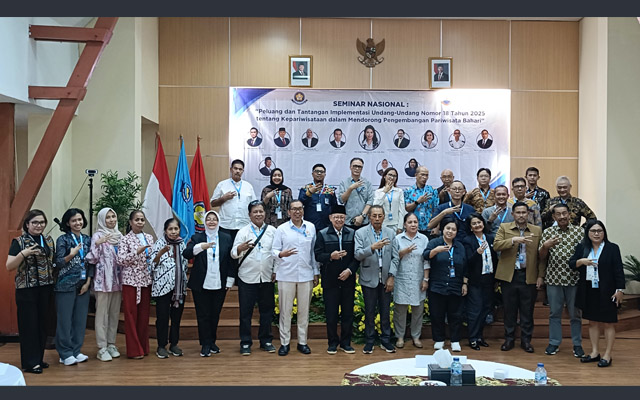
The call was made during a national seminar on implementing Indonesia’s Tourism Law for marine tourism development in Jakarta.
Stakeholders from the tourism industry, academia and trade associations agreed that overlapping regulations remain a major obstacle to unlocking Indonesia’s marine tourism potential.
Ismail Ning, chairman of the Indonesian Marine and Tourism Association (Gahawisri), said marine tourism development is still governed by multiple regulations issued by different ministries and agencies.
“Indonesia has extraordinary marine tourism resources, but we still do not have a harmonised regulatory framework that can serve as a clear foundation for developing marine tourism,” he said.
According to Ismail, overlapping regulations and differing interpretations continue to create uncertainty for operators and investors.
Citing Labuan Bajo as an example, he said industry players had faced a series of policy changes in recent years, including tax-related issues and restrictions limiting visits to national park areas to 1,000 tourists per day.
Dhaniswara Harjono, a business law professor, said marine tourism should be treated as a strategic sector requiring stronger coordination across government agencies.
“We need stronger harmonisation and perhaps even a dedicated body that can coordinate policies across ministries and agencies,” he said.
He noted that marine tourism businesses must comply with regulations covering tourism, maritime affairs, coastal management, environmental protection and investment, making policy certainty essential for investors.
The Ministry of Tourism (MoT) acknowledged that stronger coordination will be needed to translate the new Tourism Law into industry growth.
Rizki Handayani, caretaker deputy for industry and investment at the MoT, identified marine tourism as one of Indonesia’s priority tourism products.
“Indonesia has enormous marine tourism potential. The challenge is ensuring that regulations, infrastructure and investment policies move in the same direction so the sector can grow sustainably and competitively,” she said.
Rizki proposed harmonising regulations covering licensing, taxation, immigration, maritime transport, investment, safety and infrastructure to eliminate overlapping requirements.
Beyond regulatory reforms, the MoT is developing an Eastern Indonesia travel pattern linking diving destinations, yacht routes and liveaboard experiences.
Itok Parikesit, assistant deputy for tourism product development at the MoT stated: “The initiative is expected to encourage longer stays, increase visitor spending and strengthen Indonesia’s appeal to high-value marine tourism segments.”
Government agencies also highlighted reforms aimed at improving the business environment.
Nurdiansyah, head of legal affairs and cooperation at the Directorate General of Sea Transportation under the Ministry of Transportation, said licensing for marine tourism transport services has been integrated into the Online Single Submission (OSS) system to improve legal certainty and ease of doing business.
Indonesia will continue to maintain its cabotage policy, requiring domestic sea transport services to use Indonesian-flagged vessels operated by Indonesian crews. However, foreign investment remains possible through joint ventures that comply with national regulations.
Hellen Sarita de Lima, vice chairwoman of Gahawisri, said better alignment among transportation, immigration, customs, quarantine, fisheries, tourism and investment authorities would be critical to improving Indonesia’s competitiveness.
Stakeholders plan to compile the seminar’s recommendations into a policy brief for submission to seven ministries, focusing on regulatory harmonisation, streamlined licensing procedures and measures to strengthen Indonesia’s position as a marine tourism destination.