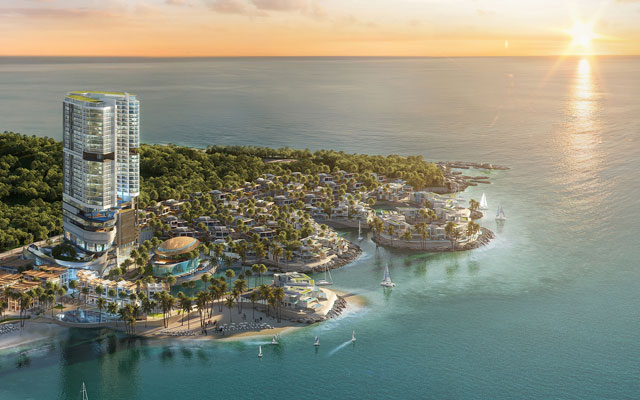
New World Hotels & Resorts has been appointed by KDI Holdings to manage the 306-room New World Nha Trang Hotel, slated to open in 2023.
New World Nha Trang Hotel will join the brand’s portfolio as the fourth property in Vietnam, following the announcements of New World Saigon Hotel and resort properties opening in Hoi An and Phu Quoc this year.
The hotel will be located within Vega City, the 44ha integrated resort complex housing the iconic Opera House, Vega Continental Shopping Centre, the Dance of Lights show, the Vega Coral Park, and a beach club.
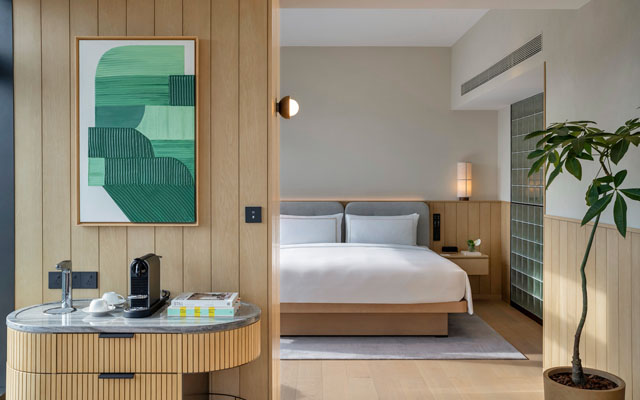
Each guestroom and suite, at a minimum size of 42m², will feature balconies with sweeping views of Nha Trang Bay, Hon Rua Island and Co Tien Mountain. A trio of free-standing, beachfront villas will offer two to four bedrooms furnished with a walk-in closet, living room, separate dining area, private pool and outdoor shower.
A total of 1,450m² of ocean-view facilities will be dedicated to events and meetings, including five individual meeting rooms, a 566m² pillarless ballroom and a special bridal suite designated for destination weddings.
Recreational amenities will abound on-site, with an outdoor infinity pool, spa, fitness centre, movement studio, kids’ club and beach club. The property will also feature four restaurants and lounges, including an all-day café, specialty restaurant and bar, poolside bar and lobby lounge.
Global air passenger demand recovery, which had been slowing since the Northern hemisphere’s summer travel season, came to a halt in November 2020, according to a release by IATA.
Total demand (measured in revenue passenger kilometers or RPKs) was down 70.3% compared to November 2019, virtually unchanged from the 70.6% year-to-year (YoY) decline recorded in October. November capacity was 58.6% below previous year levels.
Asia-Pacific airlines’ November traffic plunged 95.0 per cent compared to the year-ago period, as the region continued to suffer from the steepest traffic declines for a fifth consecutive month
International passenger demand in November was 88.3% below the previous year, slightly worse than the 87.6% YoY decline recorded in October. Capacity fell 77.4% below previous year levels. Europe was the main driver of the weakness as new lockdowns weighed on travel demand.
Recovery in domestic demand, which had been the relative bright spot, also stalled, with November domestic traffic down 41.0% compared to the prior year (it stood at 41.1% below the previous year’s level in October). Capacity was 27.1% down on 2019 levels.
Alexandre de Juniac, IATA’s director general and CEO, said: “The already tepid recovery in air travel demand came to a full stop in November. That’s because governments responded to new outbreaks with even more severe travel restrictions and quarantine measures.
“This is clearly inefficient. Such measures increase hardship for millions. Vaccines offer the long-term solution. In the meantime, testing is the best way that we see to stop the spread of the virus and start the economic recovery. How much more anguish do people need to go through – job losses, mental stress – before governments will understand that?”
Asia-Pacific airlines’ November traffic plunged 95.0% compared to the year-ago period, which was barely changed from the 95.3% decline in October. The region continued to suffer from the steepest traffic declines for a fifth consecutive month, with capacity dropping 87.4%.
European carriers saw an 87.0% decline in traffic in November versus a year ago, worsened from an 83% decline in October; while capacity withered 76.5%.
Middle Eastern airlines’ demand plummeted 86.0% in November year-to-year, which was improved from an 86.9% demand drop in October; while capacity fell 71.0%.
North American carriers had an 83.0% traffic drop in November, versus an 87.8% decline in October; while capacity dived 66.1%.
Latin American airlines experienced a 78.6% demand drop in November, compared to the same month last year, improved from an 86.1% decline in October year-to-year. This was the strongest improvement of any region. November capacity was 72.0% down, with routes to/from Central America emerging as the most resilient as governments reduced travel restrictions, especially quarantine requirements.
African airlines’ traffic sank 76.7% in November, little changed from a 77.2% drop in October, but the best performance among the regions. Meanwhile, capacity contracted 63.7%.
In domestic passenger markets, Australia’s domestic traffic was down 79.8% in November compared to the same month a year ago, improved from an 84.4% decline in October, as certain states opened up. But it continued to significantly lag other domestic markets.
India’s domestic traffic fell 49.6% in November, an improvement over a 55.6% decline in October, with greater improvement expected as more businesses reopen.
Nora Dance, a Southern Thai tradition, was part of the arts extravaganza at The Living Art Festival 2020
Leisure and entertainment destination, Blue Tree Phuket, kicked off its reopening in December with a three-day arts extravaganza that sets the stage for its drive to position Phuket as a destination for music, fashion, arts and crafts and food.
The Living Art Festival 2020, held from December 17 to 19, 2020, featured concerts, street art, street performances, workshops, art films, panel talks, and fashion shows – all delivered by top Thai artists such as Prateep Kochabua, Mueangthai Busamaro, Jarupong Juntarapech, Paretas Hutanggura, Synth X Factor, EKA Soundz, DJ Nicola Vega and DJ Fen.
A welcoming destination for all ages, Blue Tree Phuket on the popular Thai island’s west coast takes in array of amenities, such as the signature four-storey Tree House Restaurant & Beach Club, a kid’s club, walking and jogging trails, retail and lifestyle outlets. These facilities surround a 17,000m2 lagoon that is also a playground for adrenaline junkies.
Building on its strong recovery momentum of 2020, Sanya, a resort city in south China’s Hainan province, is seeing its tourism sector get off to a promising start as it ushers in the new year.
Between January 1-3 of 2021, Sanya received 407,400 tourists for the New Year holiday, ringing up RMB$964 million (US$149.1 million) in revenue, according to a press release by Sanya Tourism Promotion Board.
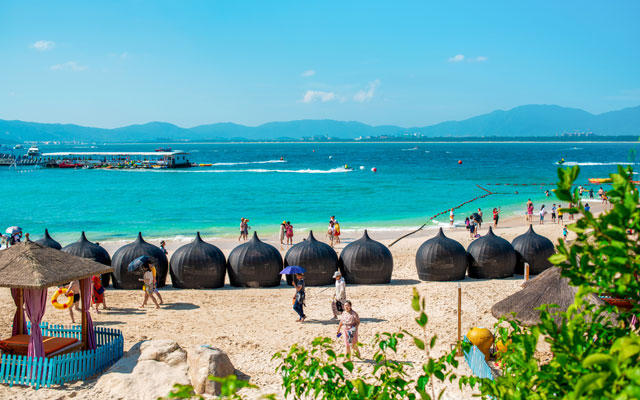
Sanya, known as the Hawaii of China, is a popular destination for both domestic and foreign tourists; Wuzhizhou Island in Haitang Bay, Sanya pictured
Since China brought Covid-19 largely under control last March, Sanya has seen its tourism sector rapidly recover in 2H2020. Last year, a total of 15.412 million passengers travelled through Sanya Phoenix International Airport, stated the release.
Sanya’s tourism sector began its steady recovery in May 2020, buoyed by the Chinese government’s policy to establish the Hainan Free Trade Port.
Overnight tourist figures and total revenue has remained stable since 3Q2020, given a boost by the coincidence of Mid-Autumn Festival and National Day during Golden Week. During that period, Sanya saw a 12.69 per cent increase year-on-year (YoY) in tourists, while total tourism revenue skyrocketed by 39.33 per cent YoY.
Sanya Tourism Promotion Board has created a series of promotional themes targeting different tourist segments, such as the recently-launched Wonderland Sanya, which seeks to attract young travellers to explore Sanya’s unique and vibrant possibilities across the five angles of food, travel photography, culture, outdoor activities, and luxury hospitality.
Digital health passes and certificates can play a pivotal role in tourism recovery by boosting consumer confidence when travelling during the Covid era, highlighted a recent report by GlobalData.
The analytics company noted that several stakeholders of the travel and tourism industry, including destinations, airlines and associations like IATA, are exploring the option of digital passes and health certificates.
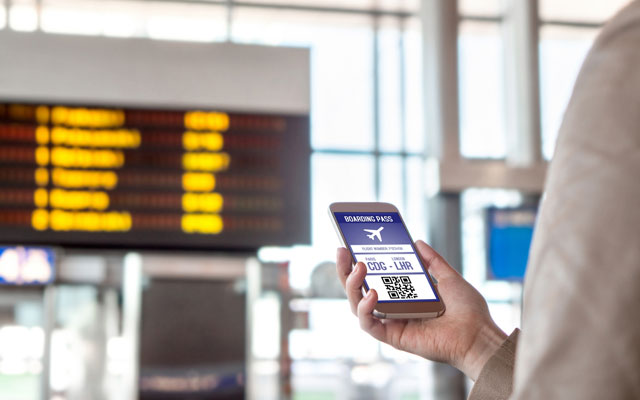
Digital passes to boost consumer confidence by enhancing efficiency, safety and data privacy, says GlobalData
These digital passes and certificates intend to lower the risk of Covid-19 infection by providing accurate details on the health status of passengers.
Since May 2020, Singapore has been testing ICC AOKpass, a digitally verifiable Covid-19 health certificate for entrance to the country. It is backed by health and security services provider International SOS, International Chamber of Commerce and AOKpass. In line with this, all travellers from Indonesia and Malaysia can make use of the facility that will be made available to other international travellers in a phased manner.
AOKpass is also being used on flights between Abu Dhabi and Karachi/ Islamabad as well as Rome and New York City/Atlanta. Another similar digital pass, CommonPass, has been tested on flights between New York and London. Additionally, IATA is also working on a Travel Pass.
Animesh Kumar, director of travel & tourism and automotive consulting at GlobalData, said: “Digital passes help passengers prove that they adhere to the health entry requirements of their destination and enhance the safety of international travellers. Since these can be stored in and used through a mobile application, they are easy to use. The app securely stores and authenticates the negative Covid-19 PCR test results. The passes can also facilitate faster clearances if airports have dedicated immigration counters, similar to Changi Airport in Singapore.”
Stressing the urgent need for a framework that brings the passengers, testing labs, local authorities, airlines and immigration authorities on a common platform, GlobalData said that such digital passes/certificates can facilitate that. The use of QR codes, blockchain and decentralised data ensures data accuracy as well as privacy, it added.
A large-scale rollout of such passes would reduce the lag created by the time-consuming processing of paper certificates, which are also susceptible to potential test result frauds.
Kumar concluded: “Digital health passes would help in boosting the consumers’ confidence as they would enhance efficiency, safety, security as well as data privacy and reduce the risks of in-flight infections. There is also a potential for expanding the use of such digital passes for domestic travel as well as entry in concerts and stadiums.”
The ACI Report 2021, an annual salary and employment trends study, has painted a bleak picture of a travel and tourism industry afflicted with job losses and reduced employee confidence.
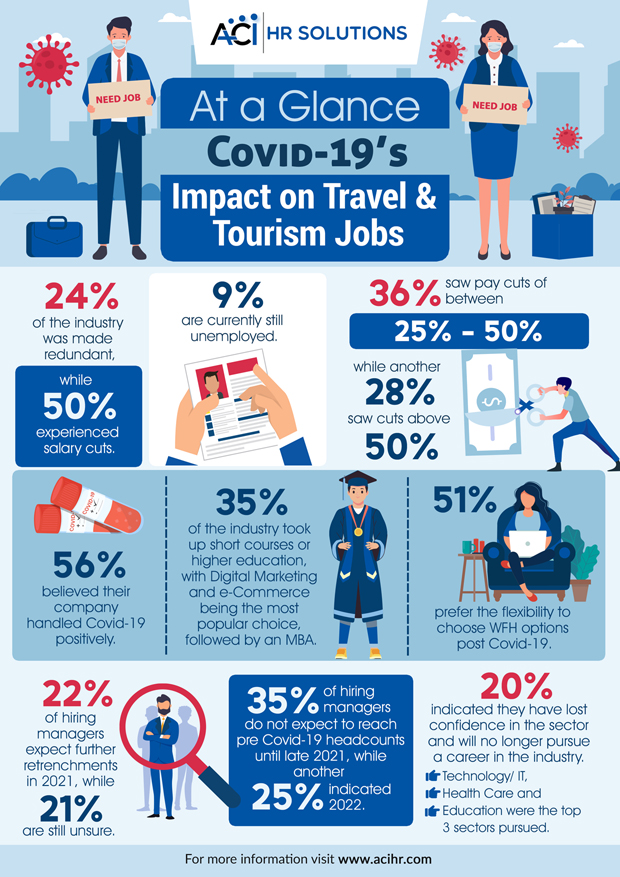
Drawing inputs from a sample of 829 travel, tourism, hospitality and lifestyle personnel from across Asia-Pacific and surrounding regions, the study identified 74 per cent of respondents whose jobs were impacted by the Covid-19 pandemic. Twenty-four per cent were made redundant in 2020 while 50 per cent experienced salary cuts, with a majority 36 per cent taking a 25-50 per cent reduction and 28 per cent shouldering a steeper cut of 50 per cent or higher.
Among retrenched respondents, 83 per cent were employed in their organisation for under five years while the most vulnerable age group was 46-55 years old, with 53 per cent of respondents from this age bracket being affected.
Twenty per cent of respondents have indicated reduced confidence in the travel and tourism industry and will instead pursue a career elsewhere; technology/IT, health care and education emerged top alternative industries.
At the same time, 68 per cent of respondents plan to leave their employers or the industry in the next 12 months, with 27 per cent open to exploring opportunities outside of the industry compared to just 15 per cent the previous year. The study pointed out that desires to exit the travel and tourism industry have been growing the past two years.
In terms of salary progression, only 28 per cent of respondents had received some form of increment in 2020 – representing a large drop compared against 2019 where 65 per cent enjoyed a pay growth. Thirty-nine per cent received a bonus in 2020, compared to 60 per cent the previous year, with the majority 40 per cent enjoying one to two months of bonus and 32 per cent receiving less than a month’s bonus.
While 74 per cent viewed career progression as extremely important or very important – compared to 70 per cent in 2019 – only 32 per cent surveyed said they believed their employer offered excellent or good opportunities for career progression, down from 2019’s 40 per cent. A further 34 per cent indicated that career prospects with their present employer were poor or zero, up from 30 per cent in 2019.
68% of respondents plan to leave their employers or the industry in the next 12 months
Andrew Chan, founder and CEO of ACI HR Solutions, the company behind the annual survey, told TTG Asia that while the results “were certainly distressing to read”, they reflected industry observations throughout 2020.
“Not surprising, most respondents thought deeply about their career progression amid this pandemic crisis, and really evaluated how their employer, or perhaps even if the industry could satisfy that. We saw one of the biggest discrepancies and disconnect on this issue in this year’s report compared to our previous surveys,” said Chan.
Commenting on the strong desires to exit a travel and tourism job or the industry, Chan explained that the 20 per cent who lost confidence in the industry might be finding it challenging to regain employment.
“Young graduates who were just entering the industry (might also be) spooked by the pandemic,” he said, adding that the report highlights an unemployment rate of nine per cent.
“The 68 per cent considering changing jobs over the next 12 months was surprisingly high. However, if we consider that many are still working on reduced salary, and perhaps functioning on fewer resources and/or covering colleagues who were retrenched, their work stress would be elevated. So, perhaps it is not surprising that many are keeping one eye out for new opportunities that would see their salary expectations returned and work stress reduced,” he added.
Chan: respondents are mostly happy with how their employers have handled the crisis
When asked about recovery solutions that are available to employers who hope to rebuild staff loyalty despite current business conditions, Chan advised continued internal communications that highlight key timelines to staff so they know when salary levels may be reinstated or when staffing levels may return to ease their work loads.
He acknowledged that “fiscal responsibilities and staff morale is a challenge to balance at the moment, and very much still depends on the macro environment”, but emphasised that respondents are mostly happy with how their employers have handled the crisis.
“A high percentage of 56 rated their company’s handling of the pandemic as excellent or good, and another 28 per cent thought it was fair, which indicates to me that employees are generally very understanding of the situation,” he remarked.
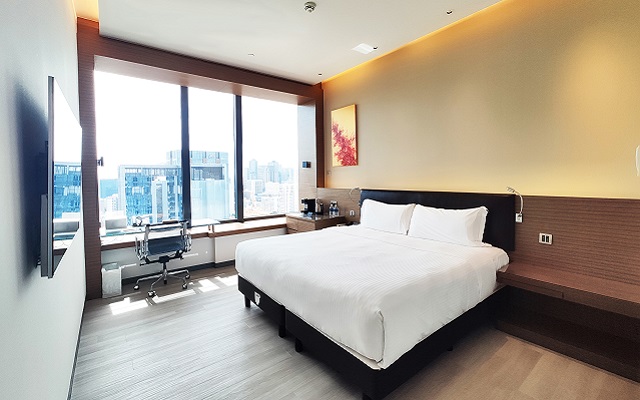
The Mint Hotel is a room category that features cutting-edge materials and intelligent design principles. Under the advice of medical professionals from Farrer Park Hospital, all 176 rooms in the Mint Hotel come with anti-viral wallcoverings, moveable furniture and the use of anti-microbial blind fabrics to allow the guest rooms to be sanitized more thoroughly.
Furthermore, carpets have been removed from guestrooms and common areas and replaced with custom gapless vinyl flooring. This does not trap dirt and can be easily cleaned and disinfected. To evoke an openness to the space, earthen tones now adorn the walls and new mood lighting fixtures have been installed.
Mental health is just as important as physical health and one way to ensure positive vibes is to get good sleep. At the same time, hotel guests spend 6-10 hours per day resting on pillows, making it one of the highest touchpoints for the hotel. In a bid to enhance guests’ quality of sleep, while improving hygiene levels, One Farrer Hotel created the Pillow Lab.
The Pillow Lab, projected to launch in early 2021, uses an industry-leading Ultraviolet-C (UVC) Chamber to remove all pathogens, natural microbiota, moulds, and yeasts. One Farrer Hotel will also be making a range of hypoallergenic pillows available for guests to purchase at the Pillow Lab as well as at the hotel lobby. With the Pillow Lab at One Farrer Hotel, guests can be assured of a restful sleep with peace of mind.
In addition to the Mint Hotel and the Pillow Lab, other health and safety measures in place include contactless entry points and sanitizer stations throughout the premises, sterilization of key cards and in-room amenities with specialized UVC chests, sterilization of guestrooms and bathrooms with UVC lamps, safe distancing demarcations for events and common areas, as well as staggered check-in and check-out times.
In redefining its dining concept for the age of safe distancing, the hotel is also launching the Nest at One Farrer. To meet increasing demand for private dining experiences, the Nest at One Farrer offers discerning diners bespoke menus by the hotel’s award-winning culinary team as well as a retinue of world-renowned guest chefs – all while immersing themselves in lush ambience and panoramic views of the Singapore skyline.
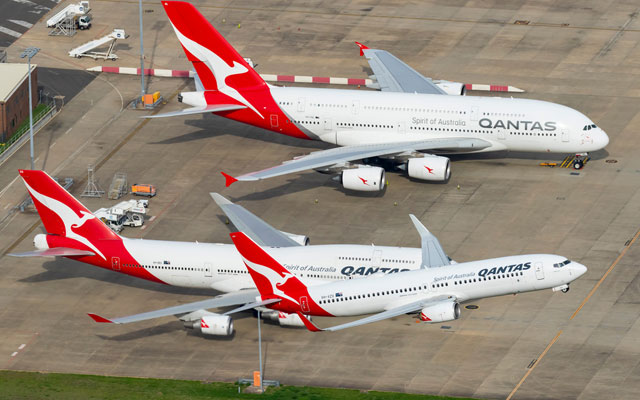
Australia’s national carrier Qantas Airways has resumed bookings for international flights from July 1, 2021, signifying that overseas travel may return earlier than anticipated.
The airline started taking bookings for almost all flights across its international network on Tuesday.
Qantas has this week started selling seats across its international flight network
Ticket sales for Japan, Hong Kong and Singapore, which was planned to start in March, have been pushed back to July, while other destinations like the US and London have been brought forward from October.
Currently, New Zealand is the only overseas destination serviced by Qantas.
“Recently, we have aligned the selling of our international services to reflect our expectation that international travel will begin to restart from July 2021,” Qantas said.
“We continue to review and update our international schedule in response to the developing Covid-19 situation.”
While tickets are on sale, the airline said the resumption of international flights would be subject to vaccine rollouts and border rules.
Qantas’ move has come under fire, with deputy prime minister Michael McCormack saying: “Decisions about when international travel resumes will be made by the Australian Government. International borders will be opened when international arrivals do not pose a risk to Australians.”
He added: “The Australian government is working on travel arrangements with countries, such as New Zealand, that have low community infections.”
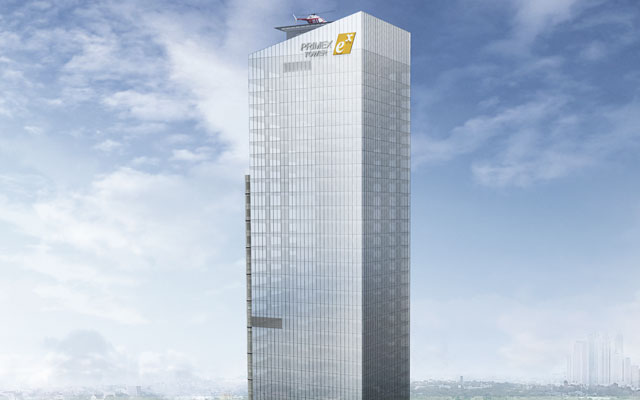
Accor has signed a deal with Primex Realty Corporation to open the Pullman Manila at Primex Tower, a mixed-use development currently under construction in the Greenhills district of San Juan, metro Manila.
Slated for completion in 2023, the 200-key upscale hotel will be situated on the upper floors of the complex, with retail and office spaces occupying the lower floors.
Pullman Manila at Primex Tower joins a pipeline of 16 hotels slated to open across the Philippines by 2025
Pullman Manila at Primex Tower will boast two restaurants, a lobby lounge, rooftop bar, fitness centre and swimming pool. Meeting and events facilities will include a ballroom, meeting rooms and a business centre.
This marks the second Pullman hotel in Manila, with the first set to debut in the Makati CBD come 4Q2022.
Accor plans to boost its presence in the Philippines from seven hotels to 23 hotels within the next five years, according to Garth Simmons, CEO, Accor Southeast Asia, Japan & South Korea.
Princess Cruises is extending its pause of sailings through May 14, 2021, including sailings in the Caribbean and along the California Coast, plus early season Alaska and Europe cruises.
The decision was made in light of the ongoing uncertainty around travel restrictions, said the company. In preparation for its return to service, the cruise line will continue to develop its plans to meet the Framework for Conditional Sailing Order issued by the U.S. Centers for Disease Control and Prevention.
Princess Cruises extends pause in operations as the pandemic continues to impact the cruising industry
Guests currently booked on these cancelled voyages will have the option to receive a refundable Future Cruise Credit (FCC) equivalent to 100 per cent of the cruise fare paid, plus an additional non-refundable bonus FCC equal to 25 per cent of the cruise fare paid.
To receive the above FCCs, no action is required by the guest or their travel advisor. The FCCs can be used on any cruises booked by May 1, 2022 and sailing by December 31, 2022. Alternatively, guests can request a full refund for all monies paid on their booking before February 15, 2021.
Princess said it will protect travel advisor commission on bookings for cancelled cruises that were paid in full, in recognition of the critical role they play in the cruise line’s business and success.
Earlier, Princess had also extended its pause for cruises departing from Australia and New Zealand through May 31, 2021, as well as Japan cruises through June 25, 2021.





 Among retrenched respondents, 83 per cent were employed in their organisation for under five years while the most vulnerable age group was 46-55 years old, with 53 per cent of respondents from this age bracket being affected.









Building on its strong recovery momentum of 2020, Sanya, a resort city in south China’s Hainan province, is seeing its tourism sector get off to a promising start as it ushers in the new year.
Between January 1-3 of 2021, Sanya received 407,400 tourists for the New Year holiday, ringing up RMB$964 million (US$149.1 million) in revenue, according to a press release by Sanya Tourism Promotion Board.
Since China brought Covid-19 largely under control last March, Sanya has seen its tourism sector rapidly recover in 2H2020. Last year, a total of 15.412 million passengers travelled through Sanya Phoenix International Airport, stated the release.
Sanya’s tourism sector began its steady recovery in May 2020, buoyed by the Chinese government’s policy to establish the Hainan Free Trade Port.
Overnight tourist figures and total revenue has remained stable since 3Q2020, given a boost by the coincidence of Mid-Autumn Festival and National Day during Golden Week. During that period, Sanya saw a 12.69 per cent increase year-on-year (YoY) in tourists, while total tourism revenue skyrocketed by 39.33 per cent YoY.
Sanya Tourism Promotion Board has created a series of promotional themes targeting different tourist segments, such as the recently-launched Wonderland Sanya, which seeks to attract young travellers to explore Sanya’s unique and vibrant possibilities across the five angles of food, travel photography, culture, outdoor activities, and luxury hospitality.