InterContinental Hotels Group has signed an agreement with City Tattersalls Club (CTC) to open a Hotel Indigo in Sydney, as part of a 49-story mixed-use tower that will be perched atop the club’s premises.
The tower, which is currently being constructed, will also include restaurants, event space, an exclusive business lounge, retail outlets, as well as health and wellbeing facilities.
An artist’s impression of Hotel Indigo Sydney Centre, slated for a 2025 opening
Scheduled to open in 2025, Hotel Indigo Sydney Centre will feature a neighbourhood story concept inspired by the 125-year history of CTC, one of the oldest community clubs in Sydney.
Amenities will include a café, bar and gym. Hotel guests will also benefit from access to the facilities within the broader development, including meeting and event space, and the exclusive lounge.
Hotel Indigo Sydney Centre will be located within the Pitt Street frontage, just a stone’s throw away from Pitt Street Mall, the heart of Sydney CBD, and the city’s premier shopping, food and entertainment precincts.
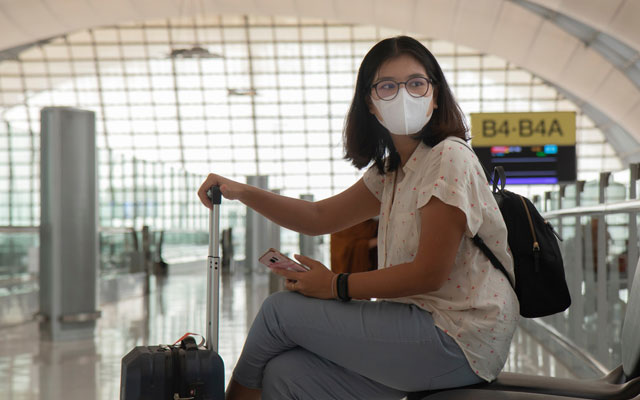
Emirates has partnered with the International Air Transport Association (IATA) to trial the IATA Travel Pass – a mobile app to help passengers securely manage their travel in line with any government requirements for Covid-19 testing or vaccine information.
The app enables Emirates passengers to create a ‘digital passport’ to verify that their pre-travel test or vaccination meets the requirements of the destination. They will also be able to share the test and vaccination certificates with authorities and airlines to facilitate travel. Travellers will also be able to manage their travel documentation digitally on the app.
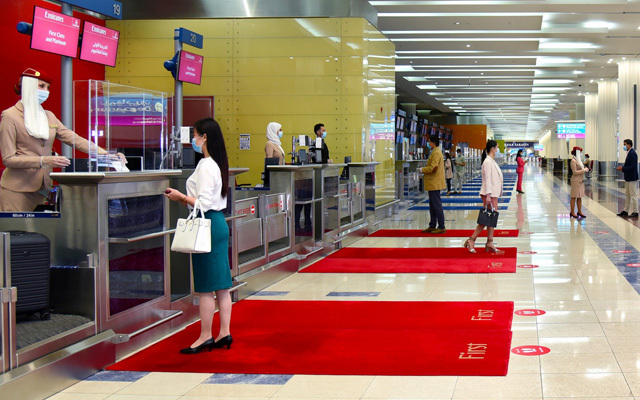
Emirates among the world’s first airlines to trial IATA Travel Pass
Prior to a full roll-out, Emirates will implement phase one in Dubai for the validation of Covid-19 PCR tests before departure. In this initial phase, expected to begin in April, Emirates customers travelling from Dubai will be able to share their Covid-19 test status directly with the airline before reaching the airport through the app, which will then auto-populate the details on the check-in system.
Within the app, the integrated registry of travel requirements will also enable passengers to find accurate information on travel and entry requirements for all destinations regardless of where they are travelling from.
It will also include a registry of testing and eventually vaccination centres – making it more convenient for passengers to find testing centres and labs at their departure location which meet the standards for testing and vaccination requirements of their destination. The platform will then enable authorised labs and test centres to securely send test results or vaccination certificates to passengers.
Nick Careen, IATA senior vice president for airport, passenger, cargo and security, said: “This is the first step in making international travel during the pandemic as convenient as possible giving people the confidence that they are meeting all Covid-19 entry requirements by governments.
“As borders re-open, IATA Travel Pass will be further enhanced with more capabilities to meet all governments testing or vaccination verification requirements and Emirates customers will be among the first to have these services.”
Thomas Cook India and its group company, SOTC Travel, have launched luxury cruise holidays to the polar extremes of the Arctic and Antarctica, targeting India’s ultra-high-net-worth individuals (UHNWI) and HNWI segments.
The new venture seeks to tap growing demand for exclusive and immersive travel experiences away from crowds during the Covid-19 era. The cruises offer natural vistas, wildlife encounters, relatively untouched terrain, with a glimpse into the lives of local cultures living in extreme environments.
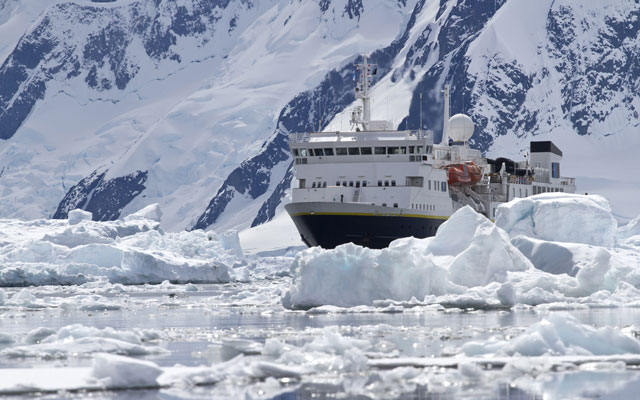
Thomas Cook India and SOTC unveil cruise voyages across Antarctica and Arctic to answer growing demand for exclusive experiences among Indian travellers
Each sailing offers a bucket list of experiences, such as crossing the Drake Passage and the Antarctic Convergence, a glimpse of the penguin colonies in South Shetland Islands and the Antarctic Peninsula, and a visit to the home of the Polar Bear in Watkins Fjord.
On board the Ponant Cruise or the Sea Spirit, guests can expect a range of international cuisines, entertainment and live shows, sports and leisure activities, spas, and scenic views from their private balconies. Optional activities include kayaking, camping, hiking and polar region photography.
The 14-day Antarctic Peninsula includes: two-night stay at the Buenos Aires Marriott or similar, one-night stay at the Arakur Hotel in Ushuaia, and 10-night stay in Deluxe Suite on board the Sea Spirit. Guests can also expect encounters with whales, penguins and other marine wildlife using a fleet of Zodiac crafts. Bookings made before January 31, 2021 can enjoy a free upgrade to Premium Suite.
The 17-day Arctic Cruise includes: two-night stay at the Novotel Tour Eiffel in Paris or similar; 14-night stay in Prestige Stateroom on board the Ponant Cruise; unlimited alcoholic and non-alcoholic beverages on board the cruise; as well as flights from Paris to Longyearbeyn (Svalbard), and from Kanergerlussuaq (Greenland) to Paris.
Guests can also experience the magnificent landscape of Greenland, interact with local Inuit tribes at traditional villages, and partake in activities such as hiking and visit to the lava caves in Jan Mayen. The cruise will also sail along the Prins Christian Sund, a 100km long passage that winds its way through cliffs and glaciers.
The Philippines, an archipelago home to more than 300 dive sites, is banking on marine and diving tourism to be a lifeline to save a tourism sector sinking under fresh waves of coronavirus.
The Department of Tourism (DOT) highlighted that dive tourism is among the country’s most bankable tourism products, buoyed by its diverse offerings, according to a report by The Philippine Star.
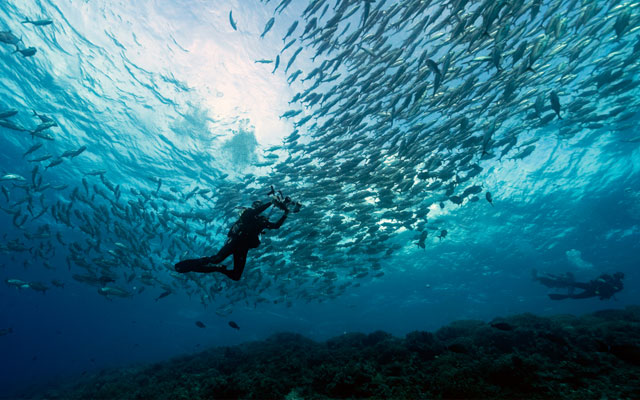
Philippines boasts several globally recognised dive sites, including Tubbataha Reefs Natural Park (above)
Speaking at the Dive Philippines webinar series, tourism secretary Bernadette Romulo-Puyat was quoted by the report as saying: “The Philippines, as an archipelago at the centre of the coral triangle, is home to biological diverse marine and aquatic resources.
“With this, the department sees dive tourism as one of the key areas for positive industry growth, including increased visitor count, extended length of stay and higher tourism revenues.”
She was also quoted by the Manila Bulletin as saying that “diving and marine sports are considered one of our country’s top tourism products and attractions. Most of the flourishing tourism activities available in the country today are water-based – from adventure to eco-tourism activities such as snorkelling, diving, and surfing.”
Among the country’s top diving spots include Tubbataha Reefs Natural Park in Palawan, a UNESCO World Heritage Site; Apo Reef Natural Park in Occidental Mindoro; Malapascua Island in Cebu; Anilao in Batangas; and the Verde Island Passage in Puerto Galera.
Last year, the Philippines beat out the Maldives and Fiji to emerge as the world’s leading dive destination at the 27th World Travel Awards.
Tourism businesses in Japan have hit another speed bump in their road to recovery from coronavirus, following a further suspension of the government’s Go To Travel subsidy scheme, as the country enters a second state of emergency in response to a virus resurgence.
Eleven prefectures – Tokyo and neighbouring Chiba, Kanagawa and Saitama; Osaka, Kyoto and Hyogo in the Kansai area; and Aichi, Gifu, Tochigi and Fukuoka – were placed under the declaration until February 7.
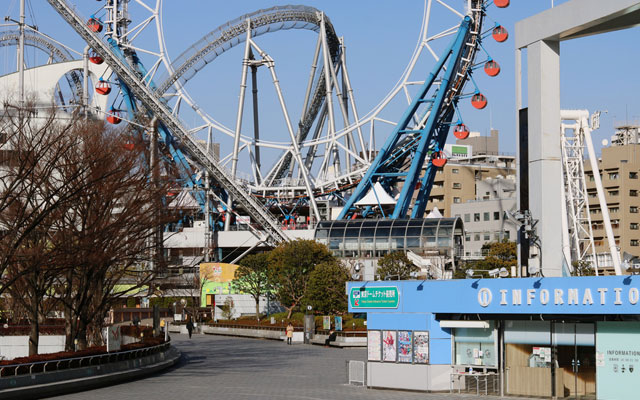
An unusually quiet Tokyo Dome City on January 7, 2021, the day Japan declared a second state of emergency
The Japanese government has urged residents in the 11 prefectures under its state of emergency to refrain from going out or travelling between prefectures unless essential, following insufficient changes in public behaviour since the emergency declaration.
As well, the suspension of the Go To Travel subsidy programme has been extended until the same date, adding further strain to the tourism industry.
Restaurants and bars have been asked to close by 20.00, which has resulted in a 60 per cent drop in the number of diners at eateries since the declaration, according to online reservation firm Toreta.
With borders shut to leisure foreign tourists, Makarim “Mac” Salman, founder and lead guide of Maction Planet, swiftly pivoted in spring 2020 to cater to the domestic market. Many visitors joined his range of Tokyo tours under the subsidy scheme launched in July 2020, which covered 50 per cent of travellers’ costs. Most were retirees, hailing from northern Japan, and cited an interest in practicing English and seeing Japan from a foreigner’s perspective as reasons for joining his tours.
“People could afford to stay longer than usual (due to the programme) so I had looked forward to developing (my offerings) further, but the cessation of Go To Travel has reduced the number of tourists coming to Tokyo,” he said.
Yuko Inamasu, founder of cultural experiences curator Toki, has also seen further losses in business as infection levels have risen. “We had some customers come in fall, but as soon as Covid started becoming a threat (again) around late November, we experienced cancellations,” she said.
In response to the continued slump in travel, Central Japan Railway Co is to cancel more than 1,500 bullet train services on the Tokaido Shinkanen between Osaka and Tokyo from January 26 to end-February.
Many industry experts have expressed uncertainty as to whether Go To Travel can be restarted given Japan’s third wave, which has raised the nationwide number of infections to around 6,000 per day.
Strong summer holiday bookings on the back of global vaccination rollout and widespread pre-departure testing could see more than 100 million jobs return to the global travel and tourism sector this year, according to an optimistic projection by the World Travel & Tourism Council (WTTC).
As the sector begins its road to post-pandemic recovery from late March onwards, a strong summer of travel is expected, with many major travel companies reporting a significant rise in forward bookings.
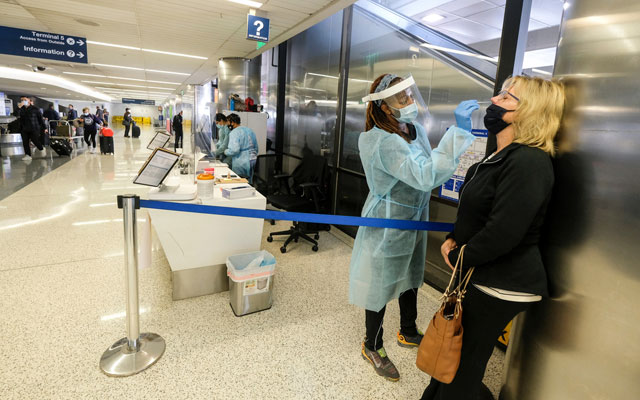
Besides vaccination, testing on departure will still be critical to restore international travel, says WTTC
The sector’s revival is backed by WTTC’s latest economic forecast. Last year, during the height of the pandemic, WTTC warned 174 million global travel and tourism jobs were at risk. However, in its latest analysis, WTTC’s most optimistic scenario predicts as many as 111 million jobs could be revived – but this would still be 17 per cent below 2019 figures, accounting for 54 million fewer jobs.
This best-case scenario, with travel recovery starting from late March, factors in widespread vaccination programmes and a swift adoption of comprehensive test-and-trace regimes, together with continual, strong international coordination from the private and public sectors.
A more conservative projection would still see a return of 84 million jobs, but this would be 25 per cent below 2019 levels, with 82 million fewer jobs recovered.
Under this scenario, the recovery of international travel is pushed to 2H2021. Vaccines would be rolled out more gradually, slowing down the removal of worldwide travel barriers and restrictions currently in place, while depressing demand to travel and reducing consumer confidence.
Gloria Guevara, WTTC president & CEO, said: “We are looking forward to a strong summer of travel, thanks to a combination of mask-wearing, the global vaccination rollout and testing on departure unlocking the door to international travel once more.
“Our latest research supports this and shows there is definitely hope on the horizon for the global travel and tourism sector in the year ahead, with the possible recovery of up to 111 million jobs.
“This projected outcome will come as a huge relief and be welcomed as the beginning of the long-awaited recovery, for a sector which has for so long suffered the brunt of hugely damaging travel restrictions.”
The new research also revealed that in the best-case scenario, travel and tourism’s contribution to global GDP will fall 17 per cent compared to 2019 figures, to US$7.4 trillion.
And in the more conservative outcome, with a slower recovery, the sector’s contribution will drop by more than one quarter (27 per cent), to US$6.5 trillion.
Domestic travel will lead the way in Asia-Pacific over the upcoming Lunar New Year (LNY) period, according to a recent Sojern report analysing travel intent within Asia-Pacific.
Sojern analysed the travel trends and insights looking at countries within Asia-Pacific that typically have the strongest Lunar New Year seasonality – Singapore, Taiwan, Thailand, Malaysia and Hong Kong.
Upcoming travel trends for Asia-Pacific and Lunar New Year
Sojern found that the demand for travel is predominantly domestically-driven, with the exception of Hong Kong where more than 50 per cent are looking at exploring international travel between February 11-14, coinciding with the LNY dates – whether it translates into actual bookings will depend on the status of travel restrictions.
At least 40 per cent of travellers started to search a month prior to LNY, with the exceptions of Japan, Thailand and Malaysia – all of which are seeing a surge in Covid-19 cases, with lockdowns and state of emergencies having been declared. In Hong Kong, more than 10 per cent of travellers are looking to book trips of at least four days. As such, Sojern advises travel marketers to start planning to target Asia-Pacific travellers now, and again two weeks prior to LNY, to capitalise on the demand.
Inter-country travel between Hong Kong and Singapore is showing a peak in demand between LNY and the March 2021 school holidays.
Hong Kong inbound flight searches from Singapore
A look at Singapore’s domestic trends shows that pre-planning has started for LNY, Valentine’s Day and the March school holidays. Sojern’s data shows that the domestic hotel search demand has improved drastically with a 73 per cent year-over-year (YoY) uplift.
Domestic hotel searches and future dates in Singapore
Domestic travel intent for Australia and New Zealand
Domestic flight bookings for Australia and New Zealand indicate that domestic travel trends continue to peak in both countries. Travel within Australia saw a 300 per cent increase at the end of November and into December 2020.
Domestic flight booking – Australia and New Zealand
When analysing the future dates of hotel searches domestically in Australia and New Zealand, Sojern sees that the lead time is short with travellers looking to book hotels from now until the start of the second quarter of the year, up until April 2021. It is clear that travellers are dreaming of future travel and hotel holiday stays.
Domestic hotel searches and future dates – Australia and New Zealand
Travel bubble between Australia and New Zealand
Australia and New Zealand were among the first countries in Asia-Pacific to open up international travel (Trans-Tasman, but one-way from New Zealand to Australia). The Australian government announced a Safe Travel Zone with New Zealand, allowing travellers from New Zealand to enter the country quarantine-free. However, upon their return, New Zealanders have to quarantine and bear the financial cost. Contrary to reports, when looking at our data from December 2020 onwards, we see that New Zealand travellers were looking to travel to Australia in February (24.2 per cent increase) up until May (almost 10 per cent).
Subsequently, Australia to New Zealand is also seeing some traction. Last year in December 2020 (53.8 per cent) and now in January 2021 (30.2 per cent), Sojern notes an increase in flight bookings.
Flight booking and future dates – Australia and New Zealand travel bubble
Gripped by a second lockdown, with interstate travel off the cards, tourism players in Malaysia are using the downtime to develop new products and strategise how to adapt their existing products for a domestic crowd.
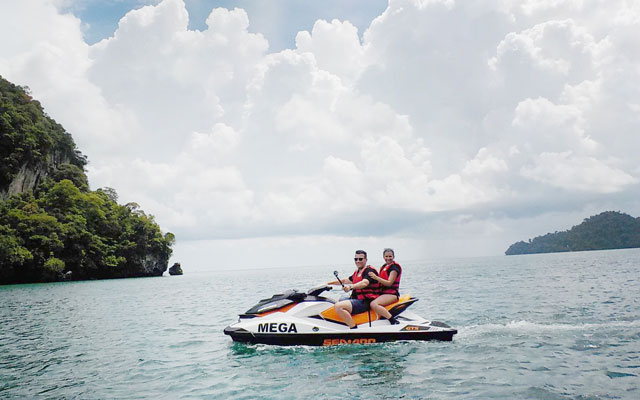
Sharmini Violet, director of sales and marketing at Mega Water Sports & Holidays in Langkawi, said the company is in the midst of developing combo tour packages marrying its signature jet ski tours with other product offerings available in the archipelago, such as mangrove kayaking, go karting and sunset cruises.
Langkawi’s Mega Water Sports & Holidays looks to combine its jet ski tours with other product offerings
“We are helping to support other travel businesses in Langkawi through marketing and sales. These combo packages will be sold at lower rates, as compared to individual products, to domestic consumers,” she said.
The company is also relooking existing products to see how they can be better tailored to the needs of the local market, such as offering shorter, two-hour tours, considering most domestic tourists would prefer to pack several activities into a multi-day excursion.
Mint Leong, managing director, Sunflower Holidays, said all her staff are working from home to develop packages to lesser-known destinations in Melaka and Selangor as well as experiential tours to Terengganu and Kelantan.
Having conducted recces in Malaka before the movement control order came into effect last week, Leong said they are now “compiling our comments and ideas on how to improve existing products”.
The company is also padding its product portfolio. “We have developed new products to off-the-beaten areas in Selangor, such as Sungai Sirip Biru, Sungai Pelek and Hulu Selangor district,” Leong said.
“When business was good, we didn’t have time to do product development, an area we are now focused on, and we will start promoting these packages once interstate travel is allowed,” she added.
“We are also looking at developing experiential tours to the east coast of Peninsular Malaysia, to promote local cultures, food and experiences.”
Meanwhile, some tour agents are spending their downtime – and hard-earned dough – on a good cause. Laili Basir, founder of Pahang-based Laili Basir Event Adventure, has appealed to his business network for cash donations to purchase basic necessities for the flood victims in Pahang and the under-privileged in Sabah.
Laili also pays the guides, drivers and others in his network to assist with the distribution of these items to the communities. He said: “It is not as much as what they used to earn in the past (before Covid hit), but it is something to help them through this difficult period.”
Thailand’s Centara Hotels & Resorts has expanded into two new destinations with the signing of hotel management agreements for a trio of resorts: one in Khao Yai, Thailand; and two in Vang Vieng, Laos.
In Laos, Centra by Centara Riverside Resort Vang Vieng (formerly Thavisouk Island Hotel) and Thavisouk Riverside Resort & Spa Vang Vieng, Centara Boutique Collection (formerly Thavisouk Riverside Hotel) are located on opposite sides of the Nam Song River, connected by a private bridge linking the two properties. The two rebranded riverside properties are expected to open in 4Q2021, following refurbishments.
Centara’s first property in Khao Yai will open within the Khao Yai National Park (above)
Housed in five low-rise buildings, Thavisouk Riverside Resort & Spa Vang Vieng, Centara Boutique Collection, boasts rooms ranging from 40-136m². The resort also features a spa and riverside restaurant, overlooking the town’s karst rock formations.
On the opposite side of the river, the all-suite Centra by Centara Riverside Resort Vang Vieng offers rooms ranging from 52m² one-bedroom units to one-bedroom corner suites measuring 55m². The family-friendly resort also features a rooftop restaurant, swimming pool, and meeting rooms ranging from 50-100m² for corporate events.
Another new addition to the Centara Boutique Collection, Roukh Kiri Khao Yai Hotel is nestled within the Khao Yai National Park, located just three hours from Bangkok. Featuring 12 barn-styled villas perched on a hill, the luxurious resort marks Centara’s debut in Khao Yai.
While Thailand’s border remains open to all visitors, a mandatory 14-day quarantine requirement continues to keep international tourists at bay.
In December 2020, the Thai government, eager to revive the country’s pandemic-hit tourism industry, started to relax travel curbs by offering the Special Tourist Visa (STV) to all countries and visa-free travel for citizens from 56 countries, including the US and the UK. Under the STV scheme, visitors can stay in Thailand for up to 270 days.
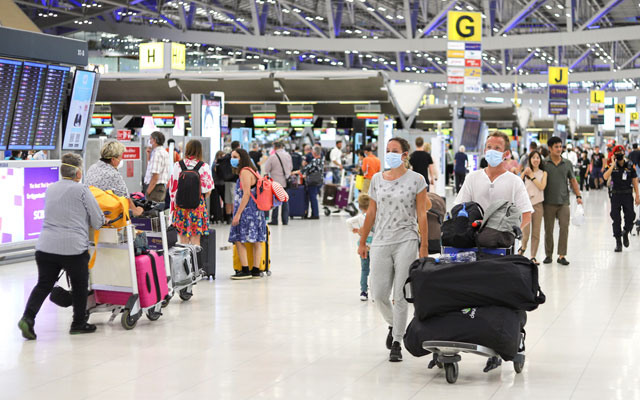
Despite reopening its borders to all foreign visitors, ongoing travel restrictions in Thailand deter tourists
To lure more foreign visitors, discussions were underway to reduce the 14-day quarantine period for inbound visitors to 10 days or less, with a proposal submitted to the Centre of Covid-19 Situation Administration.
However, a virus resurgence in Thailand halted all such discussions, with no further news of reduced quarantines over the past month.
On its part, the Thai government has not retracted any of its inbound tourism arrangements. For instance, UK visitors are still allowed in, despite the country battling with a new, faster-spreading Covid-19 variant. The Thai Cabinet also approved a proposal to extend short-stay visas by 15 days to allow for quarantines.
But foreign tourists are hardly flocking in. The Thailand Longstay Company, which facilitates the STV programme, told Bloomberg that on average, only 346 overseas visitors have entered the country each month on special visas since October – a far cry from the government’s target of 1,200 foreign tourists per month.
Medical tourists, welcomed since July 2020, have also arrived in very limited numbers. Bruno Huber, general manager at the Mövenpick BDMS Wellness Resort, described the programme’s market potential as “limited”, saying many patients opted to stay in their own countries rather than undergo a 14-day quarantine for short surgeries or treatments.
“The business sector pushes for border opening (without quarantine requirements) but the risk is too high. I too would like to see business return, but if anything goes wrong, we will be in a worse situation,” shared Sumate Sudasna, managing director at CDM – Conference & Destination Management.
“Personally, I believe the government is doing a laudable job. It is very hard to balance lives and livelihood. Deep down, they do want the economy to improve, but public sentiment on safety and health is so strong that any move they make is sure to be criticised and most of the time overblown,” he added.
High risk in reopening Thai borders without quarantine requirement: Sumate
Max Boontawee Jantasuwan, founder of Events Travel Asia, echoed similar thoughts. “It’s the public sentiment of fear putting the economy on pause,” he shared.
There are now ongoing experiments with golf quarantines, which if approved, will allow those on quarantine to move freely within designated resorts and their on-site golf courses. A wellness partnership between Thai Elite Visa and developer Nusasiri is also being trialled to draw more Thai Elite members to Thailand with the Blue Diamond Card, a 3.5 million baht membership card which affords 20 years’ visa rights, and premium health care.
As well, the Tourism Authority of Thailand (TAT) has introduced a project dubbed Amazing Thailand Happy Quarantine, which aims to showcase the country’s tourism products and services to potential visitors. It has also partnered with Thai Airways and Thai Hotels Association (THA) to push Amazing Thailand Plus packages, offering visitors value-added benefits.
Most recently, THA has joined the Association of Thai Travel Agents and the Association of Domestic Travel in calling for the government to look seriously into implementing a procedure that will allow inoculated tourists to enter the country without quarantine by 3Q2021.
Thailand tourism ended 2020 down 74 per cent, with only 6.7 million arrivals and achieving only 26 per cent of the pre-Covid projection of 3.18 trillion baht in tourism revenue.
TAT anticipates 120 million domestic tourists and 10 million foreign arrivals in 2021, with the projection for 2022 increasing to 180 million and 20.8 million, respectively.













Emirates has partnered with the International Air Transport Association (IATA) to trial the IATA Travel Pass – a mobile app to help passengers securely manage their travel in line with any government requirements for Covid-19 testing or vaccine information.
The app enables Emirates passengers to create a ‘digital passport’ to verify that their pre-travel test or vaccination meets the requirements of the destination. They will also be able to share the test and vaccination certificates with authorities and airlines to facilitate travel. Travellers will also be able to manage their travel documentation digitally on the app.
Prior to a full roll-out, Emirates will implement phase one in Dubai for the validation of Covid-19 PCR tests before departure. In this initial phase, expected to begin in April, Emirates customers travelling from Dubai will be able to share their Covid-19 test status directly with the airline before reaching the airport through the app, which will then auto-populate the details on the check-in system.
Within the app, the integrated registry of travel requirements will also enable passengers to find accurate information on travel and entry requirements for all destinations regardless of where they are travelling from.
It will also include a registry of testing and eventually vaccination centres – making it more convenient for passengers to find testing centres and labs at their departure location which meet the standards for testing and vaccination requirements of their destination. The platform will then enable authorised labs and test centres to securely send test results or vaccination certificates to passengers.
Nick Careen, IATA senior vice president for airport, passenger, cargo and security, said: “This is the first step in making international travel during the pandemic as convenient as possible giving people the confidence that they are meeting all Covid-19 entry requirements by governments.
“As borders re-open, IATA Travel Pass will be further enhanced with more capabilities to meet all governments testing or vaccination verification requirements and Emirates customers will be among the first to have these services.”