Etihad Airways has introduced a snood style face mask for its first and business class guests, as part of its new health and hygiene programme, Etihad Wellness.
The soft reusable snood has been treated with MicrobeBarrier fabric treatment, a broad spectrum antimicrobial treatment, laboratory tested and proven to reduce the presence of germs in fabrics. With this long-lasting protective layer, the snoods are washable and reusable, making them environmentally friendly.
Premium passengers flying with Etihad Airways will receive antimicrobial-treated face masks
Made out of lightweight, breathable and stretchy jersey fabric, the snood can be worn around the neck like a scarf and be easily slipped on and off to cover one’s mouth and nose as needed.
The MicrobeBarrier treated snood is one of the many initiatives the airline has introduced to create a healthier and cleaner environment.
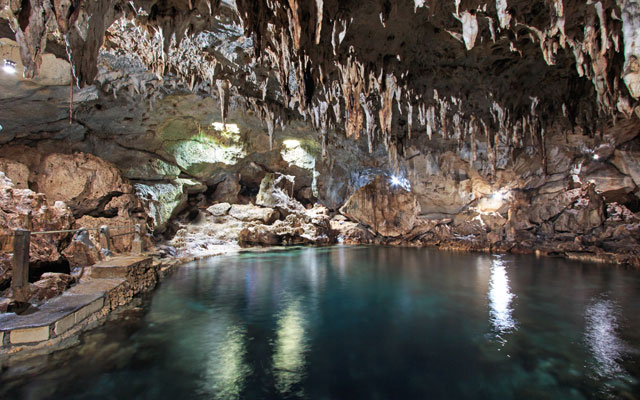
Nature attractions like Hinagdanan cave (pictured) in Panglao Island, Bohol are set to have added appeal in the new normal
A likely side effect of the pandemic is a shift in tourist preference away from mass tourism destinations in favour of more remote, less-crowded ones as health and safety become the primary concern of travellers.
The Philippines is moving to meet these changing demands by bringing in “fresh, less crowded and open destinations”, usually in rural and remote areas, shared Alice Queblatin, Southwind Travel managing director inbound, at an industry webinar.
“FITs will be in, group travel out,” Queblatin said, adding that products are being studied “to make them private, safer and more hygienic” in compliance with the health and safety protocols that were rolled out for the travel and tourism industry.
Fortunately, the Philippines, being an archipelago of over 7,100 islands, has a plethora of unspoiled ecotourism, nature and remote community destinations. Most of these destinations also have beaches, one of the country’s main attractions.
In the province of Cebu, for instance, outside the city are unexplored destinations ripe for authentic and experiential trips, including Aloguinsan, a small town on the western seaboard. Highlights from tour packages in the region include ecotour cruises along the Bojo River and interaction with remote villagers who actively participate in the tour, such as a fisherman guide and the village medicine man who performs a traditional send-off ritual.
Ecotourism consultant Boboi Costas, who developed ecotours in nature reserves including the Aloguinsan ecotour, said that with the pandemic, ecotourism sites and experiences will have to be redesigned in order to win back consumers.
That process will involve the entire tourism value chain. Everyone from local communities to tour guides should adapt to the new normal, including going digital and adhering to the health and safety protocols, while destination managers should touch base with local health practitioners, Costas said. Equally crucial is enhancing efforts to climate proof one’s operations, he added.
Product development wise, Costas said there could be a segmentation or combination of activities like ecotours, wellness or organic farming, and nature-based activities which promises a more private and customised experience – all these are already being adopted by a growing number of destinations.
Bohol, best known for the white sand of Panglao and rural scenery, has lesser-known destinations boasting the same attractions, which fortunately, were being developed and packaged following the 2013 earthquake that destroyed a number of its tourist attractions.
Lucas Nunag, Bohol Provincial Tourism Council, said they have already developed key tourism circuits anchored on the local culture, heritage and new eco-tourism products like farm and craft tourism and culinary attractions in destinations like Anda, Lila, Maribojoc, and Candijay.
In Luzon, the province of Rizal situated just a few hours from metro Manila, there are vast unexplored areas of natural attractions and indigenous communities, including the 2,700ha reforestation area of the Masungi Georeserve, which is becoming known among millennials and science-based teams due to its nature-based recreational activities.
Billie Dumaliang, advocacy officer and managing trustee, Masungi Georeserve Foundation, said that they are partnering with World of Outbound, which organises school trips to the Philippines and advocates for outdoor nature education, to develop virtual field trips, since classes will be conducted remotely and it will likely be some time before traditional field trips resume.
Another destination being primed for ecotourism is Northern Mindanao, which includes the provinces of Camiguin island, Bukidnon, Misamis Occidental, Misamis Oriental and Lanao del Norte.
The zone is vastly undeveloped for tourism but is Covid-free, according to Marie Elaine Unchuan, tourism regional director of Northern Mindanao.
Camiguin is being promoted for dive tourism on top of the usual sightseeing, nature tripping and beach activities; while picturesque Bukidnon is promising for farm and mountain tourism, said Unchuan.
Unchuan remains hopeful that an international airport will be built in Bukidnon within the next three years to further boost the eco-destinations. Skyjet used to fly from Manila to Camiguin but suspended the flight in March. Without this flight, the island is reachable only by ferry from Cagayan de Oro and a Cebu Pacific flight from Cebu to Camiguin.
Osaka International (Itami) Airport reopened its north and south terminal buildings on August 5, marking the completion of the first major renovation at the west Japan airport in some 50 years.
Operator Kansai Airports, which also manages Kansai International Airport, said the new facilities offer increased opportunities to shop, eat, relax and work in a bid to make the airport more comfortable and enjoyable for travellers and people waving them off, as well as local residents.
The renovated Osaka International (Itami) Airport will feature new Kansai-borne retail, F&B outlets
The aim is to offer visitors a “Kansai experience” by showcasing products from the seven prefectures around Kyoto and Osaka that make up the region.
The post-security Retail Zone in both terminals will be home to Japan’s first walk-through commercial space in the domestic gate area, offering 31 new stores. Most will sell exclusive Kansai-inspired products and experiences.
Five new stores will also open in the pre-security area in an effort to attract local residents and visitors to the area who are not flying.
Some 17 F&B outlets have also joined the airport’s commercial space, including many that are making their debut in the Kansai area or the airport.
The renovation of the new terminals began in February 2016 and was scheduled for completion in July, but was delayed due to Covid-19.
The work is part of a long-term upgrade on the airport, which handles about 17 million passengers per year across an extensive domestic network. The central area and observation deck were reopened in April 2018 following renovation.
Klook Malaysia is seeing a rise in demand for nature-focused staycations and theme park hotels close to home, as the country’s tourism sector looks to the domestic market to pave the way for industry recovery.
The travel booking platform recently launched a collection of exclusive staycation experiences for Malaysians, where accommodation were bundled with additional perks such as free massages, food and beverage credits and attractive passes.
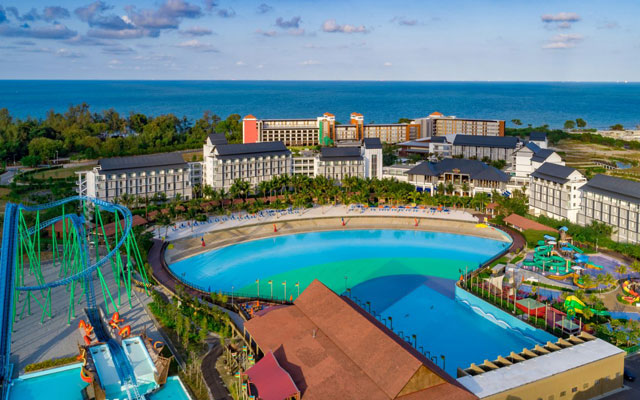
Theme park hotels like Hard Rock Hotel Desaru Coast (above) have been a hit with family travellers booking their staycations with Klook Malaysia
Emily Tan, marketing lead of Klook Malaysia, shared: “We have been experiencing a surge of demand among Klook users for both nature-focused staycations and theme park hotels. For instance, some customers enjoy a tropical paradise at Ipoh’s Belum Rainforest Resort to escape the usual hustle and bustle.
“Meanwhile, travelling groups with children prefer to stay at hotels with theme parks nearby, such as Legoland Hotel Malaysia and Hard Rock Hotel Desaru Coast. This allows both the parents and children to get an enjoyable travel experience.”
Ever since the interstate travel ban was lifted in June, Klook Malaysia has seen consumers go from joining home-based experiences like online workshops to exploring outdoor recreation, such as diving trips or staycations. The most-searched destinations by local users in June were Kuala Lumpur, Penang, Ipoh, Langkawi, Johor Bahru and Sabah.
Tan said: “Although we are still in the early stage of business recovery, we have already witnessed strong traction with our home-based and domestic experiences. Locals have booked items from attraction passes to afternoon tea packages at five-star hotels.”
Asked about forward bookings for 4Q2020, she shared: “We remain optimistic there will be a continued demand for local-based activities and experiences, especially so with the upcoming public holidays.”
IAAPA, the global association for the attractions industry, concluded its first-ever virtual expo and conference, IAAPA Virtual Expo: Asia, held on July 28-30.
The event was attended by more than 4,000 participants, and featured 131 companies on the virtual tradeshow floor, as well as nine education sessions and seven networking events.
The education conference featured 21 speakers from around the world and covered topics such as best practices for reopening parks and attractions, safety, operations, automation and digitalisation, and more.
While the virtual event was held live daily, registered attendees could access the exhibit hall, chat rooms, and education sessions at any time.
IAAPA Virtual Expo: Asia attendees may continue to engage with the Expo’son-demand content and continue to follow-up with exhibitors until August 8, 05.00 China Standard Time / August 7, 23.00 Central European Summer Time.
June Ko, executive director and vice president, IAAPA Asia Pacific, said: “IAAPA’s first Virtual Expo truly reflects the resiliency and strength of the global attractions industry. Our goal was to provide an innovative, timely new experience that brought the industry together… We are more inspired than ever by the heart and spirit of this incredible industry and are already taking key learnings from this event and applying them to our next IAAPA virtual events.”
Registration is now open for IAAPA Virtual Conference: The Americas, set to take place September 2-3; as well as IAAPA Virtual Conference: EMEA and APAC, scheduled for September 22-24.
Plastic Pollution In Ocean - Turtle Eat Plastic Bag - Environmental Problem
PATA has signed up to the Global Tourism Plastics Initiative, which aims to mobilise the tourism industry to take concerted action against plastic pollution.
Led by the United Nations Environment Programme and WTO, in collaboration with the Ellen MacArthur Foundation, the Global Tourism Plastics Initiative enables businesses and governments to take concerted action, leading by example in the shift towards a circularity in the use of plastics.
The Global Tourism Plastics Initiative aims to stop plastic ending up as pollution, so as to help preserve and protect the places and wildlife that make destinations worth visiting
As a signatory of the Global Tourism Plastics Initiative, PATA commits to eliminate, innovate and circulate its use of plastics.
Specifically, by 2025, PATA commits to encouraging affiliated organisations and businesses of partners to join the initiative by three methods: spreading the word through media channels, highlighting five successful members’ case studies, and including plastics as key component of promoting sustainability in tourism supply chains.
As well, PATA will advise and guide members to better manage plastics in their operations by integrating workshops, toolkits and trainings into Tour Link Project promoting sustainability in the Thai tourism supply chain.
PATA CEO Mario Hardy said: “We recognise that there are many opportunities to solve the plastic problem, but various challenges remain as organisations may want to focus on other sustainability priorities or are not sure of where or how to remove and reduce plastic. Therefore, PATA is committed in helping advise and guide our members to better manage plastics throughout their entire supply chain.”
The Global Tourism Plastics Initiative requires tourism organisations to commit to a set of goals: eliminate problematic or unnecessary plastic packaging and items by 2025; take action to move from single-use to reuse models or reusable alternatives by 2025; engage the value chain to move towards 100 per cent of plastic packaging to be reusable, recyclable, or compostable; take action to increase the amount of recycled content across all plastic packaging and items used; commit to collaborate and invest to increase the recycling and composting rates for plastics; and report publicly and annually on progress made towards these targets.
Rosewood Hotels & Resorts will be expanding its Asian footprint with the signing of a new property in Shanghai, due to open in 2028.
The hotel group has been appointed by Shanghai-based property development company, Lonsen Land Group, to manage Rosewood Shanghai, a new hotel in mainland China set to break ground in 2022.
Rosewood Shanghai will rise in 2028
Situated in the heart of Shanghai’s Jing’An District and Suhewan area, Rosewood Shanghai will occupy the top floors of a mixed-use project designed by international studio Foster + Partners. At 320m, the building will be one of the tallest complexes in the city’s Puxi district.
Rosewood Shanghai will offer 200 guestrooms and suites, five F&B establishments and Asaya, the hotel’s wellness concept.
“As we continue to grow the brand throughout Asia and specifically mainland China, Shanghai has long been a priority destination in which to plant the Rosewood flag,” said Sonia Cheng, CEO of Rosewood Hotel Group.
Rosewood Shanghai is the latest addition to the brand’s collection of properties in Greater China, which includes Rosewood Hong Kong, Rosewood Beijing, Rosewood Sanya and Rosewood Guangzhou. Additional projects in development in the region include Rosewood Chengdu and Rosewood Ningbo, both set to open in 2023, along with Rosewood Shenzhen and Rosewood Taipei, which are planned to open in 2024.
disabled Young man in wheelchair on a boardwalk on lake enjoying his freedom
As tourism restarts, the UNWTO is calling on destinations to recognise and cater for the needs of travellers with disabilities or specific access requirements.
In partnership with the Once Foundation of Spain and the European Network for Accessible Tourism (ENAT), the UN agency has released a set of guidelines to ensure accessibility and inclusivity for all in the new reality.
UNWTO urges destinations to ensure accessibility, as the responsible restart of tourism gets underway
The Reopening Tourism for Travellers with Disabilities guide also notes the opportunities available to destinations that take steps to accommodate the specific needs of persons with disabilities, those with specific access requirements and seniors.
The guidelines are a set of basic recommendations aimed at helping stakeholders, including accommodation providers, bars, restaurants and tourism offices, adjust to new health and sanitary demands without reducing accessibility.
The recommendations cover four distinct areas:
• Travel planning and protocols: Including steps to guarantee seamless travel, and for making relevant information available and accessible to all
• Transportation: Including the importance of upskilling employees, adjusting protocols for passengers with disabilities/access requirements at airports and stations, as well as the provision and hygienic upkeep of mobility equipment
• Accommodation, bars and restaurants: Focusing on accessibility to cater for different needs of clients, guaranteeing social distancing, and enhanced hygiene procedures in all tourism-related establishments
• Tourist activities: Including recommendations to help destinations and attractions adapt existing protocols by taking into account accessibility issues related to queuing, health and safety measures, and new venue capacities
UNWTO secretary-general, Zurab Pololikashvili, said: “Much progress has been made in making tourism more accessible to all. As we guide the responsible restart of tourism, we must make sure that this progress is not rolled back. Instead, it must be stepped up as it will benefit everyone. These guidelines, produced in collaboration with Once Foundation and ENAT show that simple, thoughtful measures can make a real difference for travellers – and in return, allow destinations to welcome this wide and diverse demographic as they look to recover from Covid-19.”
Fundación Once vice-president, Alberto Durán, underlined: “It is fundamental that we use this time of change to sensitise all stakeholders to the need to include persons with disabilities and their families in tourism, leaving no one behind. These clients can help businesses stay afloat in these challenging times, representing opportunities for all.”
The full set of recommendations can be downloaded here.
Skier going down the slope. ski trail for skiing and skateboarding. active rest and sport. shot from the top of the slope. people skiing downhill. ski resort
Tourism New Zealand (Tourism NZ) and Air New Zealand (Air NZ) have teamed up on a month-long winter campaign to boost visitorship to the country’s ski regions.
The partnership is part of Tourism NZ’s second phase of its Do something new, New Zealand winter campaign, which kicked off on August 3.
Air New Zealand, Tourism New Zealand team up to encourage Kiwis to hit the slopes
The campaign will see key ski locations Taupo, Christchurch and Queenstown promoted through social media, digital display advertising and online.
Air NZ general manager brand & marketing, Jeremy O’Brien, said: “We’re extremely lucky in New Zealand that we can fly to either Taupo, Christchurch or Queenstown and be so close to an epic adventure at one of our world-class ski fields.
“While a record number of New Zealanders travelled during the school holidays, the challenge now is to encourage Kiwis to continue to travel domestically, outside of the peak holiday period.”
Tourism NZ general manager domestic, Bjoern Spreitzer, added that the strong results from the school holidays were really encouraging, and its campaign with Air NZ is “vital to continue this positive momentum”.
Air NZ has increased domestic capacity for August to 70 per cent of pre-Covid-19 levels, up from its original plan of 55 per cent of usual domestic capacity.
The August edition of Air NZ’s inflight Kia Ora magazine has also been produced in partnership with Tourism NZ to promote the Do something new, New Zealand campaign. It showcases destinations such as Queenstown, Wanaka, Christchurch, Nelson, Wellington, Wairarapa, Ruapehu, Rotorua, New Plymouth and Kerikeri.
One might think that Philippine destinations would have reopened its doors to domestic tourism, choking as they are five months into lockdown.
But they won’t, much as they want to. The spectre of worsening Covid-19 transmissions scares the destinations’ local officials, while Filipinos deem travelling a risk although they sorely need a respite from enduring months of homestay.
They have a valid point: The government has failed in managing and containing the pandemic despite locking down the Philippines for nearly five months – said to be among the world’s longest and most draconian – in four varying categories of quarantine subject to review every 15 days.
As of August 2, Covid-19 transmissions totalled a staggering 103,185 nationwide, including 35,569 confirmed cases, which is the highest in South-east Asia.
The health crisis reached its nadir last week when the heads of some 40 medical societies representing 80,000 doctors and a million nurses urged president Rodrigo Duterte for a two-week timeout for the exhausted medical frontliners and to return metro Manila to enhanced community quarantine (ECQ) to stem the Covid-19 surge and prevent a collapse of the public healthcare system.
In response, Duterte, who late last week retained metro Manila and other areas under general community quarantine (GCQ) from August 1 to 15, reverted the metro, Laguna, Cavite, Rizal and Bulacan to modified enhanced community quarantine (MECQ) from August 4 to 18.
MECQ, the second harshest of the quarantine category, entails suspending public transport and certain work, as well as forcing people to stay home, among other strictures.
The health vs wealth argument was invoked when the ECQ was imposed in about 60 per cent of the country in mid-March, with majority in favour of safeguarding public health over the country’s financial health.
But as the quarantine measures proved futile with more people getting infected, while many continue to starve due to unemployment and lack of economic activity, the health vs wealth argument favours reopening the economy, including domestic tourism in destinations under the MECQ with zero or small number of infections .
Boracay did it, reopening to tourists from western Visayas since June. But tourists come in trickles.
Several weeks ago, the Department of Tourism announced that Coron, El Nido and San Vicente in Palawan were eyeing a reopening, with a dry run soon for El Nido.
El Nido’s dry run has yet to take place while Coron’s local government officials denied that it is reopening. Baguio, Bohol and Siargao are among those that ruled out reopening over the next few months.
As the health crisis progressively worsens, there are clamour from frontliners and the public for the government to recalibrate its strategies in tackling Covid-19 and change the officials involved in battling the crisis.
As finance secretary Carlos Dominguez put it: “We need to strike a reasonable balance between safeguarding public health and restarting the economy”.
People will travel again if they see that it is safe and healthy to do so. The onus is on the Philippine government.
Rosa Ocampo is correspondent, Philippines for TTG Asia Media. She reports for the company’s stable of travel trade titles, including TTG Asia and TTGmice.