Skyscanner has launched Travel Insight Vision, a business intelligence tool which analyses traveller behaviour by capturing flight search and intent data in order to help airlines, airports and DMOs navigate an ever-changing travel landscape.
With analysing travel demand now more important than ever, the Saas platform features a new dedicated Covid-19 impact module, tracking the changes in flight demand amid the fluid pandemic situation. Travel Insight Vision provides data within less than 12 hours from the previous day.
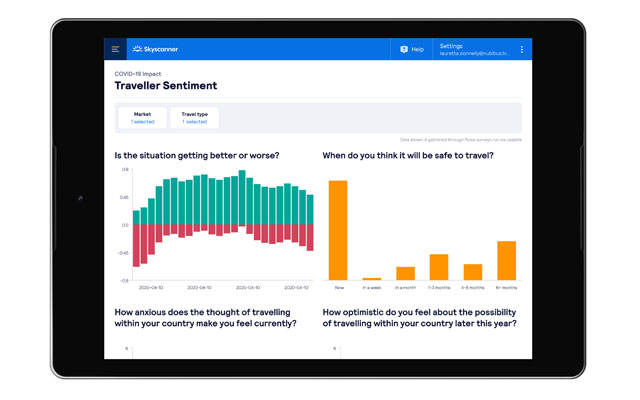
Travel Insight Vision is a business intelligence tool visualising past and future travel search and demand data
The module looks at market and route trends, up to 12 months ahead, and provides insights into traveller mindset and willingness to travel in the near future, broken down by market. Airlines can decipher the best strategies to return routes to market, adjust inventory algorithms accordingly and navigate their way towards recovery from Covid-19 impact.
Michael Docherty, commercial lead for data products at Skyscanner, said: “The way the aviation sector worked before simply won’t work anymore; pricing strategies can no longer rely on the booking curves of last year, capacity decisions are being driven by open borders and quarantine restrictions, and travel demand is changing every day.
“Our sector is facing unparalleled dynamics. It has never been more essential to have insights from real-time data to respond quickly to potential business opportunities and mitigate risks. Every day, we are unveiling new trends within the travel landscape – from a massive rise in demand for domestic travel to a growing popularity of shorter booking windows as travellers wait until the last minute to book their trips. We want to empower our partners to truly understand this new world of travel and sharpen their vision of the future.”
In addition, the new SaaS offering features a Performance module, which provides competition analysis for airlines and airports, looking at evolution and competitiveness. Travel Insight Vision will allow airlines and airports to analyse the competitor landscape in relevant markets and on specific routes, as well as monitor price evolution.
Bucking the trend of slow air travel recovery, the volume of domestic flights in Mainland China during this year’s annual Golden Week holiday, from October 1 to 8, looks set to push well past last year’s record, according to Cirium data.
Often called “the world’s largest annual human migration,” the peak travel period for this year’s Golden Week will be between September 30 and October 11. A snapshot of Cirium Core data taken on September 23 shows more than 164,700 domestic flights scheduled during the period, representing an increase of more than 11 per cent compared with the same time in 2019 when approximately 148,000 flights flew.
Scheduled domestic flights during Golden Week 2020 are up by more than 11 per cent compared with 2019, with Shanghai poised to beat Beijing as the country’s most popular domestic air travel destination
This year’s passengers will fill more than 27.8 million domestic aircraft seats during Golden Week, with the busiest day being October 7, when over 13,800 domestic flights are scheduled to take to the air. That is an increase of 9.6 per cent over the busiest day in 2019 (October 6) when more than 12,600 domestic flights were operated.
Rahul Oberai, Cirium managing director for APAC, said: “Covid-19 has clearly had a major impact on Mainland China’s international and domestic flight schedules. Between January 1 and September 23, 2020, 18 per cent of scheduled international flights and 17 per cent of scheduled domestic flights were not flown. However, when it comes to year-on-year growth, the story is completely different, with international registering a 77 per cent drop, while domestic suffered a more modest 16 per cent decline.
“Some regions are showing signs of recovery as travel restrictions begin to ease. However, those with large domestic markets, such as China, are the ones most likely to see capacity bounce back or even achieve some level of positive growth.”
This year, the most popular Golden Week destination for domestic air travellers is Shanghai. Its two airports – Shanghai Pudong International and Shanghai Hongqiao International – will welcome more than 10,800 flights between September 30 and October 11, and over 900 on October 7 alone.
The capital, Beijing, is a close runner-up. It will see some 9,840 flights fly in between September 30 and October 11, and close to 830 arriving at its Beijing Capital International and Beijing Daxing International airports on the busiest day of the annual break (October 7).
The third most popular Golden Week domestic air travel destination will be Guangzhou. Guangzhou Baiyun International Airport will be the country’s busiest individual airport, with more than 7,280 flights arriving between September 30 and October 11, and more than 600 on the busiest day. It will be followed by Chengdu, Shenzhen, Kunming, Chongqing, Xi’an, Hangzhou and Nanjing rounding out the top 10.
Oberai said: “The positive Golden Week domestic traffic figures are good news for Mainland China and an encouraging sign for other regions. They also demonstrate what Cirium has been saying since the start of the pandemic – that during the recovery, travel patterns may be fragmented, with VFR (visiting friends and relatives) traffic driving journeys ahead of business traffic.”
As global travel restrictions continue to ease, anybody who can will start packing their bags again. In fact, the resurgence in travel is expected to be so pervasive that the term “revenge travel” was coined to describe consumers hastening to make up for disrupted 2020 plans, which will likely cause a growth spurt in the travel industry.
Tourism has become a key driver of many of the region’s economies, with the sector accounting for 12.1 per cent of South-east Asia’s gross domestic product in 2019. Globally, Asia was once again the biggest growth driver in the international tourism market during the first eight months of 2019, before the pandemic dealt a severe blow to its rise.
To prevent further losses, governments are now looking intently at reigniting aviation by cautiously allowing cross-border business travel and by introducing mandatory Covid-19 testing for inbound travellers.
But is the travel industry ready to fully capitalise on this upcoming return to the skies?
Travel players may be eager to emerge from the crisis, but the truth is, they may not be looking at the same landscape they used to know. As uncertainty looms, companies need to find new ways to gear up their business to pre-pandemic levels and come out stronger than ever.
This involves not only addressing new travel risks and anxieties, but also taking the golden opportunity to reimagine their operations — from travellers’ experiences, to the business’ processes — so that they don’t fall into old traps.
Understanding new travel realities
One of the lasting legacies of this pandemic will be a greater emphasis on sustainability and health as the public becomes more conscious of the impact of their travel choices.
The pandemic presents an opportunity for industry players to rethink their customer’s journey — from when they book their first flight, to the moment they return — and integrate more sustainable practices throughout the cycle.
All travel stakeholders including governments, businesses and industry associations should also look to adapt to the changing habits and pain points in this new era.
Fully digital passports and e-passports with embedded smart chips, for example, can ease immigration procedures and checks. These chips leverage biometrics technology, and contain the passport holder’s photograph and personal information (e.g., full name, date of birth).
Governments around the globe have already started using e-passports so as to securely authenticate the identity of travellers. E-passports that integrate near-field communication (NFC) functionality to read the information from the e-passport chips can further negate the need for travellers to pass around their physical IDs at airline gates, thus easing some anxieties as we seek out a more contactless society.
Digital health IDs are also being explored to streamline travellers’ health declarations. These IDs can incorporate recent Covid-19 test results, health declaration forms and contact tracing data to validate and verify that the traveller is negative. This provides airports and hotels with a safe way to reopen, while protecting travellers’ health and safety.
Plugging gaps in operations
It is also crucial to remember that some of the challenges that existed in the industry well before the pandemic have not disappeared.
One of the biggest impediments to growth for companies is high booking abandonment rates from online travel sites. A study by SalesCycle showed that abandonment rates in Asia stood at a whopping 85.5 per cent. And this, despite Asia reporting the lowest levels of abandonment in the world!
Mitigating this issue means creating a smoother and more user-friendly booking experience that eliminates tedious form-filling, slow load times and repeated requests for the same information.
An effective solution to encourage follow-through is streamlining the capture of data, including passport and payment information. Additionally, the use of sophisticated technologies such as real-time identity verification and liveness detection (to prevent against online spoofing schemes) can create more efficient check-in processes at airports, ferry terminals, and hotels.
Fraud is another hurdle that has not disappeared, with pre-pandemic projections estimating that US$11 billion could be lost to travel fraud by 2020.
For businesses in the travel industry, it is essential to be able to verify the customer’s identity with a high degree of accuracy without adding too much friction to the booking experience. Traditional forms of authentication, such as emailing documents or video calls are time-consuming for consumers and aren’t scalable.
A new approach to solving this problem uses the consumer’s smartphone camera to authenticate their identity against a government-issued ID card or passport in a process that is seamlessly integrated into the provider’s app or website. This ensures that the customers transacting are really who they say they are, without creating any additional identity proofing steps.
Optimising your customer’s journey and bolstering business security are important business drivers in any sector. That said, for the travel industry, it may be tempting to fall back to the status quo without considering the benefits to the industry and the consumer by adopting these new technologies now.
However, as a sector that’s just beginning to chart its path to recovery, it is especially essential to delve into these areas, which would prove to uplift the experience for consumers while future-proofing the business for the years to come.
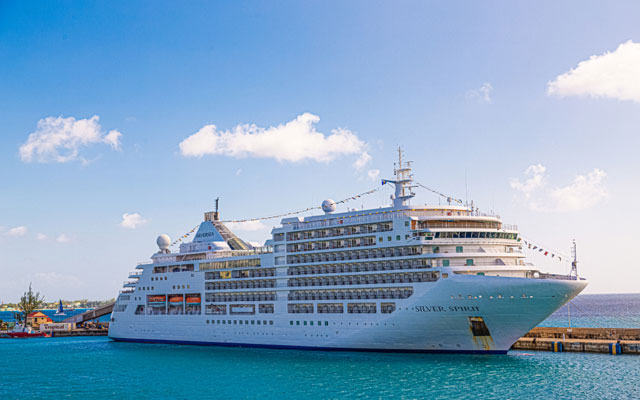
Silversea Cruises has enhanced its digital training platform Silversea Academy to now offer 18 training modules, and has made it available to travel agents in Asia for the first time.
Now accessible to travel partners globally, including those in the US, Canada, LATAM and Asia for the first time, the training hub enables advisors to learn more about Silversea’s product offerings, visited destinations, ships, and itineraries with an interactive learning experience.
Silversea Academy now available to travel agents in the US, Canada, LATAM and Asia for the first time
Each module takes an average of 20 minutes to complete. Travel partners are invited to participate in a quiz at the end of each module and are awarded a certificate upon their successful completion. Moreover, those participating in Australia, New Zealand and Asia will obtain two CLIA accreditation points for each module completed.
Among the training modules are “Selling Silversea”, offering a comprehensive understanding of the cruise line, its ships, and its visited destinations; “Expedition Cruise Expert”, delivering an in-depth knowledge of the luxury expedition cruise experience; and various modules that cover ships’ public spaces, restaurants, suites, and voyages. Plus, several modules are dedicated to visited destinations, from Africa and the Indian Ocean to South America, and more.
• Expatriates are driving staycation bookings as they seek replacements for holidays back home
• Relaxing resorts and inclusive packages most in demand
• Cautious travellers are also resulting in a late-booking trend
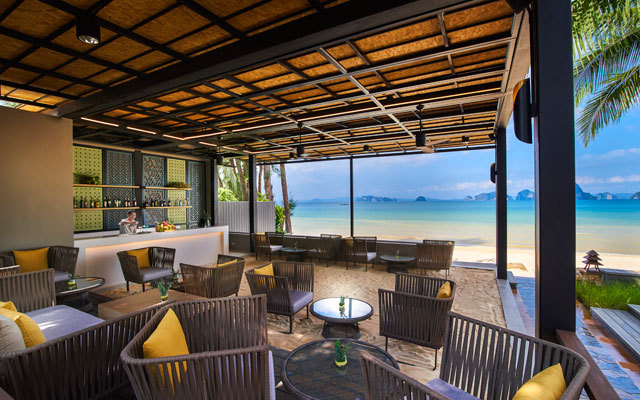
ONYX Hospitality Group is seeing an uptick in bookings at its properties like Amari Vogue Krabi (above) for the year-end holidays
Holiday bookings for the year-end are streaming in earlier than expected for some Asian hoteliers, as consumers look to confirm domestic vacations and staycations as stand-ins for their usual Christmas and New Year’s Day trips amid continuing international travel suppression.
Avani Hotels and Resorts is already getting bookings for the holiday season even though the Asian domestic markets typically book one or two months ahead. The lack of festive packages at this moment has not stopped couples and families from confirming their accommodation bookings, according to Avani spokesperson Adhiyanto Goen.
A spokesperson for The Ritz-Carlton, Kuala Lumpur and JW Marriott Hotel Kuala Lumpur told TTG Asia that enquiries on festive stays were coming in much earlier than the previous years, largely from expatriates planning to celebrate their Christmas and New Year in town instead of back home.
Early interest could have been driven by special offers for the festive season at both hotels, opined the spokesperson, adding that new F&B outlets opening at The Starhill luxury retail complex, which the hotels are part of, this year-end would bring additional gastronomic variety to the guest experience.
Long-term foreign residents or expatriates based in Thailand, Malaysia and Sri Lanka are also credited for driving early bookings with ONYX Hospitality Group, according to president and CEO, Douglas Martell.
The early forward booking trend for the year-end has been picked up by SiteMinder’s World Hotel Index, published on September 21. Hotel bookings for the Christmas and New Year’s Eve period have spiked in multiple countries, including Singapore, Thailand, the Philippines and Vietnam in Asia; and Australia and New Zealand in the Pacific, noted the study.
“It seems the world is keen to end 2020 on a high note, and usher in a fresh new year,” said Mike Ford, managing director at SiteMinder.
Bookings are likely to further improve over the three months leading up to Christmas.
Adhiyanto is pinning his hopes on Thailand and Vietnam’s recent decision to facilitate long-haul arrivals soon, which could lead to a stronger festive period performance.
Cautious bookings
Early birds are, however, not flocking everywhere. Fluctuating state of infections are causing some travellers to approach their holiday plans with caution, leading to short booking lead times, a contrasting trend to the rise in early bookers.
Kristel Joseph, director of sales with The Majestic Hotel and Hotel Stripes, both in Kuala Lumpur, Malaysia, expects year-end bookings to be strong but dominated by late bookings.
“A key observation for 2020 is that travel bookings are made with even shorter lead times than the years before, with many consumers taking a wait-and-see approach with hopes that more borders might reopen,” said Martell.
Martell added that consumers are also investing in “more detailed research and asking more specific questions before they commit”. Those questions are streaming in via social media direct messaging platforms and phone lines – and at a higher volume than usual.
“It is important that we are ready to answer questions not just about our hotels, but the real picture of the area around us, such as whether a popular local cafe or restaurant is still open and whether their full menu is still being offered,” Martell told TTG Asia.
Among secured bookings, resort options and packages with F&B and activity inclusions are clear winners.
Joseph said a preference for room and dining deals are high as locals prefer to make full use of their time in the hotel.
Martell observed that there has been stronger interest in resort and coastal properties than city hotels, with up to 70 per cent of year-end bookings in Thailand going to resort destinations like Pattaya and Hua Hin. Inclusive offers as well as new and refurbished hotels are deemed most appealing too.
Offers everywhere
To stimulate greater domestic interest and bookings, hoteliers have had to take a different commercial tack.
Describing 2020 as a “year like no other”, Martell said ONYX Hospitality Group had to alter its commercial strategy to “balance the short-term opportunities from domestic bookings and staycation market in countries like Thailand, China, Malaysia and Sri Lanka, with (continued engagement of) the medium- and long-haul markets in hopes for an eventual reintroduction of international travel”.
Expats and long-term foreign residents driving early bookings for ONYX Hospitality Group’s properties in Thailand, Malaysia and Sri Lanka: Martell
Martell said: “While many of our travellers from the Western hemisphere have cancelled their bookings for the winter season, there are still a handful of optimistic consumers who continue to hold onto their bookings in the hope that travel restrictions will be lifted before Christmas.”
The Majestic Hotel and Hotel Stripes would be launching festive deals through digital marketing earlier than usual to score advance bookings.
YTL Hotels, which has never offered domestic deals for Pangkor Laut Resort during peak season, has bucked tradition to roll out residents package for a minimum stay of three nights this time round.
“Crafting strategic room and dining offers to cater to the domestic traveller is key in securing the business during the festive season, and a powerful marketing campaign is essential in ensuring success,” the spokesperson of The Ritz-Carlton, Kuala Lumpur and JW Marriott Hotel Kuala Lumpur said.
Unfortunately, with offers aplenty and rates depressed to drive demand, hoteliers do not think that a strong performance this year-end would yield as beautifully as pre-Covid times.
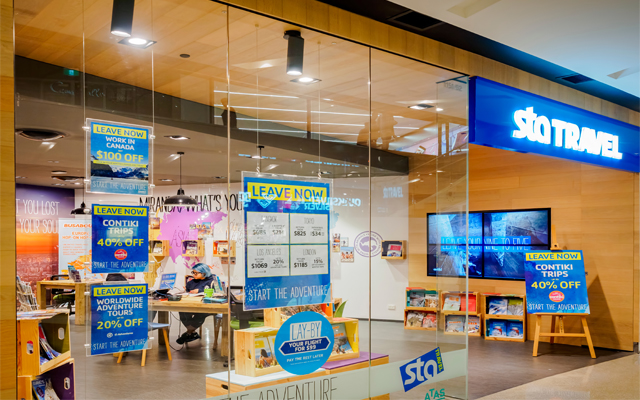
STA Travel office store at Chatswood Westfield Center. It is a travel agency with headquarters in London (UK), and caters mainly to students and young adults.
Tour agency STA Travel, which has three retail outlets in different universities across Singapore, has ceased operations, after its parent company in Switzerland filed for insolvency last month.
Its closure will affect as many as 682 customers who are listed as creditors, according to a report by The Straits Times.
STA Travel is the latest tour agency to close down as the pandemic continues to impact travel demand; STA Travel store at Chatswood Westfield Center in Sydney, Australia pictured
On behalf of STA Travel, audit firm Deloitte and Touche issued a notice last week that listed the potential creditors, with the biggest sum of S$84,088 (US$61,342) said to be owed to an individual.
The notice also lists organisations, including the National University of Singapore, Singapore Management University, Nanyang Technological University, and Republic Polytechnic. Other named creditors are the CPF Board, the Esplanade, the Singapore Scouts Association and Singtel.
According to the report, many university students who had booked flights with the travel agency, such as for exchange programmes, were affected. Some were given travel vouchers after their flights were cancelled amid the pandemic.
STA Travel offices in other countries such as Australia and New Zealand have also been placed in liquidation.
Deep cleaning for Covid-19 (corona virus) disease prevention. For safety, spray alcohol, disinfectant on the cleaning cloth wipes in places that are frequently touched at the hotel.
Daily room disinfection tops the list of hygiene and safety measures that travellers are looking out for when booking hotels and other types of accommodations, according to a recent Agoda survey.
Travellers are raring to travel again, but needs the reassurance of the implementation of hygiene and safety measures at accommodations, found the Agoda Hygiene Survey, which was conducted in June 2020 and surveyed more than 2300 people across eight markets.
Daily room disinfection is key component to get travellers moving again: survey
Globally, “daily room disinfection” followed by “daily disinfection (of general areas)” rank as the most important hygiene measures travellers expect to be implemented by hotels and other accommodation providers.
Other measures in the top five include “providing hygiene standard listings”, “providing personal hygiene kit (masks, gloves, etc.)” and “hygiene certification from the government”.
The study comes as Agoda launches HygienePlus, a new verification feature that shows travellers the health and hygiene measures taken by accommodation providers on its travel platform.
The tool is designed to give travellers peace of mind by identifying hotels or homes that meet a checklist of standardised measures, including contactless check-in/out, temperature checks for staff and guests, daily disinfection at property and room level, provision of face masks, sterilising equipment and hand sanitiser for guests, safe dining set up and signs to ensure physical distancing, among others.
For travellers from South Korea, Taiwan and Thailand, “daily room disinfection” tops the priority list, while travellers from Taiwan, the US, Thailand, Australia and Saudi Arabia prioritise “daily disinfection (of general areas)” as the most important measure to get them booking again.
Younger travellers in the 18- to 24-years-old category are more inclined to prioritise “daily room disinfection”, while “daily disinfection (of general areas)” are the most important measure for global respondents in the 35- to 44-years-old age group.
“Hygiene standard listings” is a priority for Thai and Taiwanese travellers, and the most important hygiene measure for travellers aged 18- to 24-years-old globally. Hotels that provide “personal hygiene kits (masks and gloves, etc.)” are valued most by Indonesians, Saudi Arabians and Vietnamese travellers. Bucking the global trend, only Indonesians value “hygiene certification from government” as one of the top three measures to start travelling again.
Digital Marketing Technology Solution for Online Business Concept - Graphic interface showing analytic diagram of online market promotion strategy on digital advertising platform via social media.
With hopes pinned on domestic tourism to lead the travel rebound, industry stakeholders need to sharpen their understanding of the local market and retune their offerings in order to market to the domestic audience more effectively.
That was the common refrain among travel players during a group chat session entitled Marketing During Covid-19: Should And How Do You Do It? held during the recently-concluded Virtual PATA Travel Mart.
Brands need to reposition their strategies to better target a domestic clientele, say travel players
A successful marketing strategy need not always involve fancy tech tools or deep pockets, opined the session’s moderator, Hannah Pearson, who cited email marketing as an example of low-budget marketing tactic which she has personally found to be effective.
Hoteliers should also think twice about engaging in price wars to bump up occupancy rates. PATA CEO Mario Hardy cited examples of boutique resorts in Thailand which had not resorted to price lures to elbow out the competition, but had instead rolled out value add-ons – a marketing strategy that has successfully helped to fill rooms amid the pandemic.
Marketing to senior tourists was also discussed, as this is a lucrative segment with time on their hands and money to spend on holidays.
Stirring up their interest in visiting a new destination would be best approached through direct email marketing and phone calls, as silver tourists are typically not a digitally-savvy bunch, shared Federico Gigena Sobrero, owner of Wedell Travel based in Argentina.
Akansha Dariyani, membership relations associate at PATA, agreed that traditional marketing tactics still worked best when it comes to seniors with limited digital savviness. But at the same time, she stressed, it is important to include a company website address and an email address to increase company visibility with senior travellers.
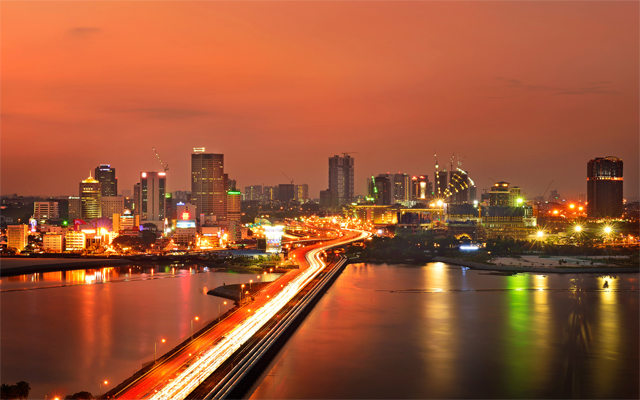
Johor Bahru is one of the biggest city in South Malaysia nearest to Singapore.
Tourism Malaysia is hopeful that cross-border tourism for leisure will reopen in stages sometime in the first quarter of 2021.
Its director-general, Musa Yusof, said in a local television programme recently that the tourism board was keen on resuming cross-border leisure travel with neighbouring Singapore, Brunei, Thailand and Indonesia.
Malaysia aims to get travel bubbles with neighbours like Singapore and Thailand up and running by 1Q2021; causeway linking Johor Bahru in Malaysia to Singapore pictured
“What we mean by cross-border tourism is situations where one doesn’t necessarily have to get on a plane to travel here. We are looking at countries such as Singapore, Brunei, Thailand, and even, Indonesia. These are the four nations that we are examining and reviewing as to whether travel can be allowed,” he was quoted by the Malay Mail as saying.
Malaysian outbound agents whom TTG Asia contacted said they were getting packages ready in anticipation of the reopening of borders to outbound leisure travellers. Those interviewed opined that neighbouring countries will be the first to allow reciprocal leisure travel with Malaysia and predicted it would take place sometime next year.
Adam Kamal, head of procurement and domestic market at ICE Holidays, believes that Thailand and Singapore will be among the first to establish leisure travel bubbles with Malaysia, and is forging plans for that.
“We are in the midst of researching what packages will be sellable, and we think it will be to destinations where Malaysians can self-drive or travel by land such as Phuket, Krabi and Hat Yai in Thailand, or Singapore,” he shared, adding that family and nature-based packages are likely to do well.
An agent from the southern state of Johor, Raaj Navaratnaa, general manager, New Asia Holiday Tours & Travel, shared that he is repackaging existing tours to Singapore with accommodation at major hotel brands.
He explained: “International hotel chains have the marketing advantage to showcase what additional measures are in place in terms of hygiene and cleanliness protocols. Personal safety concerns during this pandemic is of utmost importance to guests.”
Looking ahead, he believes that Malaysian travellers will favour nature-based and soft adventure tourism, over shopping in malls, given the lower risk of Covid transmission associated with outdoor activities.
Asakusa Tokyo , Japan March 17 2020 Man rides Japanese girls with mask on the road at rickshaw in the Asakusa district. Asakusa district with old Sensoji shrine is famous place for people visiting
Tourism suppliers in Tokyo are brimming with optimism that the upcoming addition of the capital city to Japan’s Go To Travel domestic travel campaign will inject a much-needed boost to local businesses.
From October 1, residents in Tokyo will be eligible for the campaign, and Tokyo will be included in travel packages and accommodation plans under the Japan Tourism Agency scheme.
Tokyo will be included in Japan’s domestic tourism campaign as the capital sees falling transmission rate of Covid-19; a rickshaw driver carrying two passengers in the Asakusa district of Tokyo pictured
The addition of Tokyo to the campaign is part of the Japanese government’s bid to shore up its flagging economy, and comes on the back of falling number of new coronavirus cases in the capital.
Hopes are high that Tokyo’s population of 14 million people and GDP of US$1 million will give the campaign a much-needed boost. Due to mixed messaging from local governments and customer reluctance, response to the campaign has been lukewarm, attracting only 13.4 million people to stay overnight during the period of the campaign’s launch on July 22 through end-August, according to a report by the tourism ministry.
Hans Heijligers, head of Japan IHG and CEO of IHG ANA Hotels Group Japan, expressed optimism that “people are ready to start travelling more and explore Japan”. He said the addition of Tokyo will “hopefully provide a much-needed additional boost to our markets,” citing four new hotel launches in Japan under the brand, including Hotel Indigo Hakone Gora, near Tokyo; and Kimpton Shinjuku Tokyo.
Steve Dewire, general manager of Grand Hyatt Tokyo, said the hotel is enjoying an increase in October and November reservations under the campaign.
“We started to offer a staycation package over the summer and saw a gradual increase of domestic bookings, but we can already see that this new campaign will give us an even bigger boost in business,” he said. He added that, combined with the campaign, Hyatt’s package offers 51 per cent off the standard room rate, which would be “very appealing to the domestic market and will help the hospitality industry as a whole”.
Suppliers near Tokyo are also expecting an uptick in visitors, as Tokyoites seek a countryside destination.
Mike Harris, chief refreshing officer at adventure activity and glamping provider Canyons Ltd in Nagano Prefecture, said: “With the inclusion of Tokyo, we are expecting our autumn to be even busier than normal, as 60 per cent of our summer clients are from the Tokyo region. For this reason, and the fact that temperatures are forecast to be high this autumn, we have extended our summer season of activities to mid-November.”

















Bucking the trend of slow air travel recovery, the volume of domestic flights in Mainland China during this year’s annual Golden Week holiday, from October 1 to 8, looks set to push well past last year’s record, according to Cirium data.
Often called “the world’s largest annual human migration,” the peak travel period for this year’s Golden Week will be between September 30 and October 11. A snapshot of Cirium Core data taken on September 23 shows more than 164,700 domestic flights scheduled during the period, representing an increase of more than 11 per cent compared with the same time in 2019 when approximately 148,000 flights flew.
This year’s passengers will fill more than 27.8 million domestic aircraft seats during Golden Week, with the busiest day being October 7, when over 13,800 domestic flights are scheduled to take to the air. That is an increase of 9.6 per cent over the busiest day in 2019 (October 6) when more than 12,600 domestic flights were operated.
Rahul Oberai, Cirium managing director for APAC, said: “Covid-19 has clearly had a major impact on Mainland China’s international and domestic flight schedules. Between January 1 and September 23, 2020, 18 per cent of scheduled international flights and 17 per cent of scheduled domestic flights were not flown. However, when it comes to year-on-year growth, the story is completely different, with international registering a 77 per cent drop, while domestic suffered a more modest 16 per cent decline.
“Some regions are showing signs of recovery as travel restrictions begin to ease. However, those with large domestic markets, such as China, are the ones most likely to see capacity bounce back or even achieve some level of positive growth.”
This year, the most popular Golden Week destination for domestic air travellers is Shanghai. Its two airports – Shanghai Pudong International and Shanghai Hongqiao International – will welcome more than 10,800 flights between September 30 and October 11, and over 900 on October 7 alone.
The capital, Beijing, is a close runner-up. It will see some 9,840 flights fly in between September 30 and October 11, and close to 830 arriving at its Beijing Capital International and Beijing Daxing International airports on the busiest day of the annual break (October 7).
The third most popular Golden Week domestic air travel destination will be Guangzhou. Guangzhou Baiyun International Airport will be the country’s busiest individual airport, with more than 7,280 flights arriving between September 30 and October 11, and more than 600 on the busiest day. It will be followed by Chengdu, Shenzhen, Kunming, Chongqing, Xi’an, Hangzhou and Nanjing rounding out the top 10.
Oberai said: “The positive Golden Week domestic traffic figures are good news for Mainland China and an encouraging sign for other regions. They also demonstrate what Cirium has been saying since the start of the pandemic – that during the recovery, travel patterns may be fragmented, with VFR (visiting friends and relatives) traffic driving journeys ahead of business traffic.”