TTG Asia Media has kicked off a buyers acquisition campaign for the inaugural Great ASEAN Travel Fest 2021, an online travel trade event focusing on promoting South-east Asian destinations and supporting players working towards business recovery.
Taking place on May 4 and 5 this year, the Great ASEAN Travel Fest 2021 will pack in scheduled meetings between buyers and destination sellers, unlimited walk-in meetings from 09.00 to 18.00 (GMT +8) every day, mini themed roadshows, and hosted sessions conducted by featured destinations.
The Great ASEAN Travel Fest 2021 will showcase the best of South-east Asian destinations and connect serious buyers with tourism sellers
Qualified travel trade buyers are entitled to up to 24 scheduled meetings to facilitate their sourcing needs.
Participation in eligible activities will earn buyers points. Top 10 buyers in the point leaderboard who also complete five scheduled meets will take home prizes.
A digital certificate of participation will also be issued at the end of the online event.
For more information, visit https://www.aseantravelfest.com/
In a pivot to court affluent travellers and cater to post-pandemic needs, FlyEast Philippines is offering luxury tours replete with security escorts, chartered planes and choppers, bespoke yachts and Rolls-Royces, alongside the most opulent meals and accommodations in the islands.
For travellers with safety concerns, security escorts can be arranged that don’t end in land, sea or air travel but can be extended in hotels and tours, said Yoav Golan, co-founder and chairman of FlyEast Philippines, a satellite branch of FlyEast Israel, in a recent webinar hosted by the Israel Chamber of Commerce and Industry.
Chartered planes and choppers are at guests’ disposal to reduce travel time from Makati to Tagaytay to 20 minutes from two hours by land, and from Makati to Banaue to an hour from nine hours by land, said Golan.
For 120,000 pesos (about US$2,500) a pop, a chopper flies guests from Makati to one of the country’s most exclusive restaurants, Antonio’s in Tagaytay, with a mesmerising view of Taal Volcano’s crater lake.
Private chartered planes stand ready to transport travellers to various places around the archipelago, while bespoke yachts are available for island hopping. As well, Rolls-Royces – a rarity in the Philippines – are on hand for land transfer at 80,000 pesos per four hours.
FlyEast’s range of accommodations on offer include the private island of Banwa, which at US$100,000 per night, is the world’s most expensive accommodation, according to Golan. Posh facilities include six villas with private butlers. There’s also Nay Palad Hideaway in Siargao at US$1,800 per night, and Eskaya’s presidential suite.
Other unique accommodations include the MacArthur Suite at the Manila Hotel where General Douglas MacArthur stayed, going for 500,000 pesos per night; Okada Manila’s villa for US$10,300 a night; and Conrad Manila’s presidential suite at US$5,400 per night.
Included in FlyEast’s exclusive dining list are the Nobu restaurant at the Nobu Hotel in the City of Dreams Manila, and Mirèio at Raffles Hotel in Makati.
Golan said, though, that travellers should manage their expectations about the term ‘luxury’. He cited as example the areas around the Banaue Rice Terraces, where accommodations are few and not five-starred. FlyEast uses Native Village Inn in Uhaj, which are nipa huts with shared toilets. While the mountain lodge has modest-sized rooms and lack luxe amenities like Jacuzzis, guests are treated to an amazing view of the rice terraces.
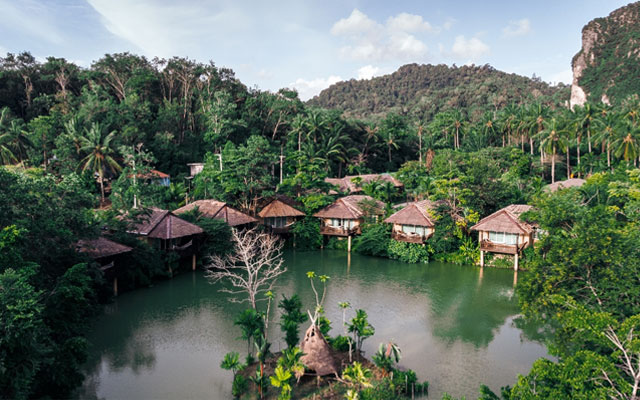
As the world leans more into wellbeing with the pandemic’s widespread impact, Banyan Tree will be launching 16 new Wellbeing Sanctuaries across its properties globally this year.
The Wellbeing Sanctuaries will combine club floors or resort wings, dedicated dining options, spas, and multifunctional practice spaces into one exclusive journey. Beginning this month, they will be launched first in China, and progressively in Indonesia, Malaysia, Mexico, Morocco, Thailand and Vietnam over the next 12 months.
Guests can explore connecting with nature at one of Banyan Tree’s Wellbeing Sanctuaries
Catered for the wellbeing-curious, the Wellbeing Sanctuary concept enables leisure travellers to design and combine a leisure vacation with wellbeing elements in a flexible, and open way. Through a simple and structured, codified approach of eight pillars, guests may personalise their stay as well as create a personal practice to sustain even after returning home. Lastly, the journey is designed to inspire a greater connection between self, others and nature, with Banyan Tree’s enduring commitment to sustainability woven through the experience.
Every individual’s journey to wellbeing is different. Each Wellbeing Sanctuary provides the time and space for guests to choose their own activities throughout their stay with a unique credit system, in consultation with the property’s wellbeing host. Stays can be anywhere between two days and more, with a variety of activities to accommodate couples or families with different leisure and wellbeing preferences.
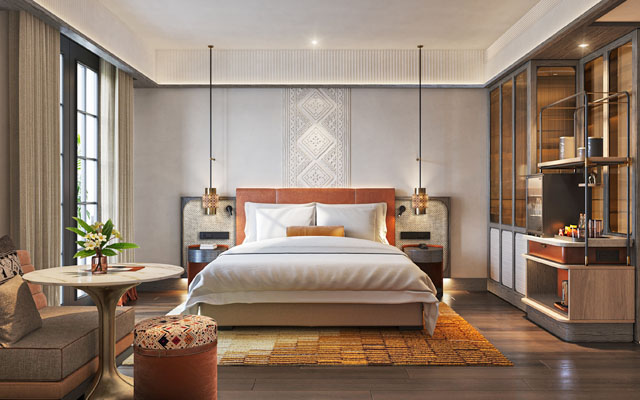
A stay at Banyan Tree’s Wellbeing Sanctuary includes accommodation at a wellbeing suite or villa designed for sleep enhancement; in-room amenities such as yoga mats, stretch bands and singing bowls for private practice; pre-sleep bath and body rituals; balanced healthy meals and mini-bar provisions using locally sourced ingredients; bodywork and spa therapy experience; access to 50 simple but impactful wellbeing activities, inspired by the destination; as well as personalised, take-home wellbeing guide for sustained learning.
Developed through two years of study and thousands of participant feedback, Banyan Tree’s wellbeing approach is codified through eight pillars: Sleep Well; Dietary Awareness; Interaction, Intimacy and Involvement; Physical Vitality; Cultivating the Mind; Learning and Development; Harmony with Nature; and Sustained Practices.
With the support of dedicated wellbeing hosts on-property, guests who book a stay at Banyan Tree’s Wellbeing Sanctuaries embark on a journey to come home to themselves, gaining deeper self-knowledge. Guests can also take home a personal wellbeing guide after their stay, which include tips on healthy living, home exercise and other recommendations for sustained practice in one’s daily life.
Most existing wellbeing offerings are primarily focused on the individual. At Banyan Tree’s Wellbeing Sanctuaries, exploring the relationships and connections within the self, and without, with others and nature, is core. In doing so, guests discover their own balancing points and find ways to improve their state of being in the now.
For example, the sensory detox White Room experience is a deep dive into the self, removing daily distractions in a guided, stress-free environment. In exploring relationships with others, guests may choose to have a conversation with a Buddhist monk, volunteer in a community setting, or go through a couple yoga session. In connecting with nature, one may choose a Conscious Grounding experience outdoors, or an Ocean Breath meditation session combining breathwork and movement.
Marriott International has launched the Marriott Bonvoy The BEST Shinhan Card, offered exclusively by Visa, enabling cardholders to accelerate the number of Marriott Bonvoy points they earn, which can be redeemed for free nights at the brand’s hotels around the world.
Touted as “the first hotel industry credit card in South Korea”, cardholders can earn Marriott Bonvoy points and enjoy member benefits that come with elite status.
For an annual fee of 267,000 won (US$236), with Marriott Bonvoy The BEST Shinhan Card, cardholders enjoy rich earn ratios and become a Marriott Bonvoy Gold Elite member upon sign-up.
Platinum Elite Status is also more achievable with cardholders enjoying 5,000 bonus points after spending 10 million won, and 10,000 bonus points after spending 20 million won. Cardholders will immediately be awarded Platinum status upon 60 million won spend in an accounting year.
Trip.com Group has launched a new travel marketing hub, Star Store, designed to allow suppliers to expand and enhance their marketing activities on the company’s platforms.
Through this platform, partners will be given a dedicated forum to integrate differentiated and tailored product offerings and develop their exposure with new product promotion initiatives. In addition, Star Store offers partners the tools to deliver a wider diversity of marketing activities, such as membership promotions, live-stream sales, external placement, and more.
Trip.com Group’s Sun Bo announces the launch of the company’s new travel marketing hub Star Store
This latest move is part of the brand’s efforts to build a one-stop travel platform, integrating differentiated travel content, driving huge traffic volume and providing comprehensive travel products to meet the evolving needs of post-pandemic travellers and further support partners.
Star Store enables Trip.com Group partners to expand and upgrade their marketing capabilities across the company’s content distribution channels, such as live-streaming and membership community networks by publishing their own content on the platform to help drive bookings.
Through its traffic management toolkit, the new travel marketing hub grants partners the ability to efficiently match and manage traffic to generate greater exposure for their product and content offerings.
Sun Bo, Trip.com Group CMO, said: “Our new travel marketing hub enables travel ecosystem partners to turn engagement into transactions through enhanced marketing activities on this dedicated platform, sharing in the benefits of Trip.com Group’s global user base. Trip.com Group will continue to develop its content and marketing capabilities, applying and expanding this approach to the international market in line with the global travel industry’s recovery.”
Why
With access to leisure travel still shut, the steady stream of domestic tours continue to see strong demand from Singaporeans hungry for creative local experiences. On the back of the success of its Chinatown Murders game tour set in the historic district, Tribe Tours launches a second version that explores Jewel Changi Airport beyond its lifestyle offerings.
What
In Jewel Heist, two teams lock horns in a battle of wits and speed to locate a ‘jewel’ in the mall, while solving trivia questions and racking up ‘prize money’ points. Puzzles encountered at each stage have time limits ranging from 15 to 25 minutes, with the entire tour running up to three hours.
Jewel Heist game tour
1 of 3
How
In accordance with safe management measures, our tour started with a pre-tour huddle, where sanitised audio sets were distributed. Then, splitting into two teams (one with four members, and the other, five), we set off on our mission.
The first task was fairly straightforward and kept us within a contained portion of Jewel, but it was a deceptively simple start. As the story progressed and the tour made its way through the different parts of the mall, we found ourselves racing and combing through entire levels in search for clues – and not before racking our brains to interpret the hidden meanings in each puzzle.
Thankfully, each team is given a collection of lifelines redeemable with the ‘prize money’ points racked up through solving puzzles and trivia questions. These pop-up trivia quizzes are a clever component of the tour that taught us lesser-known facts about Jewel. For instance, I now wield the knowledge that each of the 9,000-plus triangle glass panes of Jewel’s dome has a unique QR code for maintenance.
The end of the tour placed us at the top level of Jewel, thanks to complimentary access into the Canopy Park. From here, participants may choose to linger and enjoy the view from the top, or retreat back to the lower levels for food and shopping. Those who decide on the latter should note that they would have to pay for re-entry into the Canopy Park.
Verdict
While Jewel Heist plays out in an air-conditioned building, the tour left us sweating from scouring whole floors of the mall in between cracking puzzles. Guests who have been on the Chinatown Murders tour may have an edge, but beware that Tribe is back with trickier tasks this time.
Another marked difference of this game tour from the Chinatown Murders one is the introduction of a competitive element. Based on feedback from its Chinatown Murders tour, Tribe implemented a points system in this second instalment, which made me and the other participants more driven to quickly complete the missions. This approach has also hit the right note with its test groups, revealed Tribe Tours co-founder Jason Loe.
Discova has launched a travel clothing app that offers travellers personalised fashion recommendations, to help them avoid committing sartorial crimes while abroad.
Dubbed Travel Tailor, the DMC’s new app features an easy-to-use interface and a cheery, if not sassy, AI tailor. The app is intended to be white labelled and will be free to all Discova partners to roll out to their customers.
Andrew Turner, global director of sales at Discova, said: “Our partners trust us to deliver high-quality, tailor-made travel experiences so extending our offering to tailored fashion was a logical progression. When Covid forced our industry into hibernation, we got to work… After countless trials and ill-fitting samples, our Travel Tailor app is now ready for release. From budgie-smugglers to socks and sandals, we know that mistakes can be made when you travel, and we want to do our bit to help travellers stay the right side of good taste.”
After nearly a year of development and countless outfit changes, the Discova Travel Tailor app is poised to become the next essential travel companion. Refreshingly easy to use, travellers download the app to their mobile phone and then simply take a selfie. The cutting-edge AI technology gets to work straightaway, building a profile – complete with accurate measurements and the user’s perfect colour palette.
The user’s Discova tailor-made holiday itinerary information is uploaded to the device automatically. This allows a complex algorithm to trawl weather reports, climate history and even altitude information to best advise on appropriate laying options and dispense other fashion tips.
Users can access the app at any time during their travels for an update on their attire. The AI tailor will provide no-holds-barred commentary, leaving the user with the option to simply ignore the advice or click-through to the ‘Fitting Room’. This is a unique feature where the app comes into its own. Using the user’s profile and itinerary information, the app creates outfit options and then uses geolocation information to identify the nearest clothing stores where the outfit may be purchased.
Turner concluded: “We conducted extensive testing prior to launch, which raised some interesting questions about the dress sense of our testing team. However, having rolled out the app throughout the company, it’s safe to say that now, it’s not just our itineraries that look great!”
The Discova Travel Tailor app will be available exclusively to prioritised users on April 1.
As Covid-19 lessens its grip on the world, the economies of the Asia-Pacific region will likely be among the first to return, according to a report by ILTM Asia Pacific.
The report, titled Asia Pacific and the Global Travel Recovery, which was produced by ILTM in partnership with Barton, provides the latest insights into the luxury travel industry in the Asia-Pacific region.
Asia-Pacific is the fastest-growing wealth region in the world
Utilising data that was collated and validated during the year of a pandemic, the report reveals a long-term view of the Asia-Pacific region that provides a high degree of cautious optimism for 2021 and beyond.
As restrictions ease, in-region travel will be at the heart of the recovery – an estimated 57.5 per cent of Asia-Pacific traveller’s outbound spend is spent within the region.
Encouraging Asia-Pacific’s luxury travellers to roam more widely will be key to making 2021 a successful one for global luxury travel as these travellers already contribute US$363 billion to the global luxury travel universe (GLTU).
A huge contribution to this total is made by Asia-Pacific’s high net worth (HNW) population, which numbers 6.4 million individuals. Despite only being 0.15 per cent of the region’s massive population, they contribute almost half of the region’s total to the GLTU (48 per cent).
Asia-Pacific is the fastest-growing region for wealth in terms of both population (number of HNWs) and total wealth. Given the very strong link between wealth and luxury travel spend from the region, this means very strong growth in the Asia-Pacific contribution to the total spend on the GLTU.
Over the last decade, China has been the biggest success story in terms of wealth growth in the world, not just Asia-Pacific. As a result, it makes a huge contribution to the total Asia-Pacific spend related to travel. For instance, 49 per cent of the whole region’s spend on airfares and lodging, which equates to US$114 billion, is made by travellers from China. Of this, over half (52 per cent) is made by China’s HNW population, which is around 29 per cent of the total Asia-Pacific HNW population.
However, the future of wealth in Asia-Pacific is not a solely China story. Well-established wealthy markets such as Japan, Australia and South Korea, along with fast-growing ones like Vietnam, India and the Philippines will all contribute to the creation of an ever bigger HNW population.
Asia-Pacific travellers, inbound and outbound, contribute US$251 billion to the US$1.54 trillion global luxury travel ecosystem of activities. Outbound Asia-Pacific traveller spend is 28 per cent of this, above the global average of 23 per cent. This is reflective of the fact that many Asia-Pacific HNW individuals must travel internationally to take part in some of the most favoured activities in the luxury travel ecosystem, such as large-scale sporting events.
Asia-Pacific’s HNW population contributes almost half of the region’s outbound global spend on ecosystem activities at US$34.4 billion (48 per cent), demonstrating just how important the region’s wealthy are to the global luxury travel experience economy.
Despite the effects of Covid-19 persisting globally, many of the 55 countries that make up the Asia-Pacific region have been considered excellent examples of resilience during a period that has upended the travel industry like never before.
With 2021 now underway, businesses everywhere are understandably looking for a jumpstart in the industry, and it is in this that the Asia-Pacific region continues to draw attention. Asia-Pacific is the fastest-growing wealth region in the world, which was what identified it as a key location for the travel industry to expand into long before Covid-19 was known about.
Despite the challenges faced globally since the pandemic began, the wealth-growth trend seen in Asia-Pacific prior to the pandemic has only paused – and in some cases – even increased.
The reasons for this buoyancy are manifold. After being the hardest hit 17 years ago by the SARS epidemic, Asia-Pacific is much more used to pivoting in response to viral threats than the western world. Moreover, there has always been a huge market for those based in Asia-Pacific to travel within the region, which is fulfilling the still prevalent desire for travel among HNW individuals.
It is also clear, of course, that this is not a standard recession, allowing for well-prepared wealthy Asia-Pacific travellers to continue to accumulate their wealth in readiness for when the world’s borders are fully open once more.
With the financial resource, desire and inherent ability to pivot during incredible disruption, Asia-Pacific travellers should be seen as pioneers of the new luxury travel landscape, providing the much needed economic injection the industry has been waiting for.
Multi-day tours have been in existence for a long time, but the pandemic has changed travelling habits and trends, with industry stakeholders noticing that small groups, private and personalised itineraries, and bucket-list type holidays are becoming the order of the day.
Lukas C.C. Hempel, founder and CEO of Bookingkit, said: “There’s a tectonic shift in what kinds of activities people want to do. The clear losers are large group activities, while outdoor activities and small group activities are winners.”
More vacationers checking off bucket-list destinations post-Covid; a female tourist hiking at Gokyo Ri in Nepal pictured
Manuel Hilty, CEO and co-founder at Nezasa, shared during a session titled The Rise of Multi Day Tours at ITB Berlin: “We’ve seen a trend towards more private tours being booked, and smaller group sizes across the board, as a result of the pandemic.”
Hilty also predicted that multi-day tours will grow in the future, because “people will do less trips”, but will choose to take “longer ones and spend more time in a faraway destination”, as opposed to multiple short hops.
Staying longer in a destination would also be more sustainable in terms of transportation. Travis Pittman, co-founder and CEO at TourRadar, cited the example of a traveller who instead of holidaying in Rio de Janiero for just two days, opted for a longer, two-week stay in Brazil.
Brian Young, managing director at G Adventures, highlighted that the pandemic has taught people to appreciate the privilege of travel, and the importance of travel to their well-being, and is confident that newfound awareness would translate to them travelling more responsibly.
He added that experiential travel will gain further popularity in the wake of the pandemic. Reflecting this, Young noted that G Adventures has seen a growing interest in the agency’s “bucket-list type tours”, such as climbing to the base of Mount Everest and Mount Kilimanjaro.
Travis Pittman, co-founder and CEO at TourRadar, has also noticed searches for “polar expeditions” and other bucket-list items trending.
Experiences aside, reconnecting with friends and family is also a noticeable trend among post-pandemic travellers.
Pittman offered: “We have run trips since September 2020 and we have seen an increase in private group bookings with tailor-made elements. Family and friends just want to get away, while being in the security of a cocoon. Also, some groups have not seen each other in a long time, and the ‘bubble’ would help them reconnect with one another.”
In light of this, during Covid-19, G Adventures launched Book Your Bubble, a collection of 80 tours that groups can personalise and book. Young strongly believes that such tours will continue to be popular even after the pandemic subsides.
Solo travellers are also keen to hit the road again, but they desire to travel “in the comfort and security of a small group tour with like-minded people”.
On the topic of personalisation, Pittman noted: “(Previously), the multi-day tour sector has been fairly rigid, with not a lot of flexibility possible. (But with the pandemic), operators have realised that customers want to make changes without getting charged with a hefty fee.”
In the long run, Pittman believes that multi-tour operators would gain greater appeal as consumers who previously booked everything by themselves have realised it’s more complicated to obtain refunds when borders were swiftly shut.
He explained: “The benefit of booking through a tour operator is that you’ve got everything together; and one person, instead of seven different organisations, to (approach for) refunds.”
Singapore-based travel consultancy OMT Group of Companies will launch a blockchain-backed mobile application featuring a selection of curated itineraries, along with a secured payment gateway and rewards system.
For starters, the mobile app will feature affordable itineraries, supported by major destinations including Indonesia, Thailand and the UAE. Come April, end-users will be able to download the application from their iTunes and Android stores.
OMT Group of Companies taps blockchain technology to power its up-and-coming mobile application
This initiative comes at a time when the global economy is starting to reopen and interest in leisure rebounds in some regions. As such, the travel consultancy plans to adopt best of breed partners to help create a unique customer experience advantage. These partnerships are expected to generate a huge boost in global tourism revenue, and along with the use of emerging technology, rebuild the travel trade sector to emerge stronger than before from the pandemic.
OMT Group of Companies’ efforts to go digital bodes well to increase the standards of travel wholesalers and safeguard monies and personal data from illicit activities. It also points to Singapore’s endeavour to continue strengthening its position in the region as a cashless digital hub with its neutral regime in digital assets transactions.
James Yeow, chairman and CEO of OMT Group of Companies, said: “The up-and-coming application will look to facilitate billions of transactions on the blockchain, enable travel marketers to employ more targeted, data-driven marketing strategies and create sustainable employment opportunities for many.”
For OMT Group of Companies, the utilisation of blockchain technology to power its up-and-coming mobile application drives transparency in a safe and reliable environment, particularly when it comes to the treatment of handling sensitive data including personal identification numbers, addresses and credit card information. This, in turn, helps build trust between travel trade wholesalers and the wider community.
Said Yeow: “Emerging technologies like blockchain lets go of the need for physical documentation, replacing it with digital ones. This makes travel marketing more targeted and specific processes like payments a hassle-free experience for FITs, luxury and group corporate travellers.”
Tapping on a decentralised management system, OMT Group of Companies’ application will help destinations, brands and operators reduce costs, improve business ratings and communication, tailor unique packages and implement hassle-free loyalty programmes.
Added Yeow: “With personalisation emerging as the choice for many, and the demand for unique travel experiences increasing, we believe that the combination of our application and tailored itineraries will create a differentiated, high-touch service experience for both our existing and new members.”
Marriott International has launched the Marriott Bonvoy The BEST Shinhan Card, offered exclusively by Visa, enabling cardholders to accelerate the number of Marriott Bonvoy points they earn, which can be redeemed for free nights at the brand’s hotels around the world.
Touted as “the first hotel industry credit card in South Korea”, cardholders can earn Marriott Bonvoy points and enjoy member benefits that come with elite status.
For an annual fee of 267,000 won (US$236), with Marriott Bonvoy The BEST Shinhan Card, cardholders enjoy rich earn ratios and become a Marriott Bonvoy Gold Elite member upon sign-up.
Platinum Elite Status is also more achievable with cardholders enjoying 5,000 bonus points after spending 10 million won, and 10,000 bonus points after spending 20 million won. Cardholders will immediately be awarded Platinum status upon 60 million won spend in an accounting year.