


Shangri-La Rasa Sentosa brings bubbly daycations to Singapore

Shangri-La Rasa Sentosa, Singapore has partnered with Veuve Clicquot to host In the Sun, an exclusive pop-up beach club that comes with all the perks of a relaxing vacation without the commitment of an overnight stay.
Designed for adults – couples, groups of friends and individuals desiring a sun-kissed, Champagne-tinged beach escape, the Rasa Sentosa x Veuve Clicquot In the Sun Beach Club daycation package is available for a limited period – from January 24, 2022.
Priced at S$138++ (US$101) per adult, the package include access to the resort’s private beach from 12.00 to 19.00; one bottle of Veuve Clicquot Yellow Label Brut; S$50 nett dining credits; sea sports activities; and amenities & services including towel service and use of a beanbag lounger and changing room.
For reservations and more information, visit bit.ly/Rasa-BeachClub2.
Travelport+ updates with new tools

Travelport has brought enhanced, modern retailing tools onto its Travelport+ platform to make it easier for agents to deliver better service to their travellers.
Travel agents can expect more capabilities that improve airline connectivity and minimise back-end work in customer servicing; upgraded hotel content distribution, with richer room, rate and rules details as a result of upgraded connectivity with Hilton; and a new version of Smartpoint which now comes with more customised itinerary quotes in Trip Quote as well as faster Assisted Ticketing capabilities that streamline complex ticketing and exchange tasks for agents.
Travelport has also launched a new Trip Manager portal on Travelport+, offering travellers the ability to service their own trip, and carry out fast, easy transactions on the go. The self-service option for travellers using the new portal allows agencies to preserve resources while providing travellers an improved experience with the ability to easily add extras to their trip.
These enhancements are part of Travelport’s continued Intelligent Storefront mission, which aims to make it easier for agents to understand offers and compare brands with similar attributes on a like-for-like basis, and to easily identify upsell offers with NDC and ATPCO fares.
Jen Catto, chief marketing officer at Travelport, said: “Today’s enhanced features empower travel agents to offer more choice, enable greater self-service capabilities for travellers, and simplify the most complex servicing processes.
“All Travelport+ customers enjoy a more modern, digital-first retail experience when connecting through our platform. That includes our desktop customers, who have said that the latest version of Smartpoint has managed to transform mundane travel management tasks into superior servicing opportunities.”
Philippines lays groundwork for Covid, typhoon recovery

The Philippines is stepping into 2022 with abundant hope for global travel resumption, despite ongoing Omicron variant challenges and damages by super typhoon Rai in December 2021.
Speaking to TTG Asia, Maria Anthonette Velasco-Allones, chief operating officer of Tourism Promotions Board (TPB) Philippines, said there were telltale signs of an unhurried renewal of domestic and international tourism.
With the Omicron surge expected to peak by end-January and the Philippines’ successful vaccination and booster exercises, Velasco-Allones anticipates that the increase in domestic trips in the last quarter of 2021 would continue into the new year.
She revealed that the country’s Inter-Agency Task Force on Emerging and Infectious Diseases has approved the entry of foreign nationals to the Philippines by February 16, 2022, subject to certain requirements.
In terms of remedying the destruction of super typhoon Rai, which had hit top destinations such as Cebu, Bohol, Palawan and Siargao, Velasco-Allones said “ongoing efforts to rebuild or rehabilitate key infrastructures and support recovery initiatives in these places will surely pave the way for these destinations to be ready to welcome back visitors”.
Meanwhile, TPB continues to promote domestic tourism in key destinations as well as diverse destinations such as the Cordillera region for mountain tourism, Baguio City for culture and food trips, Boracay for sand and beach, and newly-calibrated domestic tourism circuits and routes.
Changes in the tourism landscape has compelled TPB to adapt its roles to ensure that its marketing programmes and strategies remain relevant, effective and efficient.
TPB is strengthening its role as facilitator of services for tourism stakeholders. For instance, the TPB Membership Programme has expanded by 488 per cent, resulting in a more engaged community that can respond quickly, as seen in post-Rai relief drive, and collaborate on formulating TPB’s strategic marketing programme and other matters.
Other initiatives include leveraging technology and digital platforms to sustain digital marketing and promotions, and deploying a Special Contingency Fund to support initiatives such as provision of hygiene kits and subsidising swab test costs to boost domestic tourism.
Collective approach
Asia-Pacific governments have been loosening their steel grip on international borders since 2H2021, but at your November AAPA Assembly of Presidents meeting, you noted that international passenger volumes across the region remain deeply depressed, at just six per cent of pre-pandemic levels compared to an average of 40 per cent in other regions. What is causing this recovery crawl?
There is modest pick-up in demand in November 2021, coinciding with the easing of restrictions in several Asia-Pacific markets. (Singapore’s) Vaccinated Travel Lanes (VTLs) and travel corridors are (resulting in) a surge in bookings as soon as they are launched, which is indicative of the pent-up (travel) demand.
Such travel lanes and corridors are still too few and far between but should provide the momentum for recovery in 2022 if expanded as planned. Big markets like China and India also need to open up for recovery to commence in earnest.
Is the fear of travel – stemming from a fear of infection and death so widespread throughout this pandemic – among consumers a factor too?
The main factor is travel restrictions, especially quarantine. Quarantine, as well as the plethora of regulations with each government keeping its own counsel, dampen consumer sentiment and travel confidence as potential travellers are confused and (doubtful).
The Omicron variant is making plenty of headlines, and causing border restrictions to be tightened once more and disrupting travel rebound. What should governments learn from this as they attempt to live with Covid?
The knee-jerk reaction is understandable as governments are wary of the new variant of which very little is known. As long as the re-imposition of restrictions is temporary and short-lived to buy time or fine-tune risk-based measures, there should not be too much delay to recovery.
The reality is that governments will have to base their decisions on evidence and science, which require data to be gathered and evaluated.
Hopefully, Omicron is only a fly in the ointment and not a spanner in the works. It is heartening to see several governments in the region sticking to their recovery roadmap and reintroducing only some restrictions to address the immediate risks that have been identified.
In AAPA’s opinion, what ingredients are critical for a more stable travel and tourism recovery, and what can AAPA and its Assembly of Presidents do to move regional governments down the right track?
Living with the virus means we have to take its evolution in our stride. Governments that have adopted a Covid-normal strategy and are adopting risk-based policies and practices are laying the path to recovery.
The association is calling on governments to collaborate across borders, work with the industry in applying risk-based measures and restore international quarantine-free travel progressively.
Sticking or reverting to hard borders and onerous quarantine rules would not only harm travel and tourism but also the economy and livelihoods of the people. Travel corridors and VTLs once started should be sustained so as not to undermine the demand for cross-border travel.
Generally speaking, governments should redouble efforts to spread the access to vaccines as prolonged vaccine inequity will only delay the timeline to recovery.
Besides travel recovery, AAPA has another important commitment for 2022, and that is to cut carbon emissions to net zero by 2050. Will you tell us more about this goal and how aligned Asia-Pacific airlines and authorities are with this mission?
AAPA airlines committed to the net zero emissions goal by 2050 on September 13, 2021. The focus for the industry at the moment is on ICAO CORSIA (Carbon Offsetting and Reduction Scheme in International Aviation), which is a market-based measure already available for international airline operators to reduce their carbon emissions.
The longer term focus is SAF (Sustainable Aviation Fuels), for which the airlines will collaborate with other stakeholders, namely governments, fuel suppliers, airports as well as manufacturers of aircraft and engines.
Government support to uphold CORSIA as well as to invest and incentivise SAF production will be crucial as contribution for emissions reduction from SAF use is expected to be up to 75 per cent. Generally speaking, taxes and charges increase cost without benefit to the environment, while support and incentives help the efforts to reduce emissions.
A few bright spots

Domestic tourism has been the saving grace in the Philippines’ post-pandemic travel recovery, given its estimated 110 million population – the second-largest in South-east Asia – who are eager to travel.
This goldmine is an anchor of hope in dire times like this when international tourism dries up.
Consider this: In 2019, the Philippines recorded a whopping 109.75 million domestic trips that generated 3.14 trillion pesos (US$62.7 billion) in tourism revenue, dwarfing the US$9.5 billion in foreign exchange receipts from 8.26 million foreign arrivals.
It plunged to 24.35 million domestic trips in 2020, stymied and stunted by pandemic lockdowns starting March of that year.
“Bringing in just half of the 2019 domestic tourism revenue would be “more than enough” for tourism to recover, quipped Philippine Tour Operators Association (Philtoa) president, Cesar Cruz.
Tourism is already beginning to coast along. “It’s still not as great, but moving, especially due to the fact that there are areas with fully vaccinated workers and population,” said Aileen Clemente, chairman and president, Rajah Travel Corp.
Concurring, Hotel Sales and Marketing Association (HSMA) chair, Margie Munsayac, observed that “local government units (LGUs) are slowly opening borders, restrictions are easing, and new products are being offered in each LGUs – and these make Filipinos consider exploring the various attractions of the Philippines once again”.
“We believe our patriotism will kick in. Filipinos will support local tourism which drives economic activities as well as employment in the tourism industry,” Munsayac shared.
Prospects are indeed sanguine to the extent that since several months ago, travel consultants have started offering tour packages locally and abroad. One of them, Ritchie Tuano, head of Asiareps Travel, has formed a consortium with seven other travel agencies to sell attractive packages in collaboration with airline partners, hotels and local tour operators to “jumpstart tourism”.
“We provide travellers well-priced packages as much as 30 per cent off, while helping destinations slowly rebuild their business,” Tuano said.
While the Omicron variant has prompted the country to delay the reopening of its international borders, initially targeted for December 2021, hotels in destinations like metro Manila and nearby Tagaytay have reported a pick up in domestic bookings and reservations, ahead of the peak holiday season.
A good sign is that HSMA’s September Online Sale “had doubled its 2022 sales compared to 2021, with metro Manila, Tagaytay, Boracay, Bohol and Cebu (emerging) as top preferred destinations,” Munsayac said, adding that triple the number of vouchers were sold as dining and banquet offers were also up for sale in addition to accommodation.
Industry recovery has also been buoyed by balikbayans or returning Filipinos residing abroad – mainly from the US, which is the country’s third biggest source market – who escape winter to visit relatives and friends back home. Another boon for the sector are overseas Filipino workers (OFWs) who go on regular home visits, bringing friends and colleagues from their country base.
Returning and departing OFWs have proven a lifeline for quarantine hotels which would otherwise have scant revenue amid the pandemic.
As well, the pause in tourism gave overcrowded destinations including Boracay some much-needed rest and regeneration. Certainly, the carrying capacity for Boracay and other destinations will have to be implemented as part of the safe travel protocols drawn up by the Department of Tourism (DoT) and the destinations’ respective LGUs.
Clemente said that “because of the lockdowns, one thing that badly needed attention is research. A lot of this is happening now, as well as taking stock of tourism asset inventory, measuring sustainability and carrying capacity”.
The lull in travel was also an opportune time to build and improve infrastructure, among them the new high-tech terminal of Clark International Airport, Camiguin’s domestic airport, and the soft opening of luxe Hotel Okura Manila.
This also paves the way to enhancing Philippine tourism products and developing new ones to adapt to changing traveller preferences. A DoT domestic travel survey showed that travellers favour outdoor spaces and activities, leaning towards eco-tourism, rural and farm tourism.
Clemente saw further rural developments that are open air – a trend which she predicts will grow, alongside the spread of greater utilisation of the country’s coastlines for tours.
She expressed hope that operators will develop more farm tours which promote farm produce that are indigenous to the Philippines and cannot be found anywhere else.
Along this line, Cruz said Philtoa has created several tour packages with outdoor activities; and developed farm, nature-based and gastronomy tour packages, mostly interzonal, within the island of Luzon.
Alas, just as the Philippines’ tourism recovery is gaining momentum, the industry faces yet another blow, with typhoon Odette thwarting travel rebound in parts of the country.
But if there’s one thing the pandemic has shed light on, it is the resiliency of the tourism industry. Looking ahead, the Philippines plans to build a more sustainable and resilient tourism economy.
Tourism secretary Bernadette Romulo-Puyat said the Philippines has already “shifted to high-value, low-impact, low-density travel that offers more meaningful and immersive experiences between a tourist and the local communities”.
Romulo-Puyat plans to continue empowering rural communities in tandem with LGUs to manage their own attractions while practising responsible and sustainable tourism.
The pandemic has taught us that “it is no longer enough to have the best destinations because we must also ensure first and foremost that they are safe”, she said, adding that the country’s tourism recovery plan is anchored on sustainability which the DoT has long advocated for.
She opined: “What good is spurring recovery when it benefits us only short-term?… The socio-economic benefits must be enjoyed also by future generations.”
Japan Fair 2022 goes virtual to engage Singaporeans digitally

Japan National Tourism Organization (JNTO) Singapore office will launch its first-ever virtual event, Japan Fair 2022.
Previously known as Japan Travel Fair, the event was held annually in-person prior to the pandemic.
The upcoming virtual fair will boast an array of curated events and activities to provide participants an authentic Japanese experience from the comfort of their homes.
Participants can expect immersive virtual tours ranging from popular hidden spots to countryside activities such as local festivals (matsuri) and fishing harbours, coupled with Japanese craft workshops and interactive live events from locations in Japan including a snow town and sake brewery.
Sponsored by the Embassy of Japan in Singapore and held in conjunction with various travel partners and prefectural government agencies, the virtual fair will take place from January 28 to March 13 at japanbyjapan.com/Japan-fair.
As part of the virtual fair, a three-day live event segment will feature live broadcast streamings from various locations across Japan on JNTO Singapore Office’s official Facebook page on February 13, 19 and 26.
The 10-programme line-up will showcase the Akita, Nagano, Ehime, Kochi, Kanagawa, Mie, Aomori, Ishikawa, Miyagi and Okinawa prefectures, allowing participants to discover Japan’s traditions and history through immersive and unique cultural workshops and tours. Notable features include an oyster tour, snow town tour, sake brewery tour and a trip to the Ninja Museum.
Participants also stand a chance to win travel vouchers valued at S$1,000 (US$743), Takashimaya vouchers worth S$100, and more.
Hatsume Nagai, executive director for JNTO Singapore Office, said: “The current pandemic has impacted international travel to Japan and has delayed business recovery for the local tourism sector. Through our online strategy, we hope to bring a fun and engaging virtual travel experience that promotes Japan’s cultural diversity and travel offerings.
“We have specially curated the programme and activities to feature the best of Japan and to highlight the unique Japanese experiences that can be enjoyed by all from the comfort of their homes. Singapore remains a vital market for Japan tourism, and we hope to encourage travel to Japan in the future.”
ASEAN tourism unveils new logo and tagline

The Association of Southeast Asian Nations (ASEAN) has revealed its new logo and tagline “A Destination For Every Dream”, which aims to capture the warmth, resilience, and sense of fun and adventure that is emblematic of the South-east Asia region and peoples.
Through this new branding, ASEAN will continue to market South-east Asia as a single destination and raise awareness of the region’s diversity of offerings that travellers could rediscover once borders open up again worldwide.
Designed by ASEAN member states in collaboration with its marketing agency, ELMNTL, the new logo aims to show travellers the many beautiful experiences they could enjoy in each of the ASEAN member states while highlighting the changes the region is making towards responsible tourism.
The logo consists of ten “spokes,” each representing an ASEAN member state, to form the sun in a harmonious balance. The contemporary take of the sun symbolises vitality and renewal and conveys a “propelling” movement that speaks of the future-facing aspirations of South-east Asia.
As well, the updated orange colour is brighter and bolder to draw people in and instil a sense of energy that travellers feel when travelling in this region. In addition, the new font in the logo and tagline is more friendly and invokes a sense of welcome to travellers to enjoy South-east Asia.
Meanwhile, the new tagline “A Destination For Every Dream” embodies the concept of diversity and possibilities in travel in this region.
Western Australia delays border reopening indefinitely
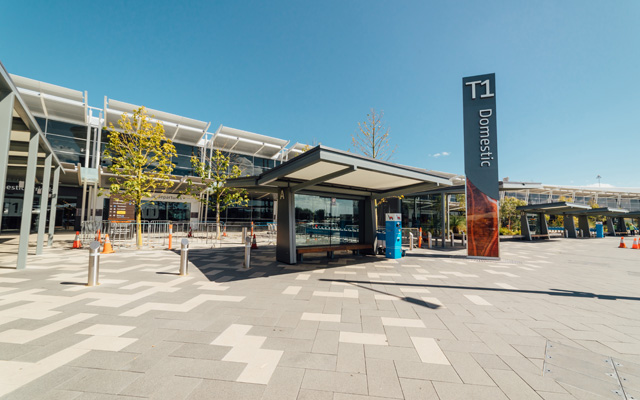
Western Australian premier Mark McGowan has extended his state’s hard border closure beyond February due to Omicron concerns.
McGowan, however, did not set a new date for reopening, stating only that it would be considered over the next month, reported news.com.au.
He explained that the delay in border reopening was in view of the large number of people in Western Australia (WA) who were not yet eligible for their boosters, which are key to fight Omicron.
The aim now for WA is to achieve a third booster vaccination rate of at least 80 or 90 per cent. Currently, around 90 per cent of locals have been double jabbed, and around 26 per cent of those 16 years old and above have received a third dose.
However, from February 5, travel exemption rules would be expanded on compassionate grounds, although individuals would still be required to undergo testing, and quarantine for 14 days upon arrival. They would also need to be triple-vaxxed.
Under the revised plan, travellers allowed to enter WA include returning WA residents with direct family connections in the state; those returning on compassionate grounds including for funerals, palliative care or terminally ill visitation; people seeking urgent and essential medical treatment, as well as commonwealth and state officials, members of parliament, and diplomats; among others.
There are now 79 active cases in WA, with 23 in hotel quarantine, 56 in self-quarantine and none in hospital.
CNY travel bookings lag, but last-minute surge possible
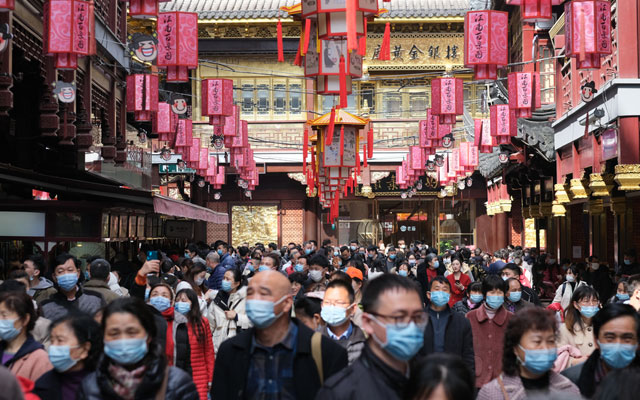
The recent lockdowns in China, imposed in response to Omicron outbreaks, have cast a long shadow over new year travel plans, according to new research from ForwardKeys.
The latest data, as of January 11, showed flight bookings for the upcoming holiday period, January 24 to February 13, were 75.3 per cent behind pre-pandemic levels but 5.9 per cent ahead of last year’s dismally low levels.
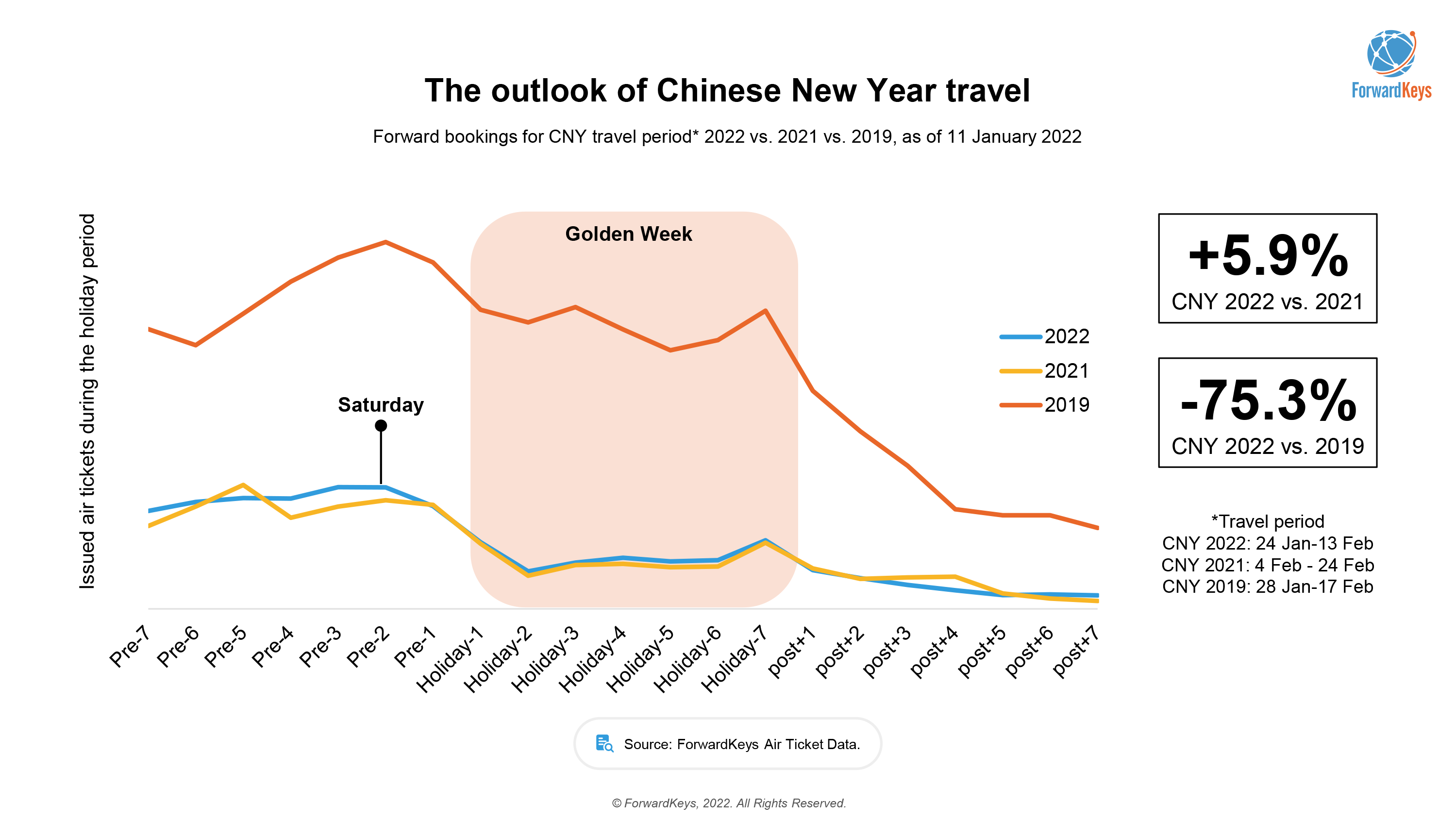
In addition to Omicron-related travel restrictions, government advice on new year travel has also been an influential factor in dampening demand, said ForwardKeys. However, it also noted that the travel advice issued by local authorities this year is “a little more lenient” as compared to last year. “That stance allows people the flexibility to wait and see how things develop and to make a last-minute decision to travel if they wish,” it said.
However, with a fortnight between the latest data and the beginning of the peak holiday period, ForwardKeys does not rule out a last-minute surge as “the lead time for flight bookings has shortened dramatically during the pandemic”. It noted that recently, around 60 per cent of bookings on Chinese domestic flights were made within only four days of departure.
The possibility of a last-minute spike, however, will depend on new outbreaks of the Omicron variant and how quickly they can be contained.
“This is because the pattern of domestic travel in China throughout the pandemic has been a tug-of-war between strong pent-up demand for travel and draconian restrictions to contain Covid-19, with travel bouncing back strongly as soon as travellers feel the risk of becoming stranded in an area of infection has receded,” it said.
Analysis of the most-booked destinations revealed that leisure travel is the light in what would otherwise be a gloomy outlook. Among the top 15, the most resilient destinations are Changchun, reaching 39 per cent of pre-pandemic levels; Sanya, 34 per cent; Shenyang, 32 per cent; Chengdu, 30 per cent; Haikou, 30 per cent; Chongqing, 29 per cent; Shanghai, 26 per cent; Wuhan, 24 per cent; Harbin, 24 per cent; and Nanjing, 20 per cent.
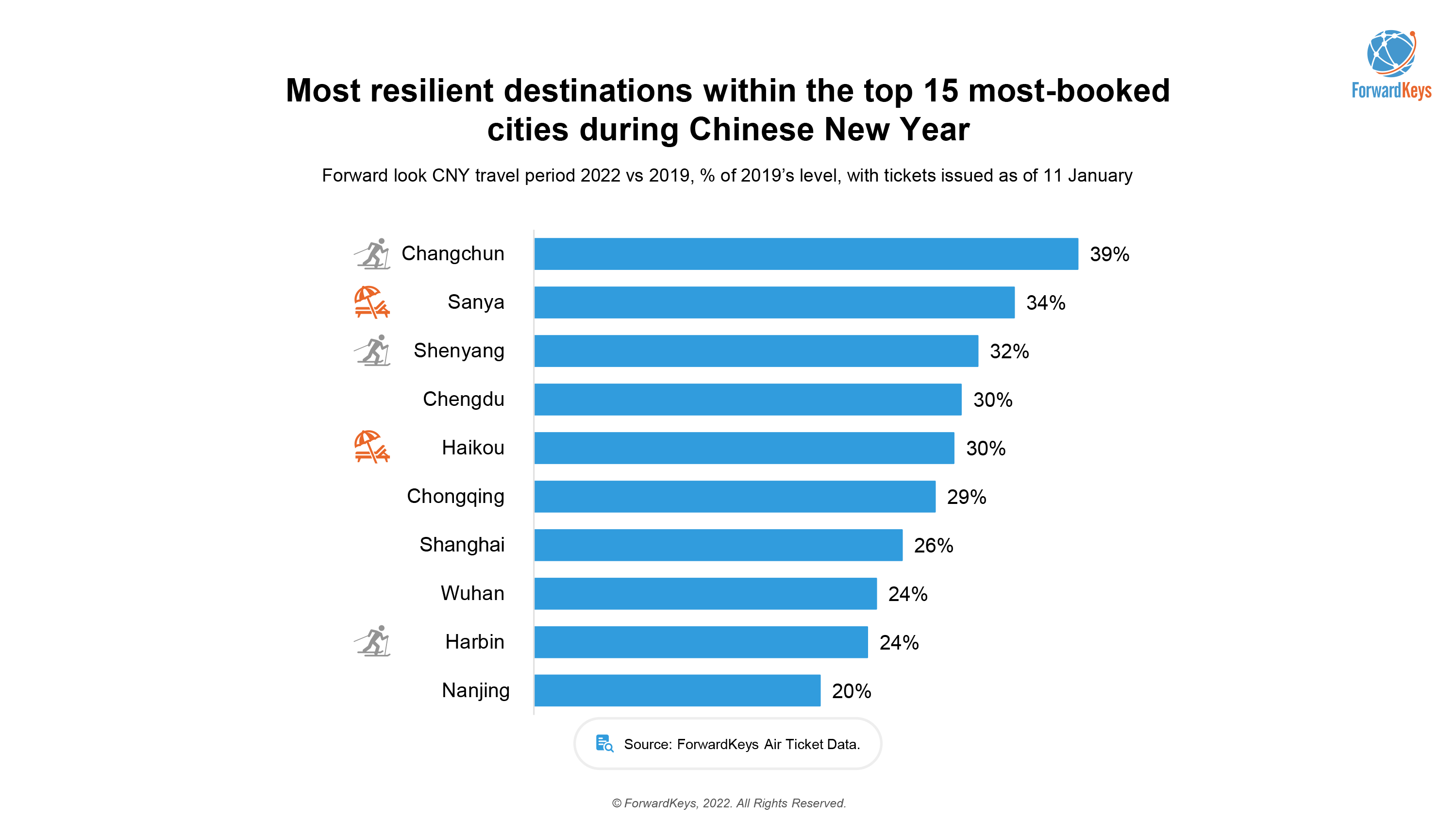
Of those, Changchun, Shenyang and Harbin contain numerous winter sports resorts; and it is notable that Harbin is still in the top 15 list even though it was affected by a Covid-19 outbreak as recently as December.
Sanya and Haikou, which are both located on Hainan, China’s holiday island in the South China Sea, have seen a consistent growth in popularity throughout the pandemic, fuelled by China’s ban on international travel and special tax treatment on the sale of luxury goods. According to Hainan’s commerce department, the number of duty-free shoppers grew by 73 per cent in 2021 and sales increased by 83 per cent.
The other destinations – Chengdu, Chongqing, Shanghai, Wuhan and Nanjing – are all popular for city sightseeing.
Bing Han Kee, vice president sales – APAC, at ForwardKeys, said: “I am not yet ready to give up hope of a last-minute recovery. The reason: throughout 2021, travel has bounced back strongly as soon as restrictions are lifted, with ever shorter lead times. I am also impressed by the strongly growing enthusiasm for winter sports, which I am sure has been encouraged by publicity surrounding the upcoming Winter Olympics in Beijing.”








PATA has formed a new preferred partnership with Flywire, a global payments enablement and software company with significant experience in the travel industry.
According to PATA CEO Liz Ortiguera, the partnership with Flywire can assist its members in enhancing their international payment processes.
Flywire brings industry-leading expertise to the PATA community to solve today’s complex travel payments and reconciliation challenges. Their focus travel segments include DMCs, travel operators as well as accommodation providers.
PATA members could benefit from expanded payment options for their guests and customers, timely receipt of payments in full, as well as digitised invoicing, automated payment tracking and reconciliation.
“Payment experience actually impacts a customer’s choice of travel agent or tour operator, and it’s not hard to understand why. Nearly half of travellers have experienced problems travelling because of payment issues,” said Colin Smyth, vice president and general manager of Travel at Flywire.
“Collecting and processing payments in multiple currencies and payment types is quickly becoming an integral part of (the) guest experience.”
Flywire can be used as a standalone product, and also integrates seamlessly with existing booking systems providing a one-stop shop for payment through receipt to reconciliation.