

TTG Asia online news bulletin will take a break for the Vesak Day public holiday on Monday, May 16.
News will resume on May 17.
 Here’s wishing all our Buddhist readers a happy Vesak Day!
TTG Asia online news bulletin will take a break for the Vesak Day public holiday on Monday, May 16.
News will resume on May 17.
Here’s wishing all our Buddhist readers a happy Vesak Day!
China’s pivot to domestic travel in the last two years provided a lifeline as her borders closed and outbound tourism dried up, but the country’s zero-Covid strategy is crushing the industry grappling with the sudden lockdown of cities and scant government support.
Still, all is not lost as industry players see opportunities even if 2022 is likely to be a write-off.
Domestic tourism’s poster child status, however, has not been without obstacles; there have been restrictions on advertising tours, airlines having to adhere to Covid-19 rules and cancel flights, and tours being stopped on short notice as was the case for the May Day holiday and the outbreak in the capital.
At press time, Shanghai was still in lockdown, Beijing was undergoing mass testing and infections were detected in Guangzhou.
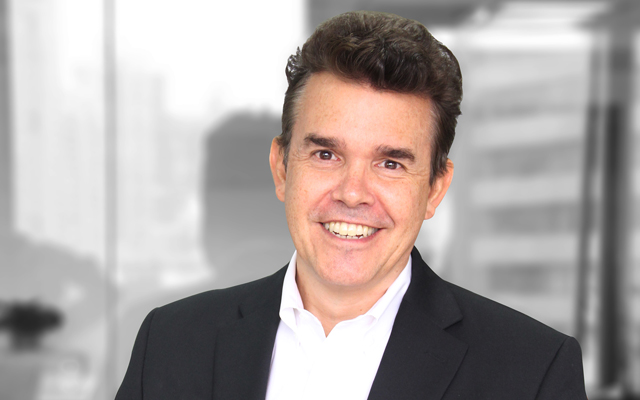
Kin Qin, deputy general manager of 25-year-old Century Holiday International Travel Group, remains positive even though 2022 is turning out to the most challenging since the start of the pandemic.
Qin, who joined the company after graduating from hospitality industry studies some 16 years ago, is determined to stay despite the setbacks; most travel businesses have had to cut headcount, fend for themselves, and scour for opportunities to stay afloat.
For Century Holiday, the opening up of countries in South-east Asia, where it has offices in Singapore, Malaysia and Bali, is a welcome development as it can start bringing European and North American tourists back to the region.
According to the director of a boutique travel agency that specialises in tailor-made China programmes for the Western market, in particular North America, the short- and medium-term is “not promising”.
The Shanghai-based director told TTG Asia: “People in China support the zero-Covid policy. SMEs will have to wait it out, be creative and innovative.”
The agency, which has offices in Shanghai and Beijing, was tapping the expatriate market and Western-educated returnee Chinese in the last two years.
The director continued: “Domestic travel is now totally impossible. April-May is peak period and business is down 90 per cent compared to last year. Even if people can travel, they are not willing.”
Although the last few years have been “unpredictable and stressful”, he is hopeful the industry will improve by the end of 2022, but remains concerned that when business is back to normal, China could be facing a lack of “skilled tourism people” who left to join other industries or moved back to their hometowns for cheaper cost of living, and may not return.
When asked about the impact of China’s zero-Covid policy on outbound travel, a veteran overseas industry observer, commented: “With the change to vaccinate older folks and using mRNA boosters for everybody from January 2022 to fight the new Omicron variant, outbound travel could start again from now.
“But as long as China keeps to a zero-Covid strategy, no outbound tourism is possible. Most host destinations will not open their borders even if China would allow Chinese to travel abroad.”
He said neighbouring destinations like South-east Asia and Nepal have been impacted, but Hong Kong suffered the most, while Macau enjoyed a windfall being the only destination which could be visited with no quarantine upon returning to China.
The industry observer continued: “As I see it, the pandemic has to be brought under control and economic growth restarted before China’s borders will open.
“With the rest of the world having brought Covid-19 infections down – to AIDS virus infection levels – there will be no fear to travel abroad and the industry could see a big China outbound wave either from October 2022, optimistically, or from Chinese New Year 2023, which is more likely.”
The industry observer advised: “Prepare now for the new demand and expectations of Chinese visitors in post-pandemic times. Embark on internal marketing in targeted destinations so that host communities are not afraid of Chinese visitors.
“To me, the Chinese government is missing a golden opportunity to help end the Russia-Ukraine conflict and develop a much improved image as peacemaker. Continuing to sit on the fence and appearing to be neutral is not helping to warm people’s heart.”
He said such an approach would make Chinese visitors less welcome overseas, while discourage foreigners from visiting China.
Shanghai-based Alexander Glos, CEO, China i2i Group, who has worked and lived in the financial centre for 12 years – and another five in Beijing – said his city’s political leaders have acknowledged it needs to fix the missteps, not usual in China.
Glos, too, fears China could lose a lot of talented people, as “everyone is figuring out what to do and where to go next”.
For Glos and i2i Group, which provides B2B and B2C tourism-related services to international and domestic clients, “China is not going away as household consumer spending is the fastest growing and it will be larger than the US by 2030″.
“China is a tremendous wealth generator not just for billionaire entreprenuers, but also for small businesses,” he pointed out.
“If you are a consumer company, the only place to be is China. That is not going to change. What has changed is demand for high-end international premium and luxury travel and shopping patterns have shifted domestically,” he said.
China has used travel as a “trading tool” and Glos sees the possibility of outbound travel, with a cap on numbers, to “safe” destinations suddenly opening up.
“It will happen by the end of this year – travel bubbles and corridors to countries that will benefit China politically and economically, and the flights will be sold out,” Glos projected.
According to him, demand in the first phase will be for high-end FIT trips to places like Singapore, Thailand, Malaysia, Bali in Indonesia and Cambodia.
So when China does open up and it will, industry players and stakeholders will have to move fast.
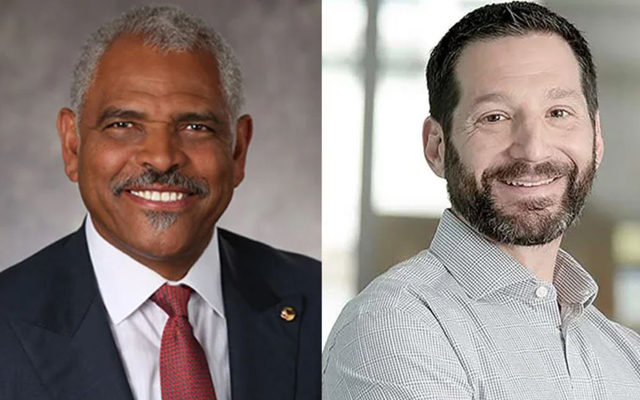
With effect from August 1, 2022, Josh Weinstein, the current chief operating officer, will assume the role of president and CEO of Carnival Corporation.
A 20-year veteran of Carnival Corporation, Weinstein has served in various senior-level roles. In his most recent post, Weinstein oversaw all major operational functions including global maritime, global ports and destinations, global sourcing, global IT and global auditing.
 During this time, Weinstein also oversaw Carnival UK, the operating company for P&O Cruises (UK) and Cunard, which he previously managed directly for three years as president.
Meanwhile, Arnold Donald, the current president and CEO of Carnival Corporation, will be appointed vice chair and member of the boards of directors. During his nine-year tenure as CEO, he led the company to record results (pre-pandemic), achieving the company’s highest profits in its history.
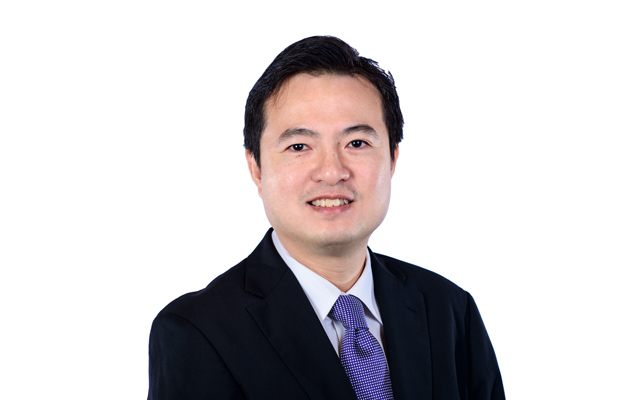
Singapore Airlines (SIA) announced Leslie Thng as the new CEO of Scoot, replacing Campbell Wilson effective June 16, 2022.
Currently the senior vice president sales and marketing, Thng has been with the SIA Group for 23 years. Prior to this role, Thng was CEO of Vistara, SIA’s Indian joint venture with Tata Sons, between October 2017 and December 2021.
 Thng has also served as chief commercial officer of Scoot from May 2016 to October 2017, and chief executive of SIA’s regional carrier SilkAir between August 2012 and May 2016.
Wilson was the founding CEO of Scoot between 2011 to 2016, in his first stint with the airline when it was a longhaul LCC, prior to its merger with Tigerair. Having joined SIA since 1996, Wilson has also run SIA’s overseas operations in Canada, Hong Kong, and Japan. He will join Air India as its new CEO.
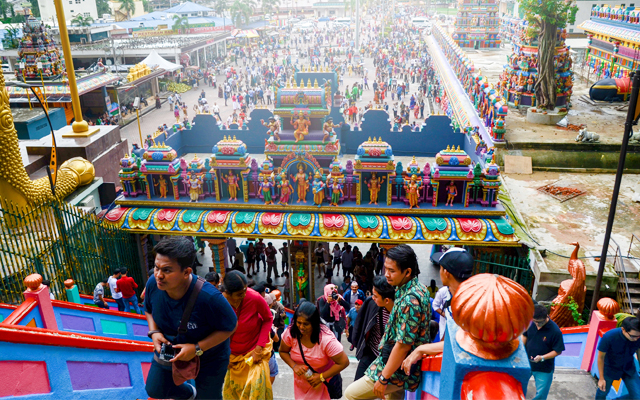
There is one thing on the mind of Tourism Malaysia and the country’s travel trade right now, and it is to rebuild the tourism industry that had suffered two tough years.
The Malaysian Association of Tour and Travel Agents (MATTA) is working closely with Tourism Malaysia on this critical task. The immediate plan after the reopening of the country’s borders on April 1 was to jointly organise a sales mission to India, from April 18 to 29 covering six cities, namely New Delhi, Mumbai, Ahmedabad, Hyderabad, Bengaluru and Chennai.
MATTA’s vice president inbound and domestic, Ganneesh Ramaa, told TTG Asia: “Our first physical sales mission (post-lockdown) was an important one, as the Indian market has traditionally been our second largest medium-haul market after China. We wish to make Malaysia the top-of-mind destination for Indian travellers and regain market share post pandemic; to rebuild the momentum and look forward to the Indian summer peak travel season from mid-May to the first week of June.”
Throughout the sales mission, Malaysia representatives highlighted the health and hygiene measures taken by hotels, food establishments, convention centres, as well as tours and transportation operators.
“As a member of Travel Safe Alliance Malaysia, MATTA’s operations has been certified by Bureau Veritas to meet stringent health and safety protocols, so (Indian partners) can be assured that their clients’ stay in Malaysia will be safe, pleasant and enjoyable,” said Ganneesh.
Besides India, Europe is also on the radar. Both agencies are working on marketing and sales strategies to attract more Europeans to Malaysia. This includes participating in B2B travel tradeshows such as IFTM Top Resa in Paris in September, The Luxury Travel Fair in London this November, and FITUR 2023 in Madrid.
Ganneesh revealed that MATTA was planning to go on sales missions to Eastern Europe this year, covering Hungary, Poland, Czech Republic and Romania.
“Our aim is to regain market share by showcasing our varied and diverse attractions, such as islands and beaches, gastronomy, culture and lifestyle. Attending the B2B travel shows and organising sales missions to Eastern Europe is an opportunity to enhance awareness of Malaysia’s diverse attractions, forge relationships with travel trade partners, and make Malaysia a top-of-mind destination.”
The Finance Ministry has allocated a special RM5 million (US$1.2 million) tourism fund for this year, channelled through the Ministry of Tourism, Arts and Culture with Tourism Malaysia appointed as executor.
The fund, named Gamelan Malaysia, is a matching grant that works on the basis of reimbursable financial assistance whereby eligible companies may claim 50 per cent of the actual cost of their promotional project, up to a ceiling of RM200,000.
Meanwhile, national carrier, Malaysia Airlines, aims to gradually increase its frequencies and network to achieve around 70 per cent of its pre-Covid 19 capacity by end of this year.
A source said the carrier is currently seeing higher demand from India, which is its signature route, as well as from the UK and Australia into Malaysia.
It has, so far, increased frequencies on its flagship Kuala Lumpur-London route to 11 times weekly, and will return to double daily services from July 1.
For 2022, Malaysia is targeting two million international tourists and total receipts exceeding RM6.8 billion.
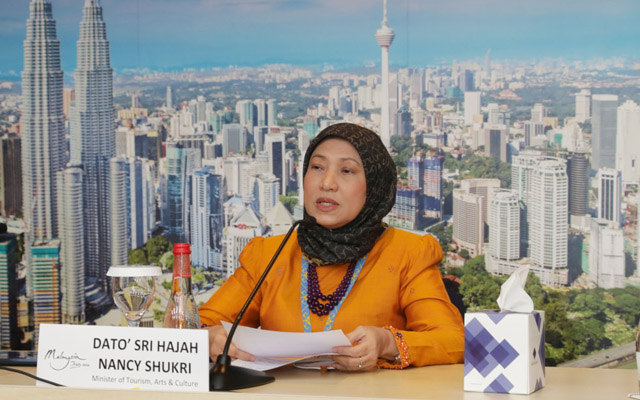
Malaysia is eyeing the Middle Eastern market and has launched a string of products to lure the younger generation.
At the Arabian Travel Market (ATM), Malaysian minister of tourism and arts, Nancy Shukri, said: “The last three years have given us plenty of time to think about what we want to do and this region is very important to us. We have come up with new itineraries and offerings to cater to this market.”
Pre-pandemic, in 2019, Malaysia welcomed 397,726 visitors from the Middle East and North Africa region – Saudi Arabia was the top source market with 121,444 tourists.
Nancy said traditionally Malaysia was a popular destination for families from the Gulf Cooperation Council, especially during the summer holidays, where they mainly visited the island of Langkawi. However, campaigns now are urging the region’s younger generation to explore other parts of the country.
She said: “We’re now trying to get tourists closer to our nature. It’s also time for us to promote more and entice a new target group – the younger generation. We have lots of exciting new offerings for them.”
In addition to promoting halal spas and accommodation, Tourism Malaysia is developing a series of cross-country motorhome and caravan tours. A series of glamping activities are also being rolled out, such as staying amid Malaysia’s orchards which bloom during the summer months.
To help stimulate arrivals from the region, Tourism Malaysia plans to lure more airlines from the Middle East to its airports this year. During ATM, Tourism Malaysia signed a Memorandum of Collaboration (MoC) with Emirates to promote tourism and boost traffic to Malaysia from key markets across the airline’s network.
Emirates also plans to organise familiarisation trips with major tourism and media to come and experience Malaysia.
Adnan Kazim, Emirates’ chief commercial officer, said: “The MoC builds on the successful relationship we have with Malaysia, and underscores its significance as a key market in Emirates’ global network.”
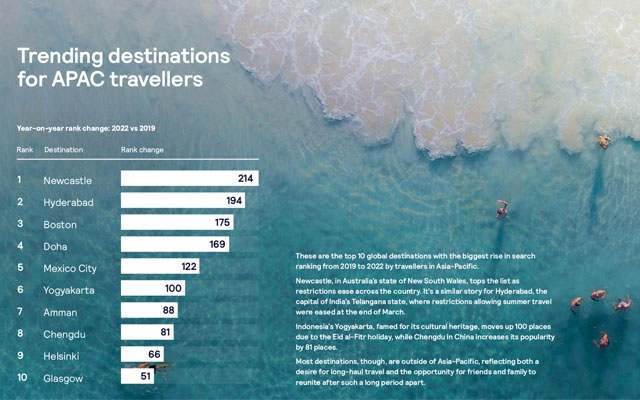
Skyscanner’s new report explored the latest trends in global travel, and combined consumer polling with extensive flight search and booking data from each region – APAC, the Americas and EMEA – to provide a comprehensive view of 2022 travel demand.
Unique and in-depth analysis of key indicators such as travel spend, booking horizons, haul type, trip length, trending destinations and how they compare to pre-pandemic provides unrivalled insights for the sector.
The report also featured expert commentary on these trends shaping recovery from industry thought leaders such as Hugh Aitken, Skyscanner VP of flights; Nick Hall, CEO of Digital Tourism Think Tank; Marco Navarria, global content and marketing director, CAPA; and John Strickland, director of JLS Consulting.
Key APAC findings showed the following: a longer booking horizons surge in Q1, specifically segments 90+ days, 60 to 89 days, and 30 to 59 days; Q1 2022 domestic travel significantly higher than in 2019 – both long haul and short haul seeing strong growth over the quarter following rising demand after the ease of travel restrictions in many APAC countries; and longer trip lengths peak in July and December (trips of two weeks to a month and longer than a month).
As restrictions ease across the region, travellers are searching for trending destinations such as Newcastle in Australia, Hyderabad in India, and Boston in the US. With a clear demand for domestic and short-haul travel, airlines are relaunching pre-pandemic routes and announcing new destinations.
Aitken commented: “Despite challenging headwinds, the aviation industry continues to prove its resilience, driven by considerable traveller demand across all regions.
“Our latest report crunches three months of data to provide unrivalled insight into the latest traveller behaviours and patterns – and how they compare to pre-pandemic. We’re seeing positive signals that seasonality is returning in both booking horizons and trip lengths, providing a degree of certainty going forward.”
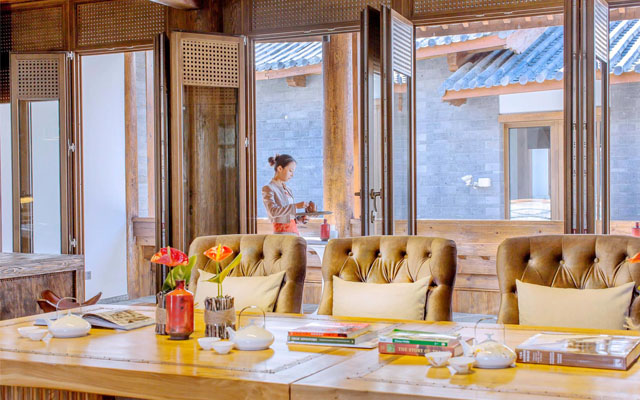
Having expanded its offerings to China in 2014, the Mauritius-born luxury hotel management brand, The Lux Collective, is furthering its ambitious Asia growth with more properties to come this year.
Once China reopens her borders, the brand plans to launch the Lux Tea Horse Road journey. With sponsorship by Audi, visitors can embark on a four- to 10-night experience that takes in all of the hotels, which sit between six and 30 keys.
Julian Hagger, executive vice president, told TTG Asia at the Arabian Travel Market: “This is a totally unique product that explores some of the most beautiful and secluded parts of Yunnan and makes us one of the largest operators in the province.”
In addition, the collective is developing a Lux property in Phu Quoc, Vietnam. Slated to open at the end of 2023 in the north of the island, the 120-key exclusive project will be built entirely over water – the first-of-its-kind overwater luxury resort in Phu Quoc.
Hagger said: “This will bring Lux to South-east Asia and really cement us regionally. We’d love to expand further.”
He noted that having saturated the Indian Ocean, Asia is a “natural progression”; and with borders across the region starting to open, further development is on the horizon.
“It hasn’t been easy in the last two years as Asia has been under door lock. However, we’ve got our eyes wide open on the whole of South-east Asia and want more presence there. The Lux brand is very powerful and we feel it’s perfect for Asia.”
Prior to the pandemic, the collective had launched the award-winning brand, SALT Resorts, in Mauritius, to which Hagger shared: “This screams for expansion in Asia. I can see it in Laos, Myanmar and Cambodia; destinations with very strong unique local cultural experiences.”
He added that the collective is currently seeking partners and investors for expansion.
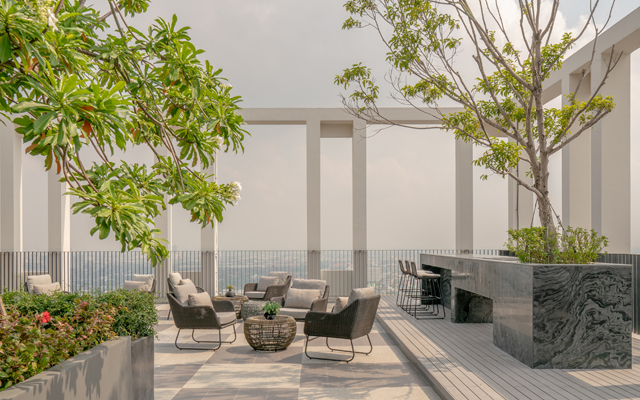
Ramada by Wyndham Bangkok Sukhumvit 87, Thailand
Located in the heart of Sukhumvit, Ramada by Wyndham Bangkok Sukhumvit 87 offers 200 rooms and suites, a stunning rooftop garden bar, an outdoor swimming pool, and views over the Chao Phraya river.
For dining, there is an onsite restaurant serving continental breakfast and favourite Italian dishes for lunch and dinner.
The hotel is within walking distance from Century Plaza mall, as well as the BTS Skytrain On Nut station, allowing guests to easily connect to the rest of the bustling city, including the nearby Klaynamthai and Bangna Hospitals.

voco Melbourne Central, Australia
The 252-room voco Melbourne Central, part of the new 380 Melbourne skyscraper, appeals to sustainability-focused travellers. Environment awareness runs throughout the guest experience from the use of bedding made from recycled materials, inclusion of locally sourced ingredients on the menu, and application of a lighting system that responds to the natural cycle of light.
voco’s Blacksmith Brasserie offers à la carte dining where guests can have a breakfast made to order, or enjoy a full buffet.
Located at the hotel’s doorstep are popular retail hubs including Emporium, Bourke Street Mall and Melbourne Central.

AC Hotel Seoul Gangnam, South Korea
AC Hotel Seoul Gangnam features 274 guestrooms and one-of-a-kind private pool suites.
The hotel’s facilities include an all-day dining restaurant, lounge, gym, sauna, kids lounge, and rooftop terrace and bar.
Boasting a great location in the Yeoksam-dong area of Gangnam district, home to upscale shopping, dining and entertainment venues, AC Hotel Seoul Gangnam also puts business travellers close to the corporate headquarters of multinational companies. It is 60 minutes by car from Incheon International Airport.







The events calendar that we aspire for the participation or enjoyment of local sports fans are a natural draw for tourism as well. We thus work closely with the Singapore Tourism Board to not only curate the events portfolio, but also the fringe activities that provide a total experience in and around the venue. Singapore’s vibrancy and energy promises that there will never be a dull moment!
Singaporeans, like tourists, attend sport events that they believe will provide them a not-to-be-missed opportunity to see the stars and enjoy good quality sporting action. At SportSG, we seek to create such opportunities through a range of mass participation to world-class spectator events.
For example, we work with our partner Ironman Asia to enhance the Standard Chartered Singapore Marathon (SCSM) race experience from year to year. That includes a great race expo, improved routes and atmosphere, inspiring elite participation, and engaging workshops. This has not only made it a must-attend event for runners in Singapore, but has also attracted growing international participation with each edition.
The pandemic did not see the SCSM come to a standstill. The races incorporated virtual and augmented reality components for the first time in 2020, and again in 2021, even when physical participation was reintroduced.
Through the SCSM’s Virtual Running Club, overseas runners could choose from a selection of virtual routes that took them through iconic sights of Singapore, such as Little India and Orchard Road, as they ran the race. Local runners were also able to participate at several SportSG sport centres that set up a network of official race treadmills.
In the same spirit, SportSG continued to work with event promoters and rights holders through the last two years to stage events in Singapore, notwithstanding the tough Covid restrictions on movement and travel. It has given our partners the confidence and assurance that we are committed to supporting the industry, that we have the capabilities and ability to adapt to and be agile under prevailing circumstances, and that we are emerging with a strong innovation mindset.
SportSG also capitalised on the downturn caused by the pandemic by offering a generous Innovation Grant to support the deployment of technology solutions for hybrid events, fan engagements, and more. The focus on engaging event experiences continues unabated as we emerge from the pandemic.
Finally, it is important to highlight that SportSG continues to be on the lookout for marquee events that have the potential to engage new fans, new athletes, and new commercial opportunities. One recent example is our bid for the World Athletics Championships 2025. Singapore25 represents a unique opportunity to host one of the world’s most prestigious sporting events and advance the sport of athletics into an untapped region. The legacy for participation here and the sport industry is expected to be very significant.
These are all major sporting events. Is SportSG also positioning Singapore as a desirable hub for smaller, local and regional events?
Local and regional events are important to Singapore’s sport development, giving our athletes opportunities to build competitive experience. They also give spectators a variety of platforms to support and cheer on Team Singapore on home ground. This is complemented by a comprehensive calendar of local leagues and competitions that focus on pathway development and recreational sport. They are an integral part of the formula in keeping Singaporeans participating, competing, and cheering.
The pandemic had set back many of these events. So, at the earliest opportunity in December 2020, we worked on a pilot to bring spectators back to the Singapore Premier League matches, learning and calibrating from the experience.
Since taking that first step, regional events have made a strong comeback. Between December 2021 and March 2022, Singapore hosted the AFF Suzuki Cup in December 2021, SEA Pencak Silat Championships in February 2022, and FAS Tri-Nations Series in March 2022. While Covid restrictions were still in place, we also encouraged modified leagues and competitions for our youth to fuel their interests.
Is SportSG also looking at attracting global sporting associations to be located or headquartered in Singapore, to encourage even more sports-related events and meetings to be hosted here? What progress is SportSG making in this effort?
The presence of global sporting associations in Singapore is a welcomed addition to the sporting ecosystem. Their activities would include international meetings and conferences, sport events, and sport development programmes. These benefit local administrators, officials, coaches and athletes; and in many instances open up employment opportunities that would upskill the local workforce, and position Singapore well as a regional hub.
Singaporeans who aspire to work abroad in the global sport ecosystem would then also find that the referrals and experience gained here would give them a leg up.
Given our stage of development as a regional sport hub, SportSG is in discussions with several parties on the prospects and opportunities to partner and collaborate on these fronts.
Is SportSG encouraging or facilitating the development of more sports facilities across Singapore that will cater to future sports events demand and possibilities? Or is the massive Singapore Sports Hub enough at this point?
The objectives behind sport facilities development in Singapore go beyond the facilitation of events. Like a balanced portfolio of sporting events, well-designed facilities are essential to cater to the wide range of sporting interests and to provide access and opportunity to a lifetime participation in sport.
The Sports Facilities Master Plan (SFMP) is a key foundation of our Vision 2030 sport master plan. The four tiers in the portfolio of facilities range from international competition-grade venues to free-to-play neighbourhood sport parks. In particular, the five regional sport hubs will complement the Singapore Sports Hub when hosting major games. These regional hubs and various other specialised facilities will also cater to the needs of national training centres for Team Singapore.
A key tenet of the SFMP is to match urban planning parameters for housing development and land-use optimisation. The latter includes opening all school sport facilities for community use on the weekends.