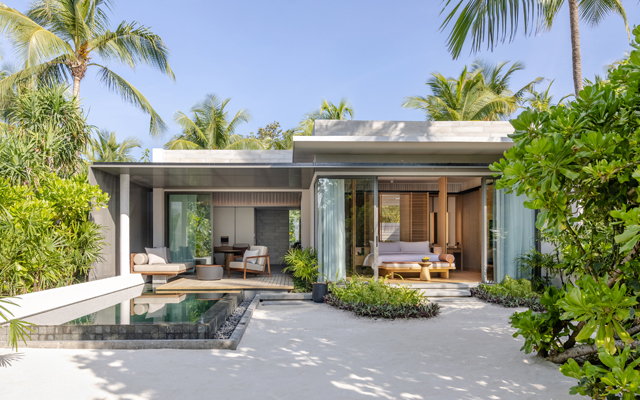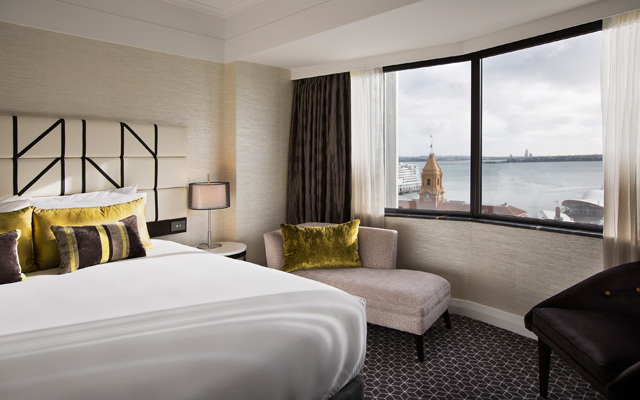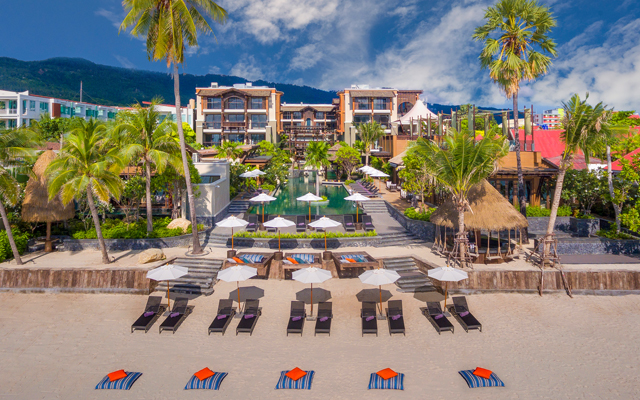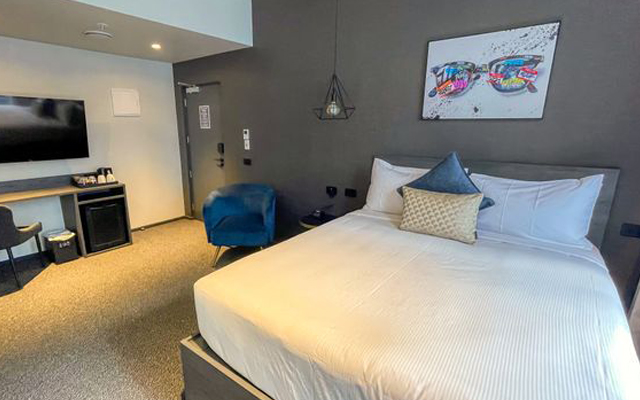
Marriott International expects to open nearly 100 properties in Asia Pacific this year, with the greater aim of opening its 1,000th property in the region by late 2022.
With leisure demand expected to outpace business travel, Marriott will be strengthening its presence in several leisure destinations such as Jeju with the opening of JW Marriott Jeju Resort & Spa in May 2022, while W Sydney is expected to open in late 2022.
A rendering of a Ritz-Carlton Reserve that will open in China’s Jiuzhaigou this year
With wellness and well-being another key traveller trend, the company’s wellness brand, Westin Hotels & Resorts, is expected to celebrate two new debuts in Yokohama and Cam Ranh in 2022.
Meanwhile, luxury demand will boom in Greater China, a key market for the company’s growth, accounting for more than half of the company’s luxury openings in Asia-Pacific this year. Ritz-Carlton Reserve will be debuting its first rare estate in Jiuzhaigou valley, while other slated luxury openings include JW Marriott Hotel Changsha and W Macau – Studio City.
Also in Greater China, Four Points by Sheraton expects to continue its growth with five openings this year, while Moxy Hotels anticipates making landfall Suzhou and Xi’an.
Outside of Greater China, the company expects to debut its AC Hotels brand in South Korea with AC Hotel Seoul Gangnam, and in Australia with AC Hotel Melbourne Southbank. In Japan, Fairfield by Marriott has six new properties in locations such as Nara, Hokkaido and Hyogo, in the pieline.
Hong Kong leader Carrie Lam’s reiteration of the region’s adherence to a “dynamic zero” regime on February 8 has intensified worries for local tourism players, who have had their business disrupted once more by Omicron infections since January 7.
All local tourism activities, such as Hong Kong Tourism Board’s Spend-to-Redeem Local Tours programme as well as cruises to nowhere, have been suspended.
Continued Covid restrictions in Hong Kong are hampering hospitality recovery
Holiday World Tours, managing director, Paul Leung, told TTG Asia that business had started to pick up in late-2021, thanks to the return of cruises. “Now, everything is halted. We are not sure what the future holds. Perhaps nothing will materialise before June,” Leung lamented.
While there is the Come2HK travel scheme that allows quarantine-free entry for non-Hong Kong residents coming from China’s Guangdong province or Macao, Leung said Hong Kong travel agents have benefited very little from it.
The situation would continue to be tough for tourism and MICE players well into 2023, even if all barriers were lifted tomorrow, opined Destination China, general manager and owner, Gunther Homerlein.
He said: “It is the perfect storm of all bad press Hong Kong received prior to Covid – during the political strife – and during the pandemic. Hong Kong has not yet had a chance to reposition herself.”
Arrivals to Hong Kong went from 55,912,609 in 2019, when the destination experienced social unrest, to 3.57 million and 91,000 in 2020 and 2021 respectively.
Homerlein said local tour operators might have made some money, “but most of us who specialise in international business had little or nothing”.
“There is noting that has been done by the government or Hong Kong Tourism Board to help, support or give the industry hope,” he remarked.
Referencing the SingapoRediscovers voucher programme by the Singapore government and the Singapore Tourism Board, Homerlein said: “It was a well directed and managed programme that allowed the industry not only to thrive, but survive. It also encouraged the development of a lot of very good new products.”
Among hotels, Hong Kong’s stance on Omicron has resulted in banquet business losses. Dine-in services after 18.00 have been banned since mid-January.
A spokesperson with Hyatt Centric Victoria Harbour Hong Kong said the property has responded with a relaunch of its Dinner Box Buffet and In-room Safe Buffet, both of which have been popular with guests. These will remain available until March 4.
For now, Hong Kong’s SME agencies will continue to receive financial aid from the government. The fifth round of the Anti-epidemic Fund, announced on January 14, commits about HK$3.6 billion (US$470.9 million) to supporting initiatives such as the Green Lifestyle Local Tour Incentive Scheme and payouts to eligible tour service coach drivers, travel agency staff and licensed agents.
The sixth round of subsidy, confirmed by chief executive Lam on February 8, will amount to HK$26 billion.
As the Philippines reopens her borders tomorrow to fully-vaccinated tourists from non-visa required countries, tourism leaders expect arrivals to be gradual and anticipate hitches with possible solutions built into reopening guidelines.
Indicative figures from Philippine Airlines (PAL) showed that inbound demand is still led by returning overseas Filipino workers (OFWs), OFWs leaving for abroad, and a considerable number of Filipinos residing abroad (balikbayans) visiting with their spouses and children.
Inbound demand is expected to return gradually, with possible hiccups in reopening procedures, say industry stakeholders; Coron, Philippines pictured
The flag carrier has started flying to 23 international and 28 domestic destinations, with the total daily flights just 40 per cent of the 300 daily flights pre-pandemic, said PAL spokesperson Cielo Villaluna at a virtual forum, Kapihan sa Manila Bay, on February 9.
Tourism Congress of the Philippines president, Jojo Clemente, said his organisation is taking a “conservative approach” in the “gradual restart” of foreign arrivals. A big influx is not expected until towards the end of the year.
Clemente added that inbound interests are coming more from longhaul markets like Europe “since they are a bit more liberal in travel restrictions” compared to Asia, which has the “toughest set of protocols for inbound and outbound”. Preferred destinations are the major ones: Boracay, Palawan, Cebu and Bohol.
Since mandatory quarantine is no longer required for fully-vaccinated foreign tourists and Filipinos coming from abroad, 76 quarantine hotels in Metro Manila have already applied to convert into regular hotels – more are expected to follow suit – and 14 of them have been approved, revealed tourism secretary Bernadette Romulo-Puyat.
Former tourism undersecretary Benito Bengzon Jr, now executive director of 303-member Philippine Hotel Owners Association (PHOA), is asking for financial lifeline for many of its hotels recording a single-digit occupancy and reduced revenue stream as quarantine guests have halted.
“What we would like is some kind of financial assistance coming from the government to help tide us over the next six to 12 months, which we see will be difficult,” Bengzon said.
It is understood that the government has not given hotels the stimulus package that they have been asking for during the pandemic.
Romulo-Puyat said the tourism authority is pushing for the “healthy rebound of tourism,” noting that the country has “moved past the worrying wave” with the Omicron variant under control and high vaccination rate of tourism workers.
Ready for the hitches and challenges that may crop up during the tourism restart, Romulo-Puyat said: “We are ready as we can be with health and safety protocols, rafted as early as May 2020 and implemented in June 2020. These protocols will continue to be changed according to the need of the times.”
As to the lack of unified travel protocols among destinations, Romulo-Puyat said that since it is the destinations’ local government units (LGUs) who are lobbying for foreigners to be allowed entry, “I would like to think that….they will make it easier for foreigners to come to the country and make it as easy as possible”.
A hot spring town in rural Japan is eyeing an uptick in eco-tourism due to the success of environmental initiatives to re-wild a rare breed of oriental white stork.
Kinosaki in Toyooka City, Hyogo Prefecture, has restored its population of oriental white stork since work to save the endangered species started in the 1960s. Then, oriental white storks were only present in a handful of regions including Toyooka. Today, about 140 of the birds fly in the skies above Toyooka and live in the city’s organic rice paddies, wetlands and biotopes.
Kinosaki has built a variety of stork-related tours for travellers keen on nature, wildlife and the environment
Efforts to revive the oriental white stork population have increased the diversity and number of many other species in Toyooka, giving the city a further boost as a green destination. The city is now home to 280 bird species as well as hundreds of kinds of other wildlife. The city supports 45 per cent of the total 633 species found in Japan.
Along the way, Kinosaki has developed a raft of stork-related tours, facilities and souvenirs. With the opening up of travel in 2022, the town, near Kyoto, hopes to attract visitors who are interested in nature, wildlife and the environment or who simply want to spend time in an environmentally friendly and sustainable destination.
A five-hour tour of the Toshima Hachigoro Wetlands, which was launched in late 2019, aims to introduce revived habitats and the diverse wildlife they support such as insects, fish, frogs and snakes. Visitors can travel through lush wetlands, including rice paddies converted into wetland, which have been registered under the Ramsar Convention. Guides will point out the wildlife and efforts by local stakeholders to create an optimal environment for the storks. These efforts include developing shallows along riverbeds, transforming unused rice fields into biotopes and fostering corridors to connect key wetlands for the birds’ easy movement. Following a viewing of agricultural sites, visitors are served a lunch featuring organic vegetables and Stork Natural Rice, a local brand grown without chemicals.
The tour will be held in full for the first time from April 1 to November 30, 2022. It is aimed at the FIT, group tour and corporate markets, including incentive travel and teambuilding segments. It is expected to generate awareness of Toyooka as a destination for bird lovers and environmentally conscious travellers, as well as draw greater numbers of visitors to Toyooka’s other wildlife-related tourism offerings.
Jade Nunez, coordinator of international relations at Toyooka Tourism Innovation, said by the end of March 2019, five million people had visited the city’s Stork Museum since its opening in 2006, the year after the storks were released back into the wild by members of the Imperial Family in a prestigious ceremony. A Stork Tourism Guide has also been produced to offer information, advice and tips for visitors to make the most of their stay.
With the rise in popularity of outdoor and off-the-beaten track tourism offerings due to demand for social distancing, and growing awareness in Japan of the need to support activities that contribute to the United Nations’ Sustainable Development Goals, Toyooka’s tourism stakeholders are poised for rapid growth. Their hopes have been buoyed by the city’s listing in the 2021 Top 100 Destination Sustainability Stories, a global initiative by the Netherlands-based organisation Green Destinations.
“This recognition is definitely helping us to raise awareness of Kinosaki as an eco-tourism destination,” said Nunez.
Queen Anne has joined the Cunard fleet, with sales for its maiden season in 2024 opening this May.
Queen Anne is the first new Cunard ship in 12 years, joining Queen Mary 2, Queen Victoria and Queen Elizabeth to make up the cruise company’s quartet of ships honouring the names of each Queen Regnant – queens who reign by right of birth – over the last millennium.
Setting sail in 2024, Queen Anne will offer new guests experiences in luxurious settings
Queen Anne will feature reimagined Cunard signature spaces as well as new guest experiences within dining, culture and entertainment. A team of world renowned designers will present an extraordinary and thoughtful standard-setting design through bold colour tones and striking aesthetic that also maintains Cunard’s timeless sophistication.
Carnival UK president, Sture Myrmell, said: “This marks a very special moment in Cunard’s 182-year history and showcases Cunard’s exciting global plans for the future, allowing even more guests around the world to set sail with Cunard. With design inspired by the past and set for the future, Queen Anne is the perfect way for our guests to rediscover the joy of exploration and travel again. We look forward to sharing more details in the coming weeks and months.”
Cunard is a part of Carnival Corporation, which also operates Carnival Cruise Line, Princess Cruises and Costa Cruises, among others.
The National Recovery Council (NRC) has once again put forth a recommended reopening of Malaysian borders to all vaccinated travellers without the need for mandatory quarantine, this time as early as March 1.
The NRC had in November 2021 recommended that the country’s borders be reopened to international travellers on January 1, 2022, but this was postponed indefinitely due to the emergence of the Omicron variant.
National Recovery Council seeks the Malaysian government’s approval for a border reopening as early as March 1
Its chairman, Muhyiddin Yassin, told a press conference on February 8 that travellers intending to enter the country must undergo Covid-19 testing prior to departure and upon arrival in Malaysia. He said the reopening of the border would support the country’s economic recovery, the tourism industry and related industries.
Health minister, Khairy Jamaluddin, who was also present at the press conference, said the Health Ministry will announce further pre-emptive Covid-19 measures, conditions and standard operating procedures (SOPs) such as pre-departure Covid-19 PCR test and others should the government agree with the NRC’s recommendation for the reopening of the border next month.
Responding to the NRC’s recommendation for the reopening of the borders next month, the Malaysian Association of Tour and Travel Agents (MATTA) president, KL Tan, said: “This is definitely a positive step moving forward, taking into consideration our nation’s move towards the endemic phase (of Covid-19), our high vaccination rates and the capability of our public health infrastructure in managing this health crisis.
“As proven the world over, the containment of Covid-19 goes beyond lockdowns, movement control orders and extreme mobility restrictions. A holistic approach taking into consideration economic activities for the well-being of the people must now be a priority.
“MATTA had earlier urged the government to revamp its current policies, and its overly-cautious quarantine rules and testing procedures which should be based on mortality rates and the category of infection levels. Repeating the same approach since 23 months ago and expecting progress is simply not producing good results.”
Malaysian Association of Hotels CEO, Yap Lip Seng, said “a forward blueprint on the reopening plans” is needed next to enable the tourism industry to strategise and “market Malaysia as a choice destination”.
It is also imperative for Malaysia to take into account the best practices of other countries which have reopened their borders so that Malaysia remains an attractive destination for tourists, opined Malaysian Association of Hotel Owners executive director, Shaharuddin M Saaid.
He said: “We have to minimise the inconvenience for tourists while at the same time, ensuring good enforcement and compliance of SOPs.”
Pan Pacific Singapore will debut its first-ever children-focused offerings on February 18, comprising a children’s play area, two themed family suites, and a host of kids’ programmes.
The hotel’s family-friendly initiatives follow a storyline of eight curious jungle friends lost their way while in search of Marina Bay, an urban jungle with various iconic sights. Young guests are tasked to ‘find’ these jungle friends.
Young guests get a jungle-themed sleeping quarters as well as many other recreational options
The Urban Jungle Village indoor play area, located on level four of the hotel and overlooking the pool, offers seven activity zones – Jungle Village, Fishing on the Tree, Interactive Games Station, Safari Trail, Forest Library, Explorer Den, and Cave Climber – all of which integrate thinking, learning and playing.
This facility is open to hotel guests only from 10.00 to 18.00 daily.
Pan Pacific Singapore has also created two 79m2 Urban Jungle Suites in partnership with Kiztopia – Singapore’s largest indoor playground located next door in Marina Square mall – on the higher floors of the hotel. The suite features separate sleeping zones for parents in the main bedroom; and for little ones, a jungle-themed room with an inflatable rocking hippo, a teepee and a treehouse bunk bed that sleeps two. Young guests are gifted an Urban Jungle Survival Pack, filled with bath toys and more.
Urban Jungle Suite guests enjoy daily breakfast at Edge restaurant as well as Pacific Club privileges.
The Urban Jungle Adventure Package is priced from at S$820 (US$610) per night for two adults and two children, and includes private access to the Urban Jungle pool cabana with Kiztopia floats and tickets to Kiztopia.
Grand Copthorne Waterfront Hotel has partnered with Very Small Exhibition, an experimental art collective, to install special light art – as part of the Very Momentary Exhibition Series.
Titled River of Life, this light installation will run nightly from now until February 14, and can be seen from the river from 20.00 to 06.00. Led by local artist Lee Wei Lieh, this is Very Small Exhibition’s first such installation created in collaboration with a hotel.
There will also be an outdoor pop-up venue by the river, which will serve a special snack menu.
The seven-day Spring Festival Golden Week from January 31 to February 6 has brought Macau 113,600 inbound tourists, a year-on-year increase of 25.4 per cent.
Mainland Chinese tourists made up the bulk of arrivals, up 29 per cent year-on-year.
Macau’s vibrant Chinese New Year events attracted 113,600 foreign arrivals in 2022, up 25.4 per cent YOY
Hotel occupancy rate rose 15.2 per cent for the festive period to stand at 63.8 per cent.
According to the Macao Government Tourism Office, the Chinese New Year travel peak season benefited from easing entry measures at the Zhuhai-Macao port that came just in time for the extended holidays, as well as a hive of festive events for the public.
Quarantine measures at the Zhuhai-Macao port were earlier tightened for a period in view of growing Covid infections in the neighbouring areas.
The destination rang in the Year of the Tiger with a parade and fireworks displays on February 3, with a second float parade scheduled for February 12. The 14 decorated floats will also be on display at the seafront next to the Macao Science Center from February 4 to 11, and at Tap Seac Square from February 13 to 20, accessible for free.
A second fireworks show was conducted on February 7, and a third will come on February 15.
Speaking at the parade’s opening ceremony on February 3, secretary for economy and finance, Lei Wai Nong, said the safe execution of the event was especially meaningful to Macau in her branding campaign as a safe and quality destination.
With Australian borders set to reopen to all vaccinated visa holders from February 21, 2022, the NTO has turned its marketing focus towards Singapore residents – one of the destination’s largest inbound markets pre-pandemic, with a A$4 million (US$2.8 million) Yours to Explore campaign.
The campaign will be rolled out both online and offline, and complemented with other marketing activities to promote tours, self-drive packages and other offers in partnership with distribution partners such as Chan Brothers, UOB Travel and Klook.
Anderson: Singapore market brings more than 80 per cent repeat visitation to Australia
“We also continue to work closely with Singapore Airlines and Qantas to recommence (more services) into Australia in the coming months,” Brent Anderson, regional general manager of South & South-east Asia, Tourism Australia, told TTG Asia.
This large investment is necessary because Australia has “long been the most popular international destination for Singaporean tourists, with more than 80 per cent repeat visitation”, Anderson noted.
Australia has implemented robust Covid-19 management measures, ranging from Covid-safe applications in each state to smaller-group size operations. Tourism Australia’s tourism website, Australia.com, also provides travellers up-to-date information on the latest border status, as well as checklists and tools to help them plan a safe trip.
Anderson said that as flexibility is one of the top priorities to get Singaporean travellers moving again, Tourism Australia has worked with its distribution partners – such as tour providers, attraction companies and travel agencies – to put in place flexible booking terms and conditions in case of Covid-19.
During the two-year hiatus, Anderson said the Australian government provided A$50 million to nine tourism regions heavily reliant on international tourism, such as the Gold Coast and Whitsundays region in Queensland, and Alice Springs in the Northern Territory.
The downtime has given rise to a suite of positive-impact tourism experiences. They include Lady Musgrave HQ, a new, zero-carbon underwater accommodation in the Great Barrier Reef; and a Conservation Connection experience that connects visitors to Kangaroo Island with naturalists and researchers.
“Singaporeans can also experience new multi-day hiking trails, high-adrenaline activities like the Burrawa Climb by BridgeClimb Sydney; and sleep in tiny solar-powered homes at Mount Majura Vineyard near Canberra. Those with children can even visit the Pooseum in Tasmania, a unique science museum dedicated solely to animal droppings!” he elaborated.
Besides new tourism experiences, this year’s calendar of events include the Dark Mofo festival at Tasmania’s Museum of Old and New Art, which runs from June 15-22 to feature large-scale light installations and a winter feast; as well as the indigenous Parrtjima festival in Northern Territory from April 8-17, which showcases Aboriginal and Torres Strait Islander cultures via live music and film screenings, dot painting and traditional craft workshops.
When asked about Western Australia’s holdout as the only closed-border state even as the country readies to welcome back tourists, Anderson stated: “Western Australia’s updated Safe Transition Plan was based on the latest health advice, and as we eagerly await full border opening in the near future, Tourism Western Australia continues to plan and look forward to offering a safe and vibrant place for Singaporean visitors when they return.”
Anderson expressed optimism in tourism revival in 2022. “We know that travellers are looking to splurge a little more, immerse themselves in more bespoke and unique experiences, find offerings that consider wellness, and explore and better understand Indigenous culture – these are all areas in which Australia has a competitive edge,” he said.
Hong Kong leader Carrie Lam’s reiteration of the region’s adherence to a “dynamic zero” regime on February 8 has intensified worries for local tourism players, who have had their business disrupted once more by Omicron infections since January 7.
All local tourism activities, such as Hong Kong Tourism Board’s Spend-to-Redeem Local Tours programme as well as cruises to nowhere, have been suspended.
Holiday World Tours, managing director, Paul Leung, told TTG Asia that business had started to pick up in late-2021, thanks to the return of cruises. “Now, everything is halted. We are not sure what the future holds. Perhaps nothing will materialise before June,” Leung lamented.
While there is the Come2HK travel scheme that allows quarantine-free entry for non-Hong Kong residents coming from China’s Guangdong province or Macao, Leung said Hong Kong travel agents have benefited very little from it.
The situation would continue to be tough for tourism and MICE players well into 2023, even if all barriers were lifted tomorrow, opined Destination China, general manager and owner, Gunther Homerlein.
He said: “It is the perfect storm of all bad press Hong Kong received prior to Covid – during the political strife – and during the pandemic. Hong Kong has not yet had a chance to reposition herself.”
Arrivals to Hong Kong went from 55,912,609 in 2019, when the destination experienced social unrest, to 3.57 million and 91,000 in 2020 and 2021 respectively.
Homerlein said local tour operators might have made some money, “but most of us who specialise in international business had little or nothing”.
“There is noting that has been done by the government or Hong Kong Tourism Board to help, support or give the industry hope,” he remarked.
Referencing the SingapoRediscovers voucher programme by the Singapore government and the Singapore Tourism Board, Homerlein said: “It was a well directed and managed programme that allowed the industry not only to thrive, but survive. It also encouraged the development of a lot of very good new products.”
Among hotels, Hong Kong’s stance on Omicron has resulted in banquet business losses. Dine-in services after 18.00 have been banned since mid-January.
A spokesperson with Hyatt Centric Victoria Harbour Hong Kong said the property has responded with a relaunch of its Dinner Box Buffet and In-room Safe Buffet, both of which have been popular with guests. These will remain available until March 4.
For now, Hong Kong’s SME agencies will continue to receive financial aid from the government. The fifth round of the Anti-epidemic Fund, announced on January 14, commits about HK$3.6 billion (US$470.9 million) to supporting initiatives such as the Green Lifestyle Local Tour Incentive Scheme and payouts to eligible tour service coach drivers, travel agency staff and licensed agents.
The sixth round of subsidy, confirmed by chief executive Lam on February 8, will amount to HK$26 billion.