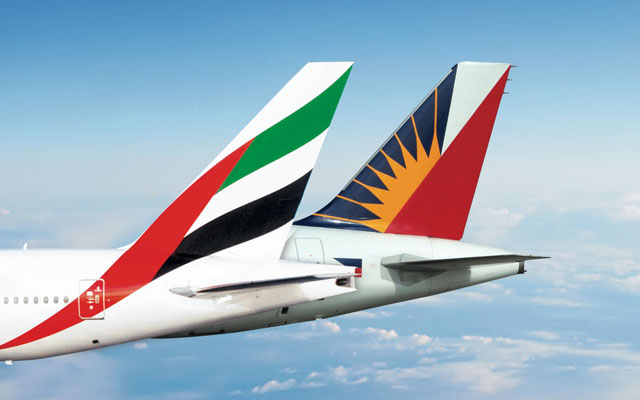
Philippine Airlines (PAL) and Emirates have teamed up to improve flight connectivity for passengers of both air carriers using a single ticket and a common baggage policy for new points on each other’s networks via Manila and Dubai.
The partnership will provide Emirates’ passengers access to 19 Philippine domestic destinations operated by PAL, including Cotabato, Davao, Iloilo, Kalibo and more, as well as two Asian regional points via Manila.
The interline agreement will benefit both Emirates and Philippine Airlines’ passengers
PAL’s passengers will benefit from access to Emirates’ global network and seamlessly connect to 21 cities operated by Emirates including Cairo, Frankfurt, Casablanca and London via Dubai.
PAL currently has daily flights between Manila and Dubai, while Emirates has 25 weekly operations in Manila, Cebu and Clark.
Bud Britanico, vice president, sales, PAL commented: “We are happy to embark on this new interline partnership with Emirates that expands the choices available to Philippine Airlines passengers, who now gain easier access to more destinations across Europe, the Middle East, India and Africa via our flights to Dubai.”
“The partnership with Philippine Airlines will help open new links for trade and tourism that will drive more inbound traffic into the Philippines, and expand Emirates’ footprint in East Asia,” said Adnan Kazim, chief commercial officer, Emirates.
This spring, The Parisian Macao is transforming into a romantic Tulip Garden, allowing guests to enjoy giant Instagrammable tulip installations and floral projection shows from now till May 31.
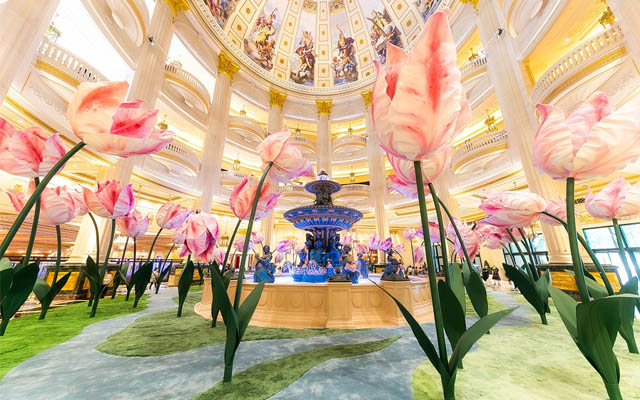
The Parisian Macao’s Rotunda will transport guests to a breath-taking Tulip Garden, featuring about 50 five-metre-tall tulip artworks around the Fontaine des Mers, each hand-painted by renowned Chinese artist Xuan Qing, bringing romance and the charm of springtime to The Parisian Macao’s French architecture.
The Parisian Macao is transforming into a romantic Tulip Garden for guests to enjoy the blooming season
A matrix of golden tulips is showcased at Level 3 of Shoppes at Parisian, where a Floating Magic Tulip Garden along the 20-metre Avenue des Champs-Élysées will create a fantastic visual impact. The installation will be illuminated with spotlights at dusk, filling the place with shining images of tulips akin to a floral dreamland.
In addition, there is also a Floral Projection Show at Place Vendôme at Level 3 of Shoppes at Parisian.
The Clan Hotel Singapore turns two this month and is celebrating with The Clan Turns Two – Double The Celebration package.
The package includes a two-night stay in a Master Series Premier Room or Grand Premier Room, Chinese calligraphy workshop, daily breakfast, one four-course dinner, exclusive anniversary gifts, welcome tea ceremony, late check-out, and more.
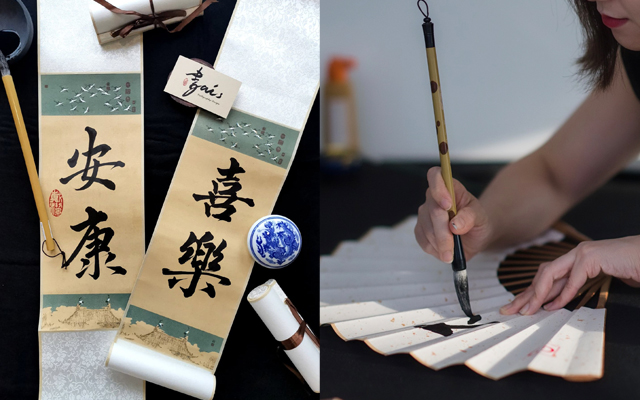
Guests can learn the basics of Chinese calligraphy in a workshop included in the celebratory package
During the Chinese calligraphy workshop, guests will be introduced to the fundamental skills of Chinese calligraphy where they will create their own art piece and bring it home in a wooden glass frame.
The Clan Hotel Singapore has also teamed up with two local artisans to create two exclusive gifts for guests to take home as a keepsake of their stay: a set of four hand-drawn postcards that showcase features and design elements iconic to the hotel, and a jar of artisanal pandan gula melaka biscotti.
In addition, there will be a special pop-up event on March 11 and 18 where Singapore-based calligrapher Corinna Tai will conduct live-writing on traditional paper fans as a complimentary personalised gift for guests.
The Clan Turns Two Package is priced at S$1,158 (US$854) and available for booking from now to May 24 for stays between March 10 and May 31.
Following a successful pilot from October 2022 to March 2023 in Australia, India and Indonesia, the Singapore Tourism Board (STB) has now launched SingapoRewards globally. This is a programme that offers complimentary experiences in the destination for international visitors.
Available throughout 2023, starting from March 7, the programme provides visitors with a chance to try one of nearly 40 new or undiscovered experiences for free.
Tan: SingapoRewards also provides a platform for local businesses to launch and test new products and offerings
The experiences are curated across various precincts and categories – Novelty and excitement; Food and dining; Sustainability; and Wellness.
Examples of what international visitors can expect include discovering the origins of Singapore Dry Gin at the Brass Lion Distillery Tour, and taking a behind-the-scenes tour of Changi Airport and Jewel Changi.
The range of featured experiences will expand, as STB evaluates and approves more programmes for SingapoRewards, STB CEO Keith Tan told TTG Asia.
STB will fund the programme and reimburse experience operators for their participation.
Tan expects these experiences to offer new perspectives of Singapore, even to returning visitors who are familiar with the city-state.
To qualify for SingapoRewards, the visitor must be a short-term visitor arriving by flight and redeeming for the first time. Redemption is a fuss-free process via the programme’s microsite or VisitSingapore app.
Asian destinations are still value-for-money for European travellers
Pricey airfares and limited air capacity are the biggest obstacles for travellers
China’s reopening may affect the rates and availability for the European travellers
Thailand is the number one Asian destination for Europeans
Bookings to Asia are looking healthy for 2023, according to European tour operators, but air seat capacity remains the main concern for the market to reach pre-pandemic levels.
The continent has bucked gloomy predictions last year following the Ukraine war and its ensuing energy crisis. Wall Street bank Goldman Sachs expects the euro zone economy to grow 0.6 per cent this year, compared with its previous forecast of a contraction, thanks to a fall in natural gas prices and the reopening of China’s borders, according to a Reuters report.
“Bookings are back in full swing and this makes us feel rather confident for this year,” said Holger Baldus, managing director of Marco Polo Reisen.
“The yearly holidays are a very important part of the German lifestyle. After nearly three years of the pandemic, customers obviously don’t want to abstain from this highlight of their year,” he said.
Stephan Roemer, founder of Tourasia, a Swiss tour operating company which also operates in Germany and Poland through subsidiaries, is seeing “excellent figures” coming from the UK, France and Switzerland.
Flight demand is high
But getting more growth is difficult.
“All flights from Europe to Asia are packed to the fullest; there is simply no more capacity,” said Roemer, who is also CEO of Thailand-based Diethelm Travel Group.
“Germany appears to us a bit slower (than the UK, France and Switzerland), again because there aren’t enough flights and there might be a certain amount of reluctance because of inflation,” he said.
According to IATA, international bookings for air travel in the UK were back to 80 per cent of 2019 levels in 2022, and more than 70 per cent in Germany.
This was a significant step up from 50 per cent of 2019 level for 2021, and 42 per cent for 2020, said a Centre for Aviation (CAPA) report. CAPA conjectured in late October 2022 that a return to 2019 levels of capacity might not occur in Europe until 2024 or 2025, given “operational constraints and economic concerns”.
TUI Group also reports a “promising booking development” for winter and summer for Asia. Spokesperson Anja Braun, however, rued that flight limitations, which have shored up air fares, have “slightly” dented Asia’s competitiveness.
“Asia has attractive pricing for accommodation compared with other longhaul destinations, but longhaul flight prices are difficult to compensate,” she said.
Thailand is the number one Asian destination for Europeans. Europe, including Russia, accounted for 6.7 million tourists to the kingdom in 2019, Thailand’s National Statistical Office data shows. The pandemic shrunk the European market to Thailand to 2.1 million in 2020, and just 251,000 in 2021. Still, that 2021 preliminary figure represented nearly 60 per cent of all arrivals in Thailand in 2021, as travel restrictions prevented Asians and Chinese – the bulk of the kingdom’s arrivals – from travelling.
The top five European sources for Thailand are Russia (1.5 million in 2019), the UK (993,000), Germany (853,000), France (745,000) and Eastern Europe (559,000).
“Demand for Asia was pretty low until late summer 2022, mostly because of travel restrictions that were still present in Asia. Since then Asia has been coming back at full speed, however, flight availability continues to be the major problem,” said Marco Polo’s Baldus.
He added that most Asian destinations are price competitive “as long as we can secure flights at reasonable fares”.
“Asia is mainly competing with the Caribbean, for instance, the Dominican Republic. It lost significant market share to the Caribbean during the pandemic, as travelling there was much easier and less bureaucratic. Ever-changing rules in a number of Asian countries during the pandemic made travel agencies reroute demand to destinations that guaranteed their income and posed much less operational problems,” he said.
Popular destinations
As to which Asian destinations are popular now, based on forward bookings, TUI’s Braun said the Maldives is topping the sales chart, thanks to its “specials and offers”, while Thailand and Indonesia “are picking up now”.
Christiane Thoma-Ratnasiri, senior product and contracting manager for TUI and Airtours brands for India, Nepal, Indochina, Myanmar, Hong Kong, Greater China, Taiwan, South Korea and Japan, sees a trend for longer stays in Cambodia.
“Cambodia’s average length of stay was 3.2 stays but now we are seeing long stays of 10 to 14 days in Siem Reap, which are really good value bookings for our hotel partners. I believe Cambodia is benefiting from its move to be the first Indochina destination to reopen borders for tourists,” said Thoma-Ratnasiri.
Baldus: Asia (demand) has been coming back at full speed
On the other hand, Laos is still suffering from being the last to reopen.
“Laos is a niche product with low bookings, but now bookings have hardly returned and I think it will take a long time for it to get back to normal,” she said.
Vietnam is picking up day by day but figures are still behind pre-Covid levels.
For Marco Polo, Japan is on fire. “Since its re-opening in August/September, Japan has seen total recovery and will enjoy a boom in 2023 if flight capacity improves,” said Baldus.
And it seems that Europeans are not cutting back on spending.
“We are seeing higher average travel budgets than pre-Covid,” said Tourasia’s Roemer.
“Asia is extremely competitive, in particular Thailand, Indonesia and Sri Lanka. Hotels are still giving high discounts for early birds. Moreover, most Asian currencies have lost in value to the USD or CHF, which makes costs even cheaper,” he said.
Travellers from China dominate Asian market
But China’s faster-than-expected travel reopening from January 8 has raised the question whether a surge in demand in Asian destinations that are popular with Chinese travellers may put a squeeze on rooms availability and jack up rates in some of those places.
Thailand is the top Asian destination for Chinese travellers, welcoming 11 million of them in 2019. Japan, Vietnam, South Korea and Singapore are next.
“Demand of the Chinese market defines the availability for the EU,” said TUI’s Braun. This is particularly for the late buying market, which requires good availability until shortly before departure, she said.
European airlines will not reinstate their capacity as quickly as the Chinese counterparts, in part due to operational constraints posed by access to Russian airspace, said Mayur Patel, head of Asia, OAG Aviation.
“For those flights, this can add up to two hours’ additional flying time in each direction, which can increase operational costs due to higher fuel prices. In turn, Chinese carriers will have an upper hand given their access to Russian Airspace. This will increase demand to Europe for Chinese travellers as China resumes package tours,” he said.
Nevertheless, Patel said additional seat capacity growth from Europe to South-east Asia will continue, “given the high confidence level in longhaul travel from European markets and Asia’s wide variety of destinations and tourism product offerings”.
In short, the conversation in 2023 has shifted, from how to fill airline seats and rooms, to how to find them.
That, augurs well for the industry to return and even exceed pre-pandemic levels.
Sim Leisure Group is expanding its Escape brand in Malaysia with a new 48.5-hectare outdoor adventure park in Ipoh opening in 4Q2023 and Escape Cameron Highlands, set to debut in 2024.
The company is also in negotiations with developers, land owners and mall owners for new sites to expand its Escape brand in Klang Valley.
Sim Leisure Group is expanding its Escape brand in Malaysia; Escape Penang’s Tubby Racer pictured
Its flagship outdoor retro-eco theme park, Escape Penang, is in its 11th year of operations and recently introduced two new attractions – Malaysia’s first Ski Slope and the Dead Sea Pool, where visitors can float similar to Jordan’s Dead Sea.
In May 2022, a month after Malaysia reopened its borders, Escape Penang launched the world’s longest zip coaster, a 1,135m ride that has entered into the Guinness World Records. Escape Challenge Centre at Paradigm Mall, Petaling Jaya, is the brand’s first indoor park in Malaysia.
Sim Leisure Group’s founder and executive chairman, Sim Choo Kheng, has provided design, fabrication and construction for over 300 themed entertainment projects around the world since 1993.
He was recently incorporated into the World’s Top 50 Theme Park Influencers list by Blooloop, which celebrates luminaries whose leadership, creativity, and innovation have shaped and improved the global attractions industry.
The group is currently working on international theme park related projects in Oman, Saudi Arabia, and China – it has also signed a deal to grow the Escape brand in Sri Lanka.
FIBA and Sport Singapore have signed a three-year partnership to bring the FIBA Intercontinental Cup to Asia for the first time, with Singapore hosting this year’s event.
The 33rd edition of the event will be staged at the Singapore Sports Hub from September 21 to 24.
Singapore will host the 33rd edition of the FIBA Intercontinental Cup from September 21 to 24
Andreas Zagklis, secretary general, FIBA, shared that Singapore boasts a melting pot of cultures, making it the ideal host destination to serve as a launchpad into the future era of global club basketball.
Conceived with the vision of a competition that would unite different cultures through basketball, the FIBA Intercontinental Cup was first held in 1966 and has since become an event where clubs from all over the world compete in.
The September event will see the field of contenders expand from four to six teams, with a Chinese club, jointly selected by FIBA and the Chinese Basketball Association, joining four teams representing the same four continental leagues as in the past two editions. The sixth participant will be announced later by FIBA.
“The FIBA Intercontinental Cup is an important showcase for top club teams from outside the NBA and reflects the strength of professional basketball leagues around the world,” said NBA deputy commissioner and COO, Mark Tatum.
Toh Boon Yi, deputy CEO, Sport Singapore, commented: “Building on the success of the FIBA 3X3 Asia Cup 2022, which will return for another edition this month, we are happy to host the FIBA Intercontinental Cup that will treat fans here to world-class high-impact basketball action.”
Quek Swee Kuan, CEO, Singapore Sports Hub, added: “Hosting the FIBA Intercontinental Cup reaffirms Singapore Sports Hub’s position as a premier destination for sporting events in the Asia-Pacific. We look forward to welcoming the teams, officials and fans to the Singapore Sports Hub for exciting hoop action this September.”
Hilton has signed with Abhijit Realtors and Infrastructure to introduce its DoubleTree brand in Maharashtra’s third-largest city Nagpur.
DoubleTree by Hilton Nagpur, scheduled to open in early 2026, will feature 135 rooms, event spaces, and F&B offerings.
DoubleTree by Hilton Nagpur will open in 2026
Situated at the junction of Airport and Wardha Roads, the new hotel will provide seamless connectivity to prime regions in the city, airport and metro stations.
“This is our first Hilton property in Nagpur, and we are excited to introduce the DoubleTree by Hilton brand to the third-largest city of Maharashtra. Hilton is deeply committed to meeting the diverse guest needs in a flourishing city such as Nagpur and further expanding our footprint in India,” shared Navjit Ahluwalia, senior vice president and country head, India, Hilton.
Abhijit Mazumdar, managing director, Abhijit Realtors and Infrastructure, said: “The globally-recognised Hilton will certainly appeal to both business and leisure customers and benefit DoubleTree by Hilton Nagpur.”
Hilton’s presence in India currently features 24 operating hotels, with 17 additional hotels in the pipeline, including properties in Nepal and Bangladesh.
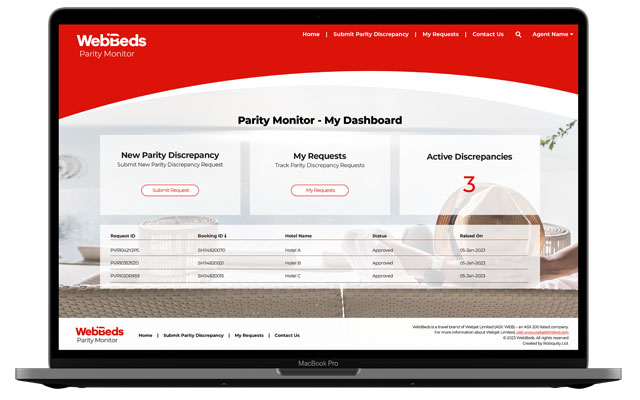
WebBeds has launched a new online tool to their hotel partners, Parity Monitor, to streamline internal processes and improve the speed of resolving parity issues.
This new tool will establish the foundations for the development of future automated solutions, with the ultimate goal of achieving zero BRG (best rate guarantee) discrepancies through the WebBeds marketplace.
WebBeds’ Parity Monitor will help streamline internal processes and improve the speed of resolving parity issues
In the first phase of the programme, Parity Monitor will initially serve as a global hub where hotels will submit parity discrepancies to WebBeds. This new tool will be the front end for the newly streamlined internal processes that will track, monitor, report back and quickly resolve rate discrepancies for hotel partners.
A simple dashboard will consolidate and display the status of any submissions, providing clarity and better management reporting for hotels.
In addition, WebBeds has created a new centralised team that will be dedicated to resolving parity issues raised via the Parity Monitor.
Future developments of the Parity Monitor will include incorporating technology solutions to prevent parity integrity issues occurring in the first place, proactive scanning of the market for rate discrepancies, automated identification and rectification of parity issues, enforcing minimum selling price and tracing opaque rates with buyers across all sales channels.
WebBeds CEO Daryl Lee said: “WebBeds is very aware of the frustrations that our hotel partners experience when there are rate parity discrepancies in market. Hotels want rate parity to be strong and consistent, particularly given the strategic priorities within their business ecosystem.
“This new tool is just the start of a programme of work to develop automated technology solutions to proactively prevent, detect and resolve rate parity issues in real time. Achieving zero rate parity discrepancies is an incredibly challenging goal but we want this aspiration to serve as our ‘north star’ internally, to provide focus and drive excellence from our teams. Anything less than this would fall short of expectations our hotel partners have of us.”
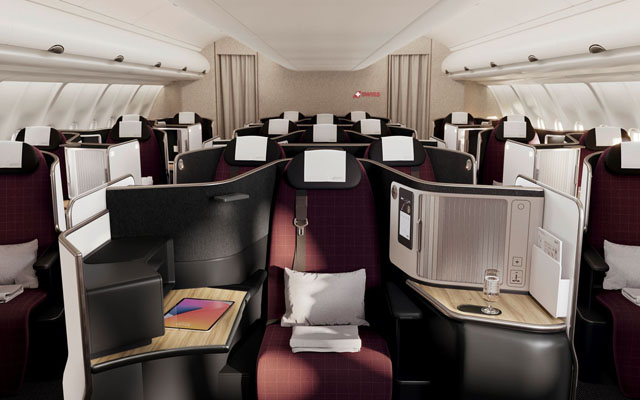
Swiss International Air Lines (SWISS) will offer its customers a new and more personalised SWISS Senses air travel experience starting from 2025, which includes redesigned cabins for the airline’s longhaul aircraft fleet.
The airline’s SWISS First, SWISS Business and SWISS Economy cabins are being redesigned, while the SWISS Premium Economy will be retained. SWISS will gradually install the new cabins throughout its longhaul fleet from 2025, while its new Airbus A350-900s will be delivered with the new interior installed.
SWISS will gradually install the new cabins throughout its longhaul fleet from 2025
The new concept also extends to SWISS’s first-ever suites, which will be offered in SWISS First and parts of SWISS Business. Other additions comprise a new Human-Centric Lighting to help alleviate jet lag’s effects, a new inflight entertainment system, and options for passengers to connect their personal devices.
“This is the most comprehensive cabin renewal in the history of our company,” said SWISS CEO Dieter Vranckx. “We want to pay due and full regard to our customers’ desire for more individuality – with this extremely high-quality product, we can continue to meet all our high aspirations.”
Tamur Goudarzi Pour, chief commercial officer, SWISS added: “With SWISS Senses, we’re making our customers’ air travel an even more personal and more sensual experience… a cosy and comfortable yet also functional environment in all our travel classes.”















Following a successful pilot from October 2022 to March 2023 in Australia, India and Indonesia, the Singapore Tourism Board (STB) has now launched SingapoRewards globally. This is a programme that offers complimentary experiences in the destination for international visitors.
Available throughout 2023, starting from March 7, the programme provides visitors with a chance to try one of nearly 40 new or undiscovered experiences for free.
The experiences are curated across various precincts and categories – Novelty and excitement; Food and dining; Sustainability; and Wellness.
Examples of what international visitors can expect include discovering the origins of Singapore Dry Gin at the Brass Lion Distillery Tour, and taking a behind-the-scenes tour of Changi Airport and Jewel Changi.
The range of featured experiences will expand, as STB evaluates and approves more programmes for SingapoRewards, STB CEO Keith Tan told TTG Asia.
STB will fund the programme and reimburse experience operators for their participation.
Tan expects these experiences to offer new perspectives of Singapore, even to returning visitors who are familiar with the city-state.
To qualify for SingapoRewards, the visitor must be a short-term visitor arriving by flight and redeeming for the first time. Redemption is a fuss-free process via the programme’s microsite or VisitSingapore app.