Family Traveller, a platform that provides families with inspiration, practical advice and planning tools for travel, is expanding into Asia with the launch of its new website, Family Traveller Asia, and has chosen Singapore’s Sentosa island as its official launch partner.
The brand’s foray into Asia is also in celebration of its 10th anniversary of establishment in the UK.
Family Traveller is expanding to Asia with the launch of Family Traveller Asia
Andrew Dent, founder and CEO of parent company Akaroa Tech, said: “As we come out of the most challenging of times, we have seen leisure travel, especially family-centric travel, leading this recovery.
“The rules have now changed – families prioritise a more flexible work-life balance while also having the ability to travel more often and for longer. There is a resilience among families that recognise, even in challenging economic times, family holidays are an important pillar of family life.”
Recognised globally as one of the top family destinations in the world, Sentosa as Family Traveller’s official launch partner in Asia will offer travellers a multitude of joint content initiative, including a selection of family activities, events, and hotel stays.
“We expect Asia to be our fastest-growing region globally and look forward to working closely with local and regional travel and tourism partners, amplifying their family offering to our affluent family audience,” commented Dent.
A gathering of some of the world’s finest jazz musicians will descend on the island for the 2023 Samui Summer Jazz Festival, happening from May 2 to 7.
Featuring six nightly concerts, the festival will showcase vocalists like Anna Serierse and Bas Toscani, Lucas Santana and his band, Sven Rozier Quintet, Koh Mr. Saxman and the Takeshi Band, Rolf Delfos, Susanne Alt and young talent, Sebastiaan van Bavel, and more, who will be joined on stage by Thailand’s top jazz musicians.
The 2023 Samui Summer Jazz Festival will feature six nights of concerts by the world’s finest jazz musicians
In addition, festival director Alexander Beets will lead his musicians in a sensational afternoon of jazz with special guest, jazz vocalist Zosja El Rhazi, who infuses soulful, bluesy melodies with her own powerful delivery.
Participants can also indulge at Centara Reserve Koh Samui’s Weekend Sunday Brunch while enjoying jazz entertainment.
Tickets are priced from 1,000 baht (US$29) for ticket entry and a welcome drink, and 2,590 baht for brunch.
The three-day-long annual Switzerland Travel Experience (STE) China 2023 held in Hong Kong last week drew 110 buyers and travel agents from Greater China, as well as 30 Swiss partners and suppliers.
Aside from Swiss suppliers conducting 15-minute sessions to introduce their latest products, the programme also included a gala dinner, and farewell dinner with games and teambuilding activities.
Switzerland is hoping to get visitors to stay longer and explore the country’s hidden gems; Lungern in Switzerland, pictured
Each day also focused on different markets. The first day was dedicated to Northern China and business events, the second to the Eastern and Southern China markets, and the last day focused on Hong Kong and Taiwan.
Switzerland Tourism’s CEO, Martin Nydegger, remarked that it was “symbolic” to be back in Hong Kong to reconnect with existing players and create new contacts. This was despite Switzerland Tourism keeping its tourism offices open during the pandemic.
He added that Switzerland is trying to “build a new form of tourism” post-lockdown, and aims to “drive more immersive experiences”, and get visitors to stay longer and explore the country’s hidden gems, beyond just visiting the main highlights.
Nydegger acknowledged that certain issues will also have to be tackled, such as the capacity for air seats, availability of hotels, and available visas for the Chinese market.
He pointed out: “We don’t want a thousand visitors staying for one night in our country. (We would prefer) 100 visitors for 10 nights, as it’ll be less hectic, and visitors will be able to enjoy Switzerland fully. It is also more cost-effective to stay longer in one country, and is better for the environment.”
On the sustainable front, Switzerland’s Swisstainable programme has already certified 1,800 local hotels, restaurants, excursions, railways, and others, into three levels. As such, Nydegger encouraged visitors to Switzerland to opt for train transfers and stay in hotels with the Swisstainable certification label to minimise their travel impact.
Currently, Hong Kong-based Miramar Travel is the only operator to offer a Swisstainable tour, available from now to October 31. The 10-day tour includes experiences like a bike tour in the old town of Bellinzona, health walking and picnic at Bachalpee, and accommodation in accredited environmentally-friendly hotels.
Alex Lee, general manager, Miramar Travel, said: “Based on our estimation, a tour group of 30 travellers generates 300 plastic water bottles (two bottles per hotel room per day) for a 10-night journey.”
To encourage visitors to make sustainable choices, he shared that the agency is offering a HK$200 (US$25.50) cash voucher to guests who bring their own water bottle for the trip, which can be redeemed at the group’s restaurants.
Overall, the Hong Kong market is expected to rebound to 50 or 60 per cent of 2019 levels, with China’s recovery pegged at 40 per cent in 2023 due to visa issues.
Aside from STE, the Switzerland Travel Mart will be happening this September, and the tourism board is planning to invite more than 500 stakeholders from around the world to meet with 500 local providers in Geneva. Buyers from Greater China would be able to return this time.
Since Mainland China resumed issuing all types of visas for foreign nationals on March 15, there has been an influx of bookings as travellers seek to rediscover China once again.
Analysis of Trip.com’s data showed that international travellers’ interest in Mainland China has increased significantly in the last few weeks compared to the same period in 2019.
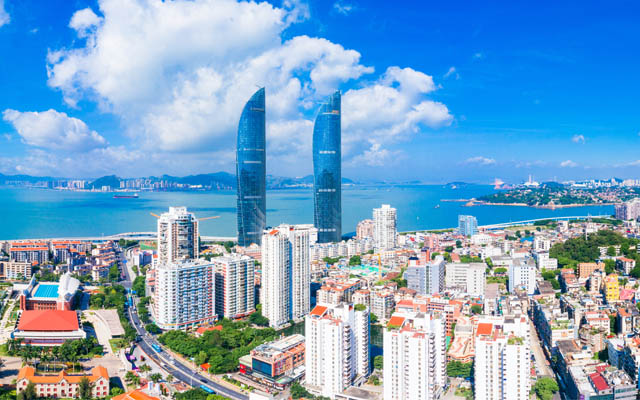
Cities in China are seeing encouraging inbound growth, such as Xiamen, pictured
Looking at the travel period between March 15 and April 14, 2023, international users searching for hotels in Mainland China on Trip.com was up 126% compared to the same period in 2019, and a seven-fold increase on 2022 levels.
Hotel bookings by international travellers also followed the same trend, rising by a third (32%) compared to pre-pandemic levels.
However, bookings to the destination are still recovering at 26% below 2019 levels due to the constrained supply of flights.
Meanwhile, travellers from Hong Kong, South Korea, Taiwan, the UK, the US, Japan and Singapore made the most flight bookings to the country last month, confirming the pent-up demand for travel to the region. Countries like Hong Kong, South Korea, Taiwan, Japan, Singapore and Australia were those making the most flight bookings in 2019, and have since evolved from the pandemic.
While the UK and the US did not feature in the top list for flight bookings to Mainland China before the pandemic, the last month has shown significant growth for inbound travel to the region from these two countries.
Data shows that Shanghai, Beijing and Guangzhou remain the most popular flight destinations, while the cities of Xiamen, the south-east beach city, and Chengdu, home of the Giant Panda, have also seen encouraging inbound growth as the industry continues to see growth in the premium leisure sector.
During the pandemic, travellers turned to last-minute bookings due to ever-changing travel restrictions, however, the latest data shows this has now reverted beyond pre-pandemic levels.
Back in 2019, Trip.com users booked their hotel stays around four days in advance of their stay. In 2023, customers are gaining confidence in the market with last month’s data revealing that the booking window has increased to six days.
The same trend can be seen for those booking air travel, with Trip.com travellers now booking flights 15 days in advance, up from 14 days pre-pandemic.
These encouraging figures are echoed across the Asia-Pacific region, with bookings to Japan and South Korea also recording strong year-on-year growth.
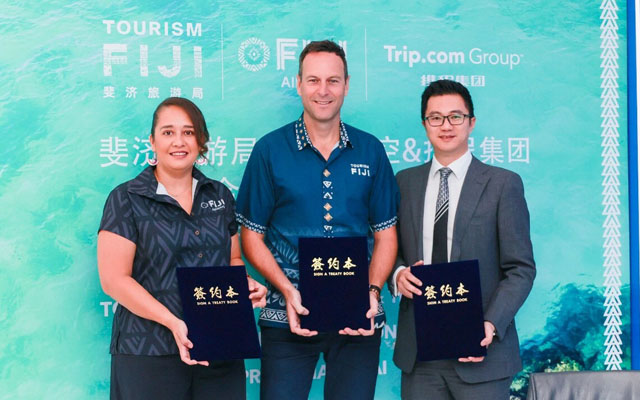
Trip.com Group has signed a three-year partnership with Tourism Fiji and Fiji Airways to develop strategic campaigns aimed at promoting traffic and tourists to explore Fiji as a destination.
The agreement will also see the three parties work together to increase exposure in the Greater China market through travel marketing initiatives, product expansion and leveraging data insights, as well as highlight Tourism Fiji’s latest Where Happiness Comes Naturally campaign launched earlier this year that showcases the rich and diverse cultures and traditions in Fiji.
The partnership will see the three companies driving traffic and tourists to explore Fiji as a destination
In addition, Fiji Airways now offers two flights a week between Hong Kong and Nadi, which will increase to three flights a week by June.
Brent Hill, CEO of Tourism Fiji, said: “China was Fiji’s fourth largest market prior to the pandemic, (and) our collaborative approach with Ctrip and Fiji Airways will undoubtedly contribute to driving more visitor arrivals from the Chinese market.”
“In line with our ‘local focus, global vision’ strategy, we have initiated a series of recovery sales activities and campaigns to stimulate overseas travel demands in the Chinese market. We look forward to collaborating with Tourism Fiji and Fiji Airways to leverage our resources and data insights to boost Fiji tourism development,” shared Edison Chen, vice president, destination marketing & strategy, international public relations, Trip.com Group.
Radisson Hotel Group (RHG) has signed with Lansum Properties to debut the first Radisson Collection hotel in Hyderabad, India, slated to open 2Q2026.
When open, Radisson Collection Hotel, Hyderabad Financial District will be close to the city’s financial district, which houses business centres, IT Parks, and Special Economic Zones.
Radisson Hotel Group will debut its first Radisson Collection hotel in Hyderabad; Golkonda Fort, pictured
The 300-key hotel will feature an all-day dining restaurant, tea lounge, rooftop bar, pool, health club, spa and meeting venues.
“This signing comes at an opportune time for us as we complete 25 years of operation in the country, which is a testimony of our stakeholders’ trust in us. Radisson Collection brings us a step closer to our vision of delivering unparalleled services to our guests while maximising the value proposition for our partners,” said Zubin Saxena, managing director and area senior vice president, South Asia, RHG.
Lansum Properties’ chairman and managing director, Umesh K, commented: “We first joined hands with (RHG) for opening Radisson Blu Resort Visakhapatnam and have closely experienced its value addition across operating and managing the hotel. We are extremely proud to introduce RHG’s luxury lifestyle brand to the beautiful city of Hyderabad… delivering a class-apart experience to travellers.”
Starting with Hyderabad as a key market, RHG will further expand its portfolio under the Radisson Collection brand by adding properties across markets, such as Delhi, Mumbai, Bangalore, Goa, Rajasthan, Chennai, Ahmedabad, and Kolkata.
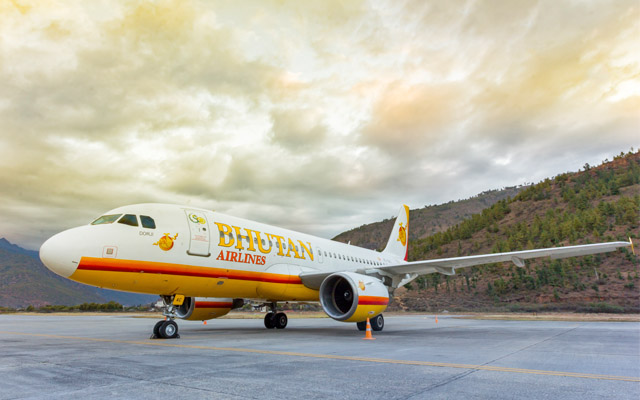
Bhutan Airlines and Amadeus have teamed up to allow travel sellers to book outgoing flights on the Amadeus Travel Platform.
This new partnership will help Bhutan Airlines gain visibility with travel sellers around the world, including travel management companies, tour operators, retail travel agencies, and online travel agencies.
The partnership will allow travel sellers to book outgoing flights on the Amadeus Travel Platform
The airline offers daily flights to Bangkok via Kolkata, India, and three flights a week to Delhi, from Bhutan’s only international airport in Paro. It is undergoing digital transformation to improve the traveller experience, and recently launched a brand-new in-flight entertainment system.
Pema N Nadik, CEO, Bhutan Airlines, commented: “These new systems are part of our ongoing efforts to improve our services and provide our customers with the highest level of comfort and convenience.”
“We are excited to add Bhutan Airlines to our roster. We are confident that the Amadeus Travel Platform will help Bhutan Airlines reach more travellers with the right offer and we look forward to supporting the carrier’s growth” said Frederic Saunier, vice president, airline distribution, Asia Pacific, Amadeus.
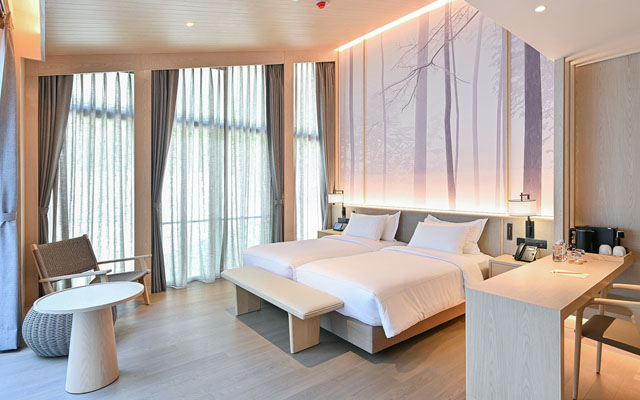
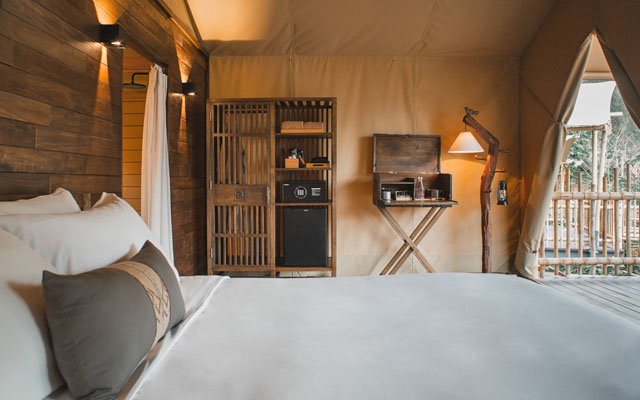
Hotel MYS Khao Yai, Thailand
Nestled in the lush natural environment of mystical Khao Yai National Park, Hotel MYS Khao Yai offers a serene living experience with nature and bespoke serenity.
The hotel offers multiple types of accommodation, from deluxe room to suite, as well as a pool villa and the MYS three-bedroom villa. It also provides a range of personalised services such as floating breakfasts, romantic treats, movie night with popcorn, and more.
Hotel facilities include gardens, pool, F&B, and event venues.
Cap Karoso
Cap Karoso, Indonesia
Located on the shores of Karoso Beach, Cap Karoso is a new eco-conscious lifestyle resort boasting uninterrupted views of sunsets over the Indian Ocean.
The resort features 47 rooms and 20 beachfront villas, in addition to a 30,000m² organic farm.
It also offers artistic residency programmes that open up the possibility for creative collaboration between Sumbanese and international artists.
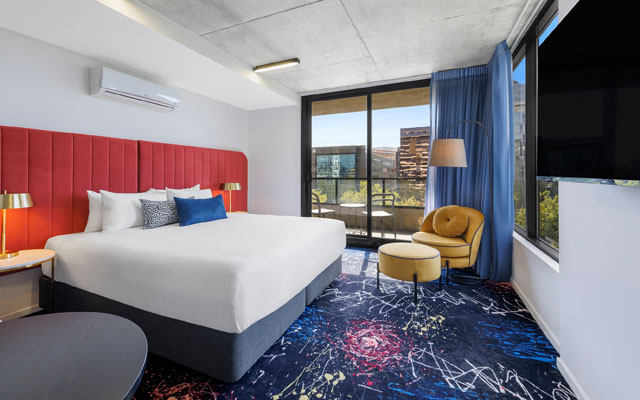
Mercure Melbourne St Kilda Road
Mercure Melbourne St Kilda Road, Australia
Mercure Melbourne St Kilda Road boasts 145 rooms and has a restaurant, bar, gym and laundry facilities.
The property is situated near numerous IT, health, and government businesses, and is only minutes from all attractions, restaurants, and shopping in Melbourne.
Parking is available at the hotel.
Travelodge Kyoto Shijo Kawaramachi
Travelodge Kyoto Shijo Kawaramachi, Japan
Travelodge Kyoto Shijo Kawaramachi is located in Kawaramachi in Kyoto, known for its famous tourist attractions like Yasaka Shrine, Fushimi Shrine, Kiyomizu Temple, and Kyoto Imperial Palace.
The 232-room hotel offers modern comfort essentials, including high-speed Wi-Fi and coin-operated laundry facilities – it also features a restaurant and a gym.
Nearby the property are numerous bus and subway stations, as well as convenient access to JR Kyoto Station, Itami Airport and Kansai Airport.
Guests on The Ghan now offers guests new ways to connect with the country as part of the journey with the latest Off Train Experiences.
These include the Standley Chasm Cultural Walk in Alice Springs, a tour of the Nitmiluk Cutta Cutta Caves or Top Didj Cultural Experience in Katherine, or upgrading to a spectacular flight and full-day experience from Coober Pedy to the Painted Hills, William Creek and Lake Eyre.
The Painted Hills and Lake Eyre Scenic Flight is an optional upgrade on The Ghan’s Off Train Experiences (Photo: Wrightsair)
The Standley Chasm Cultural Walk in Alice Springs lets guests learn about ancient geology, native flora, fauna, bush medicine and bush tucker along the way, while the Top Didj Cultural Experience takes guests on an insightful cultural experience with indigenous artist Manuel Pamkal, who shares what it is like growing up in the bush, cultural differences, tribal life and insights to his own family tree.
Venture into the immersive underground cave experience at the Cutta Cutta Caves, found 15m below the surface and formed millions of years ago, and still growing today, or head to the skies with the Coober Pedy: Painted Hills and Lake Eyre Scenic Flight, an optional upgrade. Guests will fly over the dramatic landscape to see it in all its glory, and includes an immersive ground tour in the remote Anna Creek Painted Hills, Kati Thanda–Lake Eyre, and more.
In addition, the Katherine Outback Experience is returning after a two-season hiatus. It outlines what it is like to live and work on a huge cattle station, with interactive experiences, cattle dog demonstrations and live music performances, as well as a live demonstration of the art of horse-breaking.
Tours will depend on whether it is available on northbound or southbound departures on The Ghan or The Ghan Expedition.
Booking.com has released new research that highlights a dilemma where people feel potentially forced to choose between cutting costs and being more mindful about making sustainable travel choices.
The insights were gathered from more than 33,000 travellers across 35 countries and territories, including Singapore.
More travellers plan their sightseeing so that they can walk, bike or take public transport
At a time of general global uncertainty, travelling more sustainably continues to be front of mind for Singapore travellers, with 75% believing people need to act now and make more sustainable choices to save the planet for future generations.
The news continues to be a key influence driver for 59%, who say the recent climate change news agenda has encouraged them to be more sustainable, and yet it also speaks to a quandary facing people when it comes to being more mindful about when, where and how they travel. While 44% think the environment will get worse in the next six months, 68% believe the cost of living crisis will also get worse, leaving people unsure of what to prioritise as they work to reconcile what is important to them with the demands of everyday life.
A tale of two wallets in an unsteady global climate
The economic weather has changed drastically since last year, and the big topics at the front of people’s minds are the cost of living crisis and the climate crisis. 79% of Singapore travellers say they want to travel more sustainably over the coming 12 months, while 82% think the global energy crisis and rising cost of living is impacting their spending plans.
For some travellers, the two are mutually exclusive. With rising inflation, nearly half of travellers think that they must make a choice between sustainability and spending, with 59% believing more sustainable travel options are too expensive (up 13% from Booking.com’s 2022 data). For these respondents, sustainability and travel combined can seem non-urgent when they are worried about affording bills and the energy crisis. On the flip side, 49% of today’s Singapore travellers are willing to pay more for travel options with a sustainable certification, dialling up their spend to feel reassured they are driving impact.
As an increasing number of Singapore travellers feel the pinch, they are seeking more sustainable travel options rich in rewards, highlighting the perceived trade-off between making conscious choices and saving money, and the need for incentivisation. Nearly half (46%) want discounts and economic incentives in order to opt for eco-friendly options (up 13% from 2022) while 41% would be encouraged to travel more sustainably with reward points for making more sustainable choices that they could use for free perks or discounts through online travel booking sites.
Breaking through barriers to drive change
It’s not just cost that is a perceived hurdle to travelling more sustainably. From limited data to a perceived lack of options, barriers to travelling more sustainably appear higher than ever. 60% of Singapore travellers believe there are not enough sustainable travel options, while 73% want travel companies to offer more sustainable travel choices (up from 62% in 2022). Despite good intentions, 56% of travellers do not know where to find more sustainable options. For example, 74% seek authentic experiences that are representative of the local culture, yet in stark contrast 53% do not know how or where to find these tours and activities that will ensure they give back to the local community.
Adopting sustainable micro-habits on vacation
Despite existing barriers and the tightening of purse strings, it is clear there is a huge appetite for solutions with four in five (80%) Singapore travellers confirming that travelling more sustainably is important to them. Travellers say they are converting intent into action by taking active small steps at home, and when travelling, to drive a more sustainable future. Today, 53% use reusable shopping bags, 48% recycle waste and 51% carry their own reusable water bottle – and there has been a significant uptake in travellers adopting everyday habits on vacation in the past year.
59% turn the air conditioning off at accommodations when they aren’t there, 48% use their own reusable water bottle, 65% say they turn off the lights and appliances at accommodations when they aren’t there, while one third (31%) now recycle their garbage when travelling. Even more promisingly, travellers are making conscious choices on vacation that go beyond these everyday micro-habits. When it comes to transportation, 44% now plan their sightseeing so that they can walk, bike or take public transport, while 35% travel outside of peak season in a bid to avoid overcrowding. There is also consensus among travellers on taking the “buy local” mantra on vacation, with 34% favouring small, independent stores.
Trust, truth and the travel industry
Amid rising climate anxiety, travellers are becoming more responsible consumers, from their accommodation to their transport choices. 64% aim to leave the places they visit better than when they arrived, and travellers in Singapore are increasingly adopting a regenerative approach to travel and searching for vacations with maximum positive impact, while seeking credible assurance when booking across the entire travel experience.
For example, travellers can now easily filter their rental car search results to quickly find fully electric and hybrid cars across 110 countries for their next trip; or choose one of over 500,000 more sustainable options for their next stay, no matter the accommodation type. Nearly two thirds (64%) would feel better about staying in a particular accommodation if they knew it had a sustainable certification or label, while 61% want to filter their options for those with a sustainable certification next time they book.
In response, the travel industry must adapt to meet the changing expectations of these more conscious consumers to accommodate the 35% who are always on the lookout for brands that promote sustainability as well as the 71% interested to learn more about why specific options are recognised as more sustainable, such as eco-friendly LED lighting and water-efficient toilets. Still, with 47% of Singapore travellers today not trusting that the sustainable travel options labelled are truly more sustainable, there are huge strides for the travel industry to make in gaining the trust of consumers.
Making more sustainable travel solutions easier for everyone
Booking.com’s new features and developments include the 100% Electric tagging in search results so travellers can find and book greener taxi options in 95 cities worldwide, tagging indicating where flights are offering a relatively lower emissions option, and available public transport ticketing options in 47 cities worldwide, including London, Amsterdam, Bangkok and Melbourne.
“Although travel has resumed, Singapore travellers remain mindful of the rising costs of living and the impact of travel on the environment,” said Nuno Guerreiro, regional director, South Asia, Oceania & Chains, Booking.com.
“We’re encouraged to see that travellers are driving change by adopting more sustainable travel habits and seeking responsible experiences. More sustainable travel is an investment in the world, and we’re dedicated to making it easier for everyone to travel in a more mindful and responsible way, no matter where they are on their sustainability journey.”