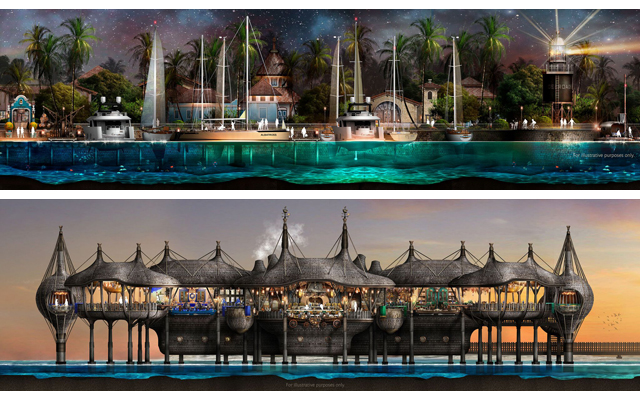
A groundbreaking ceremony has marked the start of construction of Emboodhoo Lagoon, conceived as “a multi-island integrated leisure and recreation destination resort” in the Maldives.
Developed and managed by Thailand-based Singha Estate, phase one of the US$311.5 million project comprises a three-island-resorts concept, with a core island Township offering F&B, retail, entertainment and recreational experiences.
When fully completed, the overall development will extend across nine islands and provide accommodations of 1,300 rooms and create over 5,000 jobs. The Emboodhoo Lagoon project will feature a 50-berth marina, the Café Del Mar beach club, a “new DNA” resort by Hard Rock International Hotel Group, and an upscale lifestyle resort with water villas.
As part of the overall project, Singha Estate will work with the local community and marine biologists to establish a Maldives cultural and Indian Ocean marine learning centre.
The Township and Phase One are scheduled to be complete by 3Q2018, while the second phase is set to complete within the next five years.
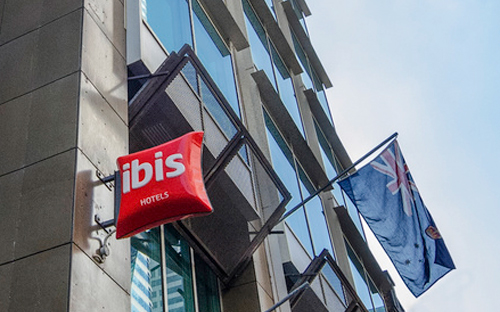
Melbourne’s city centre will see the rise of a vertical dual hotel development combining a Novotel and ibis in late 2018, after AccorHotels struck a deal with Singapore-based Well Smart Group.
The ibis Melbourne Little Lonsdale Street, taking up the lower tier of a 36-storey tower, will comprise 270 premium economy guestrooms, while Novotel Melbourne Little Lonsdale Street will offer 213 rooms in the upper tier.
Floors in between the two hotels will house the shared facilities including the lobby, two F&B venues, gym, as well as 10 meeting and event spaces. The hotel will also share back of house facilities from kitchen to engineering, common areas, and even staff in housekeeping and finance.
AccorHotels’ COO Pacific, Simon McGrath, said: “With development real estate in CBD locations becoming increasingly sparse and construction costs soaring, it makes perfect sense to literally scale up and maximise the investment across a number of brands and price points.”
Novotel and ibis Melbourne Little Lonsdale Street will expand AccorHotels’ presence in central Melbourne to more than 25 hotels and 3,600 rooms.
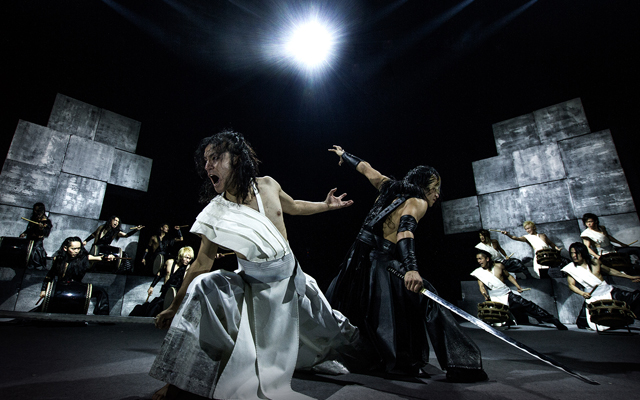
To provide more evening entertainment options in Tokyo foreign visitors, Japanese drum and dance ensemble Drum Tao, JTB Communication Design and Shinagawa Prince Hotel, Tokyo have joined hands to produce a new non-verbal performance.
Titled Mangekyo, which translates to kaleidoscope, the show uses a circular stage to represent the eye-piece of a kaleidoscope, as well as unique lighting and passionate drum beats to convey ever-changing visions and emotions.
Mangekyo will debut with two shows at 17.00 and 20.30 from September 16 to October 29 this year. The show will run again from May to June, and September to November next year.
According to Satomi Omachi, representative of JTB Communication Design’s area management division, a common complaint among foreign groups and visitors is the limited range of evening activities.
Omachi opined that Mangekyo’s compact two-floor theatre in Shinagawa Prince Hotel makes it suitable for corporate and VIP groups. Planners can choose to book their VIP guests in the box seats on the second floor terrace or buy out the venue.
The venue size also allows the audience to enjoy the performance up close, with those seated in the front rows on the first floor merely a metre from the performers.
The entire theatre seats 400 people, while the terrace takes four guests in each box and 80 in all. Seating on the first floor can be rearranged to suit larger or smaller groups in venue buyouts.
“We will seek a permanent venue for Mangekyo at a later stage as it gains popularity,” revealed Omachi.
Mangekyo has several domestic corporate bookings in the bag, but Omachi hopes the show will garner more foreign bookings from both corporate groups and FITs in 2018.
B2B travel distributor FIT Ruums has struck a partnership deal with China Airlines to provide exclusive dynamic packages for travellers in Taiwan.
Under the new agreement, a tailored collection of 15,000 hotels from FIT Ruums’ global inventory will be packaged together with China Airlines’ exclusive airfares, which are then provided to an appointed group of Taiwan’s top travel agencies for offer to their customers. More properties are expected to be added to the partnership in future.
These packages, which will be available from early August on the appointed agencies’ websites, will offer travellers savings of up to 25 per cent than if they book hotels and flights separately, according to FIT Ruums.
Building on Taiwanese travellers’ strong demand for intra-Asian travel, the majority of the destinations featured in the partnership are located in the Asia-Pacific region. These include Osaka, Tokyo, Kyoto, Hong Kong, Singapore, Seoul and Bangkok, which are expected to account for 85 per cent of the partnership’s sales.
All of the hotel content supplied by FIT Ruums will be provided in traditional Chinese language to support the local Taiwanese market. China Airlines’ platform will also provide a real-time booking option that packages the best airfares and hotel options.
The FIT Ruums-China Airlines travel packages will be sold by the following appointed travel agencies: YesTrip (a subsidiary of China Airlines), Lion Travel
Richmond Tours, FTSTour, Life Tour, EZ Travel, Star Travel, Cola Tour, Set Tour, DTS Group and Fuller Tour – the latter two will be available soon.
FIT Ruums also plans to develop dynamic packaging with more airline partners in future, it said in a statement.
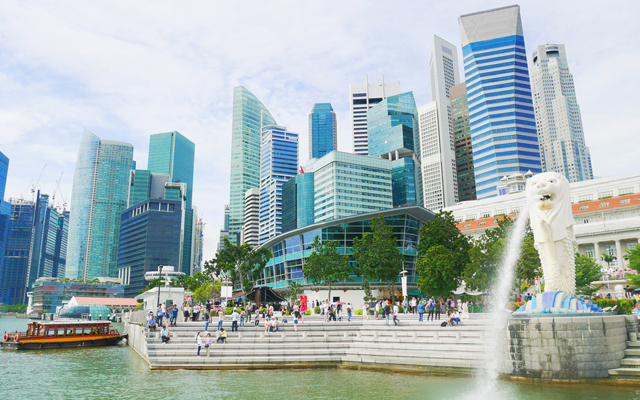
Singapore’s international visitor arrivals in 1Q2017 saw modest year-on-year growth, up four per cent to 4.3 million visitors, while tourism receipts increased 15 per cent to S$6.4 billion (US$4.7 billion).
The growth in tourism receipts was driven by shopping spend (+38 per cent) while the sightseeing, entertainment and gaming (SEG) component held steady.
Singapore
Excluding expenditure on SEG, China (S$1.1 billion), Indonesia (S$688 million) and India (S$302 million) were the top three tourism receipts generating markets in 1Q2017.
China was the top source market after arrivals increased 14 per cent to 851,000. Indonesia is in second place at 720,000 arrivals, an increase of just two per cent. These are followed by Malaysia (up one per cent to 275,000), Australia (up six per cent to 272,000) and India (up seven per cent to 241,000). These five markets accounted for 55 per cent of total international visitor arrivals during this period.
Chinese visitors contributed 30 per cent more in tourism receipts, with shopping the largest spend component, while the largest increase in tourism receipts came from Malaysia (+37 per cent). Tourism receipts from Indian arrivals showed no increase, while Australians spent four per cent more.
Notably, gazetted hotel room revenue declined 1.3 per cent to an estimated S$800 million for 1Q2017. Average occupancy rate came in at 86 per cent, a 1.3 percentage point increase compared with the same quarter last year while average room rate declined 2.8 per cent to S$233. RevPAR slipped 1.2 per cent year-on-year to S$199 due mainly to a lower average room rate.
From left: Club Med Services' Diane Limouzineau, SportQuest's Emeline Tan, Follow Me Japan's Risa Nishimura, and Club Med Services' Naazreen Tyebally
Encouraged by a growing demand for snow and ski holidays among Singaporeans, three organisations have come together to produce the city-state’s first snow- and ski-focused travel fair from August 4 to 6, with the first day being reserved for trade buyers.
The Singapore Ski and Snow Open – to be held at Snow City – is organised by Singapore-based SportQuest snow sports academy and ski travel specialist, and supported by both Follow Me Japan, a Japan travel specialist in Singapore, and Club Med.
From left: Club Med Services’ Diane Limouzineau, SportQuest’s Emeline Tan, Follow Me Japan’s Risa Nishimura, and Club Med Services’ Naazreen Tyebally
The trade day will see six exhibitors representing resorts and destinations specialising in snow and ski experiences across the world, with Asia being the main focus. Club Med, as a major partner, will showcase its ski resorts across the world, including its second ski property in Japan – Club Med Tomamu Hokkaido – opening this December.
Explaining the motivation behind the launch of this specialist travel fair, Risa Nishimura, managing director of Follow Me Japan, told TTG Asia: “According to the Japan National Tourism Organization, the number of Singaporeans who made snow and ski trips to Japan had grown from 27,000 in 2012 to 72,000 in 2016. Follow Me Japan alone recorded 2,000 snow and ski travellers last year – all being high-end travellers.
“As many of snow and ski enthusiasts plan their trip themselves, there is untapped business potential for travel agents in Singapore,” she added.
In particular, travellers can benefit from the expertise of travel agents who understand the mechanics of a snow and ski programme, said Emeline Tan, founder of SportQuest.
“For instance, some (FITs) would buy pricey daily ski passes but end up playing only at the foot of the slopes because they don’t know how to ski and did not book a trainer to teach them (the basics). Specialists like us will also know which ski resorts offer free play to children under the age of seven, bringing further savings to the family,” she explained.
Also seeing strong interest among Singaporeans, SportQuest has gone from running only seasonal ski programmes to year-round ones now. “Singaporeans are even booking their trips a year ahead,” Tan said.
Sharing the same observations, Club Med Services’ sales director-Singapore Diane Limouzineau said that half of all bookings originating from Singapore are for Club Med’s ski resorts. Of all Singapore bookings, 80 per cent are family groups. “Singaporean guests at our ski resorts are also loyal repeaters,” she added.
As PATA Travel Mart (PTM) marks its 40th edition this year since its 1978 inception in Manila, PATA CEO Mario Hardy concedes that change is imminent to this annual core event, especially in the face of growing competition from the rising number of travel tradeshows in Asia-Pacifc.
While lauding the 40-year existence of the show as its “greatest achievement”, Hardy believes the time has come for PTM to transform itself in order to stay relevant and unique moving forward.
Mario Hardy
The transformation is currently a work in progress, the PATA chief revealed. “There are ideas but we haven’t finalised what PTM will be like in the future,” he added. “We know it has to change and we have to do some significant changes to the format because there are too many similar shows already.”
Meanwhile, building PTM as a platform of “knowledge sharing” is what Hardy has strove to achieve, with seminars, workshops and forums underscoring the tradeshow in recent years.
For PTM 2017, which will be held in Macau from September 13-15, the Travolution Forum Asia will focus on technology and digital marketing while AirAsia Group CEO Tony Fernandes has been confirmed as a special guest speaker at the Youth Symposium and forum, Hardy told TTG Asia.
As well, this year’s PTM will also the introduction of a PATA branded app, which will enable users to not only access content of PTM but other PATA events throughout the year. In this way, delegates would not lose any valuable contacts and connections made at an event but continue to building upon them in future, according to Hardy.
However, PTM will retain its cornerstones of keeping the show relatively small as well as roving across different host destinations from year to year.
“It’s not the largest show and we don’t aim to be the largest; we’re small and intimate, which makes it easier for people to network and do business together as opposed to running from one place to another,” Hardy stated.
Unlike other travel tradeshows which are closely associated with marquee cities, Hardy states that the “rotating” nature of PTM, particularly to secondary and tertiary cities, is a USP and adheres to PATA’s principles of advocating sustainable and responsible tourism.
“In the last three years we have been promoting the importance of showcasing the secondary cities; there are far too many tourists in capital cities and we need to push them away to other destinations,” he commented, acknowledging that PTM’s destination choices had come under criticism from the industry.
Yet despite the proliferation of tradeshows in the region, Hardy believes the pie is big enough for everyone as “tour agencies and operators around the world are focusing on different niche markets and attend shows relevant to them”.
He continued: “I think we’re still far away from shows disappearing or seeing a slowdown unless obviously there is a crisis that stops people from travelling. Otherwise, business will continue as it is today and will continue to grow.”
Expedia has made a US$350 million primary minority investment in Indonesia-based OTA Traveloka, an investment that is expected to deepen both parties’ cooperation on global hotel supply.
East Ventures, Hillhouse Capital Group, JD.com and Sequoia Capital also contributed funding over Traveloka’s last two funding rounds, bringing the total investment amount to approximately US$500 million within the last year.
As Expedia continues growing its presence in Asia, Traveloka represents “the clear online travel leader in Indonesia, and is expanding aggressively throughout South-east Asia”.
Traveloka has partnerships with more than 100 domestic and international airlines, serving more than 200,000 routes worldwide. It also has the largest direct accommodation inventory and provides more than 40 payment options for consumers in Indonesia, Thailand, Vietnam, Malaysia, Singapore and the Philippines, with 24/7 assistance from local customer service in their native languages.
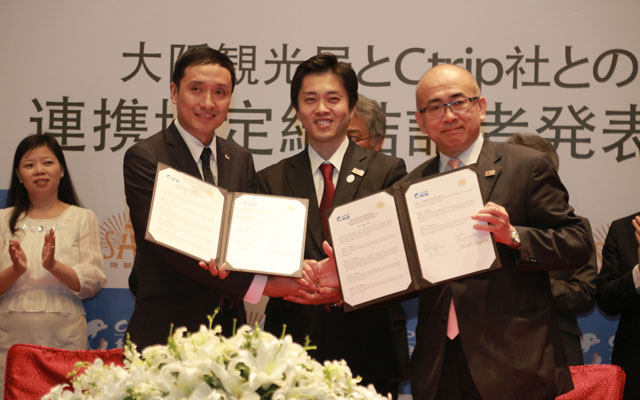
Ctrip and the Osaka Convention & Tourism Bureau have entered into a strategic partnership to cooperate on areas including product development and promotion, big data as well as marketing innovation.
As part of the deal, Osaka Tourism Bureau will issue one- and two-day city travel coupons through Ctrip. The coupons will entitle Chinese tourists to subway rides across Osaka, in addition to admission to popular local attractions.
(From left) Ctrip’s Zhang Rong; Osaka’s mayor Hirofumi Yoshimura; and Osaka Convention & Tourism Bureau’s Hiroshi Mizohata
As well, Ctrip users are expected to get more choices of hotels with Miyako Group, Hankyu Hanshin Hotel Group and Keihan Group, among others, which are cooperating with the Chinese OTA to launch exclusive products for its users.
The OTA will also design more “hotel+x” packages for users visiting Osaka.
Hiroshi Mizohata, director of Osaka Tourism Bureau, added: “Given that Ctrip is the preferred outbound travel portal for Chinese visitors, we hope to work with Ctrip to attract more Chinese tourists and enhance the visibility of Osaka. There is great potential in the Sino-Japan tourism market.
“At present, China has become the leading client source for Osaka tourism, and Chinese tourists are very important to us,” he added. According to Zhang Rong, Ctrip’s vice president and general manager of hotel business, one fifth of Chinsese tourists to Japan booked their trips through the OTA.
A deal for 10-15 Even properties in Australia and New Zealand, inked between The InterContinental Hotels Group (IHG) and Pro-Invest Group last year, has kicked off with the signing of an Auckland hotel.
IHG’s first planned property outside of North America under the wellness band, the 200-room Even Hotel Auckland is scheduled to open at the corner of Albert and Wyndham Street in the heart of the New Zealand city.
It will “bring the outdoors inside” with energising workspaces, dining and social areas as well as natural outdoor spaces. Fitness facilities, in-room exercise zones and fresh, organic foods are cornerstones of the brand, and a partnership is already in place with Australia’s THR1VE, which will design nutritious menus with supply ethically-sourced food.
Jan Smits, CEO Asia Middle East & Africa, IHG said: “Wellness travel is a global phenomenon and a US$563 billion industry today… I believe that the Even Hotels brand will be a key driver in market share growth in New Zealand and Australia.”
IHG currently has 32 hotels operating under four brands across New Zealand and Australia – InterContinental Hotels & Resorts, Crowne Plaza Hotels & Resorts, Holiday Inn Hotels & Resorts and Holiday Inn Express – with a further 14 in the pipeline including Hotel Indigo.



 imated S$800 million for 1Q2017. Average occupancy rate came in at 86 per cent, a 1.3 percentage point increase compared with the same quarter last year while average room rate declined 2.8 per cent to S$233. RevPAR slipped 1.2 per cent year-on-year to S$199 due mainly to a lower average room rate.