TTG Asia
Asia/Singapore Thursday, 23rd April 2026
Page 1547

Sustainability from an early adopter perspective

0

How did CSR come to be a part of the Banyan Tree ethos?
When we got involved in CSR in the 1980s, it wasn’t the buzzword it is today. It started two ways – one was my wife’s and my own academic inclinations. She did development sociology and I did economic development. So we were concerned about issues of poverty, rural sociology (and the like).

But even then it was just a general interest. What was visceral was me buying a piece of land in Phuket on impulse. It was a disused tin mine totally polluted by chemicals which I didn’t know about. It was while trying to rehabilitate that wasteland, which is now Laguna Phuket, that I learnt viscerally how tourism and development is a double-edged sword.

I’ve also subsequently seen it with other projects where people take a piece of forested land by the sea, clear the land and have the soil wash into the ocean and destroy the corals. Worse still you see social dislocation because you get these expensive luxury hotels charging for one room night what a villager would earn in one month.

But tourism can also uplift people in places where the areas for employment are small. So you get that sense of responsibility and realise CSR is no longer a nice-to-have, it has become a key moral value and lends purpose to what we do. We don’t have to bang our chest and say, ‘hey look at us’, because the history of Banyan Tree is all about that.

Speaking of which, so many are shouting about sustainability today. What’s your take?

If being CSR-progressive was a competitive advantage and we relied on it to be so then we would’ve lost a lot of it because everybody is doing it now. But I don’t see it that way. People should compete on price, product quality and innovation, but not on being more socially responsible. It’s a matter of the more the merrier.

One of the biggest problems today is (stockbrokers, activists, etc) saying companies focus so much on CSR when they should focus on making profits for shareholders. But this is the old paradigm.

By changing one word – from shareholders to stakeholders – you can change the entire shape of the business. With this small change we can be talking about maximising returns for the five key stakeholders – employees, customers, suppliers, the general community as well as shareholders.

It’s a good starting point for every institution to have that important discussion as to who their stakeholders are and what relative importance to ascribe to each. Hopefully we’ll have a new generation of business people who would (champion this business mindset).

What are some, maybe unexpected, payoffs of starting the way you did that are just beginning to materialise?

I think the main payoff is an intangible one. And that is – with all things being equal – I’ve discovered consumers like to express their values through their purchasing power. If you believe in a particular cause and a company does great things for it, you’re likely going to buy (from them over a company that doesn’t). But that’s not to say you would be willing to accept sub-standard or over-expensive product simply because it supports your causes.

We pay out all our service charges even in China, where every hotel company has succumbed to the owners and gives service charge back to them. We do this because we believe that’s the social contract between us and the associates. And we get it back through better performance.

More people are recognising in a world that’s increasingly cynical about companies that those that do adhere to certain values tend to be longer lasting, and I hope that’s true because we’ll continue doing what we’re doing.

How do these values continue being a part of the company today?

(Referencing shareholder vs stakeholder decision-making) associates (as stakeholders) still rank higher for us than some other companies, because being a service company we have to ensure associates are highly motivated so they can deliver good service.

For companies in city environments (where the overall populace is affluent), community may not rate so high. But because we are in locations where people are usually not so well-off, for us the importance of local community would generally rank higher than for other (companies).

But of course our hotel in Shanghai, for example, would rank community lower than one in Tibet.

Speaking of China, a ranking of most popular hotels for Chinese high net worth individuals ranked Banyan Tree fourth, really remarkable when up against much bigger hotel chains. What’s behind this success in China?

We opened in Lijiang over 10 years ago and caught a wave. Prior to this all the brands in China were Western, and ideas of luxury were all Greco-Roman, Spanish revival, copies (of what you’d see) in the West. We came in right when the Chinese educated consumers were starting to have some sense of cultural pride. We intentionally (stayed away from) big cities where the brand would get lost, so we chose Lijiang and said let’s stake our claim here, create a beautiful product here and hopefully stand up above the noise.

It’s amazing how Chinese architects have come up so quickly, now our design is a dime a dozen – but when we first did it it was a breath of fresh air. I recall party secretaries in local counties would be rushing here to have a look because they wanted to attract resorts to the location.

What then does a partner like Vanke bring to the table?

They, like AccorHotels, would bring the major projects in big cities.

Normally we wouldn’t get in there, but Accor has so many owner-partners who are in all the big cities who already have got ibis, Mercure, Novotel, etc, and would now would like to do a great city hotel or urban resort with over 200 keys. Accor can’t give them a brand – the highest they got is Pullman, they bought over Fairmont but that’s for 500-600 keys, they bought over Raffles but that’s for heritage hotels. That’s when we are brought to the table.

Any new products can we look forward to?

There’s quite a lot in the pipeline with AccorHotels, and they will be announced all in a row pretty shortly. We are in the midst of intensive negotiations.

Especially with Accor and Vanke we’ll be doing more mainstream hotels that you’d associate with maybe a Four Seasons, maybe 250-key city hotels.

We’ll also (continue doing) smaller and more edgy hotels, bearing some aspect of the Banyan Tree brand. It has to be profitable but will focus not so much on dollar contribution to the company, but how it contributes to the brand too.

The Anam’s artist home tours to paint guests a new picture of Vietnam

0
Artist Mai Lộc known for black-and-white photos of life in Vietnam

The Anam, which opened in Vietnam in late April, has launched new tours that shepherd guests into the galleries and homes of local artists.

As part of the seven-hour tour, art lovers are welcomed into the homes and galleries of acclaimed local artists otherwise inaccessible to tourists, and given a new perspective of Vietnam and its people through their art ranging from oil paintings and metalwork to sculpture and photography.

Tha Anam said one of the tour’s artists, Mai Lộc, epitomises Vietnam’s rapid transformation. With his photography journey starting with a camera gifted to him by a Norwegian couple he met as a miner, he had gone on to become a sought-after photographer whose images of Vietnam and its people have been exhibited globally.

The Water Flower by Mai Lộc, a photographer known for black-and-white photos of life in Vietnam

Other artists include painters Bùi Văn Quang; Trần Thị Bảo Trân and her husband Lưu Thành Quả; Nguyễn Hữu Bài; Ngô Đăng Hiệp; and Lê Huỳnh; as well as metalwork artist Bùi Trung Chínhand sculptor Đoàn Xuân Hùng.

To create the Nha Trang Art Tour providing “insider” knowledge about the destination, The Anam’s general manager Herbert Laubichler-Pichler enlisted Nguyễn Hồng Vân, who opened Nha Trang’s first art gallery called The Rainbow Gallery.

“Our part of Vietnam is famous for its beaches, its islands, its Cham towers and its seafood. It should be famous for its art, and we hope to help make that happen,” Laubichler-Pichler said.

The Nha Trang Art Tour is offered daily from 13.30 from The Anam and includes transfers, visits to the studios and homes with a guide and the ensuing dinner. It is priced from US$77 per person in a group of six. More information can be found at www.theanam.com.

In addition, from December 26-29, the resort will stage its inaugural ‘Garden and Sun Artist in Residence’. Artists will create works and chat with guests amid the resort’s gardens before the resulting artworks are displayed on December 29, 17.00 to 19.00 at Au Lac Ballroom with complimentary drinks and canapes.

Andaz Singapore

0

Location
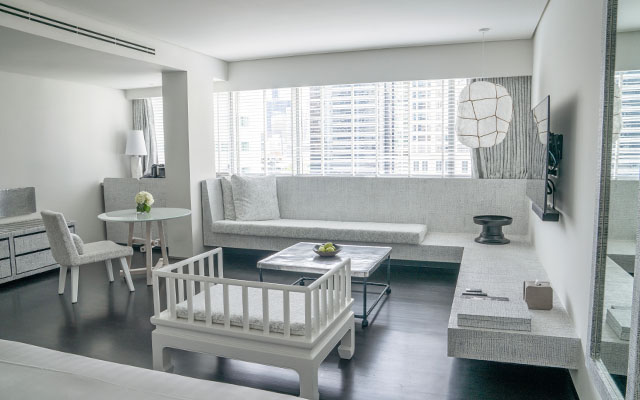
Andaz Singapore’s design is the brainchild of interior architect André Fu (of The Upper House in Hong Kong), who was inspired by the vibrant alleys and shophouse atmosphere in the neighbouring districts of Kampong Glam, Little India, and Bras Basah Bugis. Beyond the design, one might find the hotel’s proximity to local haunts and cultural attractions a big sell point.

Room
There are 342 rooms and suites across four configurations, and they are all located from levels 26 to 37 of the DUO mixed-used development.

King suite

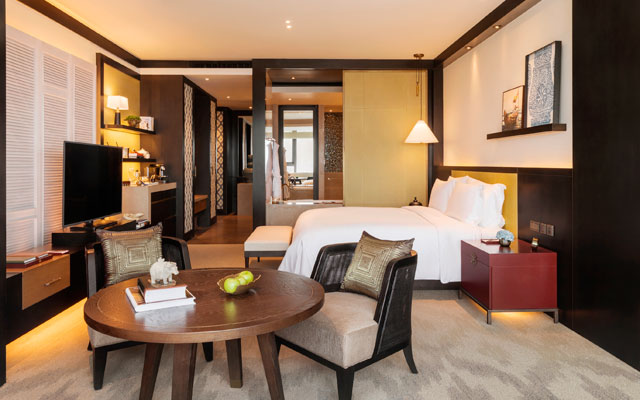
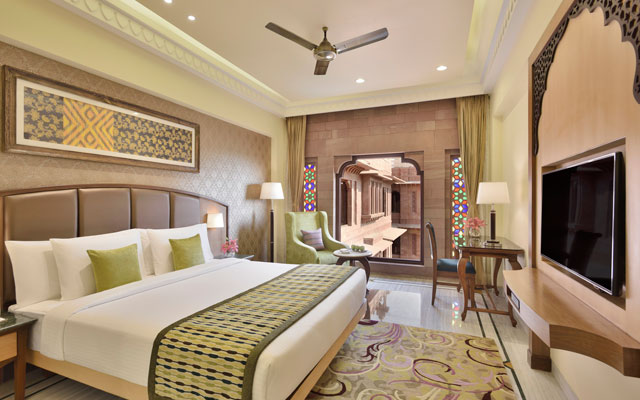
I stayed in the spacious 76m2 Andaz Suite King which had a bedroom and separate living room. The king-sized bed was the best seat in the house, as the bedroom was flooded with natural light – thanks to the floor-to-ceiling windows – and opened out to panoramic views of the harbour and city skyline.

Both spaces were painted with warm russet and mustard tones, and each came with faux shophouse doors and furnished with its own 55-inch flatscreen TV. The living room was where the plush grey sofa, minibar and Nespresso coffeemaker could be found. I was delighted to know that all in-house guests could enjoy all non-alcoholic drinks and snacks in the minibar!

Meanwhile, the bathroom had double sinks, a bathtub with a view, and a rainshower. There were also two separate toilets, as well as a massive closet – which I thought was generous but unnecessary.

If I were a weary traveller, it would be an absolute joy to return to this calm and comfy space I were to call home for a few days. I loved how the blueprint of a shophouse is cleverly incorporated within the luxurious suite, where the fluid space seemed to have no dead end. My only gripe was that the complimentary Wi-Fi was spotty in certain parts of the suite.

As a staycationer, the suite offered a respite from the humid weather and the hustle and bustle of the city. It was extremely difficult to leave such a relaxed space.

At point of writing, Andaz Singapore is only 70 per cent open, as the Large Suites and Presidential Suite were not yet ready.

F&B
There are four F&B venues: rooftop bar Mr Stork; steakhouse 665°F (opening December); Pandan cake and sandwich shop; and all-day dining venue Alley on 25. Alley on 25 is actually a diverse collection of five dining concepts split according to their different cooking methods – Auntie’s Wok and Steam, Icehaus, Plancha’Lah!, The Green Oven – and a bar.

It is worth noting that Andaz Singapore is so “hyper-local”, so much so that coffee and tea breaks for all meetings and events serve up renowned Swiss rolls from the nearby Rich and Good Cake Shop.

Other local companies Andaz Singapore works with are local label In Good Company for staff uniforms, Tiong Bahru Bakery for freshly-baked bread, and Neh Neh Pop for their signature chendol ice creams.

Facilities
There is an infinity pool on the 25th floor, which proffers a view of the sprawling cityscape below. It is open from 06.00 to 22.00.

Also on the 25th floor is the Sunroom, which essentially acts like a club room, providing complimentary water, tea, coffee and snacks to all in-house guests. From 16.00 to 18.00 daily, guests can also imbibe in complimentary red and white wine, or taste the Andaz Pale Ale crafted by local brewery Red Dot Microbrewery.

For gym rats, there is also a sizeable fitness centre decked out with cardio machines and free weights on the 38th floor; it is open 24 hours.

Andaz Singapore’s event and meetings portfolio include The Glasshouse ballroom, Garden Studio, and two smaller meeting rooms.

The Glasshouse boasts a 6.5m-high ceiling and floor-to-ceiling windows on three sides, allowing for an abundance of natural daylight. It comes with its own foyer and is the hotel’s main function venue which takes up to 320 pax banquet-style or 500 pax in a standing reception.

The second largest space is the Garden Studio, which comes with its own patio perfect for pre-dinner drinks or even a barbecue grill. This facility can take up to 120 pax banquet-style, or 220 for standing receptions.

Event planners who wish to book rooftop bar Mr Stork must also secure a back-up location downstairs in case of bad weather. Offering a bird’s-eye view of Singapore from all angles, Mr Stork can accommodate 200 pax cocktail-style and features high tables and tepees.

Service
Staff members I encountered were polite and helpful, and service was impeccable. The hotel is one of my most memorable stays to date.

Verdict
Absolutely delightful, and ranks highly as my favourite stay to date.

No. of rooms 342
Rates From S$370 (US$274)
Contact details
Tel: (65) 6408-1234
Website: https://singapore.andaz.hyatt.com/en/hotel/home.html

Aviation roundup: Scoot, Jet Airways and Jetstar

0
Scoot's Boeing 787 Dreamliner

SIA, SilkAir enter codeshare with Scoot

Singapore Airlines (SIA) and SilkAir will codeshare on Scoot flights to over 30 destinations served only by the LCC in the SIA Group.

The agreement will cover destinations such as Athens, Clark, Gold Coast, Hat Yai, Ipoh, Krabi, Kuching and Palembang.

SIA shared that the new agreement will enable SIA and SilkAir customers to travel on single-ticket itineraries to these codeshare destinations, which means that their boarding passes and baggage tags will be issued up to their final destination at the first point of check-in.

For flights over four hours, SIA and SilkAir will offer checked baggage allowance as well as a complimentary meal and beverage.


Air France-KLM, Jet Airways enhance cooperation

Air France-KLM has strengthened its cooperation with India’s Jet Airways, linking India to a larger trans-Atlantic network.

As part of the deal, Jet Airways passengers will be able to book a single ticket for a trip to the US and Europe, and fly Delta, Air France-KLM or Virgin Atlantic flights for different legs of the journey.

The newly enhanced cooperation will offer travel options for 44 cities in India and 106 destinations across Europe, Jean-Marc Janaillac, chairman of Air France-KLM said.


Jetstar ups frequencies on five routes this holiday season

Between December 14, 2017 to January 6, 2018, Jetstar will add 4,500 seats across five services from Singapore.

Eight flights will be added to Penang, four to Kuala Lumpur; four to Siem Reap; six to Clark; and four to Surabaya.

M’sian tourism ministry wants RM300 million more in promotional funds

0

The Ministry of Tourism and Culture Malaysia is seeking an additional RM300 million (US$74 million) from the government for promotional activities in China and India, Malaysia’s two largest inbound arrivals from medium haul markets.

Tourism and culture minister, Mohamed Nazri Abdul Aziz, described the RM500 million allocation in the 2018 national budget as “tight” as the ministry still had debts for advanced bookings of advertising spaces over the last two years.

More needed for promotions in key markets

A Bernama report quoted Mohamed Nazri as having said: “When the government reduced the budget from RM200 million (US$49.3 million) for promotional activities over the past years, we were left with no more than RM110 million.

“The RM500 million under the Budget (2018) was to pay our debts for the advance (advertising payments) from year 2015-2017, so we need another RM300 million to advertise and promote our tourism products (going forward).”

For the first eight months of 2017, arrivals from China saw an 8.3 per cent growth to 1.52 million tourists, whereas arrivals from India saw a decline of 21.5 per cent to 354,258 arrivals compared with the preceding year.

According to Tourism Malaysia’s statistics, tourists from China spent an average of five nights in Malaysia in 2016, spending on average RM746.20 per day, while tourists from India spent an average of seven nights last year, spending RM594.70

Luxury Escapes owner goes pure travel with brand swap

0
India regional office a year in the making

Australian e-commerce business Lux Group will become a pure travel business headlined by flash deals site Luxury Escapes, following the acquisition of local competitors Bon Voyage and Scoopon Travel, and sale of its two non-travel brands.

Luxury Escapes’ CEO, Adam Schwab, said the acquisition enables three of the industry’s major online travel brands to increase market leadership, while retaining their respective brand identities and customer service orientation.

Luxury Escapes, Bon Voyage and Scoopon Travel have combined membership of close to three million

The three brands collectively service almost 500,000 travellers around the world each year, and have a combined membership of close to three million, according to a statement by Luxury Escapes.

Schwab added: “This transformative transaction will allow Lux Group to establish a focused and scaled travel e-commerce business with over A$300 million (US$229 million) of pro forma turnover as we continue to deliver… travel packages to consumers across Australia, New Zealand and South-east Asia.”

“Over the coming months we will closely review the brand and customer strategy to determine a long-term solution that makes the most sense for all of our current and future customers and partner properties.”

The acquisitions form part of a series of transactions between Lux Group and Catch Group that sees them swapping their travel and retail assets.

While the deals direct Lux Group’s focus to travel e-commerce, the latter will turn more to serving consumers at home, having purchased Brands Exlusive and TheHome to sit alongside Catch.com.au, GroceryRun, Mumgo and Pumpkin Patch.

Catch Group and Lux Group will also provide product and travel to an independently operated, 50/50 joint venture for local experiences, which will include businesses such as Scoopon, Cudo, LivingSocial, DEALS.com.au and New Zealand-based TreatMe.

Tour East establishes leisure presence in North America

0
Travel industry marketing company helmed by Cauchi (pictured) now representing Tour East in North America

Shortly after beefing up its sales infrastructure in Europe, Tour East is now growing its representation in North America.

Travel industry marketing company helmed by Cauchi (pictured) now representing Tour East in North America

The DMC, which operates in 14 Asia-Pacific countries, has appointed New York-based Delivering America, helmed by managing director Joe Cauchi, as its representative office on the continent, building on its longstanding MICE-dedicated presence in Minnesota.

Chris Bailey, senior vice president of Tour East, said: “Increasing air connections and related capacity from several major cities throughout North America makes travel to the Asia-Pacific region so convenient. When you combine this with the wide ranging and extremely affordable experiential-based travel opportunities this region offers, visitors can only grow.”

Changi Airport mulls passenger fee increase

0

Travellers flying from Changi Airport, as well as airlines operating there, may have to pay higher fees and charges from next year.

This increase will go towards the construction of the airport’s Terminal 5 (T5), which is scheduled for completion in 2030, reported The Sunday Times. A spokesperson for the transport ministry said: “We have not ruled out implementing a passenger fee.”

Travellers may have to pay fees to help fund Changi’s upcoming T5

Passengers flying from Changi Airport currently pay a fee of S$34 (US$25.20), comprising components such as security tax, while transiting passengers pay S$6. The last increase was made in April 2013 from S$28.

T5 is expected to handle up to 70 million passengers annually and double the size of Changi Airport to more than 2,000 ha.

The upcoming terminal is part of the Changi East development project, the total cost of which – including major infrastructure and ground works – is expected to run into tens of billions of Singapore dollars.

The spokesperson clarified that the government will bear “a large proportion” of total costs for the Changi East project.

Prime minister Lee Hsien Loong announced earlier this month that taxes will be increased as government spending on investments and social services grows.

Muslim arrivals in Japan to cross one million mark

0
Muslim tourists sightseeing in Shibuya's Hachiko Square

Japan is set to welcome over one million Muslim visitors in 2018, according to the inaugural Mastercard-CrescentRating Japan Muslim Travel Index (JMTI) 2017.

The research revealed Muslim arrivals to Japan increased from around 150,000 in 2004 to 700,000 in 2016. It is projected to surpass one million by 2018 and reach 1.4 million by 2020. Sixty per cent of the Muslim visitor arrivals currently are from South-east Asia, with Indonesia representing 27 per cent of the arrivals.

Muslim tourists sightseeing in Shibuya’s Hachiko Square

The study placed Tokyo at the top as the Japanese city most equipped to receive Muslim travellers, followed by Osaka and Hokkaido in third place.

To derive this ranking, forty-seven destinations in Japan were scored based on access, communications, environment and services.

Earlier this year, Japan moved up two places to take sixth spot for non-OIC (Organisation of Islamic Cooperation) destinations in the annual Mastercard-CrescentRating Global Muslim Travel Index (GMTI) 2017.

JMTI was launched at Halal Expo Japan by Fazal Bahardeen, CEO of CrescentRating & HalalTrip, and Halal Media Japan.

The event also saw the first set of 20 Japanese restaurants being awarded “Crescent Rating”, which is based on the level of Muslim-friendly services each establishment offers.

The full report is available here https://www.crescentrating.com/halal-muslim-travel-market-reports.html.

China Eastern, BlueFocus hype new inflight retail era driven by e-commerce

0
Cheung speaking at the simulation

China Eastern Airlines and BlueFocus IFEC have jointly conducted a simulation for what they call the world’s first “Air to Home” inflight shopping service, which allows passengers to make inflight purchases on their mobile devices and have them delivered to the recipient’s doorstep.

The new service will also enable passengers to use and earn China Eastern loyalty points in their inflight transactions, and all products will be delivered free to passengers’ home.

Cheung speaking at the simulation

China Eastern selected more than 30 products – including skincare brands Whoo and Wet’n’Wild as well as designer brand De Yeen jewels – for the “Air To Home” simulation, based on the big data analysis of the purchasing preference of over 10 million passengers.

Kyle Cheung, deputy director of Transformation Office of China Eastern Airlines, said: “The traditional inflight retail (experience) is (driven) by airlines; passengers buy what airlines supply. However, the new inflight e-commerce retail is (driven) by passengers; airlines supply what passengers want; and the passengers decide to whether to shop online or offline and where to deliver.”

Pointing out that China’s inflight Internet “is obviously behind the US and other western developed countries”, the partners stated China Eastern’s intentions to give the service a new focus – in this case leveraging it to offer Internet-based retail experiences. Differentiated services, the partners say, “may (become) one of the key points of airlines’ layout”.

BlueFocus IFEC added in a statement that passenger’s consumption patterns have been migrating to online, driven by the prevalence of mobile use. It hence sees new technology as essential to creating a new inflight shopping experience, as well as product selection, purchasing, sales and logistics.

The opportunities, it states, are tremendous, as the number of China’s civil aviation passenger is expected to reach 670 million in 2017. Considered alongside the rapid development of China’s inflight Internet and the relaxation of in-flight Wi-Fi services policy, BlueFocus IFEC foresees that a new hundred-billion-yuan era of inflight consumption is imminent.

Founded in 2015, BlueFocus IFEC have independently developed the IFEC operating platform BAO and marketing platform BAM for airlines. It has launched various inflight Internet marketing strategies with several airlines.