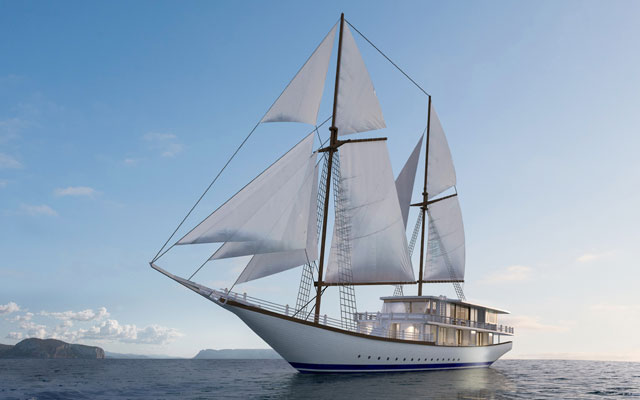
Ayana Hotels’ specially-built Phinisi cruise ship, apparently the largest in the world, will set sail on September 1.
Ayana Lako di’a
Excursions on Ayana Lako di’a (which means safe journey in Balinese) are two-, three- or five-nights in length, and will visit some of Komodo Island’s most famous landmarks such as Komodo National Park, a UNESCO World Heritage site.
Onboard the 54m-long Phinisi vessel – the world’s largest – are nine luxury cabins, which can hold a maximum of 18 passengers. Guests can expect five-star treatment, full dining options and spa treatments.
Master Suite
Water activities such as snorkelling, diving, and stand up paddle-boarding are available, alongside dry activities such as yoga and dolphin watching.
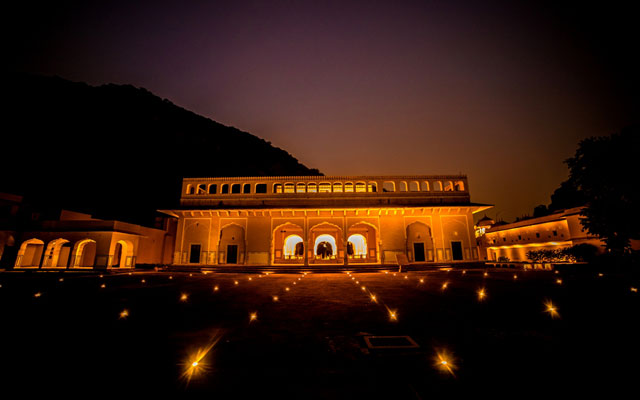
India’s Rajasthan, known for its historical monuments and rich folk culture, is embarking on night tour projects that will give its majestic attractions new life after dusk.
Kicking off in the state capital of Jaipur, projects will cover popular attractions including Amber Palace, Albert Hall, Hawa Mahal and Vidyadhar Ka Bagh.
Vidyadhar Ka Bagh
Since the monuments started operating for night viewing, the night tourism segment has attracted footfalls of 12.2 lakh rupees (US$19,000) and revenues of 12.2 crore rupees, against the total capital expenditure of 4.3 crore rupees made on the installation of lighting fixtures, according to Hridesh Sharma, director of the government’s department of archaeology and museums.
In its endeavour to boost night tourism in the city, the department has revamped Vidyadhar Park, which began opening for night viewing in 2017. Nestled in the lap of a valley and offering a panoramic view of the city, the 350-year-old Vidyadhar Ka Bagh features a lush green garden and beautiful fountains that sparkle with yellow and blue lights at night.
Similar preparations are also being made at the other places in the vicinity including the famed Ghat ki Guni tunnel and Sisodiya Garden.
And while the 16th century Amber Palace has been open to visitors at night since 2015, the department of archaeology and museum is now initiating the Amber by Night campaign to make the attraction even more enchanting beyond dusk.
Albert Hall
Open from 19.00 till 22.00, Amber by Night offers a tour of Jaleb Chowk, Diwan-e-Aam, Mansingh Mahal and Sheesh Mahal. The attraction has been enhanced with lights, fixtures, additional security and a café. A combination of LED & non-LED light fittings has also been added to create mood lighting, themed after different festivals.
Besides an upgrade of basic facilities, major additions include CCTV cameras, electric vehicles and segways.
Furthermore, the department of archaeology and museum has started holding cultural programmes at Amber Fort and Albert Hall, where renowned artistes of Rajasthan and other Indian states will stage cultural performances like kathak (on full moon nights) and other folk dances.
Jaipur’s walled city bazaars and historical gates are also set to come alive at night, with a project underway to provide façade lighting for Chaura Rasta, Tripolia Bazar and Johri Bazar, as well as Sanganeri Gate, New Gate, Ajmeri Gate, Tripolia Gate, Chandpole Gate and Hawa Mahal.
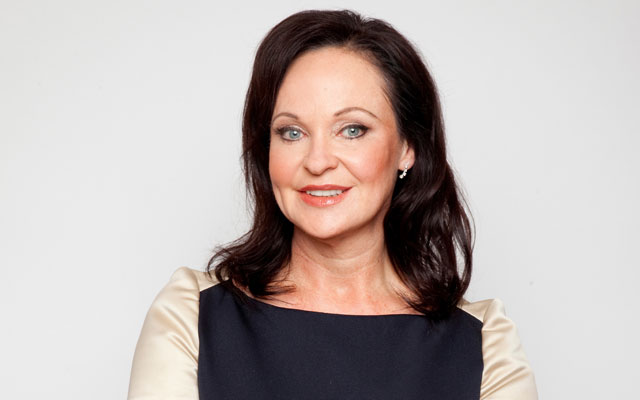
Former president of Fairmont Hotels & Resorts, Jennifer Fox, will helm Millennium & Copthorne (M&C) Hotels as group CEO from June 19. She is also a member of the Board of Directors.
Fox replaces Aloysius Lee, former CEO of M&C, based in London. Tan Kian Seng, who has served as interim group CEO since February 2017, will remain with the group as chief of staff and assume other executive responsibilities.
Jennifer Fox
Prior to joining Fairmont in 2011, Fox held senior positions at InterContinental Hotels Group (IHG) over a period of 10 years, including chief operating office for Europe, and senior vice president overseeing global brand marketing for the InterContinental brand.
She joined IHG from Starwood Hotels & Resorts, where she was global brand manager for Sheraton after spending over 10 years in various operational roles with ITT Sheraton.
Kwek Leng Beng, chairman of M&C, said in a statement: “With her strong leadership and in-depth sales, marketing and branding background, she will play a critical role in repositioning our key hotels, uplifting brand awareness of the group, as well as improving the overall performance of our portfolio.”
Fox said: “I look forward to working with chairman Kwek and the board, together with my new Millennium & Copthorne Hotels colleagues around the world. The group’s distinctive portfolio of iconic properties gives it a strong edge in tackling the challenges in today’s global hospitality market. I see this as a significant opportunity at a time of great change in our industry.”
Muslim tourists sightseeing in Shibuya's Hachiko Square
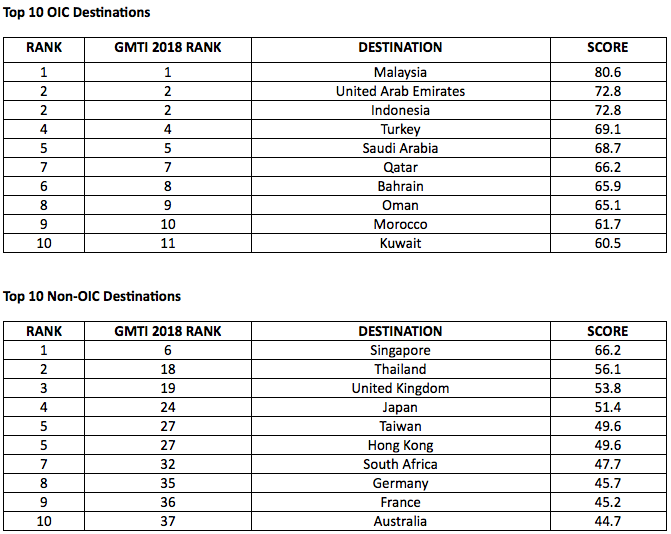
Japan and Taiwan have raced into the top five in a ranking of non-Organization of Islamic Cooperation (OIC) destinations in Asia for Muslim travellers, the latest MasterCard-CrescentRating Global Muslim Travel Index (GMTI) 2018 shows.
Malaysia and Singapore retain pole position in their respective categories on the index, while Indonesia has risen to second place in the OIC category, sharing the spot with the UAE.
Following behind Singapore in the non-OIC ranking are Thailand and the UK. Japan and Taiwan entered the top five for the first time since GMTI was released, in fourth and fifth place respectively.
“We are now starting to see the impact of investment and commitment by destinations across the world into the Muslim travel market which is reaping rewards including a real shift in the rankings. The concerted efforts of destinations such as Indonesia, Singapore, Japan and Taiwan using data and insights from the previous GMTI reports have to be commended as they are now closing the gap,” said Fazal Bahardeen, CEO of CrescentRating and HalalTrip.
All 130 destinations in GMTI2018 were scored based on criteria including access, communications (destination marketing), environment and services. New metrics were added to this year’s index, though these were not named in the joint statement from MasterCard and CrescentRating.
Muslim tourists sightseeing in Shibuya’s Hachiko Square
“This year we have revamped the criteria to better reflect the growth strategies implemented by destinations to welcome Muslim travellers resulting in positive movement across the index,” Bahardeen said.
According to a joint statement by MasterCard and CrescentRating, the Muslim travel market is on course to reach US$220 billion in 2020. It is expected to grow a further US$80 billion to hit US$300 billion by 2026.
In 2017, there were an estimated 131 million Muslim visitor arrivals globally – up from 121 million in 2016 – and this is forecasted to grow to 156 million visitors by 2020, representing 10 per cent of the travel segment.
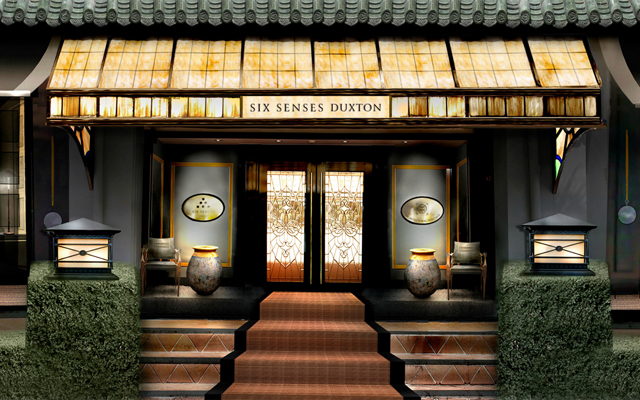
Starting with Six Senses and viewing its ownership, the private equity group Pegasus, money is never meant to sleep and there is clearly mounting pressure to value up the chain. This month marks the operator’s entry into Singapore, with twinned properties the 49-room Duxton and 120-key Maxwell set to address a new segment for the brand.
Looking further afield, in the pipeline is New York City, where a 137-room property will also feature 240 condominium residences.
Six Senses Duxton will feature 49 guestrooms, each unique
Branded real estate is a key element in the luxury hotel group’s pipeline.
Six Senses is not the only top-end brand to understand the importance of branded real estate to chains. Look no further than to global leaders like Four Seasons and Ritz-Carlton whose upcoming projects have a significant number of mixed-use and hotel residence developments.
IHG’s recent transaction with Regent was strongly underwritten on the growth strategy of new hotel residential projects and using that as a means to achieve broader brand penetration.
Shifting over to post-Zecha Aman, owner Vladislav Doronin is looking to unlock the group’s value and clearly this also lies in urban branded real estate. A New York hotel with 83 rooms and 20 residences is a key part of the chain’s move from being resort-centric.
What is challenging though is the relegation of the old-school Amanjunkies and the challenge to reinvent the dynamics with a more commercially-oriented approach.
An interesting facet of branded real estate is the licence or royalty fees for hotel residences. In broad terms these average three to five per cent of residential sales at the top end of the luxury tiers for global brands, yet the niche for bespoke players often sees fees at five-10 per cent which, given the high pricing points of the real estate, can equate to enormous revenue.
Yet, looking at a group such as Six Senses, chain value equates long-term revenue stream and this means a greater reliance on scale. It’s doubtful companies can focus on lifestyle, bucket list 20-40 key properties in the middle of nowhere. Aman’s storybook transaction history is testament to that flawed approach.
I recall seeing Alila’s founder Mark Edleson speak on a operators panel about the painful realisation that yes, scale does matter and getting properties up over 100-keys is essential to a financial lifeline for management.
Dubai-based Dnata is acquiring Qantas’ catering businesses in hopes of growing its presence and servicing more customers across Australia.
Qantas’ catering businesses include Q Catering – with centres in Sydney, Melbourne, Brisbane and Perth – and Snap Fresh, a meal production plant in Queensland that specialises in Australian-made frozen meals for airlines and customers in the healthcare and food retail industries.
Qantas sells catering division to Emirates’ Dnata
Commenting on the agreement, Robin Padgett, Dnata’s divisional senior vice president of catering, said: “This agreement reflects our confidence in Australia as a market and the ongoing growth potential into the future.”
With the acquisition, Padgett said Dnata plans to invest in more infrastructure, starting with a new catering facility in Sydney.
Dnata will supply catering for Qantas flights for an initial period of 10 years, and Qantas will continue to work with key suppliers in menu design and development.
Qantas domestic CEO, Andrew David, added: “The catering businesses will benefit significantly from Dnata’s global footprint, catering expertise and ability to drive investment and growth for what is a core focus of its operation.”
Dnata, part of Emirates Group, already operates 11 catering facilities in Australia, currently trading under the Dnata catering brand (recently rebranded from Alpha Flight Services). The company employs more than 4,000 people in Australia across its catering, cargo and ground handling businesses.
The agreement is subject to approval from the Australian Competition and Consumer Commission.
The Capella Sanya will open along the coastline of Blessed Bay on Hainan Island in 4Q2018, the outcome of a deal between Singapore-based Capella Hotel Group and China Gezhouba Group Real Estate.
Spanning 13.8ha, Capella Sanya features 190 rooms, suites and villas. Accommodation choices include executive suites, two- to four-bedroom villas, a presidential suite within the manor house, and five low-rise mansions.
A rendering of the upcoming Capella Sanya
The resort has six dining concepts including a signature restaurant, a Chinese eatery, a noodle bar and the lobby lounge. A wellness sanctuary offering treatments such as the Moroccan Hammam and ‘Snow Cabin’ complete the experience.
Capella Sanya is collaboratively designed by Jean-Michel Gathy and Bill Bensley, who drew inspiration from the legend of a Chinese trader’s adventures along the Silk Road.
Location Part of a mixed-use complex, this new hotel occupies a prime location in the satellite town of Kelana Jaya, with direct access to two major highways – Federal Expressway and North Klang Valley Expressway – which makes it a breeze to get to Kuala Lumpur and Shah Alam, the capital of Selangor.
From the hotel, it’s also less than a 10-minute drive from the Kelana Jaya and Glenmarie Light Rail Transit stations.
The adjacent upscale Paradigm Mall offers plenty of shopping and al fresco dining options, not to mention a nine-screen cinema, adding value and choices to any work or leisure stay at this hotel.
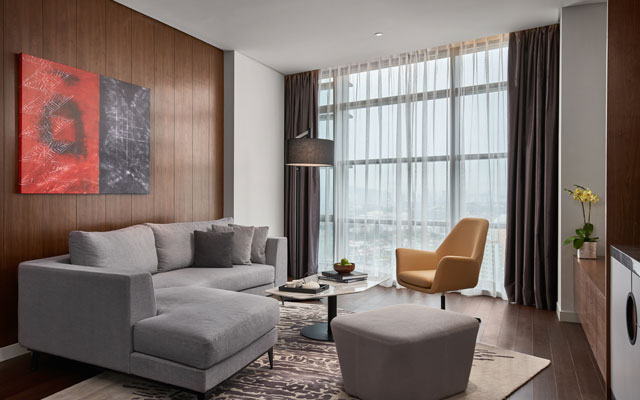
One Bedroom Suite
Rooms
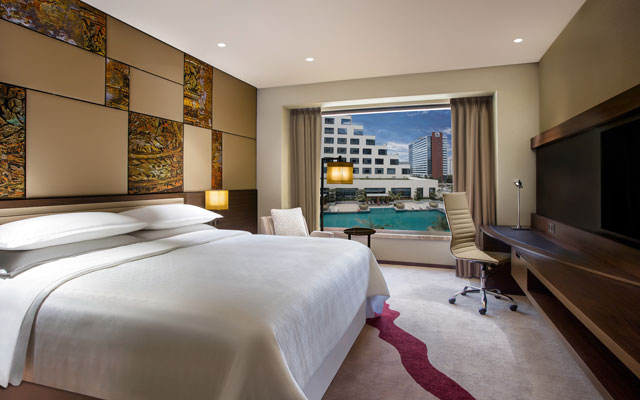
Consistent with the hotel’s use of neutral colours, all the 300 grey-and-brown rooms feature sleek furnishings, marble-clad bathrooms and bamboo flooring – which provides tactile warmth to the feet.
I stayed on level 23 of a 30-storey building, the tallest structure in Kelana Jaya. The floor-to-ceiling glass panels in the bedroom and common space in the bathroom afforded sweeping cityscape views.
Adding to the homely ambiance was the round, wooden worktable that could be easily dragged to any spot in the room. I wish more hotels would think out of the box in ensuring guests’ stay are a comfortable one.
Residence Club rooms and suite guests have access to the New World Hotels’ signature Residence Club Living Room on level 29, which offers exclusive benefits such as complimentary breakfast, all-day refreshments and dedicated concierge service.
F&B
The all-day dining Pasar Baru (meaning new market) on level 2, pays tribute to Malaysia’s multicultural mélange of Malay, Indian and Chinese flavours in a casual, market-style setting.
PJ’s Bar & Grill opened in March as the largest rooftop bar in Petaling Jaya city, featuring a viewing deck that wonderfully captures the city’s panoramic skyline. This restaurant specialises in Western and Asian grilled dishes.
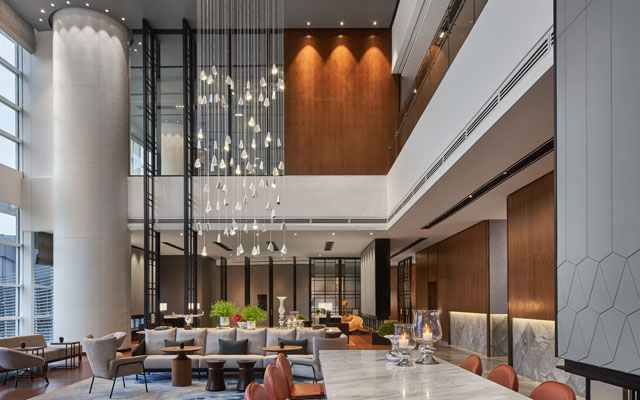
The hotel lobby
The Lounge in the lobby area offers multiple cosy seating areas, and is the perfect place to unwind and relax with friends over a drink, snack and desserts.
Facilities Recreational activities are on the rooftop and a floor below, both offering sweeping views of the city. The state-of-the-art fitness centre also comes with an instructor to assist guests with the machines and to create a workout programme.
The hotel’s event facilities includes a 1,700m2 pillarless grand ballroom which can accommodate up to 1,000 guests in banqueting style and eight meeting rooms over two levels, all with abundant natural light.
Service Excellent. I had connectivity issues way past midnight in my room and a staff came to troubleshoot right away. Another kind staff also helped me to locate my car in the carpark when I forgot where it was parked.
Verdict Fantastic hospitality, plus attentive, friendly staff who made me feel right at home.
No. of rooms 300 Rates From RM350++ (US$89.40) a night Contact details
Tel: (60) 3 7682 0000
Email: petalingjaya@newworldhotels.com
The Sukhothai Shanghai, China
The Sukhothai Shanghai has opened with 170 guestrooms and 31 suites ranging from 44m2 to 172m2. Recreational facilities include a spa, gym, yoga and pilates studio, 25m-long heated indoor pool, sauna and steam room. There are also five F&B venues, one of which is headed by Michelin-star chef Theodor Falser. For meetings and events, the second floor is home to the Grand Shanghai Ballroom and six multipurpose rooms. The hotel is part of the HKRI Taikoo Hui mixed-use complex, which also includes Grade-A office towers and a shopping mall.
Sheraton Grand Bengaluru Whitefield Hotel & Convention Center, India
Marriott International has opened its 100th property in India, the Sheraton Grand Bengaluru Whitefield Hotel & Convention Center. The hotel boasts 360 guestrooms including 39 suites, all of which are equipped with a 48-inch LED flatscreen TV, minibar and The Sheraton Signature Sleep Experience. There are six F&B venues, as well as an outdoor swimming pool, a fitness centre and a spa with five treatment rooms. Meeting and event planners can avail the hotel’s 6,072m2 of function space spread over 12 meeting rooms, including 2,602m2 in the adjoining Convention Center.
Hyatt Regency Seragaki Island Okinawa, Japan
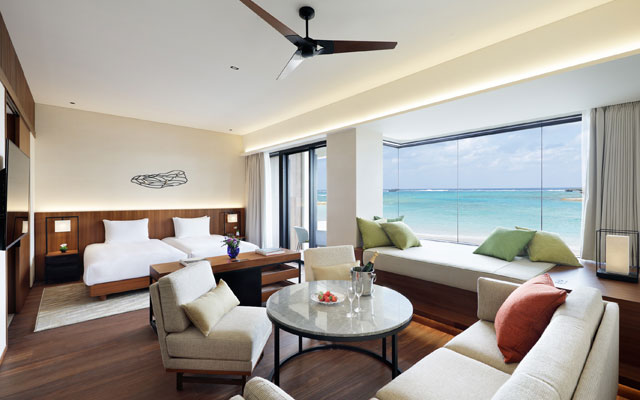
The first Hyatt-branded beach resort in Japan stands on its own island approximately an hour’s drive from Okinawa’s Naha Airport. Of the 344 rooms, 320 will be housed in a seven-storey wing on Seragaki Island, while the remaining 24 will occupy a three-storey beachhouse on the Okinawa side. A short bridge links the two zones, both of which have direct beach access. Standard guestrooms on the Seragaki side start at 38m2, while the 24 beachhouse rooms range from 55m2 to 79m2 and come with kitchenettes or kitchens. Amenities include six dining outlets, five flexible banquet venues from 90m2 to 150m2, as well as a Seragaki Island Chapel. Bookings are now open for stays from September 1 onwards.
Avani Central Melbourne Residences, Australia
The 55-storey, 456-room Avani Central Melbourne Residences is opening in August. Recreational facilities include an indoor swimming pool, gym, two outdoor spas and three entertainment areas complete with BBQs and seating. Guests will also have access to two game rooms, two movie theatres, a library, two communal dining rooms, a communal kitchen and lounge area. Bookings are now open.
Glow Ao Nang Krabi, Thailand
Glow Hotels & Resorts has a hotel in Krabi. The property, located near the beaches of Hat Noppharat and Ao Nang Beach, offers 130 guestrooms. Rooms have four configurations and come with a choice of pool, hillside, town or terrace views. Facilities include free Wi-Fi, an air-conditioned gym, as well as two restaurants – Café’ Au Lait, for breakfast and cooked-to-order dishes; and Chen’s, for casual poolside dining and cocktails.
When Blackfish, a documentary that brought to light the alleged mistreatment of killer whales at SeaWorld Orlando, was released in 2013, it unleashed a whirlwind of negative press and public outrage unto the marine theme park. SeaWorld Orlando continues to feel the wrath of the PR disaster to this day, with a sea of red in its finances, leaders abandoning ship and large-scale boycotts as recently as in March this year.
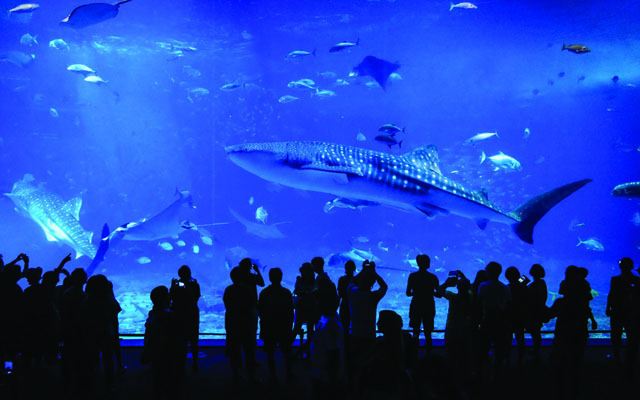
Whale shark tank at Okinawa Churaumi Aquarium, Japan
In Asia, the lessons from SeaWorld Orlando have not fallen on deaf ears. Aquarium operators are giving more thought to the long-term sustainability of the business – with a greater emphasis on conservation interests and animal welfare. And perhaps more often, efforts to stay viable and competitive are focused on innovative storytelling that makes modern aquariums more than just giant fish tanks.
Simon Foong, group managing director/CEO at Aquawalk, which owns and manages Aquaria KLCC, summed this up when he remarked that successful aquariums must have elements of not only entertainment, but also education and conservation.
Animal welfare key to longevity
Jason Horkin, senior vice president of attractions at Resorts World Sentosa (RWS), observed that environmental conservation is becoming a notable trend in the sector, with a sizeable portion of the market becoming more eco-conscious.
To appeal to marine conservation enthusiasts, S.E.A. Aquarium at RWS recently launched a new conservation group, Guardians of the S.E.A.A. Members of the group enjoy exclusive invitations to curated events such as conservation talks and outreach activities, Horkin shared.
In Australia too, many aquarium operators believe that taking the conservation message to the community is both an act of environmental responsibility and a good long-term visitor strategy.
“(Conservation) is very much on trend in terms of growing interest and how we relate that story to our guests, and also getting involved in activities like beach cleaning,” said Rob Smith, Australia and New Zealand regional director for Merlin Entertainments, which operates the Sea Life aquariums in Melbourne and Sydney.
Meanwhile, in the pipeline for Aqua Walk is Aquaria Phuket opening this year-end in the Central Festival Mall, revealed Foong. The new attraction will incorporate a combination of real and virtual fishes, which Foong says solves ethical and logistical issues of confining whale sharks and dolphins in aquariums, as well as brings down the operating costs.
The aquarium will also work closely with Chulalongkorn University on research and breeding fish, information that would be shared with other aquariums.
Ocean creatures, visual effects stars of the show
With entertainment value arguably still of greater immediate relevance to the visitor experience, many aquarium operators TTG Asia spoke with were quick to highlight how they are enhancing visual impact and interest value with technology and innovative storytelling.
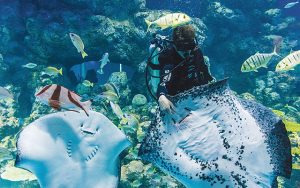
Ray feeding at Cairns Aquarium, Australia
While pools where visitors can handle some marine species have become de rigeur at aquariums, more venues are devising new ways to display their marine attractions as they would appear in the wild.
In some facilities in Japan, this includes the use of projection mapping facilities and lighting to simulate the open ocean and to show the creatures in their natural habitats.
A short rail journey south of Yokohama, the Hakkejima Sea Paradise aquarium – which attracted 1.6 million visitors in 2017 – new innovations have been rolled out in recent months.
“We installed a 457-inch LED screen to deliver dramatic presentations in conjunction with projection mapping technology in the (animal) performance area,” shared Kosuke Sudo, deputy head of operations at Hakkejima.
In Australia, Cairns Aquarium – the country’s newest aquarium in 18 years – is located in one of the most biologically diverse areas in the world, putting it in prime position to feature marine animals unique and endemic to the area, some of which are critically endangered.
Yet, general manager Julie Cullen says the aquarium, which opened last September, has chosen also to give its visitors a rainforest and reef experience.
“It’s designed so that the immersive nature of the theming is extended from what is typically just your behind-the glass (interaction),” Cullen explained. “When you’re walking through the rainforest area, you’ve got soundscapes, shadows, shades and moving lightscapes. (In the mangroves zone), you’re literally walking on the mangroves boardwalk underneath the mangroves roof. And if it’s through the tropics area, you’d be walking through tree roots and creek boulders.”
Cairns Aquarium also boasts acrylic underwater viewing tunnels for visitors to crawl through, including a coral cay allowing explorers to pop up in the middle of a refloat and see how the animals move with the tide. There are also plans to launch student sleepovers in its Oceanarium, which houses large sharks and stingrays in a big circular area.
S.E.A. Aquarium at Resorts World Sentosa
Merlin Entertainment is also creating immersive experiences for visitors with storytelling at its core. Sea Life Sydney recently introduced what it says is a first-of-its-kind penguin exhibition ride, allowing visitors to move through an area designed to resemble the habitat of sub-Antarctic penguins on a small boat.
“What we’ve tried to do here is tell the story of Australia’s Macquarie Island,” said Smith. “You’re able to see and hear the penguins trumpet their noise, which very much brings to life their daily environment.” Sea Life Sydney will also launch a cageless shark dive experience in May.
At Kyoto Aquarium, the emphasis has been on holding unique seasonal events designed to encourage return visits through the year, such as the use of augmented reality technology for its “Hado Shoot? Monster Fight” event last year.
More aquariums in Japan are also trying to raise the visual “wow” factor with size, such as the colossal window on the main tanks at the Okinawa Churaumi Aquarium, which is nearly 9m tall and more than 22m wide, giving visitors a view of hundreds of sea creatures in the pool beyond, which includes no fewer than three whale sharks, the longest of which is 8.7m from snout to tail.
While visual impact can be achieved through size, Foong opined: “It is not about having the largest aquarium, but about doing things differently – using technology and being able to come up with creative displays and exciting programmes that will win hearts.”
Aqua Walk plans to open a new aquarium in Ho Chi Minh City that incorporates high-definition projections and augmented reality (AR). The company is currently on the lookout for a suitable space.
In Singapore, aquariums are filling their year-round calendar with themed performances and seasonal events.
For example, during the recent Lunar New Year, Wildlife Reserves Singapore featured a special manatee show in its River Safari aquarium, the Amazon Flooded Forest, coupled with a zodiac predictions trail. Last year, it brought in a local jazz saxophonist and a 2m-tall cabbage cake to celebrate a manatee’s birthday.
Meanwhile, S.E.A. Aquarium offers 360-degree shark encounters using a cylindrical enclosure and sleepovers in its Open Ocean Habitat, which offers a floor-to-ceiling view of 40,000 marine animals.
Role of aquariums in education
While cynics may see animal welfare as an afterthought to fanfare, the two may not be such disparate concepts after all.
Education, the third element of successful aquariums that Aquawalk’s Foong highlighted, is becoming a key way of marrying entertainment and conservation.
The S.E.A. Aquarium at Resorts World Sentosa has adopted an annual Lunar New Year affair named Gong SEA Fa Cai. During this event, guests are treated to an underwater dragon dance performance and can learn about marine species that are auspicious in Chinese culture – as well as how to save the ocean – through an “edutainment” trail.
Said Horkin: “Through the extensive range of educational programmes, experiences and events, the aquarium aims to increase visitors’ knowledge on aquatic ecosystems, and inspire positive change towards protecting marine species.”
He added that S.E.A. Aquarium helps promote tourism in Singapore by presenting itself not just as a tourist must-see, but also as a “marine classroom to connect the public closer to marine life”.
Also notable is Aquaria KLCC’s recent addition of an AR experience, where endangered animals as well as extinct animals are brought back to life and roam free.
Similarly, Sea Life Malaysia, which will open its doors at Legoland Malaysia Resort in 4Q2018, is aiming to engage and inspire children to learn and care about the ocean and its inhabitants through compelling storytelling and up-close interaction.
Occupying 2,123m2 of land space, the two-storey aquarium will have more than 25 display tanks in 11 habitat zones, featuring thousands of sea creatures.
To enhance the learning experience, Sea Life Malaysia will include interactive elements in every habitat zone. For instance, kids visiting Rock Pool will be able to get hands-on experience to learn more about the natural habitat of Rock Pool, as well as its impact on many other sea creatures.
There will also be a behind-the-scenes tour allowing guests to learn about animal care and food preparation for all sea creatures.
Kurt Stocks, general manager at Legoland Malaysia Resort, which partnered the Sea Life chain to bring the attraction to Malaysia, said: “Quite possibly we will attract a new segment of tourists such as researchers and conservationists.”
Reporting by Adelaine Ng, Julain Ryall, Pamela Chow and S Puvanewary