AccorHotels is integrating Raffles, Fairmont and Swissôtel Hotels & Resorts into its Le Club AccorHotels loyalty programme since acquiring the trio of brands in 2016.
“With the introduction of the Raffles, Fairmont and Swissôtel hotels into one global loyalty programme, our members now have even more destinations and hotels to choose from around the world and our programme is even stronger and more attractive as a result,” said Henrik Berglind, vice president loyalty Asia-Pacific.
Fairmont Jaipur
There are 29 Raffles, Fairmont and Swissôtel properties across Asia-Pacific.
To celebrate the merging of loyalty programmes, Le Club AccorHotels has launched an incentive bonus points offer.
Members booking from July 2 to August 19 will be eligible to earn 1,000 additional bonus Rewards points for stays from July 2 to September 30 at Fairmont, Raffles, and Swissôtel properties across Asia-Pacific.
AccorHotels’ loyalty programme has more than 42.9 million members globally with 13 million members in Asia-Pacific.
Vietjet adds two new North Asian routes, plus Nha Trang-Siem Reap flights
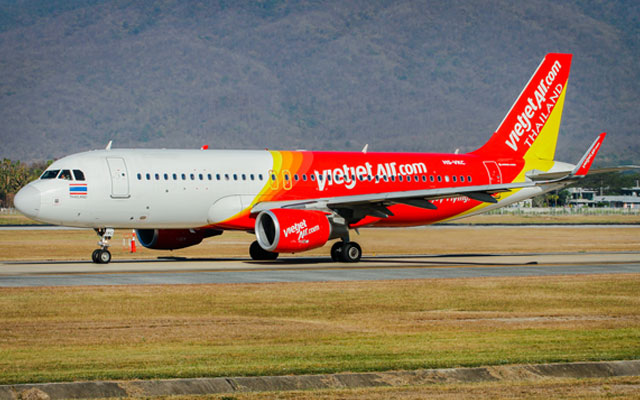
Vietjet has launched Hanoi-Taichung flights, with plans to introduce Hanoi-Osaka flights in November this year.
The Hanoi to Taichung route will operate a return flight every Monday, Wednesday, Friday, Saturday and Sunday. The flight departs from Hanoi at 13.00 and arrives in Taichung at 16.30. The return flight takes off from Taichung at 17.30 and lands in Hanoi at 19.20.
In September, the airline will launch its Nha Trang-Siem Reap service. The flight will depart from Nha Trang at 07.25 and arrive at Siem Reap at 08.45. The return leg will depart at 09.25 and arrive at Nha Trang.
And come November, Vietjet will also commence daily flights between Hanoi and Osaka. The flight will depart from Hanoi at 01.40 and arrive at Osaka at 07.50. The return leg will depart from Osaka at 09.20 and arrive in Hanoi at 13.05.
China Southern inaugurates Sanya-London route
China Southern Airlines will launch the first scheduled nonstop flight from Sanya to London on July 12. Operated with the Airbus A330-200 widebody aircraft, the Sanya-London service will operate on Thursdays and Sundays with flights departing Sanya at 13.15, arriving in London at 18.45. Flights depart London at 22.10, arriving in Sanya at 16.00 the next day.
Philippine Airlines commences Manila-Nanning service
Philippine Airlines is now serving the Manila-Nanning (China) route. Flights depart Manila at 17.50 on Thursdays and Sundays, arriving in Nanning at 21.00. The return flight leaves Nanning at 22.00 and touches down in Manila at 00.55 the following day.
Among regional flights in PAL’s pipeline for the year are Manila-Chitose (Japan) and Puerto Princesa-Beijing.
JAL to continue twice-daily service between Narita and Guam
After adding a second flight on its Tokyo (Narita)-Guam route in March with marketing support from the Guam Visitors Bureau, Japan Airlines (JAL) has announced that it will continue operating twice-daily flights through to March 30, 2019. The route will be operated with the JAL Sky Suite E767-300ER aircraft.
From October 28, 2018 to March 30, 2019, flight JL8943 will depart Narita at 09.25 and arrive in Guam at 14.05. Flight JL8944 will leave Guam at 16.40 for arrival in Narita at 19.25.
Reservations and ticket sales will begin June 27, 2018.
Dusit International has appointed Benjamin Perera as hotel manager of Dusit Princess Srinakarin Bangkok.
Perera first joined Dusit in March 2014 as executive assistant manager – F&B of Dusit Thani Laguna Phuket. He was promoted to resident manager of the hotel in October 2014, and in July last year he took on the same role at the flagship Dusit Thani Bangkok.
Prior to joining Dusit, he spent more than 20 years working in various roles for Hyatt Hotels & Resorts in Moscow, Jakarta, Singapore and Hua Hin.
With the rise of custom itineraries, lesser known destinations in Thailand such as Khao Yai (pictured) are becoming more requested
Tailor-made tours are rapidly growing in popularity among China’s increasingly sophisticated travellers, but South-east Asian destinations can still do more to tap and serve them, shared Chinese buyers at the recent Thailand Travel Mart Plus (TTM+).
Vicky Ni, general manager, Shanghai Huantai International Travel Service, foresees customised travel will “become explosive” within the next two years. She said: “Everyone perceives China to be a mass market but in reality the bespoke segment is growing fast.”
With the rise of custom itineraries, lesser known destinations in Thailand such as Khao Yai (pictured) are becoming more requested
Recognising the growth potential of this segment, Shanghai Huantai has launched a customised travel department last year to craft trips specific to high-end customers’ desires.
While group tours remain a staple market for Sea Lion Holiday, the Guangzhou-based company is already seeing signs of emergence of the bespoke tourism market in China, product manager Yuan Huiju shared.
“Customised tours will clearly be the trend in future, especially for the repeat market, as Chinese travellers will no longer stick to group tours for their return visits to a destination,” Yuan remarked. Plans are afoot too for the company to expand into this segment, she told TTG Asia.
The Chinese tailor-made tour market is especially a fast-growing one for Thailand, observed Fang Yaqin, Beijing-based product manager for Alibaba Group Holding in Thailand, owing to Chinese travellers’ familiarity with the destination.
Chinese repeat travellers to Thailand are more inclined to seek itineraries and programmes customised to their own interests and preferences, she added.
Already, destinations farther afield from Bangkok, like Kanchanaburi and Khao Yai, as well as Koh Lipe and Koh Lanta in the south are developing as new favourites.
The changing trends of the Chinese market clearly bode well for Tourism Authority of Thailand’s (TAT) efforts to target the niche markets in order to grow Thailand as a quality tourism destination, deputy governor for marketing communications Tanes Petsuwan declared at TTM+.
For instance, weddings and honeymoons have been identified by TAT as a niche segment, with the NTO promoting Thailand as a pre-wedding photography destination for young Chinese couples.
However, Thailand still needs to be more innovative and adopt a proactive, rather than reactive, approach to meet the needs of next-gen Chinese travellers, opined Alibaba’s Fang.
“Phuket has a lot of yachts that will appeal to high-end travellers from China but they are not promoting themselves to the Chinese market,” said Fang, urging TAT to go beyond promoting high-end hotels and golf courses to better target Chinese FITs.
“The preferences of Chinese travellers are changing very fast,” she reminded.
The increased usage of artificial intelligence (AI) will enable companies to explore new areas and opportunities, say data science experts as they encourage the travel industry to worry less about the complexity and focus more on the adoption of the system.
Speaking at the Artificial Intelligence and Machine Learning panel organised by Agoda on Monday, Yaron Zeidman, chief technology officer of Agoda, advised: “An important part of data is to collect as much as possible, even if you’re not using it today.”
The adoption of AI is more commonplace, but choosing the right one is also crucial
Agoda employs AI not just in its chat system, but also in recommending similar hotels to users according to their previous bookings and searches.
Idan Zalzberg, Agoda’s vice president, data engineering, added that companies must “empower all employees – not just one team – to access data science” as it is “integral to every part of the product”.
He added: “Don’t fall into the trap of defining AI as a complicated model. Take time to test and find an AI system that you can really trust.”
Zalzberg also recommended the philosophy of “explainable AI”, where companies should not hide but explain what and why data is being used to create more beneficial customer experiences.
Adopting AI now is even easier than before, with new initiatives like AI Singapore in the equation. AI Singapore is a national programme that aims to educate and train companies in building their AI capabilities.
AI Singapore head, AI engineering and AI industry innovation, William Tjhi, told TTG Asia on the sidelines of the event: “Everybody is interested to reap value from AI, but there’s a good chance that the younger (companies) are more interested in building the capabilities (of AI).
“We have a nine-month AI Apprenticeship Programme. The aim is not just to teach (participants), but expose them to real industry projects.”
In order to be selected by AI Singapore, Tjhi reveals that companies should consider the impact of adopting AI and the feasibility of doing so.
“We want them to have data and the right kind of people who can manage by themselves when (the company’s AI functions) take off,” said Tjhi.
UNWTO and Globalia have joined hands to launch a worldwide competition across 164 countries, in an attempt to find startups with innovative ideas capable of revolutionising travel and tourism.
To qualify for the inaugural edition of the UNWTO Tourism Startup Competition, the startups need not be tech-based or early-stage, the partners stressed.
Identifying startups that use innovative ways to improve tourism products and enhance sustainability
According to a joint statement from UNWTO and Globalia, the objective of the programme is to select the best solutions and the most disruptive projects. One area of focus is pioneering proposals for the implementation of emerging and disruptive technologies.
The search will also focus on finding startups that are based on new business models, such as the circular economy. In this regard, one of the pillars of this competition is to give visibility to projects that are committed to enhancing sustainability in tourism.
“Innovation and tourism investment are not ends in themselves; they are means to develop better tourism products, to improve the governance of tourism and to make the most of the proven sustainability of tourism, by creating jobs and generating opportunities,” said UNWTO secretary-general Zurab Pololikashvili.
To participate in this competition, startups must present business models that are related to at least one of four main areas: the future of travel, the tourism experience, environmental impact and community development.
To identify the best projects, UNWTO and Globalia have enlisted innovation consultancy firm Barrabés.biz. The programme will be implemented through the digital platform YouNoodle, a Silicon Valley company in the startup evaluation space at the global level.
Those interested in participating may submit their applications through the programme’s website at www.tourismstartups.org. Applications are open from June 26 to September 3. The projects will be evaluated according to five criteria: uniqueness and viability of the solution, potential impact, business model, scalability and team profile. A jury will evaluate the entries and select the best projects as semi-finalists to be announced in September 2018.
Serviced apartment operator Oakwood Worldwide will expand into Indochina as part of its regional growth strategy, with three properties set to open in Cambodia and Vietnam next year.
“We have been steadily growing our stronghold in China and Japan and are thrilled to be broadening our presence in South-east Asia,” said Dean Schreiber, managing director, Asia-Pacific, Oakwood Worldwide. “Cambodia and Vietnam have been rapidly developing with healthy economic growth rates and this is an opportune time for Oakwood to establish itself as we foresee increasing demand for long-term accommodation.”
From top: Oakwood Residence Hanoi’s façade; an aerial rendering of Oakwood Premier Phnom Penh and Oakwood Hotel & Residence Phnom Penh within the One Park compound
In Cambodia, Oakwood Premier Phnom Penh and Oakwood Hotel & Residence Phnom Penh will feature 220 units and 168 units respectively, offering guests a choice of hotel rooms; studio, one-, two-, and three-bedroom apartments, as well as penthouses.
Both properties will be situated within One Park – a prime mixed-use development comprising office and retail space, medical centre, international school and residential towers.
Over in Vietnam, Oakwood Residence Hanoi will become the brand’s third property in the country after Oakwood Apartments Ho Chi Minh City and Oakwood Residence Saigon.
Situated next to the West Lake on Dang Thai Mai Street, the Hanoi outpost will feature 265 studios, one-, two- and three-bedroom apartments, as well as penthouse units. Facilities include a children’s playroom, swimming pool with pool bar, gym, as well as meeting and restaurant facilities.
All three Indochina properties are slated to open in mid-2019.
Asian Woman Enjoying the Moment, Loma del Plieque Tumbado, Patagonia, El Chalten, Argentina
Rising affluence among a new generation of Asia-Pacific consumers is estimated to add nearly 90 million new travellers by 2025, with travellers more likely to take longhaul trips as income levels gradually rise, according to the Visa Business and Economic Insights Global Travel Study conducted with Oxford Economics.
“Travel patterns are changing among Asia-Pacific consumers. As household income growth continue to outpace economic growth in most countries in the region, overseas travel is not only becoming more common, people are also travelling more often and looking at further destinations such as Europe and the US,” said Glenn Maguire, principal Asia Pacific economist, Visa.
An Asian traveller on the Loma del Pliegue Tumbado trail in Patagonia, Argentina
In Visa’s analysis of 250 cities around the world, it was shown that once a city achieves critical mass of travelling-class household, the likelihood for increased overseas travel rises significantly.
Asia-Pacific households now account for one in three global travelling households, up from one out of four in 2006.
In the case of China, the number of cities reaching the tipping point in cross-border tourism is likely to double by 2025, adding nearly 80 million more households to the global travelling class.
Within the affluent in Asia-Pacific, Singapore travellers have the highest propensity (52%) for longhaul travel. Even among markets with growing middle-income households such as Indonesia (38%) and India (13%), regional travel destinations are becoming popular in line with income growth.
Maguire added: “As more Asia-Pacific consumers begin exploring beyond their national borders, these present opportunities as well as challenges for the tourism industry including travel providers and infrastructure operators including airports, hotels and attractions.
“Our analysis shows that China’s major cities have emerged as key Asia-Pacific destinations. This highlights the fact that China is becoming an increasingly important inbound market, as well as providing the majority of outbound tourist flows. This trend will continue as tourism infrastructure in China develops further.
Outside of Asia-Pacific, international destinations for Haj pilgrimage often marks the first international trip made by Asia-Pacific’s emerging travelling class, he continued.
SpiceRoads Cycling is introducing e-bikes in Vietnam and Sri Lanka, a move it says will allow riders of more varied experience or fitness levels to experience destinations and communities on cycling tours.
In a statement, SpiceRoads Cycling said riders with less experience, lower fitness, injuries or with less confidence in their abilities can enjoy trips and destinations without worrying about being able to keep up.
E-bikes would help riders with less experience to keep up with the rest of the pack
E-bikes would also allow sports enthusiasts to enjoy a cycling tour with a spouse, family member or friend who would otherwise not consider the activity.
SpiceRoads’ managing director Daniel Moylan said: “We believe that cycle travel provides a more authentic, sustainable and memorable travel experience for our customers and the communities they travel to and interact with. E-bikes allow us to be more inclusive of who is able to join our tours and see the world with us.”
The new e-bikes can be hired per tour, as an alternative to standard mountain, road or carbon bike hire.
Sri Lanka e-bikes are Scott Cross-E Sub 20 bikes, while select Vietnam tours feature Giant Explore E+ bikes. Both models use “pedal assist” technology, which engages the bike’s motor once the rider begins to pedal. The more the rider pedals, the more the motor is activated, making e-bikes great for tackling climbs or comfortably cruising at speed.
Costa Cruises and Italian shipbuilder Fincantieri have floated out the brand’s first ship designed and built for the China market.
“As our first ship built specifically for the Chinese market, Costa Venezia marks a new era not just for Costa Cruises and Fincantieri but for the Chinese cruise industry as a whole,” said Mario Zanetti, president of Costa Group Asia.
Costa Venezia
Costa Venezia was designed with the leisure and entertainment preferences of Chinese guests in mind, while also incorporating Venetian cultural elements such as the Carnival of Venice and the city’s gondolas.
In addition to Italian dining, luxury retail and entertainment options, guests would also be able to enjoying home comforts including a range of Chinese cuisines and Chinese-style karaoke bars.
At a length of 323m and measuring 135,500 gross tons with a capacity of 5,260 guests, Costa Venezia will be Costa’s largest ship operating homeport cruises from China. It will also be followed by the launch of its sister ship in 2020, which began steel cutting by Fincantieri in Italy earlier this year.
Expected to set sail in March 2019, Costa Venezia will arrive in China next May after a 53-day voyage following in the footsteps of Marco Polo. For the inaugural cruise, Costa Venezia will depart from Trieste in Italy and make its way through the Mediterranean, the Middle East, and South-east and East Asia before arriving at its final home of Shanghai on May 18, 2019.