TTG Asia
Asia/Singapore Monday, 27th April 2026
Page 1401

Domestic charters, marine tourism shore up boating sector in Thailand’s east coast

0
Aerial view of the Ocean Marina Yacht Club

Thailand’s east coast has seen steady growth in the boating sector in recent years, bolstered by domestic interest as well as a growth in marine tourism, according to a press release plugging the Ocean Marina Pattaya Boat Show.

Based on Ocean Marina Yacht Club’s own research, there was a staggering 730 per cent increase in the number of day trippers departing the venue between 2010 and 2017. In 1Q2018 alone, this figure grew by 66 per cent when compared to the same period in the previous year.

The Ocean Marina Yacht Club saw 66 per cent year-on-year growth and day trip departures in 1Q

This growth of join-in and private charters on the east coast is being driven in large part by Thais, with millennials and Gen-X together making up 60 per cent of Thais experiencing boating today, and weekends being the most popular time to head out on the water.

Travel trends have also contributed to a growth in marine tourism as visitors seek out more individual experiences, according to the press release, which cited the ITB World Travel Trends Report 2017/2018 that showed China, Russia, South Korea, India and Germany in top five international visitors to Pattaya.

In addition, changes to customs rules in 2016 has helped make Thailand more attractive to international visiting yachts, further contributing to overall growth in water-based activities in coastal destinations.

This, together with the growth in millennial travel, increased domestic interest in boating, the Thailand Riviera project and Eastern Economic Corridor – which has seen 45 billion baht (US$1.4 million) of investment pledged by the Thai government – are expected to further the appeal of Thailand’s east coast for both business and leisure.

“The increase in day trips and boat charters on the east coast has naturally led to more conversions into boat ownership. In terms of nationality, Thais are now the third largest enjoying day trips and charter, while we have certainly seen Thais outpacing other nationalities in boat ownership over the last few years,” said Scott Finsten, harbour master of Ocean Marina Yacht Club, organisers of the Ocean Marina Pattaya Boat Show.

He added that domestic interest in boating has been strong at the Ocean Marina Pattaya Boat Show, where 70 per cent of visitors last year were Thai nationals.

The seventh edition of the event is set to take place from November 29 to December 2, 2018 at the Ocean Marina Yacht Club.

On the back of charter growth and increased boat purchases, Ocean Marina Yacht Club completed major expansion works in August 2018 which increased the number of berths by 15 per cent to 455, retaining its position as the largest marina in South-east Asia.


Garuda Indonesia pulls plug on UK service

0

Garuda Indonesia has confirmed that it will no longer serve the UK from the end of the summer season.

Garuda Indonesia will discontinue its route between London Heathrow and Jakarta

The airline will cease its non-stop Heathrow-Jakarta service on October 28. TTG reported last month that the airline had taken flights GA086 and 087 off sale after this date. Garuda said then that the route was “being restructured”.

In a new statement, the airline said: “Passengers planning to travel with us beyond October 28 will still be able to travel to Jakarta from the UK via Amsterdam, Garuda Indonesia’s European gateway, with our SkyTeam Alliance partners servicing the UK – Amsterdam leg of the journey.

Read the full story here.

IATA calls on India to address infrastructure constraints, policies

0
Returning Indian travellers at Indira Gandhi International Airport

IATA has called on the government of India to maximise the potential contribution of aviation to India’s development by addressing infrastructure constraints and government policies that impose excessive costs on aviation.

Growth forecasts for India indicate a trebling of passenger demand by 2037 when some 500 million people are expected to fly to, from or within India. Already, aviation supports 7.5 million Indian jobs and Rs30 billion (US$419 million) of GDP (1.5 per cent of the economy).

Returning Indian travellers at Indira Gandhi International Airport

The financial struggles of India’s airline industry put the stable development of connectivity at risk, IATA stated, further pointing out that India’s carriers are suffering a “double-whammy” of steeply rising fuel costs and the decline in the value of the Indian rupee.

The rise in fuel costs is particularly acute for Indian carriers for which fuel makes up 34 per cent of operating costs — well above the global average of 24 per cent.

“While it is easy to find Indian passengers who want to fly, it’s very difficult for airlines to make money in this market. India’s social and economic development needs airlines to be able to profitably accommodate growing demand. We must address infrastructure constraints that limit growth and government policies that deviate from global standards and drive up the cost of connectivity,” said Alexandre de Juniac, IATA’s director general and CEO.

De Juniac’s remarks came during the opening address at the International Aviation Summit in Delhi, co-hosted by the Indian Ministry of Civil Aviation, the Airports Authority India and IATA to commemorate the approaching milestone of 50 running months of double-digit domestic growth for Indian aviation.

He called for work to develop a comprehensive and strategic masterplan for India’s airports, to open Navi Mumbai as quickly as possible as “urgent relief is needed for Mumbai’s severe capacity bottleneck”.

IATA also encouraged the Indian government to support the broad implementation of its One ID initiative, which uses biometric identification (similar to India’s Aadhar identity card) to save time by eliminating the need for repeated document checks in airports.

Another recommendation is for India to use military airspace to expand airspace capacity for civil operations, with IATA citing the success of a conditional airway opening through restricted airspace over Bhuj.

IATA also expressed its concerns on government proposals for concession contracts at newly developed greenfield airports. “Flexible parameters should be set that are regularly reviewed by a regulator. And we know from bitter experiences in Brazil, Australia and elsewhere that selecting the company that simply proposes the highest concession fee does not yield good long-term results,” said de Juniac.

In addition, the association encouraged the government to look at ways to improve India’s competitiveness such as by zero-rating GST for international travel in line with ICAO principles and international obligations.

And to create a more competitive market for jet fuel, IATA suggests that India adds domestic uplift to the GST framework with full input tax credit allowed, removes fuel throughput fees in line with global best practice, increases competition with common-use open-access infrastructure, among other means.

LADA touts Langkawi as gateway to Kedah, Perlis

0
The Bujang Valley (pictured) is a sprawling historical complex situated near Merbok, Kedah

The upcoming PATA Travel Mart, which will take place in Langkawi next week, is providing a prime opportunity for the Langkawi Development Authority (LADA) to position the Malaysian holiday island as a gateway to the states of Perlis and Kedah.

A 3D/2N fam tour to Perlis and Kedah will be organised for 60 interested buyers from 25 countries attending the tradeshow, shared LADA’s CEO, Azizan Noordin.

The Bujang Valley (pictured) is a sprawling historical complex situated near Merbok, Kedah

The fam trip – organised by LADA with support from the state government of both states – will be scheduled one day after the mart ends, from September 15-17. Products will revolve around ecotourism, cultural and historical themes, and itinerary stops include Bujang Valley, Jerai Geopark, Kelam Cave, as well as homestays.

Azizan added that local inbound operators from Kedah and Perlis will also come armed with ready-made packages to promote to foreign agents attending PATA Travel Mart.

PATA Travel Mart 2018 is expected to attract some 274 buyers, of which 50 per cent are from South-east Asia and the Asia-Pacific – both focus markets for Malaysia and contributing more than 70 per cent of tourist arrivals.

This year will also see the highest number of sellers from Malaysia taking part, totalling 67, including state government tourism bodies from Sabah, Sarawak, Selangor, Penang, Labuan, Kedah and Johor.

Park Inn by Radisson to check into Phuket Town

0
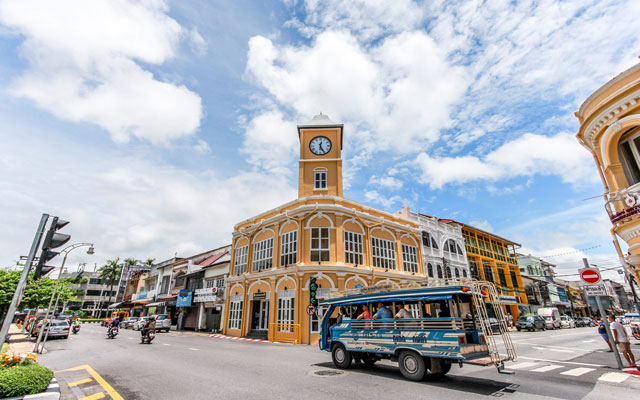
Sino-Portuguese architecture with local passenger bus in Phuket Town (pictured)

Park Inn by Radisson, the upper midscale brand of Radisson Hotel Group, will make its debut in Thailand with the launch of a new hotel in Phuket Town.

Scheduled to open in 1Q2020, the three-storey Park Inn by Radisson Phuket Town will form part of a mixed-use development. The property will feature around 130 rooms offering complimentary Wi-Fi, while facilities will include a restaurant and a fitness centre.

Phuket Town (pictured) is the next stop for the hotel group

The hotel will be located next to Highway 402 – Phuket’s main north-south highway and a major commercial corridor. Guests will also have easy access to major shopping malls, including the Central Festival Phuket, King Power Duty Free Store and Blu Pearl – The Mall Group’s multi-billion-baht lifestyle development featuring multiple retail outlets, a water park, convention centre and theatre.

Park Inn by Radisson Phuket Town will be the brand’s fourth location in South-east Asia, following Park Inn by Radisson Davao and Park Inn by Radisson Clark in the Philippines, and Park Inn by Radisson Putrajaya in Malaysia. The brand now features more than 150 hotels globally.

Mark Kobayashi now SVP sales and marketing at The Peninsula Hotels

0

The Peninsula Hotels has appointed Mark K Kobayashi as senior vice president, sales and marketing.

Reporting to the COO in his new role, Kobayashi will be responsible for global marketing, sales, revenue, brand marketing, communications, e-commerce, digital marketing, guest engagement, global guest database management and the global customer service centre.

Kobayashi began his career with The Peninsula Hotels in October 2006 when he joined The Peninsula Tokyo as director of public relations. He was then promoted to regional director of communications, Japan, in 2012. Three years after, he became director of marketing, Japan.

Later in March 2017, he relocated to Hong Kong where he held the post of vice president, marketing, The Peninsula Hotels.

Kandima Maldives throws its first tomato festival

0

Last week, Kandima Maldives hosted the first-ever Tomato Festival ‘La Tomatina’ to take place in the island nation.

Over 300 people attended the four-hour event, packed with fun-filled beach games including a tomato fight, tug of war, mini football, water bucket relay and climb the coconut tree.

During the event the house DJ entertained the crowd with his party mixes while the barmen served free Latino-themed snacks and drinks.

The first festival of tomatoes was held in 1945 in the Valencian town of Buñol, where participants got in tomato fight for entertainment.

GM announced for Hotel Okura Manila ahead of opening

0

Okura Hotels & Resorts has appointed Jan Marshall as general manager of the 170-room Hotel Okura Manila, which is slated to open in 1Q2019 within the Manila Resorts World complex.

Marshall is a managing executive officer of Okura Nikko Hotel management, having spent more than 15 years with the group. Previously, he served as general manager of Hotel Nikko Osaka. He also has spent time as general manager of Sofitel Tokyo and director of operations for Accor Japan.

He has accumulated broad working experience throughout the US and Asia, where he spent the last 20 years of his career. His postings include Los Angeles, San Francisco, Manila, Sydney, Bali, Jakarta, Tokyo and Osaka.

Lee Chee Koon takes up mantle as CapitaLand chief

0
Lee Chee Koon to be CapitaLand’s new president and group CEO

CapitaLand’s group chief investment officer Lee Chee Koon will become president & group CEO from September 15, taking over from Lim Ming Yan who gave notice to retire earlier this year.

Lim will continue to serve as a board director for the company until December 31, 2018.

Lee Chee Koon to be CapitaLand’s new president and group CEO

Lee first joined the company in February 2007 and has held several appointments within the group, including as CEO of Ascott, CapitaLand’s wholly owned serviced residence business.

Before joining Ascott in July 2009 as managing director for China, Lee was vice president in the office of the president at CapitaLand. Prior to joining CapitaLand in February 2007, he held appointments in various ministries such as the Ministry of Trade and Industry, Ministry of Finance and the Monetary Authority of Singapore.

Meanwhile, CapitaLand has appointed group COO of CapitaLand Group Jason Leow Juan Thong as president (Asia & retail) and CEO of CapitaLand China Lucas Loh Jen Yuh as president (China & investment management), effective September 15.

In his new role, Leow will look into growing the Group’s presence in Asia (excluding China), including Singapore and Vietnam, as well as to expand its retail business.

Loh will be responsible for overseeong the growth of China as a core geographical market for the group, as well as the expansion of its investment management business.

Both Leow and Loh will report to Lee in their new positions.

Tech-driven differentiation key to Asian airlines’ growth: Sabre

0
Amadeus says it is one of the first providers to have achieved level three certification both as an aggregator and IT provider

Despite acknowledging the power of innovative technologies to enable new ways to sell, a majority of Asia-based airlines surveyed by Sabre admit to falling short of their ideal ancillary sales vision.

Sabre Corporation recently surveyed 30 Asia-based airlines, and the results indicate that carriers are re-evaluating their strategic focus as they think creatively about new ways to generate revenue and increase yield.

Nearly 80 per cent of airlines surveyed say they did not meet their desired ancillary sales vision

Close to 70 per cent of the airlines who participated in Sabre’s study indicated that two main factors are influencing change: technological advancement and increasing traveller expectations.

With travellers expecting unique, targeted offers from their shopping experience, over half of the survey participants (53 per cent) believe that leveraging data intelligence, whether to gain insights into market trends or passenger behaviour, is a top growth area for their airline.

Yet, 80 per cent of the airlines surveyed claim to not have achieved their desired ancillary sales, and only one in five respondents have identified product differentiation as their airline’s strategic focus.

The results, which were announced by Sabre last week at STX Singapore, demonstrates a significant opportunity for Asia-Pacific airlines to create a personalised retail experience for the traveller as a means to differentiate their products and drive incremental revenue.

“With consumer trends evolving as fast as the markets they serve, airlines have the potential to generate significant growth by efficiently channelling their content with innovative technology solutions that harness artificial intelligence and machine learning,” said Rakesh Narayanan, vice president, air line of business, Sabre Travel Network Asia Pacific.

“Our Beyond NDC programme drives collaboration with airlines and agencies to help them create rich personas and micro-segmented offers using rich data that support their business objectives.”

Ancillary sales have increased by 88 per cent year-on-year in the region, but reports show the same top ancillary requests appear across all markets: baggage, seat selection and meals. While in-flight Wi-Fi is increasingly featured in the top three most popular ancillaries, accounting for a quarter of business traveller requests in Asia-Pacific, there remains room for airlines to partner with technology leaders to help them up the ante on competitive differentiation.

Sabre opined that successful retailers understand that the key to delivering curated experiences lies in tailoring offers to distinct buying personas, requiring a robust data-sciences approach to maximise individual consumer engagement as well as end-to-end profitability.