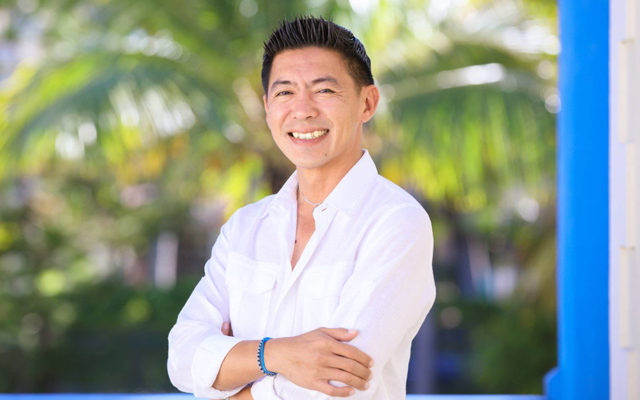
Teddy Susanto Wiryawan has joined Alila Villas Koh Russey as general manager, moving to Cambodia from his most recent appointment as general manager of Alila Jakarta.
The Bali native has over 20 years of experience in five-star luxury hotels, such as Como Hotels & Resorts, Ritz Carlton, Grand Hyatt and Shangri-La, across destinations spanning Bali, Bhutan, Bangkok, Dubai, Singapore and London.
Wiryawan has also demonstrated his leadership at luxury properties in Turks & Caicos Islands, leading the pre-opening of Sailrock Resort and running the Como Parrot Cay.
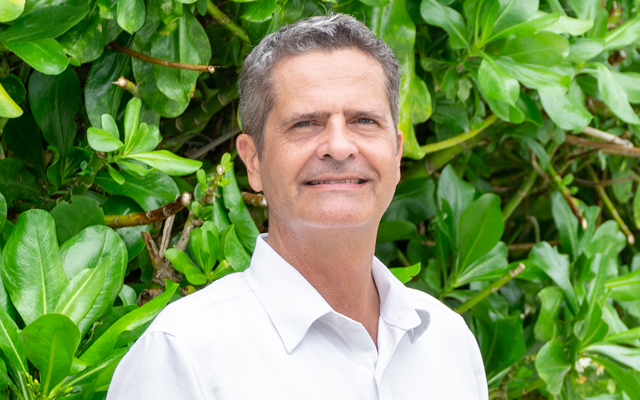
Forbes Travel Guide, a global rating system for luxury hotels, restaurants and spas, has appointed Mark Simmons to the role of senior vice president, partner services – Asia-Pacific.
Based in Hong Kong and Singapore, Simmons is responsible for driving Forbes Travel Guide’s strategic objectives within Asia-Pacific, which includes developing the company’s support services clientele.
A British and Australian national, Simmons possesses more than 25 years of luxury hospitality experience. He has held senior-level positions for leading hospitality brands in Asia-Pacific and the Middle East. Previous roles include director of sales, Asia-Pacific, Accor; area managing director, Asia-Pacific, Preferred Hotel Group; vice president sales and marketing, Asia-Pacific, Outrigger Hotels & Resorts; and area sales and marketing head, Swiss-Belhotel International Asia.
Simmons was also previously owner and director of Delivering Asia, a hospitality sales and marketing company, and a member of The Delivering Group.
Dusit International has appointed Thomas Weber as general manager of Dusit Thani Maldives.
The Swiss national brings with him more than 25 years of international experience leading pre-opening and operational hotels for brands such as Sun International, Hilton, Mövenpick, and The Leela.
His experience has taken him to seven different countries, including Hong Kong, South Africa, Saudi Arabia, India, Kenya, Switzerland and the Maldives.
Prior to joining Dusit International, he held the position of regional general manager Maldives for the five-star Diamonds Thudufushi Resort and Athuruga Resort, both under the Planhotel Hospitality Group. He was also involved in the pre-opening of Sandies Bathala, a new resort with 70 rooms and overwater villas.
Over the course of his career, he has also served as general manager of Mövenpick Resort Al Nawras, Jeddah, Saudi Arabia; Mövenpick Hotel & Spa, Bangalore India; and Oberwaid Kurhotel & Privatklinik, St Gallen Switzerland, among others.
In a move that signals the acknowledgement of the growing significance of the creative economy in tourism, Indonesia’s Ministry of Tourism has been renamed in a nomenclature change as president Joko Widodo unveiled his new cabinet on Wednesday.
This rename returns the nomenclature to the Ministry of Tourism and Creative Economy during the term of the sixth president, Susilo Bambang Yudhoyono, between 2011 and 2014.
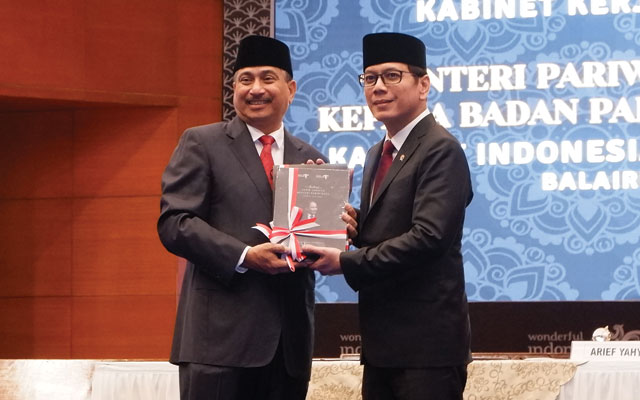
Indonesia’s former minister of tourism and creative economy Arief Yahya (left) passes on the leadership baton to Wishnutama Kusubandio at the unveiling of president Joko Widodo’s new cabinet (Photo Credit: Kurniawan Ulung)
Wishnutama Kusubandio has replaced Arief Yahya as Indonesia’s new minister of tourism and creative economy, renewing optimism in travel trade members that Indonesian tourism can be further developed and its quality improved.
Hailing from a media background, Whisnutama began his career in the TV industry in 1994. The 43-year-old has had an illustrious career, starting as a supervisor and rising through the ranks to become president director. In 2013, he established Indonesia’s NET TV.
Whisnutama’s experience in the media and creative industry led president Jokowi to appoint him as creative director to helm the opening and closing ceremonies of the 2018 Asian Games.
Industry leaders in Indonesia’s tourism sector expect Whisnutama’s background and experience to serve him well in his new post and they are hopeful that he will be able to take the country’s tourism to new heights.
Budijanto Ardiansyah, vice president of the Association of the Indonesian Tours and Travel Agencies, commented: “We know that Whisnutama is a creative person, and I hope he can transmit his creativity into making (Indonesia’s) tourism more attractive. I really hope he will bring a new energy and more creativity that will further enhance the tourism industry.”
For Haryadi Sukamdani, chairman of the Indonesia Hotel and Restaurant Association, what matters is not the nomenclature change, but the choice of leader spearheading the office.
Haryadi said that Indonesia’s tourism industry needs a head who can hit the ground running. “We have no time to allow the leader (minister) to learn and start from scratch again otherwise Indonesia will be left behind.”
On the other hand, Budi Tirtawisata, chairman of the Indonesian Convention & Exhibition Bureau, said: “Whisnutama (who has no tourism background) may not be the figure that the industry projected for this post, but he brings new hope, especially to the (business) events industry.”
Budi’s hope is that the new minister would shine attention on the business events industry, which in the last five years, has been neglected by the government.
“I have no doubt that he can successfully bring tourism forward as long as he is willing to communicate with the industry and learn fast,” he said.
Hosea Andreas Runkat, chairman of the Indonesian Exhibition Companies Association (IECA), is also hopeful about the new appointment. “I hope that the new minister will not focus on the numbers only, but also on increasing foreign exchange and making Indonesian tourism more attractive. I really have high hopes that the new minister can see that there are two sides to tourism: Leisure and business events. And I think business events demand creativity, which is in line with the concept of creative economy.”
Hosea also expressed his desire for Whisnutama to engage more with the private sector and listen to their feedback. He said: “IECA and all the stakeholders in business events are eager to work closely with the new minister to take tourism to greater heights.”
Speaking following the handover of post from former minister Arief Yahya, Whisnutama said that a destination becomes unique if stakeholders and the community work together to creatively manage its nature. He reckons that creativity is not only key in managing products in the creative economy such as film and music, but also in tourism, especially with regards to how to make tourism destinations have unique attractions.
“Indonesia exhibits natural beauty. It’s a gift from God. It’s up to our creativity to turn it into an extraordinary attraction for tourists,” he said.
Although Whisnutama said that he needs time to learn and explore, he thinks that as a start, the tourism sector can create events to attract tourists to Indonesia.
He said: “Events can bring a different experience and attract people to come. Therefore, we must create events. If it is necessary, we will bid on an international event, as long as it is a good event and makes people want to visit Indonesia. Whatever the event, I hope it can be a good starting point for people to see Indonesia as a great country to visit.”
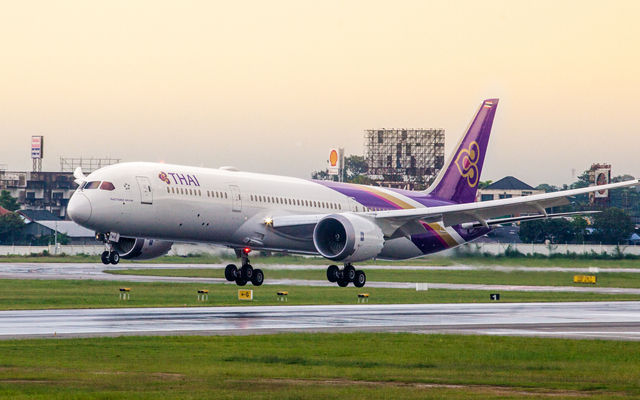
Thai Airways International (THAI) has refuted recent news reports that the company is at risk of shutting down.
THAI president Sumeth Damrongchaitham said in a statement that these news reports were a result of misconstrued messages conveyed during a meeting with the airline’s staff, which highlighted the highly competitive state of the airline industry and THAI’s competitive stance in the market.
THAI’s president denies that the company is at risk of closing down
With increased competition in the airline industry, Sumeth had urged THAI staff to take heed of the cut-throat competition between airlines in all areas of business, including LCC competition and airfare promotions, said the airline in a statement.
THAI’s staff were told to take immediate action to cut costs and boost profits to maintain the airline’s competitive edge in the industry, it added.
To get more Asians on board cruising holidays, industry leaders are rolling out more immersive and pampering products that regular travel cannot offer, from free-and-easy concepts to expeditions and river cruises.
Industry players speaking at the Cruise Lines International Association’s recent cruise seminar in Singapore were especially keen to share with travel agents how today’s highly diverse vessels make cruises an attractive option for all traveller types.
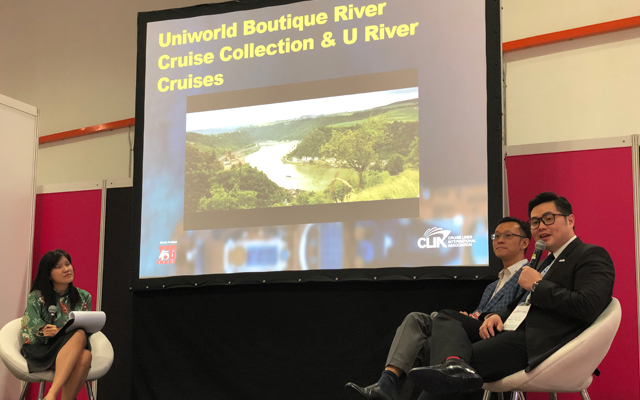
CLIA’s Jiali Wong moderating the session with Norwegian Cruise Line’s Felix Chan and Uniworld Boutique River Cruise Collection & U River Cruises’ Henry Yu discussing new cruise offerings at recent CLIA’s cruise seminar in Singapore
For instance, multi-generational families will enjoy larger ships offering a wide gamut of experiences afforded by companies such as Royal Caribbean Cruises (RCCL) and Norwegian Cruise Line, while more modern and easy-going travellers may prefer more intimate river cruises by Uniworld or wellness concepts on board Regent Seven Seas and Oceania Cruises.
Some companies have also reached out to partners and authorities to collaborate on enhancing the passenger experiences on and off the ship. For example, RCCL is working with the Singapore Tourism Board and Changi Airport Group to allow guests to purchase seamless transfers, relax in the Jewel Lounge, and have staff transport their luggage to the cabin.
“These custom opportunities for clients are especially great for groups with early arrivals into Singapore,” said Angie Stephen, managing director, Asia Pacific, RCCL.
In the case of Regent Seven Seas and Oceania Cruises, both liners under Norwegian Cruise Line Holdings (NCLH) have collaborated with wellness brand Canyon Ranch to offer spa services, yoga classes on the beach, healthy-eating workshops and tailor-made diets onboard the ship for guests.
“Asians don’t just want to be pampered on board a ship,” said Felix Chan, vice president & general manager Asia, NCLH. “This segment is very curious – more than 90 per cent of our guests will go on shore excursion tours. They are really looking for exotic and unique destinations where very few tourists can go, but which the smaller ships can.”
The cruising experience has also been redefined by personalised engagement with guests, shared Henry Yu, director, Asia, Uniworld Boutique River Cruise Collection & U River Cruises. For instance, the company organises pre-trip afternoon tea gatherings with guests to run through details and highlights of the cruise.
Post-trip, the crew gifts handwritten postcards to guests to create “a very good relationship between consumers and cruise liners”, elaborated Yu.
ASEAN Tourism Forum (ATF) 2020, set to take place in Brunei from January 14 to 16 at the BRIDEX International Conference Centre, will boast a new business speed-dating component to the three-day TRAVEX programme.
Set to be held on the first day of the TRAVEX trade fair, all attending buyers and sellers will have the chance to meet and swap contacts in this fast-paced activity, prior to business appointments and exhibition days.
ASEAN Tourism Forum 2020 will feature a new business speed-dating segment to the TRAVEX programme
“We wanted to create additional lead generation platforms for delegates to benefit from the entire ATF 2020 experience. Each delegate can easily expect to exchange at least 60 business contacts during this period. This is on top of their pre-scheduled business appointments over the next two days,” said Darren Ng, managing director of TTG Asia Media.
TTG Events, the organiser of ATF TRAVEX 2020, is targeting a minimum 1:1 buyer-seller ratio, with confirmed representation of suppliers from all 10 ASEAN destinations.
Booth spaces are filling fast. Buyer hosting programme is still open and in its final phase with over 500 registrations received to date.
Asia-Pacific’s hotel transaction volumes are expected to increase by 25 to 30 per cent year-on-year to more than US$11 billion in 2019, as investors are increasingly drawn to safe haven assets in the region’s key gateway cities, according to research by global real estate consultancy JLL.
“Despite a cautious economic climate and wider political headwinds, hotels in Asia-Pacific present an attractive yield profile amid booming tourism demand, in the context of falling interest rates and bond yields,” said Mike Batchelor, CEO, JLL Hotels & Hospitality Asia Pacific.
Asia-Pacific’s hotel investments in the first nine months of 2019 have hit US$7.8 billion, with Japan the region’s top performing market, accounting for nearly US$3 billion of transaction volumes
“Much demand this year has been buoyed by private equity firms, developers and domestic clients. This leads us to believe that 2019 will be the third most highly-transacted year in the past decade. To date, only 2017 and 2015 have surpassed the US$11 billion threshold.”
According to JLL, the first nine months of the year have already seen US$7.8 billion worth of hotel investments in the region. Thanks to Japan and its series of mega events such as the 2019 Rugby World Cup, 2020 Tokyo Olympic Games and 2025 World Expo, the country has reached close to US$3 billion of transaction volumes so far.
“These tourism drivers will boost the need for accommodation assets, with investors looking to capitalise on the wave of demand. Japan is the region’s top performing market and forecasted to hit a record high of US$4 billion in transaction volumes this year,” added Batchelor.
Across the region, the hotel market outlook remains positive. Over in China, softening office leasing demand and sluggish retail sales have turned investors’ attention towards hotels, where trading performance has been resilient.
Elsewhere, Singapore has seen a few landmark deals this year. In September, JLL advised OUE to sell Oakwood Premier OUE Singapore to a Hong Kong joint venture for US$209 million. Most recently, JLL concluded the US$344 million agreement to sell Andaz Singapore in the largest single-hotel asset transaction ever in the island city’s history.
The report revealed that while domestic investors have been active in their home markets, particularly in Japan and China, there remains an influx of foreign investment looking to tap into the region’s strong tourism growth and high yields.
South Korea, for instance, has seen a spike in international investor interest in 2019. Overseas investors are gaining increasing access in a tightly-held market as more institutional investors look to exit their investments after the pre-specified hold periods.
Nihat Ercan, managing director, head of investment sales Asia, JLL Hotels & Hospitality, said: “Up until 2015, transactions in South Korea were almost purely domestic, but today cross-border deals make up about a quarter of total transactions. As the market matures further, we can expect foreign investors to make up a larger proportion of trading volumes.”
Another recipient of continued foreign capital is the Maldives, as identified in the report. Its reputation as a sought-after tourist destination has attracted more than US$260 million in cross-border deals alone this year.
“As both overseas and domestic investors seek out higher yielding opportunities across Asia-Pacific, the hospitality sector will continue to shine. We’re confident that this investment momentum will continue to drive the region’s hotel transaction volumes going into 2020,” concluded Ercan.
Stacy: Relevance is key driving force for brand loyalty in current climate of heightened competition
The travel industry in Asia-Pacific continued to remain resilient through the first quarter of the year, despite slowing economic growth in the region. Yet, some early signs of a slowdown have begun to emerge. Against a backdrop of mounting fears of a global recession and falling consumer confidence, it is no wonder that the region has adopted a modest 2019 industry forecast. For travel marketers, this means harder work is required to win share of wallet in a tightening market.
In an environment of flattening demand and rising competitiveness, travel marketers need to shift their thinking. They must commit their limited resources to the most valuable groups of customers – not only those who spend the most now, but those with a high lifetime value, who are likely to spend the most in the future.
While some of the insights into customer value are readily available through booking channels and loyalty behaviour, a bigger commitment to achieving deep understanding of the customers through other touchpoints is required. Only then can travel brands deliver truly relevant marketing and future-proof themselves in the face of adversity.
Deeper commitment to knowing your customers
Travel brands amass a vast amount of traveller data on a daily basis – search, booking, loyalty, customer service, and even data from other brands through established partnerships. However, this data can be limiting in that it aims to provide an understanding of the highly complex customer through just a few facets of the individual.
Such data is insufficient for determining a customer’s lifetime value and travel marketers need to commit to broad information gathering to truly understand their vibrant individual customers. This has led to second-party data sharing becoming more common in Asia-Pacific, as travel brands look to partners to get a panoramic view of customers’ behaviours and intentions. For instance, Changi Airport group looks at both second- and third-party data from multiple sources, in addition to first party data collected through point-of-sale at retail stores, Wi-Fi and CRM. Similarly, Malaysia Airlines has established second-party partnerships, especially with credit card companies through its loyalty programme.
This kind of data exchange allows travel brands to tailor personalised marketing campaigns based on in-depth audience insights, while leveraging the value of real-time data to identify shifting behavioural trends of their customer base.
Travel loyalty programmes exist to influence behaviours in favourable ways. However, in Asia-Pacific’s uneven loyalty landscape, where markets stand at different points of the maturity curve, travel marketers face the daunting task of keeping existing loyal customers in mature markets engaged, while also accurately isolating and targeting high-value travellers in emerging markets.
In this era of digital-based competition and heightened customer control, relevance has become a key driving force for brand loyalty.
Studies show that customers who donate the most data are the ones that expect greater personalisation in the marketing messages they receive. Combine this with the emerging trends of last-minute bookings and mobile-first experiences, and travel marketers must be able to strategically leverage on data from various touchpoints to understand each individual’s preferences at a higher granularity.
Knowing more about each customer can also help travel marketers prioritise the most valued ones. For instance, loyalty members can be scored based on the points they have, the types of trips that are earning these points from, their level of activity, where points are being channelled to and how often they cancel. These insights can then point towards the indicators used in customer relationship building.
In the pursuit for sustained attention of existing loyalty members, travel marketers must not neglect potential customers. Not every valuable customer is necessarily already part of the loyalty programme, and travel brands that use a wider array of inputs are better poised to unlock future value.
Increasing brand stickiness
Marriott reported the symbiotic relationship between growing loyalty members and greater owner benefits for the year of 2018, proving that loyalty programmes can grow through exciting destinations, accommodations and service offerings that are new, better and more relevant to customers’ needs and preferences.
As the travel sector faces a world of renewed expectations, travel marketers must understand that digital capabilities and advantages that were once differentiators are now readily available to all. For brands to remain relevant, it is also imperative that existing capabilities and technologies are used to reinvent service offerings that address the pain points of travellers. For example, Delta pioneered the use of RFID technologies to track baggage. It has helped to alleviate the issues of lost or delayed baggage, while conferring travellers globally with greater control of their flight experience.
The proliferation of travel options across Asia-Pacific has also altered the notion of brand stickiness. Many travel programmes do a great job with providing different ways for members to redeem miles or points, but more often than not, they aren’t tailoring other elements of the programme, such as messaging, which feel generic and sometimes totally irrelevant. Being able to tailor the types of upgrades customers value is one of many examples of how loyalty messaging could be made more relevant.
It remains to be seen if travel in Asia-Pacific will be hit with a recessionary chill in the coming months. However, as savvy travel brands know, this is an opportune moment to future-proof. Travel brands must focus on maintaining brand relevance in a region where travellers are ever-evolving. Though the addition of data-driven elements to marketing efforts may add additional layers of complexity in the short-term, it may very well be the difference between success and failure in the long-term.
InterContinental Hotels Group (IHG) has appointed Steve Carroll as senior vice president, capital investments & transactions Europe, Middle East, Asia & Africa (EMEAA) and Greater China.
In his new role, Carroll will be responsible for asset management, including dispositions, restructuring and actively managing investment positions, with a focus on IHG’s EMEAA and Greater China regions.
He will continue to work closely with IHG’s development teams to drive growth through its strategic approach to M&A and capital transactions, as well as IHG’s Americas team, to take advantage of cross regional opportunities and capital flows.
Carroll has been with IHG for more than five years, having rejoined the business in 2014 as vice president, corporate finance, acquisition and mergers.