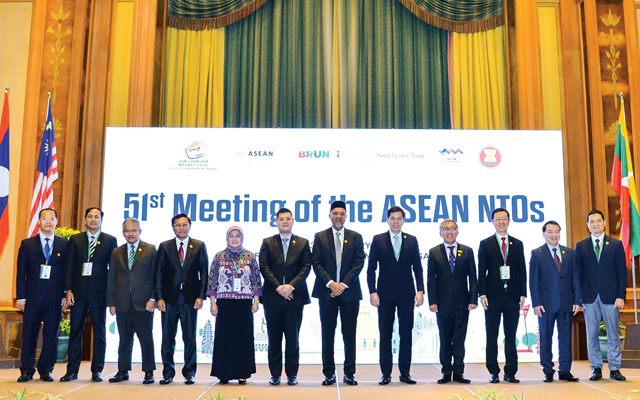
Malaysia has pledged its commitment towards promoting South-east Asia as a competitive tourism destination, while balancing its development with sustainability and inclusive development, during the 51st ASEAN Tourism Organisation (NTOs) Meeting in Brunei this week.
As country coordinator, Malaysia will be collaborating with the ASEAN-China Centre to organise the ASEAN-China Tourism Investment Seminar in Shanghai, China, in November 2020.
Malaysia pledges to help promote South-east Asia as a single destination; tourists learning about the environments in Pahang National Park, Malaysia
Malaysia will also be leading the initiative to promote South-east Asia as a single destination by updating the ASEAN Tourism Packages 2019-2020 that can be used by the NTOs and private sectors to attract more tourists, especially from the medium-haul and longhaul markets.
Furthermore, as the incoming chair of the ASEAN Sustainable and Inclusive Tourism Development Committee for 2020-2021, Malaysia will be working closely with the other ASEAN members to initiate and implement more meaningful activities for the new ASITDC Work Plan 2020-2021. In relation to this, Malaysia will be leading the mid-term review of the Plan.
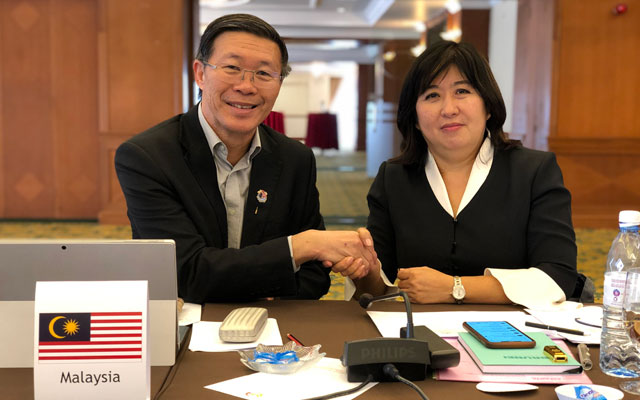
Malaysia’s delegation at the 51st ASEAN NTOs Meeting was led by Noor Zari bin Hamat, secretary-general, Ministry of Tourism, Arts and Culture, Malaysia.
Business is as usual at the Philippines booth at ATF
Philippine tourism representatives at ATF 2020 this week have reported business conversations as usual despite Taal Volcano’s elevated activity in the Batangas province of Luzon, and the cessation of tourism activities in the vicinity.
Arnold T Gonzales, officer-in-charge and deputy chief operating officer for marketing and promotions with Philippines’ Tourism Promotions Board (TPB), told TTG Asia that travel trade buyers at the show are familiar with his country’s geography.
Business is as usual at the Philippines booth at ATF
“Buyers here have not asked much about Taal, which is a good thing because it means they are aware that the rest of the Philippines is still welcoming. We are a large archipelago. We have many gateways into the country that remain open despite the volcanic activity,” said Gonzales.
“Furthermore, flights to NAIA (Ninoy Aquino International Airport, Manila) resumed two days ago,” he added.
Nomer Rena, director of sales with Movenpick Resort & Spa Boracay, also reported that Taal has little impact on business.
“I had a few Chinese buyers bringing up the volcano alert in our conversations, which allowed me the opportunity to clarify where we are located, and that Boracay is accessible and open through an international airport and a domestic airport,” said Rena.
“In general, buyers I have spoken to aren’t worried at all,” he added.
Even for representatives from Subic Bay, which shares Luzon island with Taal Volcano, tourism interest remains strong.
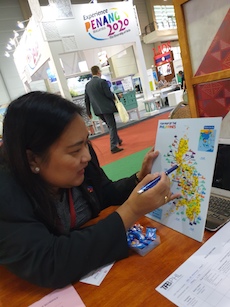
Caseja from Subic Bay Metropolitan Authority showing where Taal is on the Philippine map
Mae Anne T Caseja, recreation and welfare services officer IV, tourism department, with Subic Bay Metropolitan Authority, said: “We are on the western coast of Luzon, which is the biggest island for the Philippines, so what we are getting from Taal is some ashfall. The air quality is not as good as usual, but one can carry on with daily life. Offices and schools remain open.”
Caseja said there have not been any concerned enquiries about Subic Bay’s continued tourism viability during the lead up to Taal’s impending eruption.
“Even here at the show, none of the buyers have asked us about this matter,” she said.
And with Costa Romantica sailing into Subic Bay tomorrow on schedule, travellers should see that it is still business as usual in the Philippines, emphasised Maria Victoria T Morales, administrative officer I, tourism department, Subic Bay Metropolitan Authority.
The Federation of ASEAN Travel Associations (FATA) has elected KL Tan as its new president for the next two years, taking over from Mingkwan Metmowlee who served from 2018-2020.
From left: KL Tan and Mingkwan Metmowle
The election of Tan was done during FATA’s annual general membership meeting on Tuesday (January 14).
On his plans, Tan shared: “I hope to consolidate the efforts of travel agents in South-east Asia in promoting and strengthening (the region’s) position as a competitive, fresh and exciting tourism destination. I am continuing the efforts of the previous president and her team which is marketing South-east Asia as a single destination.”
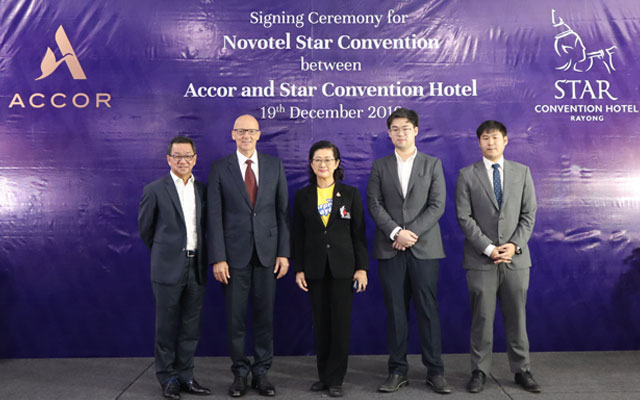
From left: Accor’s Victor Pang and Patrick Basset; and Star Convention Hotel’s Phisamai Supanuntaroek, Pong Supanuntaroek, and Pat Supanuntaroek
Accor has signed an agreement to manage the Star Convention Hotel in the city centre of Rayong province, Thailand.
Aside from being rebranded into the Novotel Rayong Star Convention Centre this year, the property will also undergo a major renovation of its public areas, dining outlets and 235 guestrooms in the first phase followed by another 336 guestrooms in the second phase over the next two years.
From left: Accor’s Victor Pang and Patrick Basset; and Star Convention Hotel’s Phisamai Supanuntaroek, Pong Supanuntaroek, and Pat Supanuntaroek
In total, the property will offer 571 keys, alongside facilities such as eight meeting spaces – the largest can hold 2,000 people theatre-style – and an outdoor swimming pool.
The hotel is situated in the hub of one of Thailand’s major agricultural and industrial provinces, and is approximately 2.5-hour drive from Suvarnabhumi International Airport and an hour’s drive from U-Tapao International Airport.
“We’re very excited to have the Star Convention Hotel join the Accor network and to grow our portfolio in a city like Rayong. We believe that the Eastern Seaboard, including provinces like Rayong, Chonburi, Trat, with the upcoming high-speed train route will offer excellent development opportunities in the future,” said Patrick Basset, chief operating officer of Accor for Upper Southeast & Northeast Asia and the Maldives.
“The signing of our partnership with Accor also reflects our confidence in Rayong’s tourism industry and the East Economic Corridor (EEC) Policy,” added Phisamai Supanuntaroek, director of Star Convention Hotel.
Accor operates over 86 hotels in Thailand, with a pipeline of 13 hotels scheduled to open over the next three years. The group currently manages a portfolio of 158 Novotel hotels across the Asia Pacific region.
Airlines globally reroute to avoid Iranian and Iraqi airspace
Major carriers in Asia-Pacific such as Singapore Airlines, Vietnam Airlines, Taiwan’s Eva Air, Malaysia Airlines and Australia’s Qantas have adjusted their flight paths, diverting routes from Iranian and Iraqi airspace.
This comes at a time of heightened tensions between US and Iraq, during which a passenger plane was shot down mistakenly by Iran in early January.
Airlines globally reroute to avoid Iranian and Iraqi airspace
Ukraine International Airlines (UIA) flight 752, a scheduled international passenger flight from Tehran to Kiev, was shot down shortly after takeoff from Tehran Imam Khomeini International Airport. All 176 passengers and crew were killed, the first fatal air accident for UIA.
After initially blaming it on technical error and denying the aeroplane was hit by a missile, Iran backpedalled, blaming “human error for the strike”, and that the plane had been “misidentified as a cruise missile”, reported the Straits Times.
The plane’s downing came hours after Iran had fired a barrage of missiles at two American air bases in neighbouring Iraq, in retaliation for a drone strike that killed Iranian general Qassem Soleimani in Baghdad.
According to Bloomberg, the US Federal Aviation Administration has also barred civilian services over Iraq, Iran, the Persian Gulf and the Gulf of Oman.
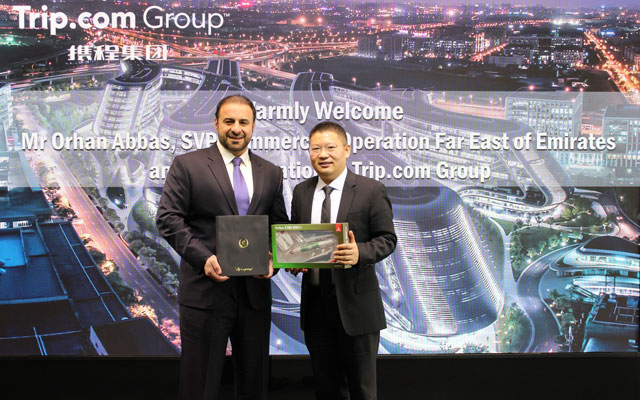
From left: Emirates' Orhan Abbas and Trip.com Group's David Han
Emirates signed a Memorandum of Understanding (MoU) with Chinese OTA Trip.com Group in Shanghai yesterday, as the airline looks to expand its reach in the Chinese market.
According to the agreement, Emirates will further explore the market’s potential by leveraging the user network of Trip.com Group, and expand customer reach and penetration in the market through exclusive fares and tailor-made products for Trip.com Group’s customer base.
From left: Emirates’ Orhan Abbas and a representative from Trip.com
In the next phase of the strategic cooperation, both parties will explore joint initiatives to provide members of their loyalty programmes with customised and exclusive offers.
Commenting on the MoU, Orhan Abbas, senior vice president – commercial operations, Far East, at Emirates said: “China has always been a key strategic market for Emirates, and last year marked the 15th year of Emirates’ direct flights to mainland China.”
Orhan added that the newly-renovated airport lounge at Shanghai Pudong International Airport was opened last October, “representing an investment of more than US$3 million”, and was a “testament to the emphasis the airline places on the Chinese market.
Tan Yudong, vice president of Trip.com Group and chief operating officer of Trip.com Group Flight Business Group, added: “The partnership with Emirates will enable users of the platform to have more choice with access to more airline options when booking international travel, more destinations to choose from, and flight options that provide seamless connectivity for their travel plans. ”
Emirates was the first airline to establish non-stop connectivity between the Middle East and mainland China in 2004. Today, Emirates operates 35 flights a week to mainland China, all operated by the A380 aircraft, with – twice-daily services to both Beijing and Shanghai, and daily services to Guangzhou.
Jetstar Asia adds 46 services over Lunar New Year
Jetstar Asia will add 46 return services between Singapore and five destinations – Kuala Lumpur and Penang in Malaysia, Yangon in Myanmar, Medan in Indonesia and Shantou in China – to meet the increased travel demand over the 2020 Lunar New Year holidays.
The expanded schedule will operate from now until February 13, 2020, in addition to the airline’s regular scheduled services.
There will be 24 additional services between Singapore and Kuala Lumpur, 14 between Singapore and Penang, two between Singapore and Yangon, four between Singapore and Medan, and two between Singapore and Shantou.
Lufthansa operates A380 to Thailand
Lufthansa Group has become the first European carrier to operate the A380 to Thailand as it looks to expand the capacity on its Bangkok to Frankfurt route.
Lufthansa initially increased capacity by going from the Boeing 747-400 to the Airbus A380 during the 2017/18 winter schedule. This is the third season Lufthansa is operating an A380 on the Frankfurt-Bangkok route.
PAL connects Clark to Quanzhou
Philippine Airlines (PAL) now offers travellers a wide array of flights to get to Quanzhou (Jinjiang), which is located in the southeastern part of Fujian Province, China.
PR350, the Clark-Quanzhou (Jinjiang) service, operates every Tuesday, Thursday, and Saturday. The flight departs Clark at 13.50 and touches down in Quanzhou (Jinjiang) at 16.30, while the return flight leaves Quanzhou (Jinjiang) at 17.30 and arrives in Manila at 19.55.
Vietjet expands reach in Asia
Vietjet has launched five new routes linking Hanoi, Danang and Ho Chi Minh City to multiple destinations in Japan.
The new routes – Hanoi-Nagoya, Ho Chi Minh City-Nagoya, Da Nang-Nagoya, Hanoi-Fukuoka and Hanoi-Kagoshima – are expected to commence operations in 2020.
As well, Vietjet has also inaugurated its first two international services connecting Can Tho, the hub city of the Mekong Delta region, with Taipei and Seoul.
The Can Tho-Taipei route operates four times weekly. The flight departs Can Tho at 12.40 and arrives in Taipei at 17.10, while the return flight takes off from Taipei at 18.10 and lands in Can Tho at 20.55.
Meanwhile, the Can Tho-Seoul (Incheon) route will operate three times weekly. Flights will depart from Can Tho at 16.50 and arrive in Seoul (Incheon) at 23.55, while the return flight takes off from Seoul (Incheon) at 02.30 and lands in Can Tho at 06.20.
An innovative twist to digital storytelling – in the form of a water screen – will take place on the Waitemata Harbour in Auckland during the Tāmaki Herenga Waka Festival on January 31.
A new festival feature, stories honouring the Māori heritage of Tāmaki Makaurau Auckland will be projected onto millions of water droplets propelled into the air at 21.00, creating an illusion of images floating on water.
Tāmaki Herenga Waka Festival
The content will pay homage to the waka that carried Māori ancestors across Te Moana Nui a Kiwa (the Pacific Ocean) to arrive in Aotearoa (New Zealand) and Tāmaki Makaurau. It will also celebrate te reo Māori, the joining of two worlds, and music.
From 18.00 to 21.00, performances will take place on a land-based stage moored against Queens Wharf. Headline acts include Māori artists Maisey Rika, Louis Baker and a seven-piece reggae band Tomorrow People.
Rika’s soulful vocals and te reo anthems will bring a close to the festival at 23.00, alongside a Kapa Haka performance by Ngā Tumanako, the winning group from Te Matatini 2019 (a nation-wide Māori performing arts festival and competition for kapa haka performers).
Festivalgoers can also be entertained by traditional Māori games, temporary ta moko tattoos, and a lighting installation inspired by pouwhenua (Māori carved pillars) on the Captain Cook Wharf. A collection of garments from designer Shona Tawhiao as well as traditional food and delicacies will be sold.
Shangri-La Hotels and Resorts has recently welcomed Allen Khoo as resident manager of Shangri-La Hotel, Singapore.
In his new role, he will support general manager Tane Picken in the group’s first Shangri-La hotel. As resident manager, Khoo will be responsible for overseeing the operations and driving optimal guest experiences across Shangri-La Hotel, Singapore, Shangri-La Apartments and Shangri-La Residences.
Khoo joins the flagship hotel with more than 13 years of hotel leadership and hospitality management experience in Shangri-La Hotels and Resorts across Malaysia, China and Taiwan.
Prior to his move to Singapore, he was the resident manager in Shangri-La’s Tanjung Aru Resort & Spa, Kota Kinabalu, from May 2017.
ASEAN NTOs have agreed to recommend a mid-term review of the ASEAN Tourism Strategic Plan (ATSP) 2016-2025 to their tourism ministers during their meetings today (January 15) and tomorrow.
Benito Bengzon Jr, undersecretary, Philippines Department of Tourism, said the Philippines has offered to take the lead in organising what will be a combination of a retreat and planning session, planned for September this year, subject to ministerial approval.
ASEAN NTOs first met on January 12 in Brunei, and meetings will continue today and tomorrow
Bengzon Jr said the mid-term review is vital to evaluate the performance of ATSP and determine the future course of action for the next five years.
He said: “(The review) will set the overall direction and vision for tourism in South-east Asia, and more specifically, it will identify what strategic concerns need to be looked into. Currently, the ATSP basically talks about two main strategic directions, which are increasing the competitiveness of the region as a collective destination, and ensuring sustainability and inclusivity for the stakeholders.”
The review will also look at the existing committee and evaluate whether alterations are needed to achieve the goals.
Thong Rathanak, director general of Cambodia’s Tourism Development and International Cooperation and vice chair of the ASEAN NTO Meeting at ATF 2020, noted that with changes in the general and tourism landscape taking place so rapidly, NTO representatives were proposing a review every six months.
Thong remarked: “Changes may take place not even in months, but in days. For example, events happening in Australia and Iran may impact South-east Asia or our industry, so it will not be productive to conduct a review only once a year.”
He emphasised that there is a need to determine what “needs to be changed, and what needs to be our top priority”.
When asked what Philippine representatives would like to see happen through the review, Bengzon, Jr said member states needed “to rethink marketing and promotion initiatives” to take into account the market shift towards digital platforms, and to pay greater attention to delivering authentic destination experiences.
Rizki Handayani, head of the delegation from the Indonesia Ministry of Tourism and Creative Economy, identified the trend of multi-generational travel as well as the development of marine and island products as focal points.
For Noor Zari bin Hammat, secretary general, Malaysia Ministry of Tourism, Arts and Culture, an effective balance between competitiveness and sustainability should be achieved.