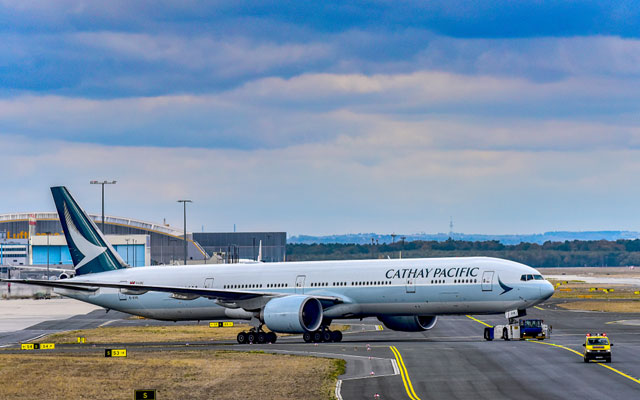
Cathay Pacific Group will slash 40 per cent of its passenger capacity for February and March as passenger numbers continue to slide.
In it latest performance update issued this week, Cathay Pacific Group reported that Cathay Pacific and Cathay Dragon had see a 1.3 percentage point decrease in their passenger load factor to 84.7 per cent over the same time last year.
Cathay Pacific cuts capacity by 40 per cent amid coronavirus outbreak
In his outlook for 2020, Cathay Pacific Group chief customer and commercial officer Ronald Lam said: “The first half of 2020 was already expected to be extremely challenging financially. As a result of this additional significant drop in demand for flights and consequential capacity reduction caused by the novel coronavirus outbreak, the financial results for the first half of 2020 will be significantly down on the same period last year.”
Besides the two-month reduction in global capacity, Lam said the cut may be extended to April “as we continue to monitor and match market demand”.
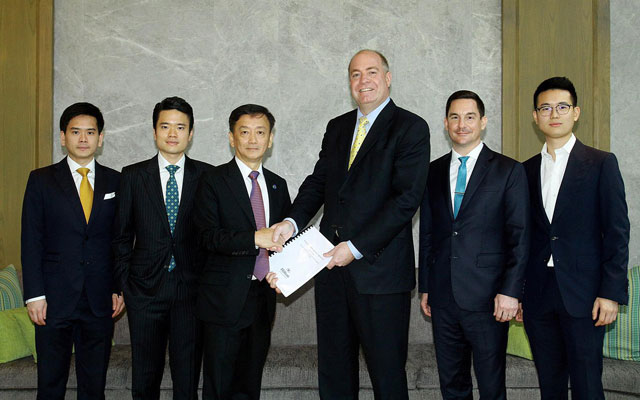
“From Left to Right: Chotiwit Taechaubol, Director of AP Prime Property Co LTD; Krittawat Taechaubol, Director of AP Prime Property Co LTD; Apichai Taechaubol, President of AP Prime Property Co LTD; Matt Fry, Senior Vice President, Development, Asia Pacific, Hilton; Christian Pucher, Senior Director, Development, Asia, Hilton; and Noppawee Taechaubol, Director of AP Prime Property Co LTD.”
Hilton Hotels has signed a management agreement with real estate company AP Prime Property Company to convert the former Grand Ayudhaya Hotel into the 608-room Hilton Bangkok Ratchada by 2022.
The hotel, which will be the Hilton brand’s largest property in Bangkok yet, is located on Ratchadapisek Road, close to commercial buildings and landmarks. The larger vicinity has also been earmarked as one of Bangkok’s rising business and financial districts.
From left to right: AP Prime Property’s Chotiwit Taechaubol, Krittawat Taechaubol, and Apichai Taechaubol; Hilton’s Matt Fry and Christian Pucher, and AP Prime Property’s Noppawee Taechaubol
Following the refurbishment, the hotel will feature an executive lounge, an all-day dining restaurant, a Chinese speciality restaurant, a café and bar, as well as a selection of spacious meetings and events venues.
“Bangkok is a key regional business hub and has long been an established destination for leisure travellers, as well as a venue of choice for meetings and events. Combined with the government’s direction for the Ratchadapisek area to be the next business and financial district in Bangkok, the upcoming Hilton Bangkok Ratchada will be in one of the most coveted addresses for businesses in Bangkok when it opens,” said Guy Phillips, senior vice president, development, Asia & Australasia, Hilton.
Chinese ride-hailing giant DiDi will launch ride-sharing services in Sydney, Australia with DiDi Express (carpooling) and DiDi Max (seven-seater) services, come March 16.
A screenshot from Didi’s official website
DiDi Australia general manager Lyn Ma said: “We are eager to work alongside local stakeholders in the Sydney transportation industry, using leading AI technologies and local operational expertise to innovate and build a better, trusted product with the aim of becoming Sydney’s preferred ridesharing platform.”
The company first moved into the Australian market in May 2018. So far, it has served more than two million passengers in seven cities across four states.
Thomas Cook India (TCIL) has rolled out a range of competitively-priced international tour packages, as it looks to tap into the rising demand among Indian travellers for multiple, smaller holidays, or mini-cations, as opposed to one long annual vacation.
More than 66 per cent of Indian travellers prefer multiple mini-cations, over just one annual vacation, according to a recent study by TCIL.
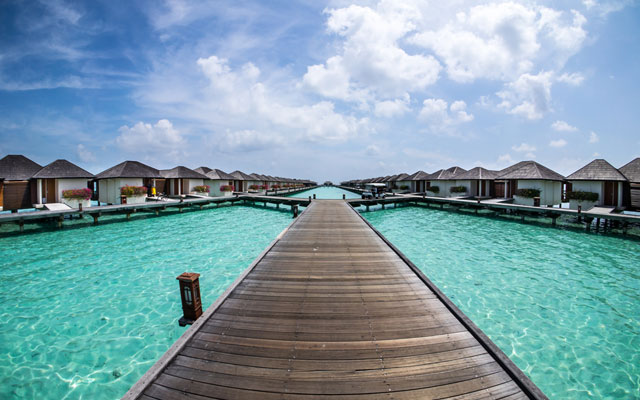
Thomas Cook India rolls out a range of all-inclusive tours to international destinations like the Maldives
Additionally, the study also found that India’s millennials are displaying an increased appetite (of 35 per cent) for travelling.
Rajeev Kale, president & country head – holidays, MICE, visa, TCIL, said: “Over the past few years, we have witnessed a dramatic shift in the lifestyle choices of Indian consumers – the aspiration for travel have increased manifold. And with multiple, bite-sized holidays seeing strong demand, we realised the importance of value pricing.”
To ride on this wave of demand for the upcoming summer holiday season, the company has launched a range of international tours of between 5-7 days, priced under Rs 99,999 (US$1,398) per person (starting from Rs 50,000), subject to T&Cs.
TCIL’s under Rs 99,999 all-inclusive holidays include a wide range of international destinations like Australia, the UK, France, Germany, Austria, Hungary, Russia, Netherlands and Belgium; as well as short-haul favourites of Abu Dhabi, Dubai, Sri Lanka, Bhutan, Maldives, Mauritius and Myanmar.
The all-inclusive tours include flights, hotels, visas, transfers, meals, sightseeing, insurance and the services of an experienced TCI tour manager.
Additionally, TCIL has also designed customised Europe land-only holidays, to give customers the flexibility of selecting their preferred airlines, with prices from Rs 31,600. A range of destinations included are London, Paris, Greece, Iceland, Georgia, Amsterdam and Brussels.
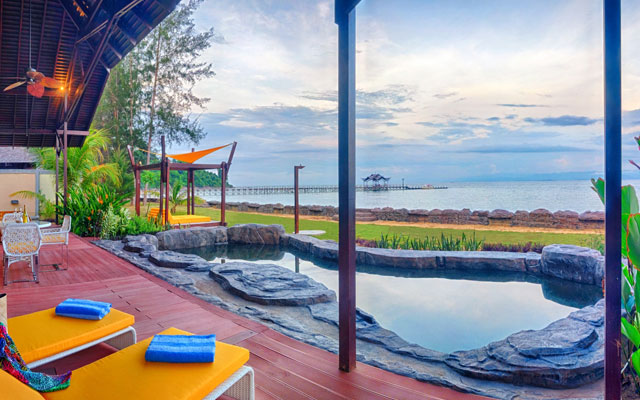
Borneo Eagle Resort, Malaysia
Situated on the island of Pulau Tiga 2.5 hours away by land and sea from Sabah’s capital of Kota Kinabalu stands the 13-villa Borneo Eagle Resort. There are three villa types, all facing the sea and come with their own courtyards. They are furnished with mod cons such as a 55-inch flatscreen TVs and Bose home theatre systems. A Personal Service Ambassador is also assigned to each villa.
Facilities onsite include the Eagles Nest restaurant with a farm-to-table concept, the Landing Bar, fitness centre, 900m2 infinity pool, a multipurpose room that can hold up to eight seated pax, a rooftop area for small events, as well as a Sand Bar by the pool. Outdoor activities include trekking opportunities in the nearby jungle to volcanic mud mounts, while waters around the island are good for diving, snorkelling and kayaking.
MeliáKoh Samui, Thailand
Meliá Hotels International’s first opening in Thailand is a nautical-themed beachfront resort on Koh Samui’s Choeng Mon Beach. The property features 159 rooms and 41 suites, alongside facilities such as two outdoor swimming pools, two restaurants, an executive lounge, beach club, spa, fitness centre, kids’ club and mini water park. There is also the Gallery, a not-for-profit social enterprise of art and design gift shop.
Meanwhile, event planners may avail the seven indoor multifunctional spaces, ballroom that can accommodate up to 200 guests, as well as an outdoor poolside and beachfront function space that can host dinner for 500 guests. This opening is the start of a strategic roll-out of the Meliá brand in Thailand with at least two more to come online in Bangkok and Chiang Mai.
Novotel Melbourne Central and ibis Melbourne Central, Melbourne
This dual-branded new-build houses 483 keys within a 35-storey tower on Little Lonsdale Street.
Novotel Melbourne Central
Occupying levels 20-35, Novotel Melbourne Central’s 213 rooms and suites start from 20m2 in size. All rooms are fitted with rainshowers, as well as 55-inch Google Chromecast televisions. Novotel guests will also have access to its InBalance gym, and 24-hour guest services and a concierge desk.
ibis Melbourne Central
Located on levels 4 to 18, ibis Melbourne Central features 270 premium economy guest rooms averaging 18m2, and are fitted with rainshowers and 49-inch Google Chromecast televisions. Other amenities include three flexible meeting spaces that can cater for up to 50 guests, as well as three restaurants and bars on-site.
Pullman Rotorua, New Zealand
New Zealand’s Bay of Plenty region has received its first international five-star hotel in the form of the Pullman Rotorua. The new-build offers 130 rooms across five categories, some of which offer panoramic views of the city and lake area. Facilities on-site include the Barrel & Co Bar and Grill, an executive lounge, bar, gym, as well as four event spaces.
Courtyard by Marriott Suwon, South Korea
The first Courtyard by Marriott in Suwon has opened as part of the new MICE Complex within Suwon Gwanggyo New Town. The property offers 288 rooms, starting from the lead-in 28m2 Premiers to the 84m2 Lake Park Suite. Meeting amenities include the 70-seater Executive Lounge featuring views of Gwanggyo Lake Park, the Lake Park Ballroom which can take up to 300 pax theatre-style, as well as three multipurpose boardrooms for 16 pax each theatre-style. There is also a fitness centre, laundry room, and two F&B options.
John Woolley has joined The Ritz-Carlton, Bali, as general manager.
He brings over 20 years of experience with Marriott International to his new role, where his career has taken him around the globe.
Prior to his move, Woolley was general manager at Courtyard by Marriott Bali Seminyak Resort from 2015 to 2019.
The dual US/UK national’s career highlights include positions of area director of sales and marketing, South Asia and then the Caribbean. In addition, Woolley also launched a sales engine – the European Convention Network – that supports Marriott’s large group hotels in Europe before his move to Bali.
Crossroads Maldives, an integrated entertainment destination developed and operated by S Hotels and Resorts, has appointed Audra Arul as cluster director of sales and marketing for the complex, where she will be overseeing the SAii Lagoon Maldives, a Curio Collection by Hilton; and Hard Rock Hotel Maldives.
In her new role, Arul will be responsible for the overall commercial objectives of Crossroads Maldives and the two resorts, including achieving goals in revenue generation, yield management and brand engagement.
With more than two decades of experience, Arul has served in a variety of hotel sales and marketing positions with hospitality companies such as Accor, Marriott, Hyatt, and most recently, Banyan Tree Hotels and Resorts.
Israel will ban all non-Israelis who were in four East Asian countries and territories in the last 14 days, as part of efforts to curb the spread of the coronavirus, announced interior minister Aryeh Deri on February 17.
Until now, travellers coming from Thailand, Singapore, Hong Kong and Macau had to quarantine themselves for 14 days, under the directives issued by the Health Ministry on Sunday.
Israel bans travellers from Thailand, Singapore, Hong Kong and Macau due to Covid-19
The new restrictions were advised by the Health Ministry. As such, Hong Kong’s flagship carrier Cathay Pacific will be suspending all its flights to Israel, and employees will be banned from entering the Jewish state under the new ruling, according to media reports.
The Foreign Ministry is reportedly concerned about diplomatic fallout from the ban, and that the East Asian countries will retaliate by issuing more frequent travel warnings about Israel after terror attacks, or lower their degree of economic cooperation, reported The Times of Israel, which cited anonymous officials interviewed by other media outlets.
As well, Israel’s national airline, El Al, was considering temporarily suspending all its flights to Thailand. It has already suspended flights to and from Hong Kong until February 20.
Since late January, Israel has banned foreign nationals who were in China recently from entering.
Last week, health minister Yaakov Litzman advised against travel to Thailand, Japan, Hong Kong, Singapore, Macau, South Korea, and Taiwan.
As the coronavirus epidemic tightens its grip on the aviation sector, China’s airports are projected to face a 30 per cent drop in passengers in 2020, according to new data from Boyd Group International (BGI).
The aviation research firm’s report also indicated that China’s airports will handle 945 million arrivals and departures, down from almost 1.4 billion in 2019, and representing a reduction of over 413 million.
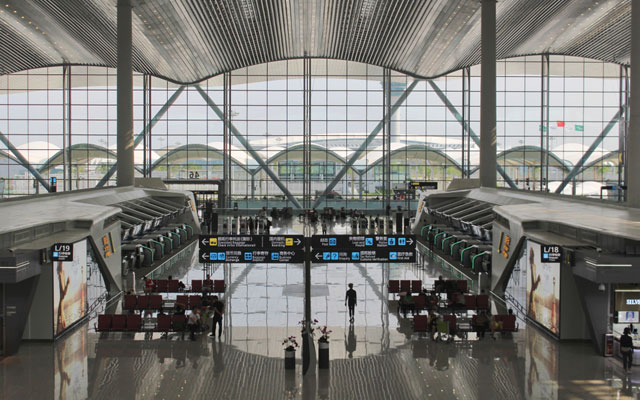
China’s airport traffic projected to drop 30%, with airline shutdowns and consolidation possible; Guangzhou Baiyun International Airport pictured
International traffic is forecasted to decline by over 22 million, while domestic travel within China will plummet by over 391 million, said BGI.
Furthermore, Beijing’s two airports will see more than eight million fewer international arriving and departing passengers, while Shanghai Pudong will experience a seven million drop.
“Even before this epidemic, annual growth rates had already been expected to shrink to eight per cent or less, but now traffic will be in a free fall at least through 2020 – assuming control of the contagion. This is not a short-term hit to air transportation in China. For example, foreign visitation will be nearly non-existent for at least the next 12 months,” noted Michael Boyd, president of BGI.
“Existing fleet capacity is way in excess of expected 2020 demand. Consolidation is in the cards, possibly some shutdowns,” he added.
Boyd also stressed that the coronavirus epidemic should not be compared to the 2003 outbreak of SARS. He said: “Back then, total China airport traffic was less than 20 per cent of that today, and the rapid spread of coronavirus across all parts of China is a fundamentally different situation. Traffic will not bounce back quickly.”
Pune-based Travind Institute of Travel & Tourism Management is looking to establish its next school in Singapore, a project that aspires to provide cross-cultural connections for international students as well as internships and on-the-job training opportunities.
Deep Bhong, director of Travind Institute, which is part of the BTW Group that has businesses in travel and tourism, food and nutrition, tourism and hospitality education, and legal and apostille services, told TTG Asia that Singapore was chosen for its positive reputation as a place for education and as a welcoming multi-culture and multi-racial destination.
Bhong: Singapore picked as location for India’s Travind Institute of Travel & Tourism Management next branch due to its positive reputation for higher education
Bhong said: “Singapore’s higher education reputation is strengthening, and it is set to become one of the best destinations for tourism education. Furthermore, Singapore has a strong appeal among Indians, who regard the country as a second home that offers superb infrastructure and a high standard of living.”
He envisions the new institution to provide courses led by trainers and guest lecturers who are travel sector professionals, promote interaction between students from different cultures, and to facilitate internship and on-the-job training arrangements.
Travind Institute hopes to draw support from travel agencies, trade associations, semi-government bodies or public-private partnerships, said Bhong, who added that the Singapore Tourism Board “would be at the forefront” of his partnership acquisition efforts.
“I believe the local NTO plays a vital role in shaping the functioning (of the new institution),” he remarked.
Bhong hopes the next Travind Institute in Singapore will bring about a revolution in the way tourism education is offered.
He opined that many leading and globally-recognised travel and tourism institutes offer somewhat similar specialised degree courses, and there has not been “any revolution in this sector”. Furthermore, many people who were educated in tourism end up working in only one country despite there being vast opportunities to work elsewhere in the world.
“The travel and tourism industry will remain a manpower-heavy industry, even with all the new technology coming onstream, and we want to invest in grooming this manpower of the future,” he said.
The five-year-old Travind Institute in Pune has 300 graduates on record to-date.