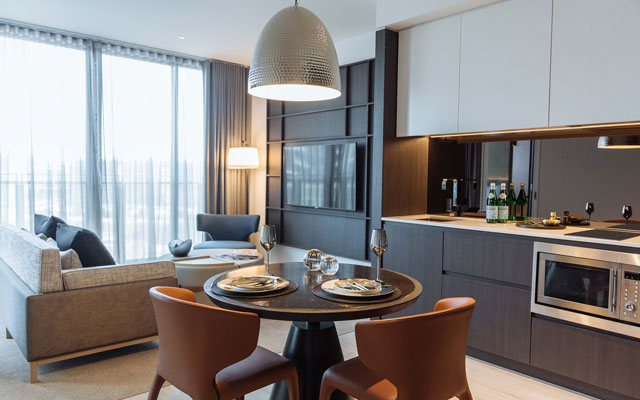
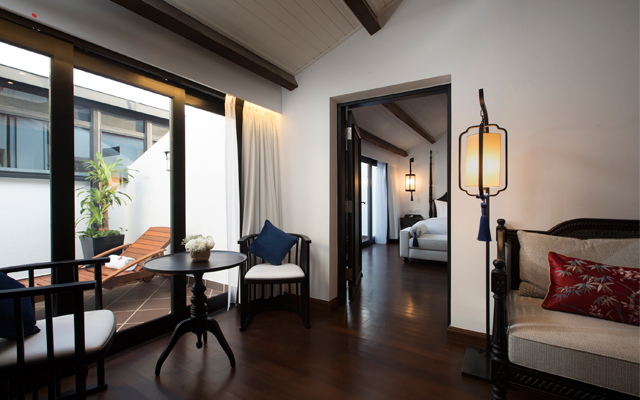
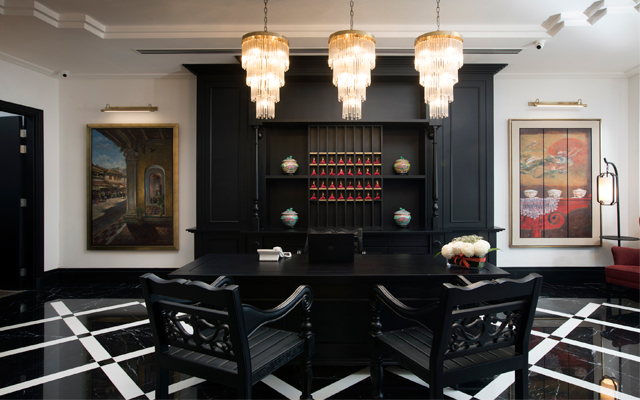
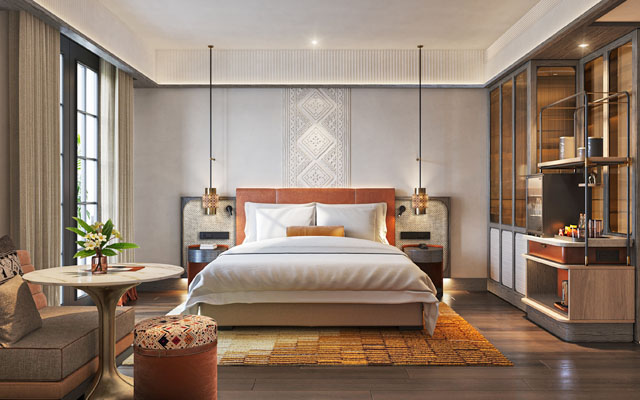
Skye Suites is fast-tracking the opening of its third hotel in Zetland, New South Wales, which is located within the US$575 million architectural precinct, Infinity by Crown Group, in response to the surge in demand from the long-stay market.
Skye Suites Green Square is set to officially open as a hotel in July, but from next week, Skye Residences will offer luxurious serviced-apartment stays of three months or more to long-stay residents.
1 of 2
Infinity
SKYE Suites & Residences
The other two Skye Suites hotels opened in Parramatta in 2017 and in Sydney’s Arc by Crown Group on Clarence Street in late 2018. All three properties offer a range of studio, one- and two-bedroom apartments.
Amenities include kitchens which boast SMEG cooktops, microwave ovens and a fridge, a washing machine and dryer, an enclosed balcony or courtyard, and second wall-mounted flat-screen TV in the two-bedroom apartments.
Keyless entry and “virtual concierge” tablets in each suite allows guests to access hotel services, with an option for mobile check-in.
With virtual travel rapidly gaining steam in light of the coronavirus pandemic, home-sharing giant Airbnb has unveiled a suite of Online Experiences, allowing communities globally to continue immersing in handcrafted activities worldwide from the comfort of their homes.
Online Experiences connects virtual tourists to local hosts from more than 30 countries, and was launched to help Airbnb’s hosts to continue earning an income despite Covid-19 disruptions, while enabling guests to learn a new skill, safely connect with others, or pursue an interest.
A guided meditation with sheep in the Scottish countryside is among Airbnb’s Online Experiences offerings
Guests can choose to meditate with a Japanese buddhist monk in Osaka, take coffee-making classes from a national judge in Mexico City, or go on a virtual bike tour with Olympian Alistair Brownlee in Otley, the UK.
With Planet Earth on lockdown and people’s movements severely restricted, Airbnb said that Online Experiences provides new activities for families to explore like learning the secrets of magic; options for work colleagues who want to bond with team activities like making coffee with a professional coffee taster; and features for groups looking to celebrate birthdays or get togethers privately, with the option to request specific dates for Experiences like bartending with experts.
“Human connection is at the core of what we do. With so many people needing to stay indoors to protect their health, we want to provide an opportunity for our hosts to connect with our global community of guests in the only way possible right now – online,” said Catherine Powell, head of Airbnb Experiences.
To help those who are most isolated, like older adults, Airbnb has also curated a set of free Online Experiences for them, in partnership with local organisations around the world, including SAGE, National Council on Aging in the US, Associazione Nazionale Alpini – Sezione di Milan in Italy, and Amigos de los Mayores in Spain.
Booking opens immediately with more than 50 virtual Airbnb Experiences available at airbnb.com/online-experiences, with thousands more coming online in the coming months.
Online Experiences will be hosted on Zoom, and Airbnb is providing hosts access to Zoom free of charge along with personalised support services for curating, capturing and sharing their Online Experience.
The travel and tourism industry will play a pivotal role in Asia-Pacific’s economic recovery, once the Covid-19 pandemic resolves, according to a new report by the World Travel & Tourism Council (WTTC).
In its latest annual Economic Impact Report (EIR), WTTC shared that in 2019, travel and tourism generated US$2,971 billion towards GDP, or 9.8 per cent of the region’s economy, representing a 5.5 per cent growth from the previous year. This figure puts it ahead of the overall regional economy for the fifth consecutive year, which grew by 4.2 per cent.
Tourism receipts in the Asia-Pacific region accounted for nearly 10 per cent of the region’s GDP last year; Universal Studios Theme Park in Osaka, Japan pictured
International visitor spend totalled a staggering US$548 billion, representing 6.6 per cent of the region’s total exports.
This surge in tourism receipts was driven by the continued growth in middle income households, visa facilitation, improved connectivity and government prioritisation of the sector.
In addition, WTTC’s study also showed that over the last five years, the travel and tourism sector created more than 21 million new jobs in the region, accounting for 56 per cent of all new jobs globally.
As well, leisure travel makes up the majority of total travel and tourism spend (81 per cent), with only 19 per cent being attributed to business travel. When considering domestic and international spend, the numbers skewed similarly, with domestic visitor spend comprising 74 per cent of the total, and international making up 26 per cent.
China led the region in 2019 in terms of GDP and employment size, with strong performances in other major Asian markets such as Vietnam, Malaysia and the Philippines.
The travel and tourism industry supports more jobs in China than in any other country in the region, accounting for nearly 80 million jobs, or 10.3 per cent of total employment. Last year, the travel and tourism economy in the country grew by 9.3 per cent and is the second largest in the world, making up 11.3 per cent of China’s overall economy.
Malaysia and Vietnam also witnessed significant growth, up 6.6 per cent and 7.7 per cent respectively, with both displaying an even split between domestic visitor spending (49 per cent) and spend from international (51 per cent). The majority of the travel and tourism spending in both countries overwhelmingly came from leisure travel, with Malaysia attributing 86 per cent of visitor spend to leisure, and Vietnam attributing 90 per cent.
The Philippines also saw significant growth by 8.6 per cent once again, making up 25.3 per cent of the total economy in the country and supporting 24.1 per cent of total employment, the equivalent of more than 10 million jobs. Leisure spending made up 66 per cent of total visitor spending, and 85 per cent was made up of domestic visitors.
Gloria Guevara, WTTC president & CEO, said: “WTTC’s 2019 EIR shows how intrinsic travel and tourism was last year to the economy in Asia-Pacific, making it the fastest growing region in the world in terms of its contribution to GDP, supporting more than 182 million jobs or 9.6 per cent of the total number of people employed.
“Our report underscores how vital travel and tourism will be in powering the recovery of the region’s economy, generating new jobs and driving visitors back to Asia-Pacific, having a positive economic domino effect on suppliers large and small throughout the industry.
“Until then, it is crucial that all governments throughout the region help to protect travel and tourism as the backbone of the regional and global economy, which is currently in a fight for survival. Our research shows that up to 75 million jobs globally are at immediate risk, with more than 48 million at risk across the Asia-Pacific region alone, highlighting how critically the sector requires support.”
On a global level, the travel and tourism sector outperformed the 2.5 per cent rate of global GDP growth for the ninth consecutive year in a row, thanks to an annual GDP growth rate of 3.5 per cent. This made it the global economy’s third highest sector in terms of GDP growth.
The EIR shows the sector supporting one in 10, or 330 million, jobs; making a 10.3 per cent contribution to global GDP and generating one in four of all new jobs.
A breakdown by WTTC shows Asia-Pacific to be the top performing region worldwide, with a growth rate of 5.5 per cent, followed very closely by the Middle East at 5.3 per cent. The US and EU both demonstrated a steady growth rate of 2.3 per cent, while the fastest growing country was Saudi Arabia, growing four times than the global average.
The Federation of ASEAN Travel Associations (FATA) has raised concerns that many passengers and travel agents are not getting refunds from flight cancellations as a result of the pandemic.
In response to an open letter circulated by the International Air Transport Association (IATA) to the travel agency community on April 2, FATA president, Tan Kok Liang, shared that airlines should issue refunds instead of vouchers which have little or no value should they be liquidated.
FATA says airlines should hold customers’ deposits in a designated or trust account until services are rendered
He said: “As (air) services are (halted) due to the current circumstances, it is a matter of principle to return payments that have been collected from customers.”
He warned that lawsuits might result if the matter was not resolved.
Tan stressed: “IATA has a duty to include traveller claims as a component of its members’ responsibilities with respect to existing Resolutions and ensure those are respected by airlines in terms of fulfilling contractual obligations with both passengers and travel agencies. Without this action (taken) now, the collapse of the distribution channel is inevitable.
“IATA recently estimated the industry liability in this area is at US$35 billion and stated that airlines’ most urgent need is to keep their remaining liquidity to pay salaries and face their fixed costs. While we are sympathetic, we remain in our position that taking deposits for future services and the inability to provide refund is poor financial management. Customers’ deposits should be placed in a designated or trust account until services are rendered.”
Tan added that FATA is ready to engage in an open discussion at the respective countries Agency Program Joint Council (APJC) or through Passenger Agency Program Global Joint Council (PAPGJC) to resolve the issue.
FATA also calls on government worldwide to provide financial resources and reliefs to the aviation and travel industry which is crucial to facilitate industry recovery.
Governments across Asia are tightening the screws on social distancing and travel restrictions, with many announcing the extension of travel bans and lockdowns, in a bid to stem the Covid-19 spread.
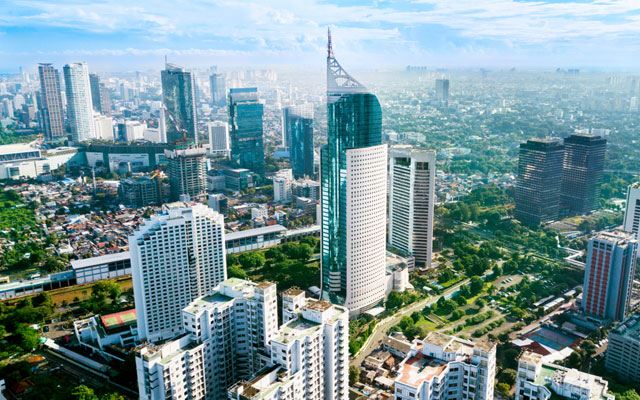
Jakarta imposes partial lockdown and tighten social-distancing rules; aerial view of South Jakarta CBD pictured
Indonesia
Local authorities in Greater Jakarta have imposed large-scale social restriction (PSBB) to further limit people’s movement beginning Friday (April 10), in response to a spike in confirmed Covid-19 cases and fatalities in the region, which includes Jakarta, Depok, Bogor, Bekasi and Tangerang.
Anies Baswedan, governor of Jakarta, was the first to implement the 14-day PSBB, after extending the state of emergency to April 19 and earmarking a three trillion rupiah (US$189 million) stimulus package to soften the economic blow of Covid-19 in Indonesia’s capital.
Thereafter, Ridwan Kamil, governor of West Java, and Wahidin Halim, governor of Banten, followed in Anies’ footsteps by declaring similar restrictions in Bogor, Bekasi and Depok in West Java, as well as Tangerang and South Tangerang in Banten.
In Jakarta, the PSBB was enforced on April 10. In West Java, it is slated to kick in on April 15. Banten, on the other hand, has yet to announce when the PSBB will come into effect.
Under this stricter restriction, violators face up to one year jail term and a fine of 100 million rupiah.
In light of the physical distancing measures ordered by president Joko Widodo, schools, offices, public spaces and entertainment venues in Jakarta continue to remain closed. As well, religious gatherings, social and cultural activities, public celebrations like weddings, and any gatherings of more than five people are also banned during the PSBB period.
Companies in eight essential industry sectors such as health, food, energy, communications, finance and banking, delivery of logistics and daily needs, are allowed to remain fully operational.
Furthermore, public transportation services are permitted to operate only from 06.00 to 18.00, with passenger capacity capped at 50 per cent of the usual limit. App-based motorcycle taxis are also barred from transporting passengers within the PSBB period.
While roads in the capital city remain open, a limit has been placed on the number of passengers in private vehicles on Jakarta’s streets.
In Jakarta alone, the coronavirus has infected 2,044 people and killed 195 as of April 12, making the capital city the country’s epicentre of the Covid-19 outbreak. West Java is the country’s second worst-hit city, with 450 confirmed cases of Covid-19 and 43 fatalities. Banten has seen 281 infections and 21 deaths.
The entire country has seen 4,241 confirmed cases and 373 fatalities. – Reporting by Kurniawan Ulung
Malaysia
Malaysia’s government has announced a second extension of the movement control order (MCO) by another two weeks to April 28, from April 15, citing feedback from the Health Ministry and medical experts.
All businesses, schools, religious institutions, and government offices will remain shut, and only essential services including banks, supermarkets, and pharmacies are allowed to operate. All mass gatherings are also banned.
The MCO kicked in on March 18 and was initially for a period of two weeks to March 31, but was extended by another two weeks to April 14.
Yap Lip Seng, CEO of Malaysian Association of Hotels, commended the government’s extension of the MCO, but said it represented steeper losses for the tourism industry. “Even when the MCO ends, tourism is not expected to recover for at least another six months, depending on the situation worldwide,” he said.
He had earlier called for the government to provide targeted support for the tourism industry to tide through the MCO period and beyond.
He also acknowledged that post-Covid-19, travel will never be the same again and hotels in Malaysia are armouring up for the anticipated changes.
“The tourism industry, and particularly hotels, are actively drafting new standard operating procedures and practices to enable people to travel without worries in the near future. Operations such as F&B services and (corporate events) will be adopting new preventive measures to protect attendees and participants as (part of) the new norm,” he said.
Meanwhile, hotels are using the activity slump to give their properties a facelift. Anthony Wong, managing director, The Frangipani Langkawi Resort & Spa, said that he was using the MCO period to do maintenance and renovation works on the property.
The hotel’s 140 employees have also taken on new responsibilities, such as giving the resort a fresh coat of paint and planting more vegetables on-site for their own consumption.
Wong reckoned that it will take two to three years for the inbound travel industry in Malaysia to bounce back to pre-Covid-19 levels. And after the MCO is finally lifted until year-end, he expects occupancy at the property to hover between 10-20 per cent, with the domestic leisure segment forming the bulk of visitorship.
On Friday, the country reported 4,346 confirmed Covid-19 cases, with a death toll of 70. – Reporting by S Puvaneswary
Japan
Following Japan’s move to declare a month-long state of emergency for seven prefectures, other prefectures in the country are also crying out for a similar decree to be passed.
The governors of Aichi and Kyoto, the eighth and tenth worst hit prefectures, asked the government on Friday to grant them the state-of-emergency classification.
Both Gifu and Hokkaido have declared a state of emergency, but they cannot requisition buildings or supplies without the government classification.
Narita Airport shut one of its two runways on Sunday, in response to a slump in air traffic and the “soft lockdown” requirement of limited on-site workers. Lack of demand has also pushed Haneda Airport to close its new passenger facility at Terminal 2.
In Japan, the number of Covid-19 cases passed 6,000 on Saturday, prompting the government to ask residents nationwide to avoid nightclubs, downtown and other busy areas to help curb infections. – Reporting by Kathryn Wortley
India
India’s prime minister Narendra Modi is set to extend the nationwide lockdown for another two weeks, said state ministers on Saturday (April 11), in response to the growing fallout in the country, which boasts a population of 1.3 billion.
The 21-day lockdown is due to end on Tuesday, but several chief ministers from India’s 29 states and territories have been pushing Modi to extend the lockdown due to the rising death toll from the coronavirus.
Two states, Odisha and Punjab, have already extended the lockdown by two weeks, but there is growing pressure on the government to enforce the extension nationwide to freeze movement between states.
India has so far reported about 7,500 cases and 240 deaths.
PATA is conducting a business impact survey to better understand the concerns, challenges and issues faced by the region’s travel and tourism industry stakeholders during the current pandemic and economic crisis.
The information may be used in PATA’s communications with local governments and policymakers across Asia-Pacific, to enable the provision of the right response to and assistance for travel and tourism organisations.
Survey responses will enable better government support for travel and tourism organisations
The PATA Business Impact Survey requires only a few minutes to complete, and is available here.
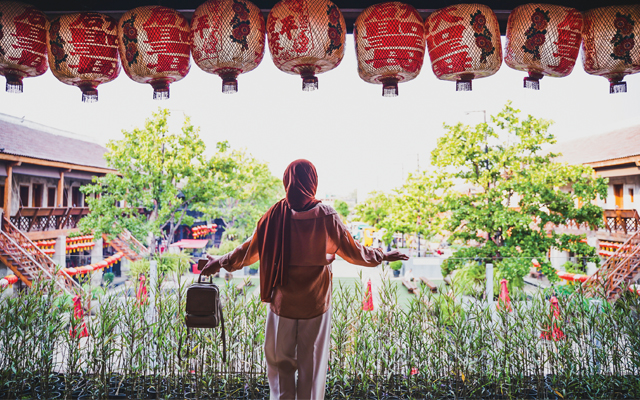
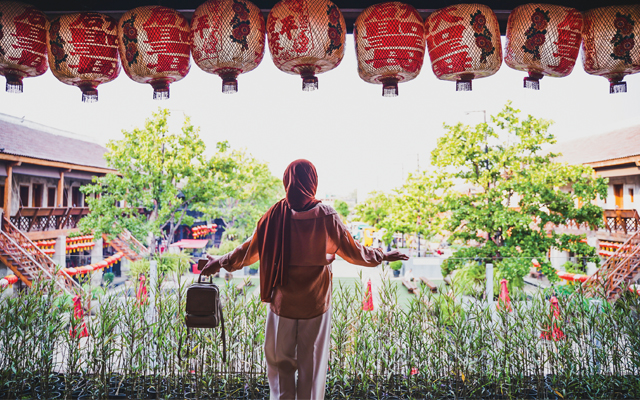
The stigma that Muslim women are conservative – that they only travel when accompanied by a male chaperone and only visit Muslim countries – is outdated.
Mastercard-CrescentRating Muslim Women in Travel report, published last year, showed that 63 million female Muslim travellers spent around US$60 billion on travel in 2018. They made up 45 per cent of 140 million Muslim travellers in the same year.
Most female Muslim travellers were aged between 20 and 40, noted Raudha Zaini, marketing manager, CrescentRating and HalalTrip.
The report is just one in a series of evidence that show Muslim women travel as frequently as their peers, and are as eager to learn more about different cultures.
Driving the market’s growth are several factors: the growing population of young and educated Muslim women; the expanding middle class in Organisation of Islamic Cooperation (OIC) countries; as well as higher disposable income.
Trends within the market were also highlighted. For instance, the report noted that more Muslim women are travelling solo for business.
At the same time, Nazirah Ashari, strategy director, TBWA Kuala Lumpur, noted a new trend of all-girls group travel. This is driven by a younger generation of travellers, who are becoming more independent and are more able to make decisions on whether to travel.
Choice destinations
Q Akashah, executive director of OgilvyNoor, an Islamic branding consultancy, noted that a common misconception was that female Muslim travellers only go to OIC countries. In reality, they are travelling everywhere because of their “innate curiosity about others’ culture and way of life”.
In fact, any countries that offer pop culture, deep history as well as attractions that make for stunning Instagram backdrops are popular among female Muslim travellers.
Japan, South Korea and New Zealand are such choice destinations, according to the TBWA report.
Answering faith-based needs
In a panel discussion held in conjuction with the launch of the MasterCard-CrescentRating report, Nisha Barkathunnisha, principal consultant of Elevated Consultancy and Training, shared what it would take for destinations to court this attractive market.
According to Barkathunnisha, destinations need to work on meeting the market’s faith-based needs. While Muslim women crave exploration and seek self-fulfilment, they also want to abide by Islamic principles while travelling.
The panelists acknowledged that some Asian industry players have taken steps to cater for female Muslim travellers, by offering more than just the basics of halal food and a place to pray.
Singapore, Malaysia and the Maldives, for instance, incorporate women-only facilities and services, said Belkhir Housna, a content creator from France. These destinations stand out for her 50,000 Instagram followers and 120,000 subscribers on YouTube, most of whom are Muslim women who like to travel, said Belkhir.
Measuring one’s impact
In time to come, women-only facilities alone may not be enough to win over female Muslim travellers who are conscious that Islam is not just about “doing the basics”, but in “how (one is) affecting the community, society and the environment”, commented Barkathunnish.
Therefore, there is a rising demand for travel experiences that allow these travellers to make a difference to the environment and society of destinations they visit. It comes as no surprise that more millennials and Gen Z travellers are looking for hotels that are “eco-friendly” and “support local businesses”, noted Barkathunnish.
Businesses that simply talk the talk are not going to find their efforts sufficient to attract female Muslim travellers, as they desire authenticity, said Akashah. Industry players need to work at hiring people from diverse backgrounds and buying products from local farmers.
It’s all in the details
Attention to detail continues to be an important attribute for tourism establishments and destinations wanting to attract any market.
Aisha Islam, vice president of consumer products, South-east Asia, MasterCard, recalled a business trip in Thailand where a simple detail made all the diffference for her.
Having arrived after midnight on her own, she found that a female chauffeur was assigned to her rental car. “That made me feel more secure,” she said, adding that personal security is an important consideration for solo female travellers.
Another time, a hotel in Germany provided Aisha with a Quran and prayer mat upon realising she is a Muslim. At breakfast, hotel staff took the initiative to caution her to steer clear of certain dishes because they contained pork.
For Aisha, it was a refreshing gesture that demonstrated the hotel’s genuine care for its guests.
Along the same lines, Akashah suggested that attention should also be paid to Muslim guests at events, where mocktails could be served during networking parties “so that everyone can enjoy their time together”.
Buddyz.co is a new B2C travel platform targeting millennials who seek authentic experiences and are willing to explore places off the tourist map with local guides who have intimate knowledge of the area and are passionate about the subject matter.
The person behind the platform is 37 year-old Eric Yap, who holds a degree in economics from the University of Malaya, and who is an experienced traveller himself.
The portal, Buddyz.co (www.buddyz.co), is the result of Yap’s personal frustrations in researching for information on the many hidden gems and local activities in Malaysia and around the world. Information that he could find featured mainly well-known destinations and activities. The platform was built with the purpose of addressing this gap.
Buddyz.co went live on January 24, 2020. Initially, it offered 20 experiences in Kuala Lumpur, Selangor, Penang and Sabah. Currently, the platform has 27 experiences across the same states; 18 of them are available in Chinese or Cantonese.
Activities on the site include cultural walks, food adventures, outdoor rock climbing and trekking, as well as street photography. What sets Buddyz.co apart is the strong focus on the travel buddy’s – the local expert’s – profile, as well as its emphasis on communicating to customers the buddy’s experience in a particular tour or activity.
According to Yap, buddies are carefully assessed through an interview before they are allowed to market themselves and their activities on the platform.
Buddyz.co selects those who show passion in their work, are skilled at communicating and have “something unique to offer” that “could promote the local living culture”.
Over the coming months, Yap hopes to extend the area the portal covers to other states in Malaysia. He is also seeking to revive local crafts that are in danger of becoming lost traditions, such as shadow puppet making, kris- and wau- (dagger- and kite-) making, as well as bamboo weaving.
Additionally, Yap plans to raise funds to upgrade the platform so buddies can upload videos of themselves and better manage the experiences they offer.
The company is looking to collaborate with tour guide training institutions in Kuala Lumpur to conduct workshops and short courses that will further enhance the skillsets of their buddies.
By end-2020, he aspires to expand Buddyz.co to include activities from Thailand and Indonesia.
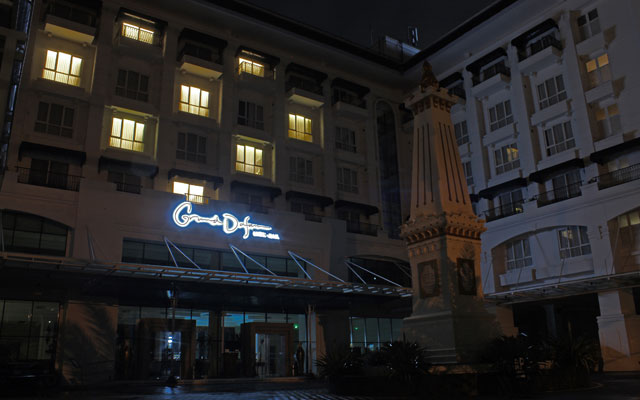
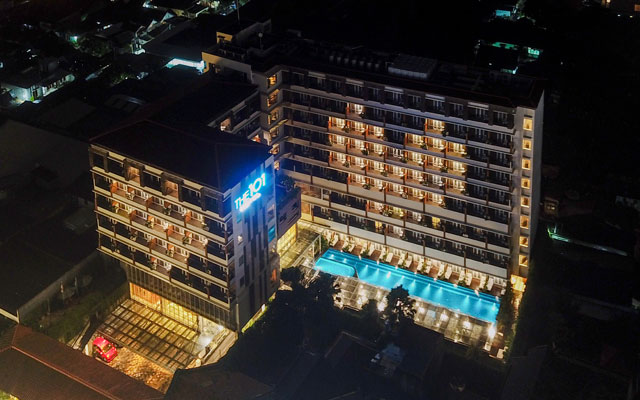
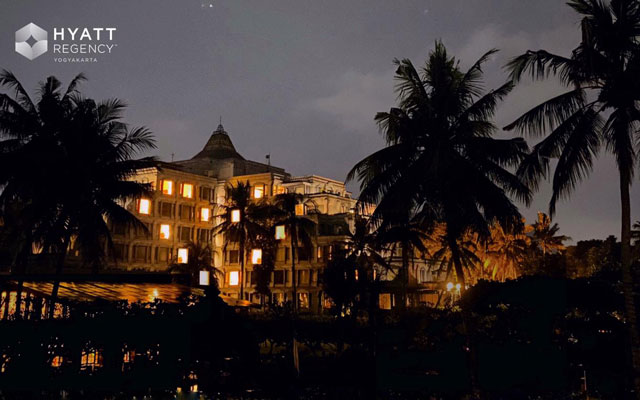
Amid lockdowns and mass hotel closures worldwide, hotels across the globe are lighting up with hearts, in a show of solidarity with fellow hoteliers and communities battling the coronavirus pandemic.
Over in Indonesia as well, hotels are turning off their room lights in the evenings and illuminating select windows to form the symbol of hearts to signify hope and love during these challenging times.
1 of 4
Grand Ambarrukmo Hotel
Grand Dafam Rohan Jogja
The 1O1 Yogyakarta Tugu
Hyatt Regency Yogyakarta
In Yogyakarta, 66 hotels in unison for two hours lit several room lights after sunset to form a glowing heart as a symbol of hope. The show of solidarity, which began last weekend, will continue every Saturday between 19.00 and 21.00 until the pandemic passes.
The movement, dubbed From Jogja with Love, is the brainchild of the Indonesian Hotel General Managers (IHGM) Yogyakarta Chapter.
“We want to spread hope and positive energy to the people (who are battling) the Covid-19 pandemic. Even though it is difficult, we must stay united to fight it,” said Kukuh Wibawanto, IHGM’s Yogyakarta Chapter chairman.
Through this movement, Kukuh added, they wanted to show the unquenched spirit of solidarity and boost morale in the hospitality community during this current time of uncertainty.
Khairul Anwar, representative of the Yogyakarta Hotel Public Relations Association (H3Y), said that this show of solidarity could be a morale-booster during this time of adversity.
“It is time we spread the spirit of love to those around us. This pandemic is making everyone stressed and worried. We see this as a time to strengthen love and kindness,” he said.
This initiative inspired hotels in Solo, Makassar, Aceh, Tangerang, and Cirebon to create glowing hearts of solidarity on their hotels’ facades.
“We hope that this small contribution can encourage the world to overcome this big problem together. With optimism and (a spirit of togetherness), we believe we will see the light at the end of the darkness,” Khairul elaborated.
Meanwhile, in Bali, a group of 68 individuals, including those from the travel and hospitality industry, have rallied together to create a video clip of them singing the song Karena Cinta (Because of Love) by late Indonesian singer Glenn Freddly as a form of support for medical staff, victims, and all parties who are currently fighting the pandemic.
At press time, the clip produced by Bagus Nugroho, director of sales and marketing of Mutiara Group Villas, has been watched over 5,500 times.
“We present this song to Indonesia on behalf of the hospitality industry. Because of love, we can unite to break the chain of the spread of Covid-19,” Bagus said.
Elsewhere, Artotel Group has released the #GardaDepan (the vanguard) video campaign on their social media. The empathy campaign is aimed at health care workers currently fighting Covid-19.
“This is our appreciation for their struggle. Through this video, we also hope to spread positive attitudes and care for our fellow humans,” said Yulia Maria, director of marketing and communication at Artotel Group.
As well, InterContinental Bali Resort has taken the initiative to make their own face masks and distribute them to employees and their family members, as well as the local community.
These homemade face masks produced by the resort’s tailoring team under the Housekeeping Department are fashioned from upcycled linen, and the team is committed to produce 40 to 50 masks daily.
Location
Situated at the historical heart of Melaka on Jalan Tokong, this luxury hotel sits in the midst of old shophouses, temples and mosques. It’s in the middle of the touristy area, and a five-minute walk from the famous Jonker Street lined with antique, handicraft, textile shops and restaurants during the day and turns into a buzzing night market after sunset.
The hotel building was originally six shophouses in a row, and in 1939, they were transformed into a home before it was converted into the current hotel, which retains the influences of 1930s colonial art deco and the Peranakan culture.
Other major attractions like Stadthuys, one of the oldest Dutch buildings in the city, A’Famosa Fort, and Christ Church are a short rickshaw ride away.
Rooms
The restored heritage property offers 30 rooms in six categories lined along the corridors overlooking the three-storey courtyard.
My Hang Tuah room, which is the second lead-in category, was on the top floor, conveniently located near the elevator. The hotel’s minimalist interior draws inspiration from colonial and heritage elements, with the room decked out in colonial-style decor like an antique ceiling fan. The king-sized bed has a very comfortable mattress – thick, soft and fine duvet.
The hotel room is fitted with several electricity plugs, making it very convenient for me to charge my gadgets within easy reach. The only grouse I have is the placement of the air-conditioner such that it was blowing cold air directly towards the bed.
F&B
The hotel’s pièce de résistance is the Courtyard, featuring a glass atrium where guests can lounge and dine with a view of the sky during the day.
Having breakfast at the Courtyard feels like dining in someone’s home garden. Antiques like an old radio set, vintage telephones, and colourful tiffins added to the blast-from-the-past aesthetic.
Sitting at the marble-topped table in the company of friends under the natural light coming in from the glass ceilings, with a cup of coffee and a bowl of cereal or a plate of nasi lemak, was a perfect way to kick-start the day.
An a la carte menu offering western and continental cuisines are available for lunch and dinner. This writer highly recommends the afternoon tea with Nonya cakes and pastry served in bamboo tiffins, which is available upon request. A group of minimum 15 people can order a mini buffet of the sweet and savoury local snacks, which includes silky talam, onde-onde and savoury popiah.
Facilities
There may not be a variety of facilities within the hotel compound, but the lobby and reception area have seating areas elegantly decorated with large and colourful paintings, as well as armchairs and sofas, making it a comfy hangout spot, not to mention, pretty backdrop for photos.
Upon request, the hotel provides concierge programmes such as the Vintage Becak Heritage Tour covering the major historical attractions, a walk along Jalan Tokong and Jonker Street visiting temples and shops, and a family outing to the Mamee Jonker House, which offers a design-your-own noodle cup experience.
Service
The friendly, attentive staff made my stay at Liu Men a very pleasant one. The driver sent to pick us up from the Kuala Lumpur airport to the hotel was knowledgeable, and he pointed out places of interest along the way and fed us some information on them.
Verdict
A boutique property with character and gracious service – that, coupled with its prime location in the heart of the Melaka heritage site, makes it a choice stay. Other plus points include the Insta-worthy interiors, great bedding, quality furnishings, attentive service, and complimentary snacks.
Number of rooms 30 Rates From US$116 Contact details
Tel: +60 6288 1161
Email: welcome@liumenhotel.com