Tourism suppliers should employ a strong focus on promoting domestic and near-domestic travel instead of plotting their longhaul strategies during this period, urged speakers at the ITB Asia 2020 Virtual last week.
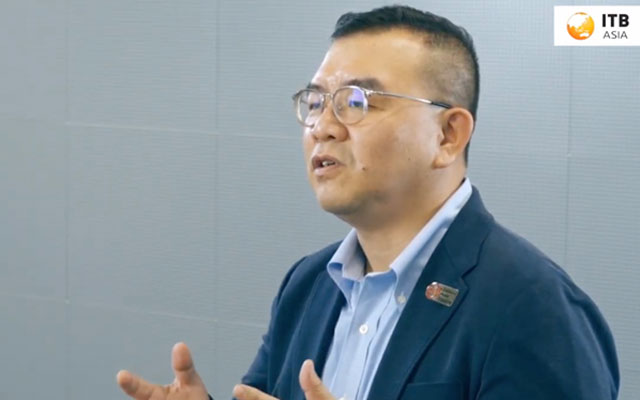
Timothy Hughes, vice president, corporate development, Agoda, expressed that while longhaul travel will eventually return, it will not come as “a surprise”, and the industry will receive ample “warnings” to plan their next move.
Location-based marketing help travel suppliers curb costs, while improving ROI of their marketing spend: Shibata
“Don’t get distracted by conversations about green lanes, corridors and vaccines. Just focus on what is right here in front of us: domestic travel. Save the thinking about longhaul (for) when we start to get signals that it’s coming back,” he advised.
Among the characteristics of domestic travel that Hughes reported is the pattern of “near-domestic” travel, where residents of major cities like Bangkok, Seoul and Tokyo have expanded their vacation radius to 200km around the city.
These “drive markets” have short lead times, with Agoda seeing many same- or next-day bookings, and are “on the hunt for a deal” on “high-category hotels, villas and houses”. Observing that consumers are looking for flexibility, he also advised the industry to “put ‘non-refund’ on hold for a while”.
In Japan, local tourism authorities have pivoted their strategies that were once geared towards the international market. Prefectures are now providing discount coupons and promotions to local residents, shared Kei Shibata, co-founder and CEO, Line Travel jp and Trip101.
He observed: “We have started to see a great amount of demand through location-based marketing. This is working well to avoid overtourism, and it helps destinations and hoteliers save costs while increasing their ROI on marketing. Last-minute booking is also a big thing now, and our mobile push notifications are working extremely well to capture this demand.”
As companies feel the crunch on cost amid the pandemic, Hughes continued to stress that travel businesses should heavily consider investing in fintech solutions.
He asserted: “If you are not a fintech company in travel, you are giving money away. You’d need either teams of people – or if (one) cannot afford teams, then really smart partners – who can help manage complexity of payments in (the) most cost-effective way. If you’re a travel company, you’d better have fintech solutions.”
Travel suppliers in the South-east Asia region can now register their interest to participate in The Great 2021 ASEAN Travel Fest, a year-long B2B and B2C virtual travel festival designed to help regional hospitality suppliers source new business opportunities.
Organised by TTG Asia Media, the festival will spotlight one or more of the ten South-east Asian countries each month, starting from February through November; alongside an All ASEAN showcase in the month of June.
Each monthly destination showcase will take place over three days, comprising of two components: B2B Tradeshow and B2C Live Selling.
During the two-day B2B Tradeshow, which will take place on Thursday and Friday, participating sellers will be able to engage with travel trade buyers from Asia-Pacific and international markets, through a 24/7 virtual exhibition, walk-in business meetings, as well as interactive giveaways and games.
This will be followed by the B2C Live Selling on Saturday, where suppliers can connect with local and regional consumers through a virtual broadcasting event capped at two hours, and sell attractive deals and offers direct to them.
Leveraging on the popularity of live broadcast shopping, production of this segment promises to be hassle-free, with suppliers having to provide only their product information and inventory. The rest will be managed by TTG Asia Media, which will handle aspects from programming and production, to event hosting, live-stream platforms, and an online transaction medium.
Suppliers can also tap into TTG Asia Media’s vast network of travel professionals and enthusiasts to market their event to a wider audience.
Companies can get two showcases for the price of one, with the ROI-driven packages starting at US$2,500, which includes B2B participation with virtual booth and business meeting tools at one destination showcase, plus one All ASEAN showcase.
Other benefits include eight pre-scheduled appointments during the All ASEAN showcase, unlimited walk-in meetings for both showcases, alongside the opportunity to sponsor prizes for interactive games and giveaways.
The price excludes an additional US$2,000 participation fee per B2C Live Selling event, and a 20 per cent commission for inventory sold.
Singapore-based budget hotel operator RedDoorz has launched a new economy lifestyle hotel brand, SANS, as part of its strategy to build the largest new-age hospitality company in South-east Asia.
SANS, which is derived from the Indonesian word “santai” which means to “chill”, aims to provide a vibrant and cosy stay experience at a low cost, with properties to feature trendy furnishings and amenities.
The launch of SANS signals RedDoorz’s new vision to become “an ecosystem of various accommodation products”
The brand will debut in Indonesia next month, with five new properties targeted by year-end.
RedDoorz will also embark on a major rebranding exercise in 2021 to reposition the company as a multi-brand accommodation platform. The company said that it plans to add new accommodation products to its platform across economy lifestyle, mid-scale and extended stay segments, in addition to its existing budget hotel brand and co-living service KoolKost.
As part of the rebranding, the company will also roll out a new redesigned app and rebranding campaign in 1Q2021. The new app will allow users to browse the company’s portfolio of accommodation brands, and will also be complemented by a new loyalty programme, which can be used to earn and redeem discounts and access exclusive partner offers and benefits.
Amit Saberwal, founder and CEO, RedDoorz, said: “We are now getting ready for our next phase of growth and despite Covid-19, we remain deeply committed to South-east Asia’s hospitality potential. Once the pandemic gets behind us, we will be the first hospitality company in our part of the world to spring back into full growth mode again, thanks to everything we’ve done during this challenging year.”
The Singapore Tourism Board (STB) will roll out three programmes by end-2020 to give local tourism businesses a boost in their data transformation journeys, announced the board’s acting chief technology officer, Poh Chi Chuan.
Poh shared that the first initiative is an aggressive push for augmented reality (AR) technology. The board aims to build a bank of some 1,000 “high-quality” AR resources on its Tourism Industry Hub, test prototypes to showcase AR applications, launch a set of recommended standards, and introduce AR training courses on its Tech College.
Data transformation critical for survival in the post-Covid landscape: Poh
This strategy follows the successes of local attractions, Singapore Zoo and nightclub Zouk, which adopted AR marketing and events to engage with consumers during the pandemic.
Poh said: “We decided to focus on AR as it is an accessible technology that we believe will be mainstream in the next couple months.”
The second initiative will see the full-scale launch of the board’s Tourism Transformation Index (TXI), which has been in limited pilot phase since June.
Once fully launched, tourism businesses in Singapore will be able to assess their current state of transformation against a holistic set of metrics, as well as access a new dynamic industry benchmark to measure against other companies and gauge the growth of the industry.
Finally, STB plans to enhance its Singapore Tourism Analytics Network by introducing new data domains and features, resources such as the Data College, as well as a governance playbook for companies to guide them on proper handling of data privacy.
“Covid-19 has led a paradigm shift that has accelerated data transformation from something that is good to have to something that is a must-have for survival,” expressed Poh.
He added that STB is also launching a white paper, Beyond Covid-19 – Tourism Transformed, detailing its recovery predictions.
As countries cautiously restart their tourism engines and airplanes return to the skies, Asia-Pacific is set to be the first region in the world to rebound, which will provide a blueprint for post-Covid recovery.
“If we look at which regions are going to be at the forefront of (the) recovery momentum, Asia-Pacific is ahead of the race. Reason being, firstly, (it has) a great deal of regional travel. There is a lot of hopping within countries, and across regional countries,” said Anita Mendiratta, special advisor to secretary general, The UN World Tourism Organization.
UNWTO advisor urges continued safety protocol, clear messages, tourist dispersion
“And, Asia-Pacific was the first to experience the pandemic. (It is) getting through it first, (showing) the rest of the world what recovery will look like.”
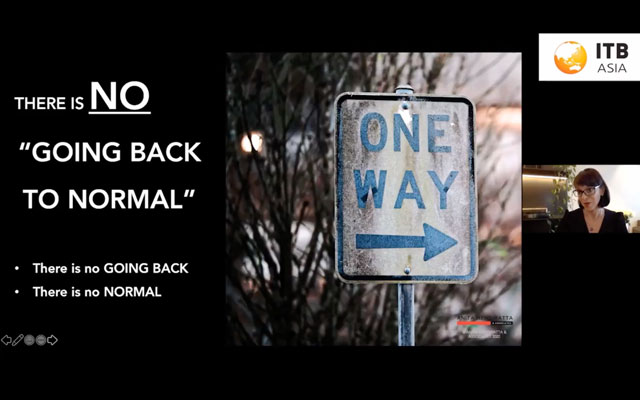
Speaking at the ITB Asia 2020 Virtual session, titled The Future of Travel Post-Covid-19, Mendiratta quashed any notions of a return to normalcy, instead dubbing the new world of travel as the “next normal”, where uncertainty abounds in light of recurring waves, and the many questions surrounding a Covid-19 vaccine.
In this climate of uncertainty, destinations have to adapt to new ways of working and connecting with travellers for tourism recovery to gather pace.
Noting that at the height of the pandemic, 16,000 aircraft were grounded around the world, Mendiratta said that airlines now need to determine route profitability and where the demand lies, while also accessing stability risks in terms of the virus to prevent future groundings.
She also cautioned destinations against growing lax with safety protocols. “The protocols are critical; they are part of the experience that we must now accept as the future of travel, particularly, in a post-Covid-19 world,” she stressed.
Noting that the need for space will sway future travel decisions, she said destination marketers need to “(unlock) areas in destinations that have really not been discovered before – places that are more remote, less densely populated, allowing dispersion”.
With trust hailed as the new currency for tourism marketing, she also reiterated the critical importance of communication in managing traveller expectations and giving them peace of mind.
“Now is the time for communication, not campaigns. Destinations, airlines, airports, attractions can all speak to travellers, but speak to them as equals, focusing on why – not where – they are travelling.
“Create that connection now, so that when they are ready to travel, they know that there is a place and there are people looking forward to seeing them,” concluded Mendiratta.
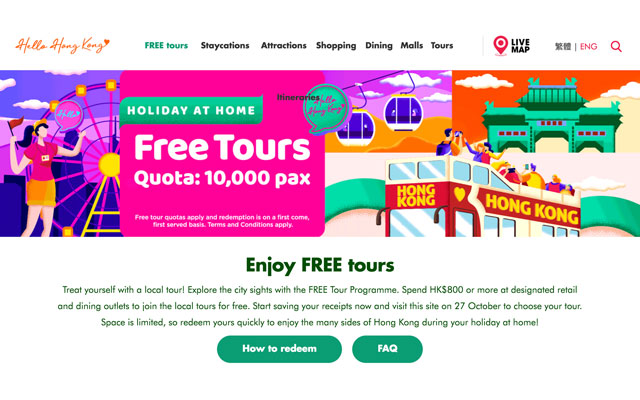
Residents in Hong Kong are eligible to join a free local tour by spending at least HK$800 (US$103) at brick-and-mortar retail and dining outlets in the city, under a new initiative by the Hong Kong Tourism Board (HKTB).
The launch of the Free Tour programme follows the government’s announcement to exempt local tours from social distancing restrictions – a move that HKTB said will “pave the way for the resumption of travel”.
All travel agencies participating in the Free Tour programme need to register their tours with the Travel Industry Council of Hong Kong (TIC). In addition, they are obligated to sign the Anti-epidemic Undertakings for Local Tours, devised by the TIC to guarantee appropriate epidemic prevention measures are carried out during the free local tours.
The new scheme is part of the second phase of HKTB’s Holiday at Home campaign, launched in mid-June to encourage local residents to be tourists in their own city. Phase one saw a series of offers rolled out to stimulate domestic consumption in the travel, hotel, dining and retail sectors.
In the second phase of the campaign, the Free Tour programme aims to boost the local economy by giving free Hong Kong tours to local residents.
Since October 20, local residents can start collecting machine-printed receipts after shopping and eating at brick-and-mortar retailers and dining outlets. A maximum of two receipts with a minimum spend of HK$800 can be redeemed for each tour.
Details of the various free tours on offer, and how to redeem them, will be available on the campaign website from October 27. Eligible local residents can contact the corresponding travel agencies to sign up for their preferred tours. In the first stage of the programme, a total of 10,000 seats will be available on a first-come, first-served basis.
The free local tours will kickstart from November 1, and run for two months. Participants can choose from about 50 immersive tours designed by various local travel agencies. A tour guide, return transportation, one meal and basic insurance are included in all tours, each lasting at least half-a-day. Participants will visit at least two points of interest, including social media “check-in” hotspots and unique Hong Kong attractions.
Travel analytics firm ForwardKeys has enhanced its flight data capabilities through a new long-term partnership with global flight information provider OAG.
Under the agreement, OAG will provide ForwardKeys with a weekly feed of the latest worldwide airline schedules, a daily feed of schedule changes to understand volatility better, a daily feed of flight status data to track flight cancellations worldwide, and improved modelling and identification of aircraft configurations used on specific routes.
Jager calls ForwardKeys’ partnership with OAG to tap its flight data an “appropriate and timely change”
This will enable ForwardKeys to provide even more accurate data on airline seat capacity to its clients, amid the rapidly evolving Covid situation, the company said in a statement.
Olivier Jager, CEO and co-founder of ForwardKeys, said: “Seat capacity and schedule data is a core, strategic asset for ForwardKeys. It is not only a dataset that is consumed directly by a significant number of clients via our online platforms and offline reports, but it is also used extensively in the company and is a key component for our algorithm to model and generate total air market estimates.
“After careful consideration and analysis of OAG’s data, our team collectively agreed that this was an appropriate and timely change to make as we strive to continuously improve.”
The new data files will be available to ForwardKeys clients via its flagship online subscription tool ForwardKeys Nexus, as well as through the company’s offline reports, API web services or flat-file deliveries. The new dataset will also appear in new products and services that ForwardKeys bring to the market, according to Jager.
Sindhorn Kempinski Hotel Bangkok, Thailand
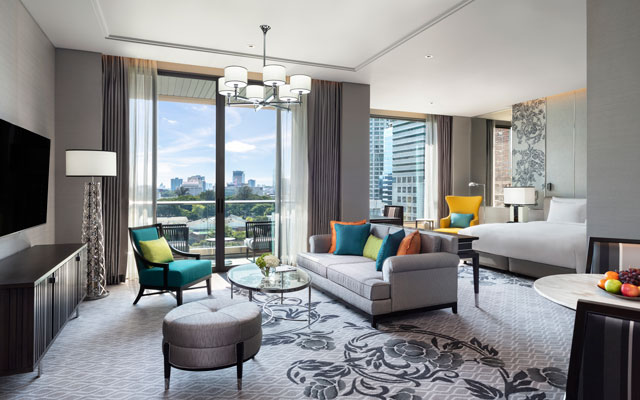
Set in Sindhorn Village, the green and upscale residential expansion to Lumphini Park, Sindhorn Kempinski Hotel Bangkok has debuted its 285 rooms and suites, including the three-bedroom Sindhorn Royal Suite, as part of the next phase of the hotel’s opening process. Room sizes start at 66m², with each room boasting floor-to-ceiling windows, alongside its own private balcony seating.
New amenities include a 25m² infinity swimming pool; and the newest stage of Sindhorn Wellness by Resense, with the hammam and the thermal area, with its sauna, bio sauna, steam room, cold room, micro-salt inhalation room, rasul mud room, experience showers and infrared tepidarium relaxation beds. These facilities join the fitness, yoga and Pilates studios, which had opened earlier. On-site F&B venues include a bar with a cigar lounge, a lobby lounge, as well as an all-day restaurant with an open kitchen and a garden terrace.
Each of the hotel meeting and event rooms boast natural daylight and an outdoor balcony. There are five flexible venues spanning a total 268m² indoors, and an outdoor garden venue covering 436m², available to host corporate meetings and an assortment of events.
Mercure Kyoto Station, Japan
Situated just minutes from JR Kyoto Station, Mercure Kyoto Station boasts 225 guestrooms, ranging from 23-34m² with design elements including motifs from the Heian period – a nod to the ancient history for which Kyoto is renowned. Trattoria M Kyoto, a live kitchen-style bistro restaurant and bar, will offer all-day dining. Guests can also unwind in the underground lounge, which will feature original furniture from the Heian period and books providing insights into the ancient traditions of Japan.
Fairfield by Marriott hotels, Japan
Fairfield by Marriott will double its footprint in Japan with the opening of eight hotels across four prefectures by year-end. The new hotels are located at roadside ‘Michi-no-Eki’ destinations inspired by rural landscape, mountains and historic sites.
Six properties have opened their doors this month: Fairfield by Marriott Gifu Seiryu Satoyama Park (85 rooms), Fairfield by Marriott Gifu Mino (54 rooms), Fairfield by Marriott Tochigi Utsunomiya (87 rooms), Fairfield by Marriott Kyoto Kyotamba (75 rooms), Fairfield by Marriott Gifu Gujo (87 rooms), and Fairfield by Marriott Mie Mihama (63 rooms). Soon to follow is Fairfield by Marriott Tochigi Motegi (52 rooms) in November, and Fairfield by Marriott Kyoto Miyazu (93 rooms) in December.
All eight hotels feature a lounge with a relaxed seating area, with each guestroom averaging about 25m². The hotels also offer fast complimentary Wi-Fi, and optional breakfast takeaway in bento boxes.
This latest string of openings is part of Marriott International’s Trip Base initiative, a project seeking to revitalise local sightseeing spots by opening hotels alongside ‘Michi-no-Eki’ roadside stations, designed to provide comfortable stopover rest facilities for road trip travellers in Japan.
• Continued freeze on foreign travel forces airlines to innovate and unlock new revenue streams
• Sales for sightseeing tours, virtual reality flight experiences soar on back of pent-up travel demand
• From pyjamas to fried dough fritters, no product is off-limits for airlines desperate to generate some cash
Thai Airways opened access to its Airbus and Boeing flight simulators earlier this month, offering aspiring pilots and aviation fans the chance to experience piloting a plane
As the fate of international tourism worldwide remains up in the air, Asian airlines have been spreading their wings into new revenue sources in a desperate bid to stay afloat.
From F&B initiatives to sightseeing flights that go nowhere, novel ideas spun up by airlines keep staff working, homebound travellers engaged, and cash tills ringing.
Next destination: Homebound
As the concept of sightseeing tours in the skies takes off in Asia, more airlines are seeing it as a runway for revenue growth, pencilling in additional dates or throwing in complementary perks around these no-destination flights to pique pent-up wanderlust – and pandemic-weary consumers are lapping it all up.
Airlines like All Nippon Airways, EVA Air, and Qantas have sold out flights that take off and land at the same airport, satisfying the travel urge of frequent flyers and homebound travellers, as the majority of borders across the globe remain sealed.
As the latest carrier to hop on the trend, Hong Kong Airlines (HKA) is set to operate a 1.5-hour sunset flight from Hong Kong to Hong Kong. Dubbed Embrace “Home” Kong flight, the October 24 service also aims to support local businesses and artists.
All 100 tickets for the joy flight sold out within 30 minutes, and a spokesperson from HKA told TTG Asia that due to the “overwhelming demand”, the airline may consider launching similar flights “in the very near future”.
Hong Kong Airlines join a growing list of carriers in Asia who are operating flights to nowhere amid the pandemic
Using an Airbus A320 aircraft, the flight will fly within 200 nautical miles from Hong Kong over the South China seas. Starting from HK$852 (US$110) for one or two passengers and HK$1,188 for a party of three, the airfare includes HK$600 in cash vouchers, which can be used to purchase air tickets from HKA or products from the airline’s wholly-owned subsidiary HKA Holidays.
An add-on staycation at Novotel Citygate Hong Kong priced at HK$1,288 is also available for purchase for ticket-holders, which includes a one-night stay in a standard room plus dinner and breakfast buffet for two adults.
To help struggling local agents, an undisclosed number of tickets to the sunset flight were sold at appointed travel agencies. A tie-up with inflight caterer, Gate Gourmet, will provide snack boxes to all participants. Customers can also redeem a dining discount at aviation-themed restaurant, The Galley by Café Proud Wings.
A lucky draw on that day will dangle prizes including luxe staycations, restaurant vouchers, an experience in the airline’s flight simulator, as well as an airfare and accommodation package for two in Bangkok from HKA Holidays.
Through this initiative, the airline also aims to promote local art and culture, through the sale of special travel memorabilia designed by four local artists, alongside take-home souvenirs featuring their work for all participants.
Over in South Korea, Asiana Airlines will conduct scenic flights over four resort areas including Jeju island for 310 passengers over two days – October 24 and 25. Using A380 airplanes, the flight experience will include an in-flight meal and amenity kit. Discount coupons for domestic routes are built into the fare, ranging from 250,000 won (US$175) to 305,000 won.
Tickets for these flights to nowhere sold out within hours, according to The Korea Herald – and they aren’t the only faux flights to sell like hotcakes.
Qantas Airways’ seven-hour scenic flight over Australia’s Outback and Great Barrier Reef in October was the fastest-selling flight in the airline’s history. All 134 tickets on the Boeing 787 were snapped up in 10 minutes, with passengers forking out between A$787 (US$579) and A$3,787 for the joyride.
Similarly, all 120 tickets to Tigerair Taiwan’s sightseeing flight from Taipei that circled over Jeju in September sold out within four minutes. The airfare, costing NT$6,888 (US$240), includes a one-year voucher for round-trip tickets from Taiwan to South Korea, which can be used after Covid-19 travel bans are lifted.
The record-holder for fastest-sold sightseeing flights, though, is Taiwanese start-up carrier Starlux Airlines. In early August, Starlux unveiled its first “pretending to go abroad” flight piloted by its chairman, and all 188 tickets for the 3.5-hour trip over the Taiwan-controlled Pratas Islands in the northern part of the South China Sea flew off the shelves in just 30 seconds. Tickets went for NT$4,221 (US$147) each.
Changing the game, upping the ante
Grounded passengers who are unable to fly abroad, are also opting to fly past the moon instead. In conjunction with the Mid-Autumn Festival, Chinese budget carrier Spring Airlines offered around 100 moon-viewing flights from September 26 to 28, giving travellers the chance to get a close-up view of the supermoon lunar eclipse, reported CNN. Keeping festival traditions alive, activities such as writing couplets, giving out mooncakes, and guessing lantern riddles were also carried out during the flights.
Likewise, EVA Air and Starlux have also launched moon-gazing flights in early October, allowing passengers to catch glimpses of the moon in its full glory.
EVA Air took over 300 passengers on a Boeing 787 Dreamliner to view the moon for NT$5,888 in economy class, with a window seat going for NT$1,000 more. Tickets for business class cost NT$7,888 each.
Pre-boarding, passengers were serenaded by a string quartet from the airline’s own symphony orchestra who played moon-themed classics such as Fly Me to the Moon and The Moon Represents My Heart. Passengers who shared the same name as the Chinese moon goddess, Chang’e, were gifted with a Dreamliner model.
Promising to bring passengers on a journey “closest to the moon”, the Starlux Fly to the Moon flights included a Michelin-starred meal in each NT$5,888-priced ticket.
The airline has since chalked up more than a dozen flights to nowhere, with most of the flights being scooped up within 10 minutes, Katie Chao, a spokesperson for Starlux, told the Times. Aiming to up the luxe ante on these no-destination flights, the airline has been bundling flight packages with hotel stays, she added.
For Taiwan’s flag carrier China Airlines, its flights to nowhere were paired with flight attendant lessons for kids. In August, the carrier started conducting morning camps at its Taoyuan headquarters which saw participating children playing the roles of cabin crew and serving passengers in a mock cabin. This was followed by a two-hour sightseeing flight over the island, which also flew into Japanese airspace.
Also looking to engage families with kids, Singapore Airlines (SIA) is offering behind-the-scenes tours of its training facilities over the November school holidays. Visitors will gain insights into the airline’s 70-year history, with the opportunity to interact with the crew. Admission tickets, which include an in-flight meal and goodie bag, are priced at S$30 (US$22) for adults, and S$15 for children aged three to 12.
Several activities are also available as add-ons, including a junior cabin crew experience (S$88), a full flight simulator ride (S$500 for up to three participants in a 30-minute session), a wine appreciation experience (S$38), and a grooming workshop which includes a Lancôme makeup palette (S$88).
Ready for virtual take-off
There are even opportunities for grounded travellers to enjoy the thrill of take-off, without even leaving the ground.
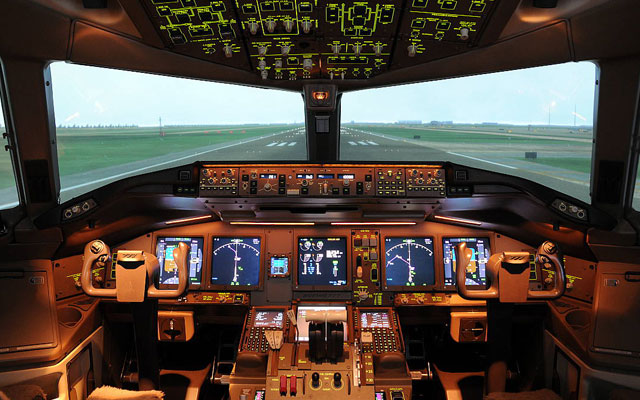
This month, the debt-ridden Thai Airways International (THAI) opened access to its Airbus and Boeing flight simulators, offering budding pilots and aviation fans the chance to play pretend pilot. Customers can hop into a mock cockpit of their choice from four aircraft models – the Airbus A380, Boeing 777-300ER, Boeing 747-400, and Boeing 737-400 – and be able to use the flight training devices.
Pilots and co-pilots will accommodate customers throughout the entire session, with prices ranging from 12,000 baht (US$385) for a half-hour session for two users to 36,000 baht for a 90-minute experience for a trio.
The simulators are normally reserved for the training of pilots employed by THAI and those from overseas, and have only opened to the public for the first time as part of the THAI Flying Experience & Beyond project, which also includes plans to conduct sightseeing flights around the country, reported the Bangkok Post.
Grounded Japanese tourists have been flocking to virtual aviation facility First Airlines for a faux travel experience in a mock airline cabin, with flat panel screens displaying aircraft exterior views including passing clouds
Non-airline companies are joining the game too. Tokyo-based First Airlines offers virtual travel experiences in a mock airline cabin, where guests are served in-flight meals by staff dressed as flight attendants, while ‘touring’ famous sites through virtual reality headsets.
While the entertainment company has been in operation since 2017, the take-up rates for the 6,580 yen (US$62), 110-minute flight simulation has doubled amid Covid-19 as Japanese holidaymakers turn to virtual reality for a taste of travel, Reuters reported.
Selling everything from airplane food to pyjamas
To recreate the experience of in-flight dining, SIA turned its A380 double-decker superjumbo aircraft into a pop-up restaurant which will host diners over the next two weekends. More seats and dates were added after tickets for the original two seatings were snapped up within 30 minutes.
Diners can savour the airline’s signature dishes, or familiar favourites from its Peranakan menu, at the pop-up Restaurant A380@Changi. Prices range from S$50 (US$37) and S$90 for a three-course meal in economy and premium economy class, to S$300 for a four-course meal in business class and S$600 in suites. Each meal comes with two complimentary alcoholic drinks and free flow of other beverages.
Singapore residents can enjoy an inflight dining experience on the ground at SIA’s Restaurant A380@Changi
Other highlights include a heritage showcase of the airline’s cabin crew uniforms through the years, an exclusive pre-lunch tour of the A380’s private access areas including the cockpit, alongside limited-edition souvenirs.
For those who prefer home-delivered airline meals, SIA@Home lets customers enjoy first class and business class meals in the comfort of their own home, for the starting price of S$448 and S$288, respectively. Ten menus are on offer, with limited-edition dining ware and amenities included in select packages.
For a taste of the ultra-luxe dining experience, customers can also book a private chef who will reheat, plate and serve the meal for them in their homes.
SIA’s pop-up eatery follows THAI’s move in September to transform its cafeteria at its Bangkok base into an airplane-themed restaurant, complete with aircraft seats and cabin crew serving in-flight meals on trays.
The Thai flag carrier, which is undergoing debt restructuring, has also started selling its own version of fried dough sticks at the airline’s five food outlets in Bangkok. The dough fritters are a hit, reportedly raking in 10 million baht in monthly sales, prompting plans for a franchise, reported the Bangkok Post.
When it comes to airlines peddling stuff for added cash flow amid the travel slump, nothing seems off-limits. In August, Starlux launched a limited-edition biscuit set dubbed Starbox, which came in a case shaped like an air freight container used on the airline’s Airbus A321neo planes. All 1,500 Starboxes, each priced at NT$1,780, sold out within 35 minutes. Buoyed by the success, the airline released a second edition of the gift box early last month.
Limited-edition biscuit boxes launched by Starlux created buzz for its cargo container-shaped casing
After Qantas was forced to retire its Boeing 747 fleet six months early due to the pandemic’s impact on air travel, it sought to make a quick buck by peddling the bar carts salvaged from the jumbos. A total of 1,000 “well-travelled” bar carts which were up for sale came stocked with alcohol, sweet treats, business class amenity kits and pyjamas, and a first-class Sheridan throw.
Offering customers a chance “to own a piece of aviation history”, the carrier claims that “each cart has travelled the world, from London and Los Angeles to Singapore and Santiago”, with each averaging around 2,000 flights. Priced at A$974.70 for a half-cart, and A$1,474.70 (US$1,038.74) for a full-size cart with double the items, the catering carts quickly sold out.
The Australian airline in August had also turned its excess stock of in-flight perks typically bestowed upon premium passengers into 10,000 care packs, slapped a A$25 price tag on each one, and put them up for sale online. All packs sold out within a few hours. Besides the airline’s highly coveted business class pyjamas, the kits also contained tea bags, Tim Tams, hand cream, and smoked almonds.
Earlier this month, Qantas sold off more 747 memorabilia – including emergency exit signs, phone handsets and a galley control unit – via a charity auction, with the resulting funds donated to the Royal Institute of Deaf and Blind Children.
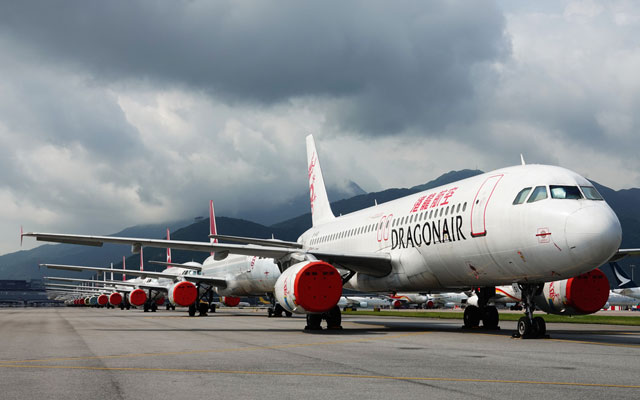
Cathay Pacific will cease the operations of its regional subsidiary Cathay Dragon after three decades with immediate effect, as part of a wider restructuring in response to the ongoing pandemic travel slump.
The Hong Kong airline said that it plans to seek regulatory approval to continue operating a majority of the routes offered by Cathay Dragon, mainly through its wholly-owned subsidiary HK Express.
Cathay to cease operations of its regional airline, Cathay Dragon, and reduce workforce by nearly a quarter
At the same time, Cathay will also cut 8,500 jobs, or nearly a quarter of its workforce across the entire group. About 5,300 employees based at its headquarters in Hong Kong and another 600 elsewhere will likely lose their jobs, while 2,600 unfilled positions will also be cut, it said in a statement.
Hong Kong-based cabin and cockpit crew members will be asked to agree to changes in their conditions of service to match remuneration more closely to productivity. Executive pay cuts will continue throughout 2021 and a third voluntary Special Leave Scheme for non-flying employees will be introduced for the first half of next year.
The airline said it will offer severance packages that “go well beyond statutory requirements”. It will also be extending medical benefits and staff travel entitlements, as well as providing counselling and job transition support services.
Cathay Pacific CEO Augustus Tang said: “The global pandemic continues to have a devastating impact on aviation and the hard truth is we must fundamentally restructure the group to survive. We have to do this to protect as many jobs as possible, and meet our responsibilities to the Hong Kong aviation hub and our customers.
“We have taken every possible action to avoid job losses up to this point. We have scaled back capacity to match demand, deferred new aircraft deliveries, suspended non-essential spend, implemented a recruitment freeze, executive pay cuts and two rounds of Special Leave Schemes.
“But in spite of these efforts, we continue to burn HK$1.5-2 billion cash per month. This is simply unsustainable. The changes announced today will reduce our cash burn by about HK$500 million per month.” Nothing that recovery will be slow, Tang said the airline expects to operate below 50 per cent of 2019 passenger capacity for the entire of next year.

















Travel suppliers in the South-east Asia region can now register their interest to participate in The Great 2021 ASEAN Travel Fest, a year-long B2B and B2C virtual travel festival designed to help regional hospitality suppliers source new business opportunities.
Organised by TTG Asia Media, the festival will spotlight one or more of the ten South-east Asian countries each month, starting from February through November; alongside an All ASEAN showcase in the month of June.
Each monthly destination showcase will take place over three days, comprising of two components: B2B Tradeshow and B2C Live Selling.
During the two-day B2B Tradeshow, which will take place on Thursday and Friday, participating sellers will be able to engage with travel trade buyers from Asia-Pacific and international markets, through a 24/7 virtual exhibition, walk-in business meetings, as well as interactive giveaways and games.
This will be followed by the B2C Live Selling on Saturday, where suppliers can connect with local and regional consumers through a virtual broadcasting event capped at two hours, and sell attractive deals and offers direct to them.
Leveraging on the popularity of live broadcast shopping, production of this segment promises to be hassle-free, with suppliers having to provide only their product information and inventory. The rest will be managed by TTG Asia Media, which will handle aspects from programming and production, to event hosting, live-stream platforms, and an online transaction medium.
Suppliers can also tap into TTG Asia Media’s vast network of travel professionals and enthusiasts to market their event to a wider audience.
Companies can get two showcases for the price of one, with the ROI-driven packages starting at US$2,500, which includes B2B participation with virtual booth and business meeting tools at one destination showcase, plus one All ASEAN showcase.
Other benefits include eight pre-scheduled appointments during the All ASEAN showcase, unlimited walk-in meetings for both showcases, alongside the opportunity to sponsor prizes for interactive games and giveaways.
The price excludes an additional US$2,000 participation fee per B2C Live Selling event, and a 20 per cent commission for inventory sold.
Register your interest here.