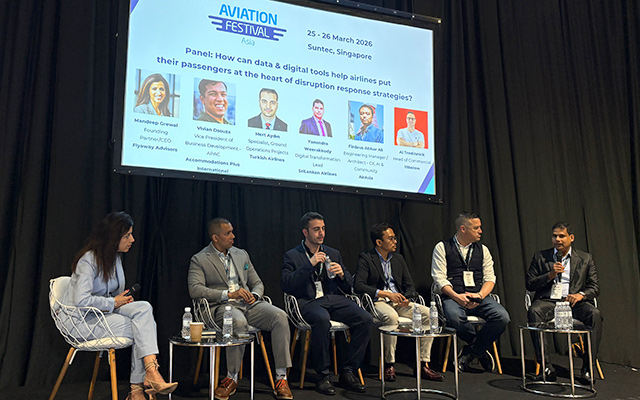
Airlines and aviation stakeholders are increasingly turning to data and digital tools to place passengers at the centre of response strategies during disruptions. However, effective customer service practices remain essential for the best outcomes.
This remains the case even as chatbots evolve into agentic AI.
Speakers at a panel discussion at the recent Aviation Festival Asia in Singapore stressed the importance of regular communication and not leaving passengers in the dark, even if only to say there is no update.
“Humans still need to provide the emotive connection even when using technology,” said Al Tredinnick, head of commercial at 15below, adding that airlines need to give passengers’ family members access to flight updates.
SriLankan Airlines’ digital transformation lead Yanendra Weerakkody remarked that communicating as one team is key.
Vivian Dsouza, vice president of business development for APAC at Accommodation Plus International (API), called for the use of a channel platform for discussions to alleviate frustration, which can be AI-moderated to make “passengers feel heard”.
Dsouza added that API uses climate and geopolitical data to plan and prepare for 95 per cent of scenarios, with 85 per cent of passenger accommodation handled through AI and machine learning combined with human analysis.
Moderator Mandeep Grewal, founding partner and CEO of Flyaway Advisors, emphasised “looping in frontline staff”, while Mert Aydin, specialist in ground operations projects at Turkish Airlines, opined that systems must be constantly checked and updated.
AirAsia engineering manager and architect for customer experience, AI and community, Firdaus Abhar Ali, said introducing a rating system has increased customer satisfaction.
He added that there are plans to introduce a travel concierge chatbot into the group’s booking channel.