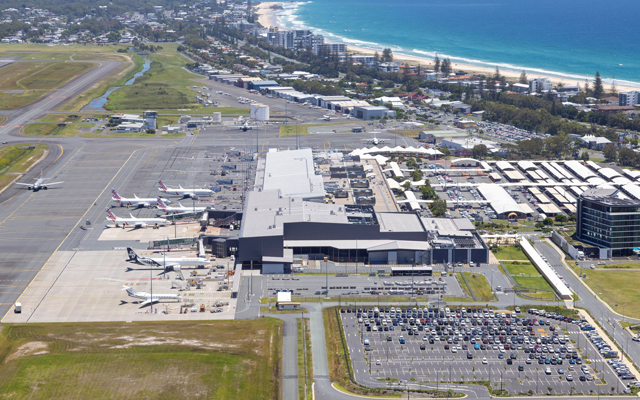
Securing new direct flight capacity with overseas markets represents a major goal for Gold Coast Airport, as it moves to capture rising travel demand that is driven by rapid population growth and an unprecedented local economic boom.
Gold Coast Airport recently added Qantas services to Auckland and Fiji Airways flights connecting through to North America.
“We’re targeting markets that have existing strong demand for travel in and out of the Gold Coast and northern New South Wales regions,” Adam Rowe, chief of aviation at Queensland Airports, told TTG Asia.
“Our catchment is craving a hub connection that services not just the Asian region but also the UK and Europe.”
According to recent International Visitor Survey data, 28 per cent of international visitors to the Gold Coast arrive via Brisbane Airport, whereas 66 per cent fly directly into Gold Coast Airport on either domestic or international flights.
Rowe noted that traffic congestion on the drive down from Brisbane is resulting in a clear visitor preference for flying direct or transiting through domestic hubs like Sydney or Melbourne instead.
“We’re keen to strengthen our direct links as much as possible to ensure visitors are offered the best experience, with efficient transit through Gold Coast Airport offering substantially more time in destination,” Rowe explained, highlighting the seamless experience at Gold Coast where processing time from aircraft to landside can take under seven minutes.
Strong economic indicators are driving the push for expanded capacity. The region is seeing rapid population growth and leads Australia in construction activity – holding the nation’s highest ‘crane index’, which measures economic growth by counting the number of active building cranes in the skyline.
Upcoming developments include high-rise apartments and new luxury hotels such as Australia’s first Andaz, Ritz-Carlton, Marriott Luxury Collection, St Regis, and Westin.
To attract new international carriers, Gold Coast Airport works closely with local, state, and national tourism bodies, leveraging initiatives like the state’s Connecting Queensland Fund along with advocacy from Tourism Australia to incentivise airlines.
Addressing global supply chain issues and hub capacity constraints, Rowe stressed the importance of long-term sustainability over temporary market shifts. The strategy is already showing strong results, with the airport recording 25 per cent international growth in FY26.
“Hub capacity limits or supply chain constraints are temporal – we need to be able to see past that to seek and support the establishment of new capacity that captures existing market demand and stimulates additional travel,” Rowe added.