TTG Asia
Asia/Singapore Thursday, 9th April 2026
Page 917

Thai hotel outlook remains bleak for 2021

0

Sharp drops in hotel occupancy as a result of January’s soft shutdown to deal with Thailand’s second Covid-19 outbreak as well as various challenges, including unequal domestic travel rebound and vaccination limitations, have led travel analytics firms STR, Inc and C9 Hotelworks to predict a slow year for the Kingdom’s hotel industry.

According to Jesper Palmqvist, area director Asia Pacific for STR, Thailand occupancy for the full year of 2020 ended at 23.5 per cent, compared to 72 per cent in 2019, using Total Room Inventory (TRI) Occupancy, where the metric includes hotels that are temporarily closed.
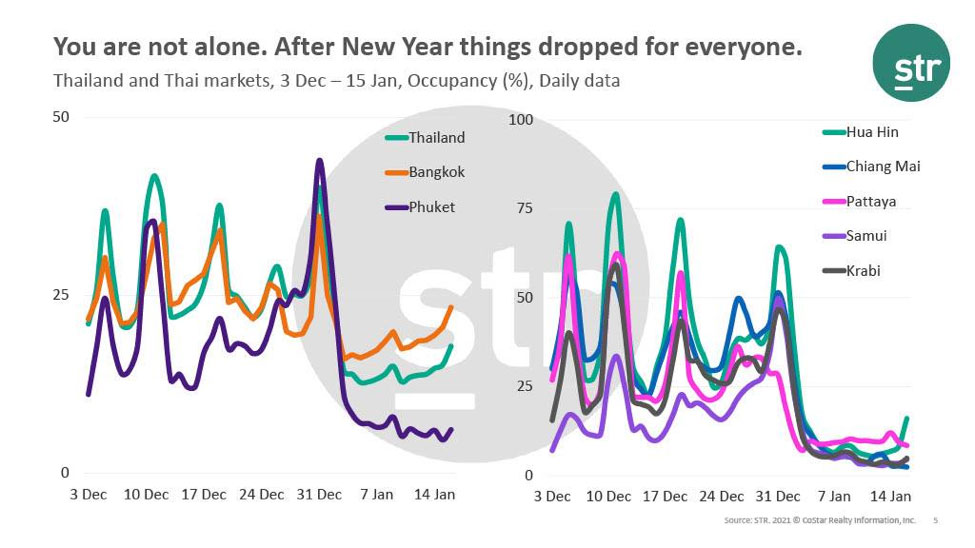
Hotel business hit by fresh waves of infection in January 2021

With Standard Occupancy (excluding hotels that are closed), those numbers become 29.3 per cent and 72.9 per cent, respectively.

Palmqvist noted that occupancy rates dropped sharply for all major markets in Thailand after the New Year, as the government imposed measures to restrict the spread of Covid-19 following the second outbreak at end-January 2021.

Presently, five per cent of hotel rooms across Thailand are temporarily closed, an improvement from six months ago when over 30 per cent went into hibernation, shared Palmqvist, who added that STR is forecasting Thailand occupancy to rise to 37.7 per cent in 2021. This is a downgrade from previous forecasts, “primarily due to the combination of time frames for the rollout of vaccines in the country and continued measures of restriction movements”.

Marisa Sukosol Nunbhakdi, president of the Thai Hotels Association (THA), remains gravely concerned and has described the year 2021 as a “dangerous one” because many more hotels will soon run out of cash.
Five per cent of hotel rooms across Thailand are now temporarily closed

A Covid-19 surge in the middle of Thailand’s traditional peak in December 2020 had severely crippled travel and tourism players, and another wave soon after will push stakeholders deeper into the abyss.

Marisa expects more hotel operators to decide whether or not to shut their doors following the January wave of infections, which will deepen job losses; half of the hotel workforce – or about 200,000 – has been laid off since the start of the pandemic.

“This second wave of infection is hurting us even more,” she said, adding that the small domestic market will not be able to plug the loss of international arrivals and hotels will continue to feel the impact of depleted business for the next two years.

According to THA, only 30 to 40 per cent of hotels in major Thai destinations such as Phuket, Koh Samui, Phang Nga, Pattaya and Chiang Mai, are still in operation.

Hopes for upcoming holidays
With infections under better control, the Thai government eased restrictions on 13 types of businesses and venues in the capital on January 22, and lifted the 14-day quarantine for visitors to Phuket from Bangkok and Samut Prakan.

“This was driven in expectation of a strong opportunity for domestic visitors over Chinese New Year and another long government mandated holiday in February,” shared Bill Barnett, founder of C9 Hotelworks.

The Thai government has added eight holidays to the 2021 calendar, including, for the very first time, Chinese New Year, and according to Barnett, “consensus is that the current restrictions will ease by March prior to Songkran holiday.”

Both Barnett and Palmqvist anticipate drive-to holiday markets like Hua Hin and Pattaya to fill up more quickly.

“Chinese New Year is so far not showing any major movements outside drive-to markets from Bangkok, and we are yet to see concrete plans on what any incentivising projects before and after Songkran will lead to,” said Palmqvist.

He blames “domestic travel patterns” for the lack of interest in inbound-tourism geared destinations.

“While markets like Hua Hin and Pattaya quickly saw good weekend demand from larger Bangkok, and over time this was also seen in Chiang Mai during 4Q2020, it’s a much more challenging situation for Phuket and Khao Lak and other destinations that over time have become hugely popular with overseas visitors – and not much at all from a domestic Thai perspective. Destinations like Krabi and Samui have seen slightly more (travellers) in 4Q2020, but it is still very limited and behind other markets up north,” he elaborated, adding that vouchers and an incentive scheme will not be able to alter traditional domestic travel patterns, particularly in Thailand.

C9 Hotelworks anticipates that Phuket can look forward to 150,000-160,000 travellers a month, but a considerably lower average length of stay.

“A lower average length of stay for the domestic market is a reality of the marketplace, given shorter holidays and friends and family travel patterns. For Phuket hotels though, they would gladly want 20 to 30 per cent annual occupancy in 2021 given the single digit start of the year after the Bangkok shutdown,” opined Barnett.

Confidence restoration is key to recovery
Barnett observed the countrywide situation remains volatile, as long as there is no vaccination for the communities where tourists frequent.

“There has to be a national priority to vaccinate and (correct) the negative sentiment of Thai people (and their fear) of incoming tourists. This is key to a (successful) reopening,” he said.

A successful vaccination programme in Thailand can reassure local communities and rebuild travel confidence

Vichit Pragobgosol, president of the Association of Thai Travel Agents, agrees that Thailand’s Covid-19 vaccination programmes are critical for the industry’s survival. He expects a rebound to normalcy only in late-2022 or early-2023, in line with air travel projections.

Considering current challenges, Palmqvist finds it “hard to see imminent projections of rapid growth”.

“While we expect a gradual increase of key economic factors in the country in 2021, Thailand’s current plans of the vaccine rollout via the Covax programme make it reasonable to believe that travel-inhibiting restrictions to some degree will remain in place even beyond the first half of 2021,” he concluded. – Additional reporting by Suchat Sritama

Jean-Philippe Jacopin joins Parkroyal Collection Pickering

0

Pan Pacific Hotels Group has appointed industry veteran Jean-Philippe Jacopin as general manager of Parkroyal Collection Pickering.

Jacopin hails from a family of hoteliers, and his thirty-year career has seen him hold senior management positions for some of the world’s leading hospitality brands in Europe and Asia-Pacific.

A 22-year stint with Hilton International took the French national from the UK and Ireland to Japan, South Korea and China before joining Shangri-La Hotels and Resorts in Xi’An.

Jacopin went on to manage The Pavilions Hotel Resorts in Thailand for two years and, most recently, was general manager of Orchard Hotel Singapore.

Samit Ganguly moves to Indonesia to helm Westin Jakarta

0

The Westin Jakarta has appointed Samit Ganguly as general manager of the 256-key luxury hotel in Jakarta.

Over the last two decades, Ganguly has held key management roles in various aspects of management and operations of hotels. Prior to joining the team at The Westin Jakarta, he was general manager of Hyatt Regency Phuket Resort.

This assignment marks his return to Marriott International after beginning his journey back in 2012 with The Ritz-Carlton Jakarta Pacific Place as director of sales & marketing, and later as hotel manager.

His journey in the hospitality industry began in 2000 with The Oberoi Grand, Calcutta, soon after he concluded his studies. He then moved to join Hyatt Hotels & Resort Kolkata, then Hyatt Regency Dubai and Galleria in 2007 as director of convention sales.

Olympic hopes dim for Tokyo

0

Prospects for Tokyo 2020 look increasingly bleak amid speculation on the feasibility of the Games and declining public support as Japan grapples with a third wave of Covid-19.

Despite growing speculation that the event may have to be cancelled, organisers remain adamant that it will be held as scheduled this summer.

More than 70 per cent surveyed in Japan in January by the Japan Press Research Institute said the event should be cancelled or postponed

International Olympic Committee (IOC) member Dick Pound admitted there is no guarantee that Tokyo 2020 would go ahead, but there is “a very, very good chance” it will.

“I think the IOC and the organisers are committed to going ahead with the Games, if at all possible. And so they’re not going to cancel unless there’s a consensus among the government, health authorities and IOC that it would be too dangerous,” he told Kyodo News.

Following the one-year postponement of the Games, the IOC and Tokyo Organizing Committee (TOC) agreed in June 2020 to hold a “simplified” Olympics that would limit the financial impact of the delay and ensure the safety of all those involved. However, uncertainty on the feasibility of that plan is growing.

Toshiro Muto, TOC CEO, said implementing the anti-coronavirus rulebook is the organisers’ biggest challenge, according to a report by SFP.

“If we don’t plan this thoroughly, we can’t hold a safe and secure Olympics,” he said, but added that organisers are “unwavering” in their commitment to hold the Games this summer. They have also not discussed making the vaccine a condition for athletes or fans.

Additional measures to reduce contact points at the Games have been suggested in recent days. Hosting spectators, for example, is a “nice-to-have” and not a “must-have”, according to IOC’s Pound.

With Tokyo reporting some 90,000 Covid-19 cases so far, people in Japan are increasingly opposed to holding the Games. More than 70 per cent surveyed in Japan on January 24 by the Japan Press Research Institute said the event should be cancelled or postponed. Of those, 83 per cent said the event would attract many people to Japan, leading to more infections, and 64 per cent thought the pandemic could not be contained by July 2021.

The IOC maintains that a further postponement of Tokyo 2020 is impossible.

New hotel booking site to clear distressed inventory, aid cashflow

0

A new online hotel booking platform, JustTonite, is launching February 1 out of its Malaysia home base, specialising in same-day, room-only bookings with a late check-in at 18.00.

Unlike other booking platforms, rooms retailing on JustTonite fall into four rate tiers: Platimum at RM200 (US$49.45) nett, Gold at RM150 nett, Silver at RM100 and Bronze at RM50.

JustTonite offers only single-night hotel room bookings with no frills, targeting transient travellers for now

According to Hanley Chew, founder of JustTonite, hotels retailing on the platform are able to choose the tiers they wish to participate in as well as the number of rooms to be allocated for the night. This, along with the one-night-only booking, allows hotels to protect their rates.

“I understand what hoteliers need, especially in these trying times. Besides filling up distressed inventory, they also need immediate payment to ease their cashflow. While hotels are aggressively adopting cost reduction programmes, JustTonite is the platform for them to drive revenue,” explained Chew, who is a hospitality veteran with 28 years of experience, having worked with major brands and companies such as Marriott, Sunway, Berjaya and Theme Attractions Hotels & Resorts.

Prior to establishing his company, JustTonite, Chew headed the hospitality arm of Vietnam’s largest conglomerate, Vingroup, which operates 47 Vinpearl Hotels across Vietnam.

For an extended stay of more than one night, guests will use the same platform to book the next day or choose to book directly with the hotel at their prevailing rate.

“Our platform does not focus on regular room bookings which are available on all OTAs and Airbnb platforms,” Chew added.

The ongoing first phase features hotels in Kuala Lumpur and Petaling Jaya – area which are badly hit by travel restrictions. There are plans to include hotels in the rest of the country and to go beyond Malaysia in the second half of the year, revealed Chew.

JustTonite targets transient travellers at the moment. Chew said Malaysians are craving for staycations, daycations and workcations, and have a clear budget for a night’s stay at a hotel.

“In the future, we are also looking at flashpackers or immersive travellers who travel on-the-go and transit in cities,” he said.

EGL Tours axes 120 guides as pandemic lingers

0

Hong Kong-listed travel agency EGL Tours has laid off 120 tour guides as business activity remains dormant owing to border restrictions during the pandemic.

The layoff accounted for a quarter of its existing workforce, with a total of HK$20 million expected to be paid to retrenched staff.

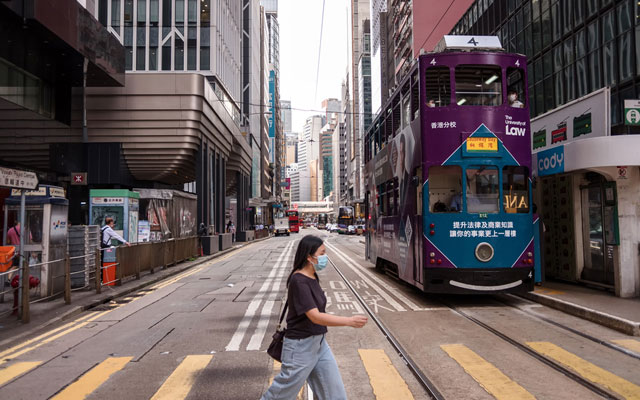
Hong Kong imposed its first Covid-19 lockdown this past weekend in the Kowloon Area

This marked the second major retrenchment exercise conducted by a Hong Kong travel agency, after Wing On Travel Service sacked 120 staff last December.

EGL Tours executive director, Steve Huen, told TTG Asia that affected employees were tour guides in charge of conducting tours in Japan and longhaul markets.

“Since our business was dormant for almost one year, only 20 of them chose to continue to work, while the rest opted for no-pay leave over the past 10 to 11 months. (The layoff) is a timely move and we hope to help them by offering some cash payouts before Chinese New Year,” Huen said.

Each retrenched worker received an average of HK$160,000 (US$20,600) in severance pay, with long-time employees (i.e those who have spent 20 years with the company) receiving HK$300,000.

“We promise to give them the priority to rejoin the company when the situation improves and business rebounds,” Huen said, adding that no further retrenchment is on the cards.

An agent, who requested anonymity, said that with many agencies downsizing in manpower to keep businesses afloat during the pandemic, it would be tough for agencies to return to pre-pandemic scale when travel recovers, as many agents may have already switched careers by then.

She added that as an independent travel agent, operating costs are “pretty low”, especially given that she is able to share her office space with two other agents after the Travel Industry Council relaxed the rule. She said they were holding out hope for business to improve at the end of 2021.

Bus operators are also suffering the brunt of prolonged border closures. One such company is Chinalink Express Holdings, a subsidiary of Kwoon Chung Bus Holdings, whose fleet of 550 coaches and small vehicles account for nearly 50 per cent of total market supply.

The company, which provides cross-border coach services between Hong Kong and Guandong province, has seen its staff count plunge from 2,000 before the pandemic to 900 since borders were closed.

Managing director Alan Chan lamented insufficient government assistance for coach bus operators. He said: “We have been losing HK$1.3 million on a daily basis, and most operators owe money to the banks, so it would be a big help if the government could set aside HK$200-300 million for us to cover costs for safety, repair and anti-pandemic measures on coaches.

“Currently, more than 1,000 coach buses have been sitting in a government site in Kwai Chung for months and we call it the graveyard for coaches.”

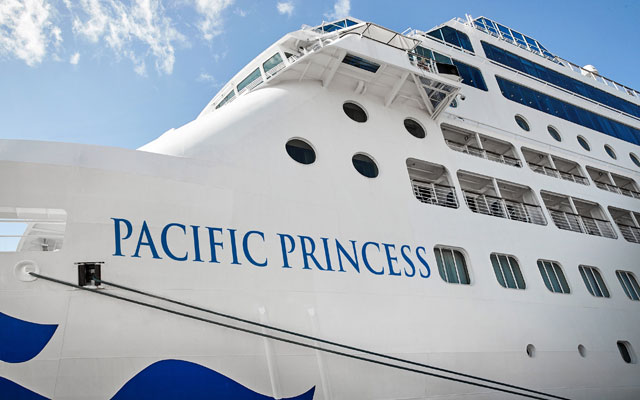
Pacific Princess departs fleet

0

Marriott going strong in APAC

0

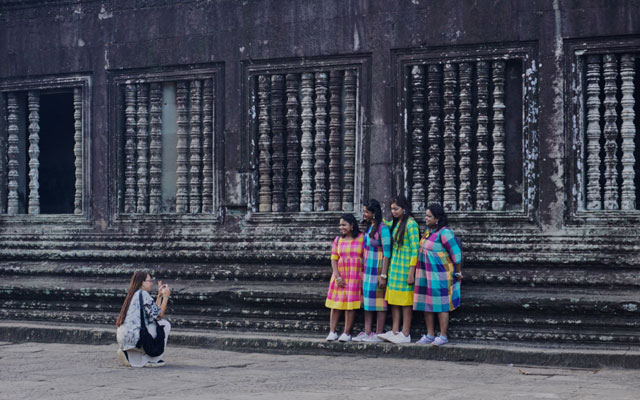
Direct flights between India, Cambodia to take off

0

Tourists trickle back to Sri Lanka after borders fully reopen to all except UK visitors

0

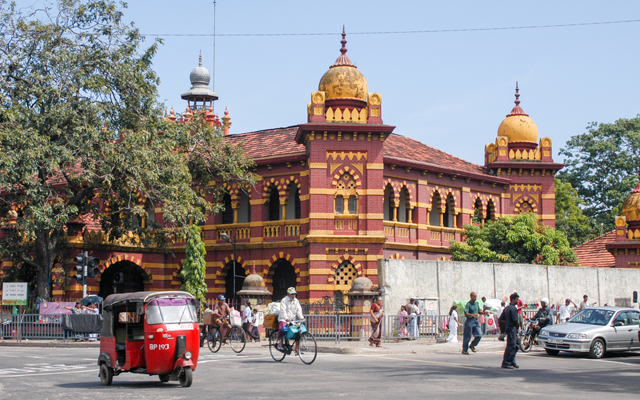
Sri Lanka has welcomed its first batch of visitors from Germany, the Netherlands and Switzerland, after reopening its borders to foreign tourists last Thursday, following a 10-month pandemic-induced closure.

The lifting of the ban on all commercial travellers, bar those from the UK which is currently under lockdown amid a virus surge, comes after a successful pilot project to test the waters ahead of the country’s full reopening. Started on December 28, the month-long pilot project involving Ukraine tourists ended on Sunday with a total of 1,700 arrivals.

All foreign visitors, except UK travellers, can now enter Sri Lanka under strict health protocols

A Sri Lankan Tourism official said on Sunday that since the reopening of the Bandaranaike International Airport (BIA) and the Mattala International Airport (MRIA) for commercial travel, the country has seen “a trickle of arrivals”, but is hopeful that “interest would catch up” down the road.

As of Sunday, less than 100 tourists including a group of five travel agents and two journalists whose agenda is to examine Sri Lanka’s potential for wellness holidays, have arrived in the country. A group of Chinese visitors are due to arrive this week, while the country expects to start receiving Russian tourists from next month, with SriLankan Airlines resuming flights to Moscow from February 15. To date, 15 airlines have scheduled regular flights to Sri Lanka.

As Sri Lanka reopens its doors to the world, every effort has been made to ensure that the island country is “safe, secure and serene” for visitors, Sri Lanka Tourism chairperson Kimarli Fernando told a conference in Colombo on Thursday. She said breaching the health guidelines could amount to an offence, urging travel and tour agencies to inform their clients of the strict regulations in place and to ensure no violations occur during their tours.

Under the health guidelines, visitors need not serve a mandatory quarantine on arrival, but they must obtain a visa online, and a mandatory Covid-19 insurance cover costing US$12, which covers US$50,000 worth of hospital or medical bills for a month. All visitors must also present a valid PCR test taken 96 hours before arrival.

Travellers also have to pre-purchase PCR tests online prior to setting foot in the country. Each test costs US$40. The first test will be taken on arrival at their hotel, and the second, after five to seven days or at the onset of symptoms. A third test is required for visitors staying between 10-14 days.

A pre-confirmed booking at a safe and secure certified hotel is also required for the first 14 days. A quarter of the room inventory in these hotels will be kept vacant to be used as health facilities in case tourists have to self-quarantine.

Sri Lanka’s main source markets are India, the UK, Russia and China. The country attracts around two million tourists a year, but officials said no targets have been set for this year.

As of Saturday, Sri Lanka has reported 57,587 cases of Covid-19 and 280 related-deaths.