Hotelbeds Group has made further senior management appointments across its group in Asia-Pacific (APAC) following its integration of Tourico and GTA.
Hui-Wan Chua has been confirmed as the regional director for wholesale sales for the APAC market. In this role, Chua will be responsible for growing the group’s business in the APAC region across the three different bedbank brands – Hotelbeds, Tourico Holidays and GTA – reporting directly to Sam Turner, the wholesale sales & sourcing director with global responsibility.
Chua was CEO at Zuji before she joined GTA in 2017
Chua joined GTA in 2017, before it became part of Hotelbeds Group in 2017, and was most recently the vice president of Asia sales & marketing.
Prior to that, she was CEO at Zuji. Chua has also held a number of senior roles in Asia at leading travel companies such as Travelport and Abacus International.
Additionally, the regional management positions that will report to Chua have been confirmed. Hotelbeds said in a statement that the new appointments combine “the best of existing internal talent from across the three bedbanks”.
In the regional manager roles, Chan Tze Yuan has been appointed to cover South-east Asia, Hong Kong and Taiwan; Isabelle Kim will cover East Asia; Richard Styles will be in charge of Pacific and Indochina; and Laura Wang and Joy Huang will lead China.
Since January, the group has been identifying top employee profiles from the three companies, at both senior management and management levels. So far 350 appointments have been made.
Hotelbeds says growing business in the APAC region is a top priority. China remains the number one source market in the wholesale channel for Hotelbeds Group in APAC and is now the fourth biggest for the group globally, up from fifth place only last year.
Tour East Singapore, a DMC and daily sightseeing tour operator, has launched a lounge at Grand Copthorne Waterfront Hotel.
Located on the third level of Grand Copthorne Waterfront Hotel, the Hospitality Lounge opens 08.00 to 20.00 daily, serving as a “one-stop shop for the sightseeing tour needs” of Tour East guests and providing complimentary Wi-Fi, refreshments and reading materials.
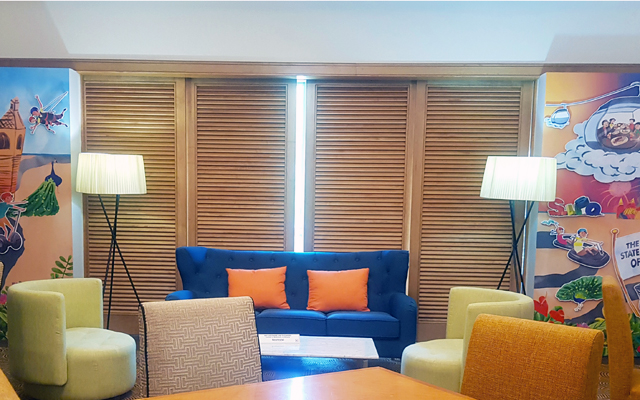
The Tour East Singapore lounge features ‘works of art’ from Wildlife Reserves Singapore, Sentosa Dev Corporation and Gardens by the Bay
Moreover, there will also be a designated foyer for Tour East guests awaiting coaches. This departure foyer will also be used as a holding area for guests to check-in for tours should they walk over from hotels within the vicinity of the Grand Copthorne Waterfront Hotel.
CEO and president of Tour East Holdings, Shigeyuki Suzuki commented: “The Tour East Lounge is a big step forward to provide additional value for our daily sightseeing tour customers… Besides upgrading its physical facilities, Tour East has also enhanced its present range of sightseeing tour itineraries and planned a range of new and exciting tours to be added progressively. Further announcements will be made nearer to the time of introduction.”
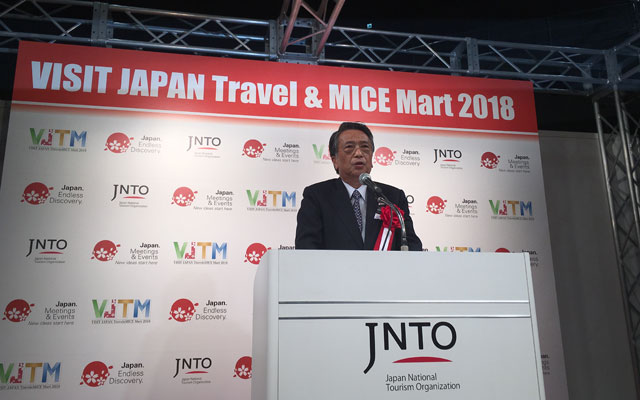
JNTO’s president Satoshi Seino addressing the crowd at VJTM’s 2018 opening ceremony
An unprecedented number of natural disasters this summer has dealt a severe blow to Japan’s tourism, but the trade is confident that it will soon bounce back.
Osaka was struck by a 6.1 magnitude earthquake on June 18. The western part of the country experienced torrential rainfall over July 6-8 and, on September 4, Osaka saw the arrival of Jebi, the strongest typhoon to hit Japan’s mainland in 25 years. A few days later, Hokkaido was hit by a 6.6 magnitude earthquake.
JNTO’s president Satoshi Seino acknowledged that the string of natural disasters resulted in a dip in inbound numbers
Speaking at the recent Visit Japan Travel & MICE Mart (VJTM) in Tokyo, Satoshi Seino, president of Japan National Tourism Organization, said the disasters have resulted in “a strong sense of crisis” as inbound numbers fall, particularly from South Korea.
In the first six months of 2018, Japan and South Korea reported 18 per cent growth in visitors from their respective countries. In July and August, Japan experienced a decline of 5.6 per cent and 4.3 per cent respectively.
At VTJM, Japan and South Korea signed a pact to work together to expedite the return of South Korean travellers to areas affected by the disasters.
For Maiko Kobayashi of tour group Made in Hokkaido, the South Korean market is of concern. Almost all of its South Korea clients have cancelled their summer and autumn trips to Japan.
Most clients in Thailand and Malaysia, however, have postponed their travel date, thanks to Made in Hokkaido’s regular updates to overseas agents on the status in affected areas, Kobayashi told TTG Asia.
She is confident that the Philippines market will bounce back with the launch of the Manilla-Chitose (Hokkaido) flight on October 8, postponed from September 10 because of the earthquake.
According to Lo King Yin of Hanatour Japan’s international business department, 200 of its customers from the Philippines and Malaysia cancelled their September and October trips to Osaka within days of Jebi’s arrival.
She is working with her foreign counterparts to rearrange their flights to Tokyo, from where they will tour the Hokuriku region instead.
Meanwhile, Valentin Chao of HIS’ inbound travel sales division reports a small decrease in sales to the Kansai region but said Kyoto and Osaka will always be popular destinations. In the long term, he anticipates no damage to these markets.
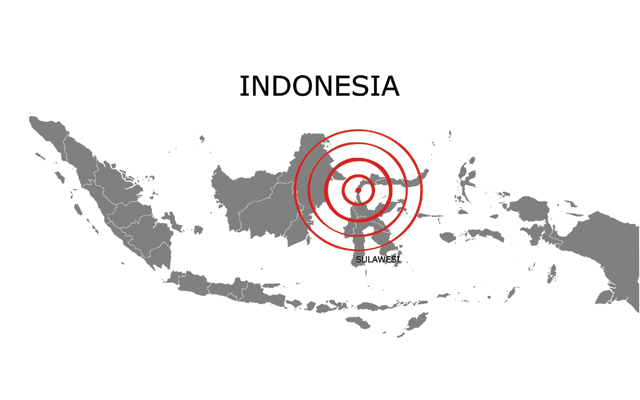
Five foreigners have been reported missing and 66 declared safe following a deadly earthquake and tsunami that devastated Indonesia’s Central Sulawesi on Friday.
Indonesia’s National Disaster Mitigation Agency (BNPB) told reporters yesterday that three French citizens and a Malaysian tourist remain missing, while a South Korean is believed to be trapped under the rubble of the Roa Roa hotel in Palu.
Death toll expected to keep rising
Dozens of people were believed to be trapped in the rubble of several hotels and a mall in the city of Palu, which was hit by waves as high as six metres following the 7.5-magnitude earthquake, CNBC reported.
As of Sunday, the death toll from the disaster was at 832, and is expected to rise into the thousands as rescuers reach outlying communities.
Questions now surround the failure of the tsunami warning system put in place after the 2004 tsunami catastrophe, triggered by a quake off Sumatra.
On Friday, Indonesia’s meteorological and geophysics agency BMKG had issued a tsunami warning, and withdrew it after 34 minutes later.
In some areas where there was no electricity to power sirens, no alerts were sounded to warn of the tsunami.
The confusion led up to hundreds gathering on a Palu beach to celebrate a festival, before the tsunami waves hit.
AP reported that a new system of sensors that could have warned residents had for years been stuck in testing phase, leaving them to rely on limited information from existing tidal gauge stations.
Meanwhile, Sutopo Purwo Nugroho, a spokesman for the BNPB, told reporters at a press conference that none of Indonesia’s tsunami buoys, an instrument used to detect the waves, had been operating since 2012 due to funding problems, according to the CNBC report.
Singaporeans are nearly as enthusiastic about staycations as they are about overseas trips, found a new Expedia study, which identified parents with kids as being the most avid staycationers.
The study revealed that six in 10 Singaporeans had gone on at least one staycation in the past 12 months.
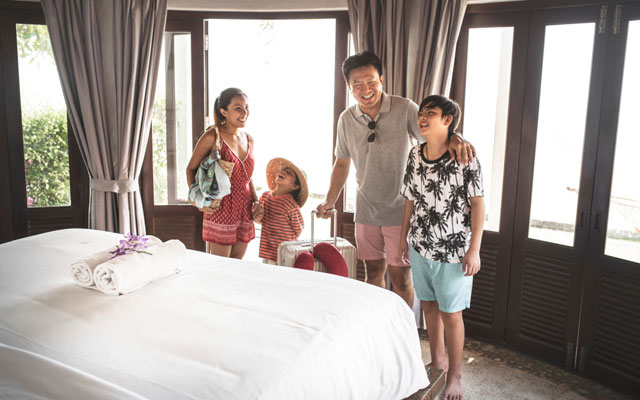
Singaporean parents with kids are the most avid staycationers
It also showed that Singaporeans averaged 2.4 staycations over the past year, just under the three personal overseas flights they take in a year.
“Over the years, staycations have been growing in popularity among Singaporeans. Based on our historic data, we saw year-on-year increases of 25% in 2016, and 40% in 2017 for local hotel bookings by Singaporeans on Expedia.com.sg,” shared Simon Fiquet, managing director, global series markets, Brand Expedia.
“Not only does this underscore the growing appeal of Singaporeans being tourists in their own backyard, staycations have also become quick and easy alternatives for Singaporeans to take a short break without the need for detailed planning or extensive travelling.”
Comparing the staycation habits across various demographic groups – including single adults, adults who are married without kids, and parents with kids – Expedia found that Singaporeans who are married with kids emerged as the top staycationers in Singapore, with 68% of them having gone on a staycation in the past 12 months.
This was followed by those who are married with no kids (66%) and the singles (58%).
Corresponding to this trend, the months of June and December also came up tops as the most popular staycation periods.
Forty-one percent of staycationers go on a staycation in December, 32% in June, 18% in November and 17% in March.
In addition, 70% of staycationers who are married with kids typically go on a staycation in the school holiday months of June, November and December.
Besides being the most avid group of staycationers, the discretionary spending among those married with kids is also one of the highest among groups, with spending on staycations averaging S$238 (US$174) a night, second only to those who are married without kids.
Additionally, 45% of those who are married with kids stayed three to four nights on their last booked staycation and 68% of them went with three or more people on their last staycation.
With family-friendly facilities, proximity to tourist attractions, and easy access to complimentary Wi-Fi and breakfast, it came as no surprise that hotels are the preferred staycation option among Singaporeans.
Some 74% of staycationers booked a hotel for their staycation in the past 12 months. Among this group, 54% of staycationers who booked a hotel for their last staycation chose a four-star hotel, while 33% opted for a five-star hotel.
Notably, parents with kids stood out from the crowd with their preference for hotels, especially for five-star hotels. Nine in 10 (89%) staycationers who are married with kids booked a hotel for their last staycation. Out of that, 39% of chose a five-star hotel and 55% chose a four-star hotel.
In terms of activities that staycationers engage in, making use of hotel facilities (70%), visiting nearby attractions (62%), dining in (56%), going shopping and watching movies emerged as the five most popular activities among the respondents.
With seven in 10 (66%) of Singaporeans likely to book a staycation in the next 12 months, the study also uncovered insights into the key motivational factors for booking an upcoming staycation.
When asked about the consideration factors for selecting an accommodation for a staycation, 33% of Singaporeans indicated free breakfast as their top consideration, followed by 31% who indicated great deals and 29% who indicated convenience of locations.
However, among those who are married without kids, complimentary upgrades emerged as the top consideration factor. This reflects the tendency for this group of staycationers to prefer pampering experiences over convenience and cost savings, as compared to single staycationers, who displayed clear preferences for free breakfast and great deals.
Among Singaporeans who are married with kids, 32% indicated free breakfast and convenient locations as their top two considerations.
Millennium & Copthorne Hotels (M&C) has announced that Jennifer Fox has stepped down as group CEO and director on September 27, just months after assuming the post.
The industry veteran was formerly president of Fairmont Hotels & Resorts and COO for Europe at InterContinental Hotels Group.
Jennifer Fox
Tan Kian Seng, M&C’s group chief of staff, will serve as interim CEO from September 28, a company statement said on Friday.
M&C did not offer the reasons for Fox’s departure, but a separate statement on the company website stated that a contractual pay-off of £1m (US$1.3 million) would be given to her.
AccorHotels has announced two senior appointments to its development team.
Jeff Tisdall has been appointed senior vice president development residential and extended stay, while Andrew Langdon will take on the role of senior vice president development Asia, responsible for South-east Asia, Japan & Korea.
From left: Jeff Tisdall and Andrew Langdon
Both men come to these senior positions after joining AccorHotels through acquisitions. They will also be members of the Global Development Co-Dir.
Tisdall, whose current role is vice president residential development international, came from Fairmont Raffles Hotels International in 2016. In his new role, he will lead branded residential growth opportunities and oversee development in the extended stay segment.
Prior to joining Movenpick, Langdon was based in Jones Lang LaSalle’s Hotels & Hospitality Group Thailand office where he was executive vice president. He has over 27 years of diverse property experience in Australia and Asia, including CBRE and Savills and has spent over 21 years living in Asia.
In addition to his new responsibility, Langdon will continue to coordinate the development of the Movenpick brand for the coming months.
A lotus pond near Kampung Ampang Pecah in Kuala Kubu Bharu
The Selangor state government is working towards getting Kuala Kubu Bharu town listed as a UNESCO World Heritage Site, under the Garden City Heritage category.
It is understood that a consultant will be appointed in December to ensure the town fulfils the necessary requirements.
A lotus pond near Kampung Ampang Pecah in Kuala Kubu Bharu
If the application is successful, Kuala Kubu Bharu will be the first place in Selangor state to have the prestigious UNESCO branding.
Abdul Rashid Asari, Selangor state government’s chairman of standing committees for cultural and tourism, Malay Tradition and Heritage, said: “The UNESCO branding is important to further attract foreign and domestic tourists to Kuala Kubu Bharu as well as the state of Selangor.”
Kuala Kubu Bharu town, the principal of Hulu Selangor district, was built in 1928 after floods destroyed the old district capital of Hulu Selangor. It was designed by Charles Compton Reade, Malaya’s first town planner, based on the garden city movement of the early 20th century where self-contained communities are surrounded by greenbelts.
As a tourist destination, Kuala Kubu Bharu is rich in ecotourism activities such as hiking at Bukit Kutu and Lata Medang, trekking to Chiling waterfall, paragliding, white water rafting and mountain biking.
Annual sporting events held at Kuala Kubu Bharu includes Kuala Kubu Bharu paragliding Accuracy Championship, Selangor International Bird Race and Pertak Trail Run.
The bag measurement tool can be accessed by travellers when booking a flight on the Kayak app
Kayak has introduced a patent-pending tool that uses augmented reality (AR) technology to help travellers measure the size of their carry-on bag before arriving at the airport.
“A pain point in the travel experience is that moment you begin to worry if your bag will fit in the overhead bin and now we’ve got a tool that can help,” said Kayak chief technology officer Giorgos Zacharia. “There are a lot of AR applications that are fun – but this one was designed to be truly useful for travellers.”
The bag measurement tool can be accessed when booking a flight via the Kayak app
To measure your carry-on luggage, travellers open a flight search in the Kayak app and click “new bag measurement tool”. They will then be prompted to scan the floor (this helps calibrate measurements) and then move their camera around the bag to capture its size.
The tool will alert them with the bag’s exact measurements (length, width and height), so they know whether it can be carried on on a flight as a carry-on, or if it needs to be checked. The tool compares baggage fee policies for all Kayak-tracked airlines in one place.
The tool is currently available in the Kayak app for all iOS devices running iOS 11.3 and up.