American investment firm Blackstone will be selling its 5.8 per cent stake in Hilton, after 11 years of holding shares in the hotel chain.
The sale of 15.8 million shares would generate more than US$1.3 billion, closing out one of the most profitable private equity transactions.
Blackstone will have US$14 billion of profit, meaning the firm has more than tripled its initial investment
In a statement last week, Hilton said it did not offer any shares of common stock in the transaction and will not receive any proceeds from the sale of shares by the selling stockholders.
Hilton will repurchase about 1.3 million shares from shareholders from the shareholders affiliated to Blackstone.
Blackstone in 2016 sold a 25 per cent stake in Hilton to China’s HNA Group for US$6.5 billion.
Earlier this year, the heavily indebted Chinese conglomerated announced its intention to sell some or all of its US$6.3 billion stake in Hilton.
Andaz Singapore has partnered with Vouch to develop and launch the ConcierGO programme, a digital concierge system that functions as a chatbot with artificial intelligence through the hotel’s Facebook messenger account.
Besides helping the team answer everyday queries about the hotel, the chatbot serves as a guide, providing curated tours, recommendations for various food haunts and interesting activities in the neighbourhood. This is expected to help Andaz Singapore improve manpower productivity and enhance the service experience for guests.
Chatbots can be one of the ways to build a lasting and engaging relationship with customers
Currently in the first phase, phase two of the project will see the chatbot managing guests’ basic room requests through an integration with the hotel’s direct logistics system.
This endeavour was supported by the Singapore Tourism Board (STB), which launched the Tourism Innovation Challenge for Hotels last year to crowd-source novel solutions that address the challenges and opportunities faced by hotel and travel agency industries.
Over 350 of Asia’s most senior digital travel professionals representing top hotels, airlines, OTAs and metasearch engines descended on the resort island Resorts World Sentosa in Singapore, for the third edition of Digital Travel Summit APAC. Held from 17 -19 April, this year’s Digital Travel APAC played host to over 70% new speakers with some industry big-names like Peter Yoshihara, General Manager, Japan, Ctrip and Joey Faust, Head of Customer Shared Services & Digital of Air New Zealand.
A technology benchmarking pre day gave attendees an unbeatable, time-saving opportunity to meet and compare leading technologies in the space with new level of detail and interactivity in just one afternoon of networking.
With in-depth tracks for Directors and VPs of eCommerce and Digital Marketing, creative boardrooms, debates and case-studies, Digital Travel APAC ensures there is something for everyone.
Now in its third year, Digital Travel APAC has made a name for itself as APAC’S Most Senior-Level E-Commerce and Digital Event for Travel.
“A wonderful event for digital marketers in travel. Digital Travel APAC provides rich insights that are relevant to effectively target the modern travelers now in Asia”
– Anita Ngai, Chief Revenue Officer at Klook
“Gave me plenty of fresh new ideas on how we can improve our ecommerce and digital marketing”
– Victor Tseng, VP of Global Corporate Affairs, Ctrip
“Truly addresses the ecommerce and digital marketing challenges facing us; an excellent way to learn how my peers are tackling the same issues”
– Anni Ahnger, Head of Digital Revenue, Finnair
This year also saw technology provider MadHouse partaking in the conference. MadHouse is the world’s largest independent mobile ad platform company. It was announced during the event that a new mobile ad platform aimed to help local travel industry marketers to target the upcoming and growing Chinese travelers everyday, has been officially launched and named TravelMad.
As the day came to a close, attendees were treated to an in-house carnival featuring a clown sculpting balloons, a claw machine and tons of fun carnival games and cocktails.
Digital Travel APAC is part of a series of two ecommerce conferences organised by WBR addressing markets in the Asia-Pacific. The next edition of eTail Asia will be hosted in Singapore, 5 – 7 March 2019 whereas Digital Travel APAC is on 9 -11 April 2019.
About Digital Travel APAC
Digital Travel APAC is APAC’S Most Senior-Level E-Commerce & Digital Event for Travel designed to offer senior travel professionals the unique opportunity to address their most pressing digital challenges and network with key market participants.
It is Asia’s premier Digital Travel event bringing together 450 digital travel professionals.
While the GST removal is good news, stakeholders in Malaysia are seeking details on the new SST in order to price their tours
With the Harapan Coalition now in power, Malaysia’s travel trade is looking forward to the promised reduction of the Goods and Services Tax (GST) to a zero rate beginning June 1, down from the current six per cent, effectively scrapping the consumer tax implemented on April 1, 2015.
The GST will be replaced by the Sales and Services Tax (SST), which will only kick in after the government makes a decision on it, likely after the zero-rated GST is effected in June.
While the GST removal is good news, stakeholders in Malaysia are seeking details on the new SST in order to price their tours
While welcoming the zero-rated GST, the Malaysian Association of Tour and Travel Agents (MATTA) and Malaysian Association of Hotel Owners (MAHO) are currently seeking clarification from the Royal Malaysian Customs Department on details of the GST removal and implementation of the new SST system.
MATTA president, KL Tan, said: “It is not entirely clear whether GST needs to be charged for tours sold before June 1, 2018 but with a travel date on or after June 1, 2018.
Still, he expects the removal of the GST to ultimately grant a “discount” on the price of local tour and travel, which is likely to in turn boost the domestic travel industry.
Tan added: “The ‘zero per cent GST’ is bound to promote spending by both locals and tourist especially on Malaysian shopping and F&B, including tourist attractions, thus potentially increasing the price appeal of Malaysia as a travel destination and encourage more tourist spending.”
Likewise, MAHO’s executive director Shaharuddin Saaid expects the lower price of hotel rooms and services to buoy domestic and inbound tourism, in addition to spurring non-room spending in hotels in the interim period between June 1 and the introduction of the SST.
MATTA’s Tan added that the policy shift will also bring consistency in GST treatment between Designated Areas – Labuan, Langkawi and Tioman, which are tax free destinations, with the rest of Malaysian travel locations.
Meanwhile, Diethelm Travel Malaysia managing director, Manfred Kurz, expressed concern over the lack of information about the SST.
He said: “Contracts for 2019 have to be finalised by end of May because many tour operators in Europe start printing their brochures in July and selling in September. We cannot give them details about the SST such as how many per cent it will be because at this point – no one knows. What will it include – transportation, entrance fees to attractions? We don’t know at this time.
“Our strategy is to be very open with our partners. We have informed them that the GST will be zero-rated from June 1 and that the SST will be reintroduced at some point in the near future. We will keep them updated when we get more information, and advise them not to publish lower rates in their new brochures.”
A new generation of Chinese travellers is placing experiences at the forefront, driving a stronger demand for in-depth, customised travel in Europe with their greater world knowledge, confidence and savviness, industry insiders say.
“Unlike the older generation of Chinese, who don’t know much about Europe and are happy to leave trip planning to agencies and follow typical itineraries, the new generation has a better understanding of European history, attractions and diversity, and as a result know what they want to see, visit and experience in the continent,” Quentin Ma, chief operating officer of Hiseas International Travel Group, shared with TTG Asia last week at ITB China.
A Chinese tourist taking a picture of the Old Town of Dubrovnik, Croatia, a filming location for Game of Thrones
With a greater appreciation of Europe’s diversity and experiences, Chinese millennials are not afraid to plan their travel according to their preferences and interests, may it be for skiing, witnessing the Northern Lights or visiting the filming sites of Games of Thrones, added Ma.
It is also not uncommon for special interest groups or associations, say, chess or painting clubs, to come together and request a customised European trip according to specific themes, he elaborated.
This observation also gels with the findings in the latest Customised travels of Chinese visitors to Europe study co-published by leading Chinese OTA Ctrip and China Outbound Tourism Research Institute, which revealed that “in-depth travel” is the most popular demand for customised tours to Europe.
According to this study, such itineraries span an average length of stay of 12 days and no more than two countries per trip, a contrast to most package-tour travellers who visit three or more countries in 10 to 12 days.
The Chinese customised travel market in 2017 is “universal, young and growing fast”, the report further stated. European travel accounts for 10 per cent of Ctrip’s overall outbound customised travel business, posting a 130 per cent year-on-year increase between 2016 and 2017.
The growing quest for in-depth experiences among Chinese travellers has benefited smaller and lesser-known European nations.
“The Baltic States offers a level of ‘exclusivity’,” said Gabriel Orentas, marketing director of Lithuania-based DMC Baltic Vitalis. “It’s where (premium Chinese travellers) come to have some time and space for themselves, seeking unique experiences like foraging the forest for wild fruits and mushrooms.”
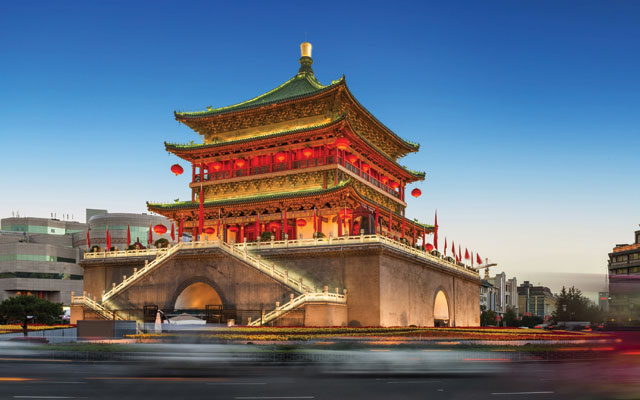
The BRI is likely to usher a new tourism era for Xi’an (its City Wall pictured), once a key crossroad on the ancient Silk Road
The Belt and Road Initiative (BRI) is ushering in benefits for China’s travel and tourism, with industry members reporting positive spinoffs such as renewed interest in Silk Road programmes, and increasing demand for second- and third-tier cities.
Secondary destinations in China are some of the greatest beneficiaries of the BRI as they become more attractive to travellers with new air services launched and the rising popularity of China’s high-speed rail (HSR), according to inbound tour operators.
The BRI is likely to usher a new tourism era for Xi’an (its City Wall pictured), once a key crossroad on the ancient Silk Road
Kin Qin, deputy general manager, Century Holiday International Travel Group, commented that demand for its Silk Road programmes jumped 50 per cent to some 1,800 travellers last year, with Malaysia, Singapore and Indonesia being the top three markets.
Qin said: “We started promoting our six- to 10-day Silk Road programme to Xinjiang in Malaysia for leisure or incentives last year. We are also targeting Muslim travellers from the Middle East and Indonesia as they are interested in sightseeing on the Silk Road and providing halal food is not a problem.”
The company will continue to promote Silk Road tourism for the August to October peak season during roadshows in the Philippines, India, Indonesia and Cambodia.
Qin pointed out that there are now more flights to destinations like Xi’an, Chongqing and Lanzhou from South-east Asia, and also direct flights from Europe and the US.
“We are seeing demand for second-tier cities like Changsha among repeat visitors and also first-timers from the US. The better air access is giving travellers more options and some are choosing to avoid the air congestion that can cause delays in some top-tier cities,” Qin continued.
The number of overseas tourists to China has continuously increased since the implementation of BRI, said Julia Shi, China general manager of Diethelm Travel, adding that it has undoubtedly become an important force in leading the development of China’s inbound tourism and benefitting places like Yunnan, Guangxi, Guangdong and Xinjiang.
Shi said: “Yunnan is China’s gateway for South Asia, Guangxi for South-east Asia and Xinjiang for Central Asia.”
With stable fares plus fast and regular connections, the HSR network is also making inbound programmes more attractive and reasonably priced, said Shi. About 80 per cent of travellers prefer this mode of transport, she explained.
“Flights can easily be affected by external factors such as weather and can cause delays or cancellations. There is potential for HSR to overtake domestic air travel among international visitors in the coming years,” she remarked.
On the business events front, Ricky Yang, deputy general manager, Easy Tour China Travel, added Nanning, which is at the crossroads of BRI, and Guangxi are attracting a lot of exhibitors from South-east Asia like Malaysia, Singapore, the Philippines and Vietnam.
“Air access from Thailand, Malaysia and Cambodia… has improved. At the same time, the rapid development of China’s HSR network has resulted in more Chinese airlines shifting their focus on expanding their international services from second-tier cities like Chengdu, Xi’an, Chongqing, Kunming, Xiamen and Wuhan to South-east Asia and Europe.
“BRI has definitely increased opportunities for tourism and expanded inbound options for repeat visitors who have visited Beijing, Shanghai and Hong Kong, and people now are also curious about BRI and what China is doing,” Yang said.
The Capitol Singapore. Photo credit: Perennial Real Estate Holdings Limited
Perennial Real Estate Holdings has appointed Europe-based luxury hotel group Kempinski Hotels to operate The Capitol Kempinski Hotel Singapore at Capitol Singapore, the first luxury heritage lifestyle integrated development in the city’s downtown Civic District.
Comprising three heritage buildings, Capitol Singapore houses the premier shopping and dining destination Capitol Piazza, the iconic Capitol Theatre, the luxurious Eden Residences Capitol and the upcoming The Capitol Kempinski Hotel Singapore, which will be Kempinski’s flagship hotel in Singapore.
The Capitol Singapore will soon house a Kempinski hotel. (Photo credit: Perennial Real Estate Holdings)
A luxury lifestyle destination,The Capitol Kempinski Hotel Singapore will offer 157 guestrooms and suites within the restored Capitol Building and Stamford House. The hotel will also feature a leading international restaurant under the helm of a Michelin-star chef.
The Kempinski gourmet experience will be extended beyond the hotel to the Galleria, an air-conditioned sheltered promenade also part of Capitol Piazza. The Capitol Kempinski Hotel Singapore’s full range of services will be rolled out in phases later this year, starting with the hotel’s services in September 2018.
Pua Seck Guan, CEO of Perennial, said in a statement: “Combining the rich heritage of Capitol Singapore with the finest traditions of European hospitality, The Capitol Kempinski Hotel Singapore is set to become a landmark destination which will redefine service standards and create exquisite guest experiences.”
The Europe-based luxury hotel group has in recent months stepped up its presence and headcount in Asia, a region where Amanda Elder, Kempinski’s senior vice president business development, thinks there is still a lot of room for growth.
Speaking to TTG Asia at the recent IMEX Frankfurt, Elder said: “In Asia, the market is saturated, so we need to see where the next opportunities can be. We’re actually pitching for on a second property in Asia (in addition to The Capitol). We have a vice president based in Bangkok who is 100 per cent dedicated looking for opportunities for new hotels in Asia.
Elder: enormous growth opportunity in Asia
“We will also be opening a global sales office in Singapore, as well as have representation in Sydney, (both) by the end of this year,” she added.
Four months ago, Kempsinki also added three headcount in India, in a partnership with Nijhawan Group. Elder shared that there has been “immediate success”, where the three employees have “booked us half a million dollars worth of business in four months”.
Elsewhere in South-east Asia, opening at the end of this year is The Apurva Kempinski Bali. Located in Nusa Dua, the property will be home to 432 guestrooms and suites, and 43 one-, two- and three-bedroom villas. Facilities include five F&B options, a Cigar Bar, Javanese spa, fitness centre, swimming pool, kids club, as well as meeting facilities and three wedding chapels.
Seamless transportation is set to play a bigger role in shaping and influencing growth of tourist destinations, industry players forecasted at PATA Annual Summit, which took place in South Korea’s Gangneung last week.
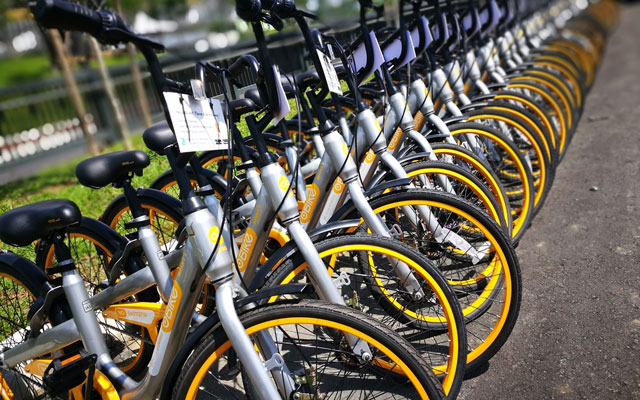
Termed “intermodal” and “multimodal” transportation, integrated modes of transport have proven to be in demand among international travellers, said Edward Chen, co-founder and chief marketing officer of Singapore-based bicycle sharing company oBike.
oBike first launched in Singapore but has since expanded to over 30 cities in 10 countries worldwide
“oBike started out as a service for locals, but it has become popular with tourists as well, hence we started collaborating with local tourism organisations and companies to make the tourist mobility experience more convenient,” said Chen.
For example, oBike has collaborated with ride-sharing service Grab in South-east Asia to allow Grab users to also activate oBike within the Grab app, extending and improving the land transport experience for users.
Arun Mishra, regional director, Asia & Pacific Office, International Civil Aviation Organization (ICAO), also cited how France and Belgium have integrated more than 30 airlines to provide a joint air-rail ticket, raising connectivity to various destinations in the area.
From left: International Civil Aviation Organization’s Arun Mishra and Korail’s Jae-hun Yun
In South Korea, industry stakeholders are well aware of this trend, and are “seeking other ways to expand bus services to reach across the nation”, shared Jae-hun Yun, Korail’s director of tourism division.
“We are seeing adequate demand for single tickets linking air and railways, subways and buses, so we are preparing to provide these services,” he said.
What the country is lacking, Yun opined, are proper policies to support this, as South Korea has different government authorities in charge of different means of transport.
“Intermodal connectivity is important to provide convenience to travellers. It’s the role of the government to coordinate different opinions and between stakeholders,” he pointed out.
Online travel booking engine Traveliko, which was launched in early 2017 to offer a flat 10 per cent commission rate for hotels, is now touting a zero commission model.
This zero commission policy will enable hotels to “challenge” and “break away from the burden of high commissions charged by dominant OTAs”, Traveliko stated in a press release.
World’s first zero commission booking engine is set to challenge global online travel giants
Yann Gouriou, Traveliko’s co-founder and COO, commented: “We work directly with hotels to guarantee the best available rate, and we have replaced commissions with a subscription model that provides hotels with a free listing for up to 100 bookings per month, supplemented by a range of premium options for a modest fee.”
Bjorn Harvold, traveliko’s co-founder and chief technical officer, elaborated: “Our zero commission policy means hotel owners and management companies now have access to an efficient high-value booking solution. The more hotels that come on board, the stronger Traveliko becomes, and the closer we get to fixing the industry,”
Traveliko is also in the midst of creating an intelligent payment platform using blockchain technology to facilitate faster, easier and lower-cost money transfers.
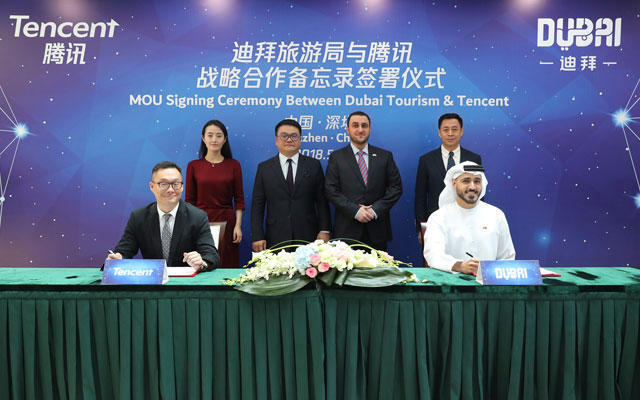
Tencent joins hands with Dubai Tourism to increase visits to the Emirate
Chinese Internet giant Tencent has signed an MoU with Dubai’s Department of Tourism and Commerce Marketing (Dubai Tourism), an agreement expected to see Chinese travellers receiving targeted social feeds about the city’s offerings and spearhead smart tourism along the route of the Belt and Road Initiative.
Issam Kazim, CEO of Dubai Corporation for Tourism and Commerce Marketing, commented that the agreement is an extension of the organisation’s ongoing partnership with Tencent to build affinity with the Chinese target audience.
Tencent’s Poshu Yeung (left, front row), and Issam Kazim, CEO of Dubai’s Corporation for Tourism and Commerce Marketing (right, front row), at the MoU signing ceremony
WeChat first rolled out the CityExperience Mini Program in November 2017 to offer an interactive platform for Dubai Tourism to connect with Chinese travellers. As Tencent’s offerings increasingly penetrate Dubai’s tourism sector, the programme could also be enhanced with Tencent Cloud’s suite of smart travel solutions to provide value-added functions such as AI customer service.
Meanwhile, Tencent Cloud will continue to incorporate an array of advanced offerings such as cloud computing, Internet of Things, Artificial Intelligence and big data to work towards a Smart Dubai.
In addition to providing user insights for targeted marketing, Tencent will also offer recommendations for other local stakeholders to start or improve their WeChat Official Accounts.
Through Dubai Tourism’s inetwork in Dubai, Tencent hopes to promote its offerings including WeChat and WeChat Pay as an option for convenient and secure mobile payment among Chinese tourists at local merchants. On the other hand, Dubai Tourism will also encourage Dubai merchants to adopt and leverage Tencent Cloud and ad solutions.