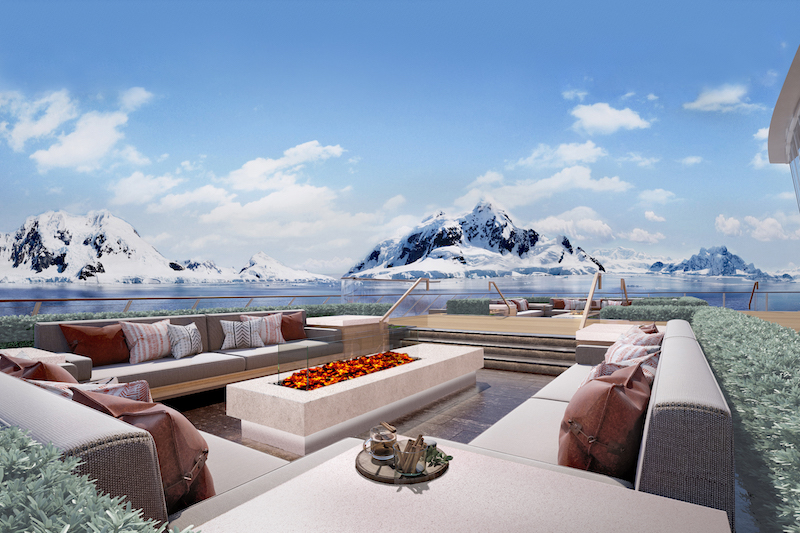
Rendering of the Deck 2 Aft area, Finse Terrace, on-board the Viking Expedition ship
Viking Cruises has launched a series of trade training emails for agents to learn about Viking Expeditions, the cruise line’s new expedition voyages which debut in 2022.
Agents can register to receive seven weekly emails from May 18, 2020 to learn about Viking’s two purpose-built ships’ offerings to their clients, and how booking a Viking Expedition voyage benefits both agents and clients.
Rendering of the Finse Terrace on board the Viking Octantis and Viking Polaris ships
Set to sail in January 2022 is the 378-guest expedition ship, Viking Octantis, which will head to Antarctica and North America’s Great Lakes. A second expedition vessel, Viking Polaris, will debut in August 2022, sailing to Antarctica and the Arctic.
Viking Cruises said that the ships will boast “industry-first” features such as two complimentary underwater submersibles; an enclosed, in-ship marina called The Hangar that enables the launch of small excursion craft through the ship’s shell doors; and an onboard laboratory, where resident scientists will conduct research which guests can take part in, as part of Viking’s Cultural Curriculum.
Erin Kramer, trade marketing manager, Viking Cruises ANZ, said: “Our bespoke Viking Expeditions trade training email programme is perfect for agents who are looking for opportunities to upskill while spending more time at home.
“By boosting your expertise in this increasingly popular category, you maximise your opportunities to increase your commission too. And with departures in 2022 and 2023, all backed by our Risk-Free Guarantee, Viking offers your clients peace of mind to plan in advance.”
Agents can register to receive the email series here.
Many hotels have had to go into hibernation as a result of travel and movement restrictions. What is the state of Minor Hotels at the moment?
We have a mixed bag situation.
Our China operations are back in full operation, with full compliance with the restrictions that are still in place. Anantara Xishuangbanna Resort still has some limitations imposed by the authorities.
We are happy to report that our Vietnam resorts never had to completely close. Our hotels always had a small portion of domestic business and a lot of F&B take-outs by the local community. We were full at both the Anantara Mui Ne Resort and the Anantara Quy Nhon Villas over the long May 1 weekend.
In Thailand, our residences in Chiang Mai (Anantara Chiang Mai Serviced Suites) and Phuket (Layan Residences) remain in operation but elsewhere our hotels are closed. We are now awaiting approval from the local authorities to ease limits on inter-provincial travels. Once that happens, we will resume operations and focus on attracting the domestic market.
In the second phase, we expect regional traffic to return, but that is dependent on the lifting of travel restrictions as determined by respective country governments.
In phase three, which could come very late this year, a return in international travel.
Meier: resorts that operate with a high villa component will be popular, as they provide guests with a sense of safety and privacy as well as the option to stay indoors with access to their own facilities
WTTC has just laid out some health and safety protocols for the reopening of hospitality sectors. At the same time, WHO has said that the virus may never go away, and the world will just have to learn to come to terms with it. How do you see this impacting the concept of hospitality, which is all about human connection and runs counter to the guiding principal for many of these measures, which is to limit human contact?
We have pondered over this for weeks and weeks, and have discussed this with industry professionals and among ourselves.
We have created a committee with a WHO representative based in Thailand as well as representatives from EcoLab and Diversey to get us expert advice.
We have approached this by looking at key touch points with our guests, from emotional, experiential and physical angles. We have broken down the physical touch point into steps, to see how we, as a hotel operator, can provide assurance to the guest.
Six months ago, a guest coming to our hotel in Bangkok for a long weekend would most likely not have booked the hotel limousine because he is familiar with the destination and has access to Grab.
Now, we would strongly recommend that all our guests transfer with a designated hotel limousine upon arrival at the airport. They will be greeted by our staff who will assist them to our limousine. The driver will wear a mask and a pair of gloves, and has a Plexiglass screen between him and the guests; the driver doesn’t leave the car and our staff will help place the luggage in the boot.
At the hotel, the same approach is taken. We have Plexiglass screens at the reception, and we have discreet crosses on our beautiful marble floors to highlight distancing requirements. We will need some contact here and there to complete guest registration in some countries, like in Thailand where the guest needs to sign on a registration card. For this purpose, we will provide guests with UV-disinfected pens to use.
That approach will be replicated across the entire stay.
We are using only EPA-rated cleaning products – the same grade used in hospitals, and we have introduced a number of new cleaning procedures, such as UV sanitisation in rooms and electrostatic disinfectant treatment for hard surfaces.
I’m sure there is also a big question about hotel breakfast (laughs). There will be a buffet but the experience will be different. The guest will select his food from a menu at the table. Meal service will be direct to the table, which is easier for the guest.
We will keep a live kitchen concept and allow for some interactive stations that are completely protected by Plexiglass screens. Guests can still see the chefs at work and tell them how they want their eggs done.
We have tested this in Vietnam, and it has been successful. The common feedback in the first weekend was that guests wanted a bigger buffet and more breakfast choices. In the second weekend, most guests understood the concept and we foresee that they will be happy that we are implementing these steps.
In WTTC’s health and safety protocols, one of the suggestions is to remove extraneous items throughout the hotel. I take these extraneous items to mean soft furnishing. Will that mean a hotel stay in the future will be in rather bland surroundings?
Based on current cleaning methodology, there is no need for that. UV sanitisation lamps, for instance, will be able to disinfect the entire room, including soft furnishing.
Again, we are depending on experts to guide us in accordance to WHO standards.
What are the implications on operations and costs?
All these will obviously take more time to complete. A room attendant will probably get to clean two or three rooms less a day, which means it will take longer before we can resell a room.
In a restaurant operation, we can expect 30 to 40 per cent fewer guests being accommodated due to distancing measures. As such, we may need to have two restaurants for breakfast because nobody will be happy to be made to wait until 10.00 for a seat.
Operations have to adapt, and we will need more team members. As hotel operations return, we may need eight to 12 per cent more team members to cope with the new measures. Manpower needs will depend on government requirements and the type of property, say an island resort versus an urban meeting hotel.
Our hotel will need extra equipment to be compliant to new health and cleanliness standards. These are investments on our part. But the costs will not be the same across properties because in some resorts without meeting facilities, we will not need certain equipment.
Every hotel has 10 to 15 bottles of hand sanitisers, masks for guests, etc, which will raise our operating expenditure. These are expenses we will obviously cover to ensure the safety of our guests and team members.
How long do you suppose these measures will remain in place?
That is a crystal ball question, Karen. At this moment, we expect these measures to stay with us into the foreseeable future. I think we will see variations country to country, depending on the approach governments take on health and safety as well as tracing measures.
We expect to revisit some aspects of these measures whenever there are breakthroughs in cleaning methods or technology.
Will hotel design for your new openings in 2021 change based on the new health and safety considerations?
Our properties that are scheduled to open in 2021 are in an advanced planning stage, but there is certainly room for some tweaks. Our properties are developed with a lot of flexibility around F&B experiences, so as to be able to cope with different markets at different times of the year.
While we don’t foresee a lot of changes (needed as a result of the health and safety measures), we expect demand for private villas will spike because they offer guests their own space and access to their own facilities like the pool and lounge areas.
Our resorts that operate with a high villa component will be able to provide a sense of safety for the guest as well as the option for them to stay in the privacy of their villa.
Will this mean the end of recreational and wellness activities offered by the hotel? Some Anantara resorts offer sunrise yoga. What will happen to these activities?
We think the opposite is true. Guests can still do sunrise yoga while maintaining safe distancing of two metres between other guests.
Wellness and outdoor activities are expected to see far greater demand as travel resumes. We have requests for our resorts in the Maldives and Sri Lanka for November and December, and they come with specific interest in wellness programmes. We are selling Ayurvedic programmes for five, seven, nine days in Sri Lanka for January and February 2021.
Considering how the domestic market is expected to drive recovery, and most book direct, do you think this will change how Minor Hotels regards its travel trade partners?
Domestic business is pretty straight-forward. They book directly with the hotel and the airlines, although some have a preference for OTA apps.
Regional markets could return in 3Q2020, while our Vietnam properties are now in active discussion with Taiwan and South Korea for the first wave of business soon. We will continue to support our partners.
When longhaul markets return, it will be interesting to see what consumers prefer. Some may book direct (to access promotions offered by airlines) while others may want to rely on travel agents that offer assurance around cancellations.
The last couple of years we have a lot of longhaul markets that book multi-destination programmes through travel agents – four countries in three weeks, going through 20 different transportation, 10 different hotels, 25 different restaurants. We believe that kind of travel, which remains very much in the hands of travel agents, will take a longer time to rebound, as travellers need to regain confidence in all those countries.
Sojern has launched a new interactive dashboard providing real-time Covid-19 travel insights that will empower travel marketers to forecast travel demand and make informed decisions about market recovery.
The dashboard, updated daily at 10.30 (UTC), will provide market-level details on future searching and booking trends indexed to pre-Covid levels to provide visibility into timing for a recovery in specific destinations.
Sojern rolls out interactive dashboard providing real-time data on travel demand
Sojern collects and analyses travel intent data from thousands of airline and hotel partners from around the world to use as the foundation of its travel insights. This data provides an unparalleled view of travel demand by looking at online travellers’ path to purchase.
Travel providers can use these insights to help determine when to reopen or when to accelerate marketing to power recovery. Dashboard users will also be able to compare different regions to see when travel is likely to recover in each market.
Sojern director of travel insights Amber Kuo said: “Normally, weekly or even monthly data updates about how consumers are travelling would be acceptable to inform marketing campaigns. However, in Covid times, travel marketers are feeling stressed and uncertain about the future. Providing daily updates gives marketers more control because they can see how the situation is evolving, and when is the right time to act.”
This week’s insights on Covid-19’s travel impact in Asia-Pacific, which are based on data collected on May 4, 2020, showed signs of positive momentum in domestic travel, and revealed that destination markets can expect an uptick in travel in February 2021.
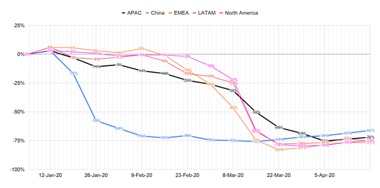
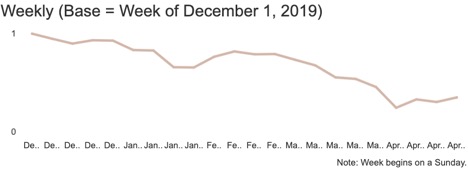
Following the WHO declaring that Covid-19 was officially a pandemic, from March 12 onwards, Asia-Pacific was seen to have a 40 per cent decrease in search volume. Following which, the individual countries within the region saw a further decrease in search intent as stricter travel restrictions came into play.
All Regions Year-To-Date Index in Searches
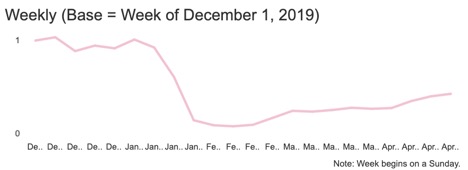
While Mainland China outbound travel started declining in December, it has since reached a plateau. Trends show that domestic travel took a sharp drop in mid-January when China imposed a lockdown, but continues to improve since mid-February, showing positive upticks.
This trend comes amid China’s prominence in the news, where a lengthy rebuttal of allegations was submitted over its handling of the Covid-19 outbreak, as well as the reopening of Shanghai Disneyland on May 11 to a reduced number of visitors, ending a three-month closure.
Source Market: China – Domestic Travel
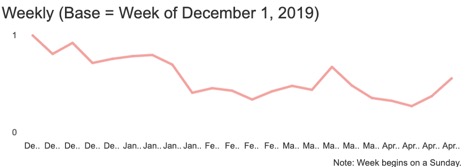
Hong Kong domestic travel was on a decline, but is showing clear signs of recovery since mid-February. Hong Kong outbound travel declined until the end of January, but has started to show signs of recovery at the end of April. Sojern noted that this uptick is coming from Hong Kong to China specifically. While Hong Kong has been celebrating progress of the containment of the virus, it remains to be seem if flash mobs that broke out over the Mother’s Day weekend will dent demand.
Source Market: Hong Kong – Domestic Travel
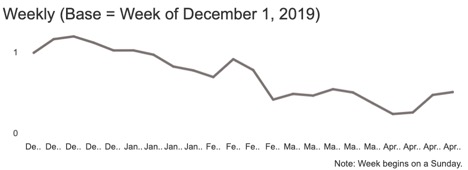
South Korean domestic and outbound travel has seen a general decline since mid-December, but Sojern’s data showed a slight improvement in April. Following positive news of containment of the virus, over the weekend, South Korea warned of a second wave of cases as a new cluster formed around a number of nightclubs. Since then, the capital Seoul has shut down all nightclubs, bars, and discos.
Source Market: South Korea – Domestic Travel
Taiwan domestic travel has a slower decline than average and showed signs of recovery in the second week of April. Additionally, Taiwan outbound has been on a decline since mid-January, but has reached a plateau. Taiwan reported over the weekend that they had no new cases of Covid-19, meaning the country has gone 28 days without reporting a single local transmission. This could reflect positively on travel trends in the near future, said Sojern.
Source Market: Taiwan – Domestic Travel
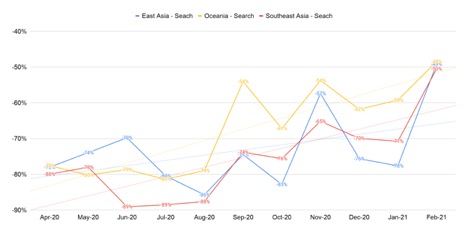
Looking at its flight data and the flight searches conducted across Asia in the last 28 days, Sojern noted that travellers are searching for potential destinations to visit during some specific months ahead. February 2021 has the highest search volume intent, presumably due to the Chinese Lunar New Year holidays. Additionally, Sojern also saw a high search volume for September and November this year, which could be due to the Mid-Autumn Festival in China.
Future Flight Departure Date Searches from East Asia, Oceania and South-east Asia
Hong Kong seems to have the highest search volume in November and this could be due to two anticipated events happening – The Airline Economic Growth and Fintech Conference. As for Singapore and Australia, February 2021 is the highest search month.
Even though the numbers are still lower than last year’s volume, it is a positive sign that travellers are “dreaming” of and planning their next trip, said Sojern.
Australia and New Zealand largely avoided high casualty cases by introducing strict nationwide stay-at-home orders and border closures, including travelling between states.
Positive signs coming out of Australia indicate that students of New South Wales and Queensland began returning to school this week on a limited basis, as the country’s rate of new infections continue to slow.
Future Flight Departure Date Searches to Australia, Hong Kong and Singapore
Having remained Covid-19-free thus far due to its stringent lockdown measures, Bohol is cautious about reopening and will have to ensure proper health and safety protocols to maintain its enviable reputation.
Speaking at a webinar run by Tourism Congress of the Philippines last Tuesday, Allen Christian Varquez, president, Bohol Association of Hotels, Resorts and Restaurants (BAHRR), observed that the locals fear that the virus might seep in when borders are opened, especially in high-risk Cebu.
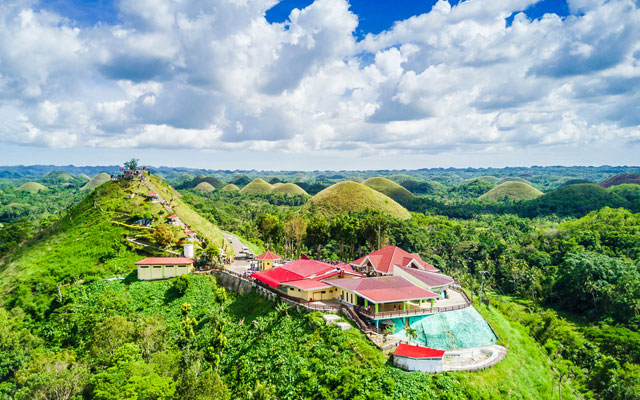
Covid-free Bohol looks to implement strict measures on incoming tourists as it eyes reopening of borders; aerial view of Chocolate Hills Complex, a major tourist hub in Carmen, Bohol pictured
He added that “most accommodations are not keen on reopening mainly because they don’t expect to get the same volume of guests as before”, since tourists generally are still scared of travelling.
While metro Manila, Cebu City and Laguna remain under modified enhanced community quarantine until May 31 as these areas are categorised as high-risk, Bohol and other destinations have been placed on general community quarantine (a relaxed quarantine). Hotel openings and tourism activities are not allowed in all these areas until May 30.
Bohol governor Arthur Yap, who implemented a curfew, wearing of face masks and other measures as part of the extreme community quarantine for Bohol two months ago, said that authorities are looking to quell Covid-19 fears among locals and tourists through proper health, medical and safety protocols being developed with the industry.
Yap also highlighted the need to enforce Covid-19 testing on incoming visitors to prevent a virus breakout, adding that “there are critical border issues that we need to have an agreement on”.
Prior to the Philippines’ lockdown, Bohol was accessible through air services from various destinations as well as direct ferry services from Cebu, Dumaguete and Cagayan de Oro, among others.
Yvonne Villacorte, general manager, Best Western Plus The Ivy Wall Resort-Panglao, said the new guidelines for the hospitality industry being developed by the governor alongside BAHRR and other tourism-related associations will help assure locals and tourists that the province remains safe.
Villacorte added that since most locals don’t want to go out even in this month of festivals, normally a peak season in the province, there would be a better chance of reviving business if Cebu and Manila were reopened.
Lucas Nunag, president, Bohol Provincial Tourism Council, said that as the industry can write off 2020, tourism players in Bohol should use this downtime to prepare for tourism rebound.
Lourdes Sultan, president, Bohol Federation of Travel and Tour Operators, said that in preparation for reopening Bohol, the Department of Tourism should work on training and re-tooling tour guides, as well as providing financial assistance to travel players, especially freelance tour guides who were unable to access the wage subsidies.
CLIA has launched an online course for travel agents to sharpen their industry knowledge and help them combat common misperceptions around cruising by keeping them informed on existing regulations that govern cruise operations worldwide.
Called Cruise Champion, the new course is an interactive programme that deep dives into the workings of the global cruise sector and offers travel agent members the knowledge to become ambassadors for the industry.
CLIA releases online course for travel agents as it looks to dispel misconceptions around cruising
CLIA head of international training Peter Kollar said in a press release that the course would train cruise specialists on how to respond to their clients’ common queries.
He elaborated: “There are a lot of myths and misperceptions that circle the cruise industry and they can affect a travel agent’s ability to cater to their clients. This course is designed to help them respond confidently to some of the issues that customers may raise.”
Some of the topics covered by the course include regulations, safety, health, security, environmental protection, and CSR.
“By knowing more about cruise line practices and the strict regulations that govern cruise operations, agents will be able to join the growing network of voices who help advocate for cruising globally,” Kollar added.
Cruise Champion has been introduced within CLIA Australasia/Asia’s new Members Hub online learning platform, launched last week to provide an improved and streamlined education service for travel agents.
More education resources would be rolled out in the near future to help inform travel agents on the measures CLIA and cruise lines are developing in response to Covid-19, according to Kollar.
CLIA Asia travel agent members can access Cruise Champion via the new CLIA Member Hub here.
Khiri Reach, the charitable arm of Khiri Travel, has been supporting vulnerable communities across South-east Asia whose income has been hurt by the downturn in travel due to Covid-19.
Many of these communities are in long-standing relationships with Khiri Travel, such as local families, artisans or community-based projects that were regularly visited by tours before lockdown.
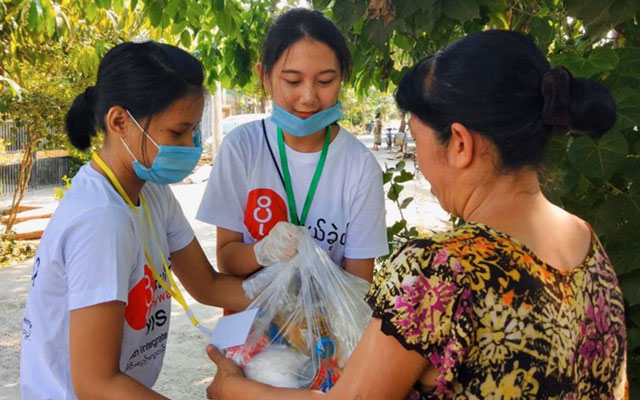
Khiri Reach partners local volunteer groups to distribute grocery packages to the needy in Myanmar
In Sri Lanka, Khiri Reach worked with local people to distribute grocery packages to 250 families in Grandpass Colombo.
Over in Myanmar, Khiri staff and local volunteer groups have been busy setting up two social enterprises: KuMel Volunteer connection and Honeybee Arts & Crafts.
KuMel – the short form of “Ku Nyi Mel” in Burmese or “We will help” – aims to support local communities or organisations who need volunteers to help communities. KuMel also keeps active people in the loop about volunteer jobs through its Facebook page and website.
On the other hand, Honeybee Arts & Crafts enables local artisans to sell their crafts and souvenirs online and worldwide. All the products available on Honeybee are made from sustainable materials, such as bamboo, paper mâché, cotton (from longyi fabric), recycled plastic, or coconuts.
Khiri Travel Vietnam staff also donated funds to a CanCham project to purchase about 148kg of rice to help families in Binh Tan, Hooc Mon, Cu Chi, Tan Phu and Nha Be – suburbs around Saigon where many labourers have been made unemployed.
Local communities developed the system of “rice ATMs” – automatic rice dispensers – which limit physical contact. People in need come with their own bags, which they can fill up with free rice.
Meanwhile, Khiri Travel in Thailand is supporting the Covid Relief BKK Project set up by SOS Thailand (Scholars of Sustenance). Khiri is providing two vans for donating deliveries to communities, homeless shelters and health care centres. The Covid Relief BKK Projects have distributed over 500 bags of dry goods so far.
When tourism resumes, Khiri Travel will offer visits to select NGO sites in Asia at cost, so that all profits go in full to the projects. These non-profit travel experiences help community projects such as The Endangered Primate Rescue Centre in Cuc Phuong National Park in Vietnam, Free the Bears in Laos, the Saunders Weaving School and Burmese Star Tortoise Conservation Project in Myanmar, and the Gibbon Rehabilitation Centre in Phuket.
The luxurious Melia Koh Samui has families in mind
Alma Resort, Cam Ranh, Vietnam
Opening in 2Q2020 on Cam Ranh’s Long Beach, the Alma Resort is an integrated development that boasts a diverse picking of attractions and activities that everyone in the family can appreciate and enjoy.
Alma Resort’s layout from a bird’s-eye view
To start off, Alma Resort’s accommodation collection seeks to impress. Every one of it 580 oversized suites and pavilions afford sweeping vistas of the ocean. Multigenerational travelling families can check into a three-bedroom oceanfront pavilion, each offering 224m2 of space that takes in a living room, kitchen, four bathrooms and a private pool.
Resort guests will never have to go hungry, as the development features a broad spectrum of restaurants helmed by top chefs, a food court as well as a classical bar, pool bar and beach bar.
For recreation, Alma Resort keeps guests busy with 12 swimming pools cascading down to the beach, the 6,000m2 Splash Water Park, a 13-treatment room spa, a 70-seat private Alma Cinema which airs three films daily, the 400-seat Alma Amphitheater, an art gallery, a science museum, a gym and yoga room, an 18-hole mini golf course, a youth centre outfitted with virtual reality games, a kid’s club, and a water sports centre.
What’s super: Alma Resort provides multigenerational families, especially those with little ones, the convenience of having so much to do, see and savour under one roof.
Foodie Jet ski tour, Langkawi, Malaysia
Conducted by Mega Water Sports in the Malaysian resort destination, Langkawi, the food tour on Jet ski is designed for participants aged five and up. While Jet ski riders must be at least 16 years old, younger tour participants can join as pillion.
Prior to the tour, a safety briefing is carried out and it includes a lesson on how to ride a Jet ski.
Explore Langkawi’s tastiest finds on a Jet ski tour
The two-hour long guided tour explores Langkawi’s much-loved local cuisine. It starts on Pantai Cenang Beach and goes all the way to Pantai Kok Beach, before returning starting point. On Pantai Kok, guests will get to try dishes such as laksa pulau, pasembor and mee rebus.
Along the way, views of Mt Machinchang can be enjoyed from a distance and the local guide will narrate the legend of the mountain. Participants will also learn what a geopark is, and the significance of Langkawi’s UNESCO Global Geopark status.
What’s super: More than just a food tour, the activity packs in educational, fitness and bonding opportunities. It is also the only food tour on the island which is water based, requiring participants to Jet-ski their way to venues to savour local delights.
The company scores bonus points for its commitment to green practices – it uses a fleet of low emission Jet skis that reduces noise, air and water pollution. It also maintains a high safety standard.
The Great Asia Africa, Lembang, West Java, Indonesia
Opened December 2019, The Great Asia Africa in Indonesia’s Lembang is an interesting family attraction that takes visitors on a whirlwind tour of seven countries in a single day.
Roam the world in a day at The Great Asia Africa
Miniature tourist destinations in Asia and Africa – specifically Japan, South Korea, India, Turkey, Egypt, Indonesia and Thailand – are recreated in seven pavilions. Each pavilion displays one or two local landmarks. In the Japan pavilion, for example, one can find a duplicate of Fushimi Inari Taisha, a popular Shinto shrine in Fushimi-ku, Kyoto.
Cooking demonstrations are offered at selected pavilions, providing a real taste of the destination to curious visitors.
The Great Asia Africa promises a great snapshot of the diverse cultures of Asia and Africa, through stories and visuals of local history, arts, ornaments and traditional clothing.
Visitors can choose to rent traditional clothing and dress up for a memorable family portrait against the miniature background, enjoy performances, and participate in cultural workshops that teach traditional dances or kimchi making, among many other things.
Besides the country pavilions, The Great Asia Africa also boasts a chocolate factory where visitors can marvel at the production process of the popular sweet treat, and even try their hand at making some chocolate to bring home.
What’s super: When a real-life world tour is not possible, a day at The Great Asia Africa makes a great alternative. There are plenty of activities to engage everyone in the family. Families can also choose to book a private workshop, which is good for groups of up to 20 people.
Hong Kong Disneyland Hotel
Kingdom Club Themed Suites at the Hong Kong Disneyland Hotel, inspired by popular fairy tales, unveiled last summer a new accommodation offering in the form of four Cinderella Suites.
Hong Kong Disneyland Hotel’s four new Cinderella Suites are designed for families
As its name suggests, each Cinderella Suite takes guests into the realms of Cinderella and Prince Charming where it is romance everywhere and interior decorations convey the famed rags to riches tale. Themed amenities and a complimentary Cinderella refreshment platter round up the experience.
The Cinderella Suite can accommodate up to four guests.
Families staying at the Hong Kong Disneyland Hotel are invited to partake in a variety of recreational activities suitable for all ages, such as a treasure hunt that requires participants to find a hidden Mickey on premises and discovering magic within the architecture.
With recreational activities updated from time to time, returning guests at the hotel are bound to be surprised by fresh experiences.
What’s super: While many hotel club lounges are off-limits to younger guests, the Hong Kong Disneyland Hotel has chosen to welcome all with open arms.
A dedicated section within the club lounge is designed for children, featuring smaller-sized furniture and a collection of Disneyland cartoons and storybooks to keep little ones engaged.
Many activities elsewhere in the hotel have also been designed just for children, so that parents wanting their own relaxation time know that their little ones will be entertained on their own.
Melia Koh Samui, Thailand
Opened on January 10 this year, the luxurious nautical-themed Melia Koh Samui on Koh Samui island’s secluded Choeng Mon Beach charms holidaying families with some outstanding recreational facilities and programmes.
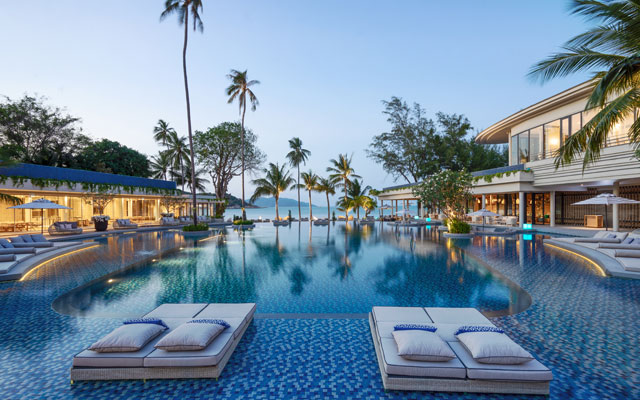
The luxurious Melia Koh Samui has families in mind
The large lagoon pool that loops like a river through the resort’s lush grounds is bound to fascinate all ages who may desire some impressive Instagram shots if not some splashing good fun in the sun. Ask the hotel for complimentary foam floats.
Multigenerational families can participate in yoga, Muay Thai, and cooking classes that impart the art of whipping up local favourites such as tod man goong and tom kha gai.
Other children-friendly fun facilities include an outdoor playground, a mini-waterpark, and a kid’s club manned by professionals who curate entertaining and educational activities for the little ones.
Melia Koh Samui clearly had holidaying families in mind when it designed its accommodation product. Its 200 keys include spacious family suites that come with complimentary access to board and console games.
For a truly unique stay, opt for the elegant two-story boat suites that were converted from century-old merchant vessels. Boasting sizes 91m2 to 100m2 each, these suites offer either sea views, garden views or direct pool access.
What’s super: The hotel is luxurious and beautiful enough to please grown-ups, and entertaining enough to exhaust high-energy youngsters. And should the grown-ups crave some time alone to enjoy a restful treatment at YHI Spa or a drink at the bar, Melia Koh Samui has a babysitting service on request.
Singapore Rugby Sevens
A unique leg of the Rugby Sevens international tournament, the Singapore Rugby Sevens is catered specially to sporting fans with children from around the region. Besides revelling in the energy of the highly charged matches, fans and their families can enjoy a bevy of fringe activities and live performances.
Singapore Rugby Sevens packs in a bevy of fringe activities for the family
Last year’s carnival was headlined not only by rugby stars, but also by popular DreamWorks characters from movies such as Trolls, Shrek, Kung Fu Panda and more. The action moved from centre field to centre stage as local and international acts – featuring American rock band Smash Mouth and Broadway musical Rock of Ages – charged up the crowd.
The event returns this year on October 10 and 11 with more spoils for all-round fun, such as a new “Flying Try” foam diving pit; the Singapore Sevens Splash Party with local entertainment as well as a children’s FunZone with stage performances, live shows, art activities and face painting. More activities will be announced at a later date closer to the event, which has been pushed from its initial April run.
What’s super: To entice younger and bigger family groups, the Singapore Rugby Sevens is free to enter for children under four years old. The event also offers a family package that admits two adults and two youths across both days.
Japan National Tourism Organization has initiated The Dream Japan Journey contest exclusively for Singapore travel agents to craft creative and original Japan itineraries, in a bid to keep Japan top-of-mind among local agencies during this travel slump.
Submitted itinerary entries may either be for a group tour package, specialised/customised tour, or FIT plan; and have to revolve around one of the following three travel themes: Family Educational Trip, Luxury Trip, or Insta-worthy Japan, said JNTO in a statement.
JNTO calls for Singapore travel agents to dream up original Japan itineraries
Places such as Hokkaido, Tokyo, Osaka and Kyoto are acceptable, but entries are required to also include other prefectures in their plan, it added.
Itinerary should also include realistic details of travel attractions and accommodations, though an estimated or final price is not necessary.
The best entry will win a pair of return air tickets to Japan, whereas the best entry for each of the three themes will each receive a sponsorship of joint advertisement of up to S$2500 (US$1,760), on the condition that the participant’s company develops the itinerary into an actual travel product.
As well, the best five entries for each theme will walk away with a goodie bag consisting of JNTO branded products.
Agents can submit their itinerary entries in PDF format, alongside their company name, name, designation, contact number, email address and selected theme, to singapore@jnto.go.jp.
Submitted itineraries will be deemed void if the organiser determines that an entry is not original, or already an existing travel product.
Participants are allowed to submit multiple itineraries, on the condition that each entry is an original.
Entries will be judged on the following criteria: technicality (how well the itinerary captures the appeal of Japan), creativity, and originality. Deadline for submission(s) is June 12, 2020, 11.59.
Interested agents can direct queries about this contest to singapore@jnto.go.jp.
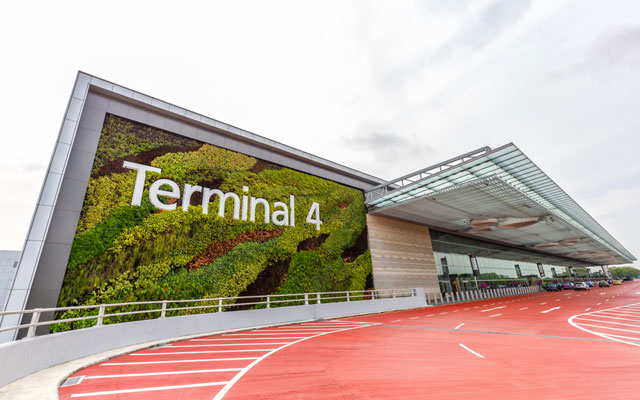
Singapore’s Changi Airport will suspend operations at Terminal 4 from May 16, as part of efforts to further consolidate terminal operations due to the sharp decline in air traffic caused by the global Covid-19 pandemic.
The move follows the suspension of Terminal 2’s operations earlier this month.
Changi Airport suspends T4 operations as air traffic demand plummets to new lows
The airport handled some 25,200 passengers in April 2020, a drastic 99.5 per cent drop compared to last April’s 5.58 million.
Cathay Pacific and Korean Air, which currently operate out of T4, will operate at Terminal 1 instead. Other airlines will be assigned to either Terminal 1 or 3 when they next operate flights at Changi Airport.
With the suspension of T4’s operations, stores and restaurants in the terminal will close and the shuttle bus service connecting to T3 will be suspended until operations in T4 resume. The timing of this will depend on when air travel demand picks up, and on the requirements of airlines seeking to relaunch flights, said Changi Airport Group.
During the current circuit breaker period in Singapore, F&B outlets in the rest of Changi Airport are open for takeaways, and essential services such as pharmacies continue to serve airport staff and the public.
Greater connectivity and safety, and a wider range of family-friendly options could be some of the pull factors drawing the segment to Asia
From exclusive private islands and spacious villas to luxurious itineraries designed to cater for children through to grandparents, the region’s upmarket travel companies are eyeing the rise in longhaul multigenerational bookings.
Greater connectivity and safety, and a wider range of family-friendly options could be some of the pull factors drawing the segment to Asia
Generations of family members travelling together has continued to be a significant trend in luxury travel, making the top observation in Virtuoso’s Luxe Report for five straight years.
Prior to the Covid-19 outbreak, travel consultancy Strategic Vision’s annual Pulse of the Industry Survey 2020 found 81 per cent of the top luxury travel executives surveyed expected to see a surge in interest in multigenerational travel in 2020 and beyond.
Tailored experiences
Nicky Thongpunparn, director-sales, ICS Travel Group, shared that multigenerational travel has always been popular with the Asian market. However, she has seen an increase in longhaul bookings – particularly from the US.
Nicky’s company offers customised itineraries for well-heeled travellers through its premium brand, STYLE by ICS.
Recently, STYLE by ICS designed an itinerary for a family of 15 from the US who chose Thailand as for their vacation.
The itinerary involved luxurious private accommodation as well as curated experiences – cooking classes, picnics on the beach, and excursions to the countryside.
Nicky observed that travellers in the segment are looking for spacious villas, educational sight-seeing experiences, and the opportunity to forge lasting family memories.
Hospitable response
The segment’s interest in Asia has also not escaped the notice of Martin Koerner, group director-sales, marketing and distribution, The Anam.
Since the upmarket, 213-key resort opened in April 2017 at Cam Ranh on the central Vietnamese coast, Koerner has been seeing a “steady increase” in large family and multigenerational bookings from longhaul markets.
This prompted The Anam to launch its Family is Everything package in February. It combined a stay in one of the resorts’ two-storey Family Hall Villas and a wide range of culinary and recreational experiences for all ages.
The Anam is one among many accommodations that have been tracking and responding to the preferences of the segment.
Simona Chimenti, general manager, The Pavilions Bali – a boutique retreat with 24 traditional-style villas – noted that the segment would opt for beachside resorts with a kids’ club in the past. Parents would drop children off at the club and head to other sights and activities by themselves.
“Now, it’s about wanting to spend quality time with kids and (the rest of the) family. They want to be together in a boutique resort, experiencing things together and creating common memories,” observed Chimenti.
Drivers of growth
Koerner attributes the rise in bookings from the segment to three factors: more connectivity; wealthier, healthier, and more active retirees; as well as the wider availability of family-friendly options.
Commenting on the work Vietnam has put in for the last factor, he said: “Once the realm of intrepid backpackers, the destination is now on the luxury travel map and lends itself to extraordinary family experiences.”
For Andreas Grosskinsky, general manager, Destination Asia Indonesia, increased safety in the region has encouraged multigenerational groups planning longhaul trips to consider Asia.
Paradise dreams
It remains to be seen how important privacy will be for the segment. Some families have, after all, chosen to reserve an entire island.
Over at the Philippines’ North-eastern Palawan, multigenerational groups have been travelling to Banwa Private Island since its opening in 2019, shared Robert John Horrigan, CEO, Aquos Management, the company behind Banwa’s operations.
He shared that some of these groups booked out Banwa, which is able to cater for 48 pax at a time.
According to Horrigan, the Middle East is the top longhaul market for the island located in one of the Sulu Sea’s protected marine areas.
At Banwa, families are offered activities such as scuba diving at the famed Tubbataha Reef – accessible via a day cruise – and stargazing.
The segment’s influence cannot be underestimated.
“We are seeing a lot of bookings (where all three generations are) travelling together, wanting to share the ultimate experience. This is becoming a big thing,” Horrigan remarked.