The Mekong Tourism Coordinating Office (MTCO) will be hosting a half-day virtual summit on August 25, offering recommendations and insights for travel businesses to prepare for a balanced recovery amid Covid-19.
The Virtual Destination Mekong Summit will be organised by public-private partnership Destination Mekong, and sponsored by UNWTO Affiliate Member Chameleon Strategies, under the theme of Balanced Tourism Recovery for a Better Future.
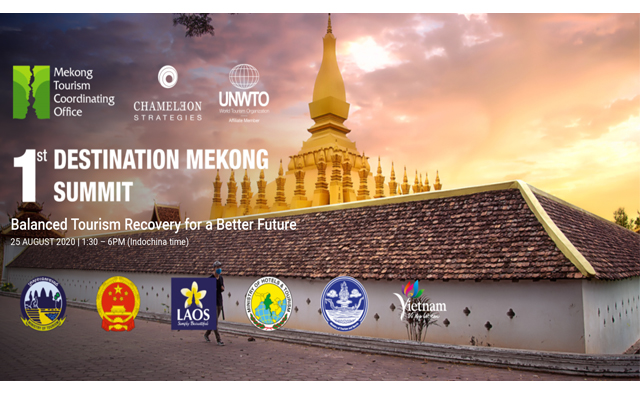
With feedback and significant contributions by members of the Mekong Tourism Advisory Group (MeTAG), and a focus on resilience and tourism recovery in the Greater Mekong Subregion, the 1st Destination Mekong Summit aims to give actionable insights and action steps to businesses, operating in the member countries of the Mekong Region.
With 15 short sessions and 40 speakers, the summit will address issues like changing sentiments from source markets China and Japan; recommendations for the meetings sector; latest data and insights for travel businesses; how to communicate to stakeholders in these times; sustainability concerns including climate change, plastic pollution, child protection, and wildlife conservation; as well as a scenario analysis to prepare for the future today.
Instead of following the usual presentation format, the virtual summit will engage in pointed and focused discussions that aims to answer burning questions, offer actionable suggestions on how to survive these challenging times, and how to best prepare for an accelerated recovery. The summit will be emceed by Jutamas Wisangsing of Perfect Link Consulting, and MTCO executive director, Jens Thraenhart.
The summit will have two short take-away sessions, led by Horwath HTL Global Tourism Practice Leader Mr Siniša Topalović, calling in from Croatia. These two sessions are designed to give delegates a quick view on key dos and don’ts, drawing on global research of many destinations and travel businesses.
The opening keynote will be given by the author of the upcoming book Travel & Covid-19, Simon Hudson of South Carolina University in the US, who will look at case studies and best practices from all over the world.
Reflections from past crisis’ and ideas will be discussed by Weearasak Kowsurat, a Thai senator and Thailand’s former minister of tourism and sports; and Htay Aung, Myanmar’s former hotels and tourism minister.
Steven Schipani from the Southeast Asia Department of the Asian Development Bank will lead a session about economic development measures and tourism recovery in the region, alongside the vice chairman of the Vietnam Administration of Tourism, Ha Van Sieu, and the director general of the Ministry of Tourism of Cambodia, Rathasak Thong.
Communicating during Covid-19 is a challenge for many businesses – from branding, marketing, and positioning. A session on when to sell, how to discount, and what message to send will be led by the deputy governor of the Tourism Authority of Thailand, Tanes Petsuwan, and Michael Marshall, CCO of Minor Hotels, operating hotel brands such as Anantara and Avani.
When international travel resumes in the Mekong Region, two source markets are said to have great potential: China and Japan. The co-founder and CEO of leading China travel marketing firm Dragon Trail Interactive, George Cao, and the chief research officer of JTB Consulting, the research division of leading Japanese tour operator JTB, will discuss how to market to Chinese and Japanese consumers post Covid-19, how to build relationships with the trade now, and changing consumer sentiments in both key source markets.
Kelvin Lee of the International Air Transport Association, and Bernard Kee of leading hotel data firm STR, will share about the latest trends and insights, and what businesses from hotels, tours, and restaurants should do to survive the crisis and how to best prepare for recovery.
Finally, in a very special session, Gloria Guevara, CEO of the World Travel and Tourism Council, former UNWTO secretary general, Taleb Rifai, Thailand’s former tourism and sports minister, Kobkarn Wattanavrangkul, and CEO of the Pacific Asia Travel Association, Mario Hardy, will give recommendations and opinions to stakeholders in the visitor economy.
Interested travel professionals can register for free here.













Mobile-first entertainment marketplace Headout has launched the Safe Experience badge verifying that attractions have adhered to WHO safety standards, in a bid to build trust and ensure traveller wellbeing.
This comes as the Covid-19 pandemic has triggered a seismic shift in travellers’ demands, with higher hygiene standards, touchless services, and enhanced safety protocols topping the wishlist of travellers.
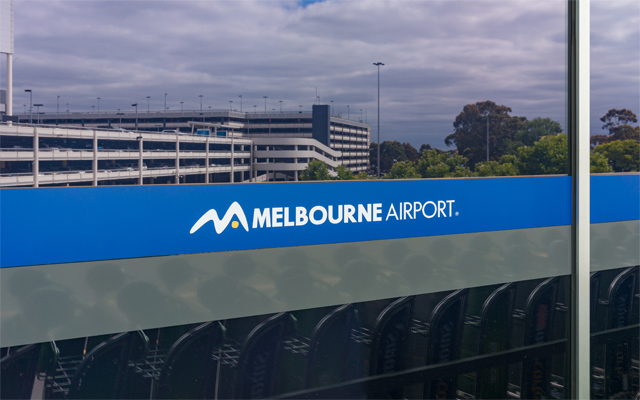
Headout has awarded the Safe Badge to more than 1,900 experiences across 25 countries, including several in the Asia-Pacific region such as Universal Studios Singapore, Siam Park City in Bangkok, Sky 100 Hong Kong Observation Deck, BridgeClimb Sydney, Melbourne Zoo, Phuket Simon Cabaret, and RamaYana Water Park in Pattaya.
Safe Experiences on Headout are displayed to users on a real-time basis. “Today, safety and trust are the need of the hour to get back to the world as we knew it. With Safe Experiences, we have pioneered a massive data project to ensure our users get accurate and updated information on safety measures around the world,” said Varun Khona, CEO and co-founder of Headout.
Before accrediting the Safe Badge, Headout approbates five safety protocols that ensure traveller safety from multiple touchpoints. These include contactless entry and exit, minimal touch services and the mandate of online tickets; mandatory mask-wearing, temperature checks, and social distancing measures; capacity restrictions and time-slotted entry; sanitation, disinfection, and deep cleaning practices on-site, including sanitisation of audio guides and transfer vehicles; as well as staff trained as per WHO guidelines.