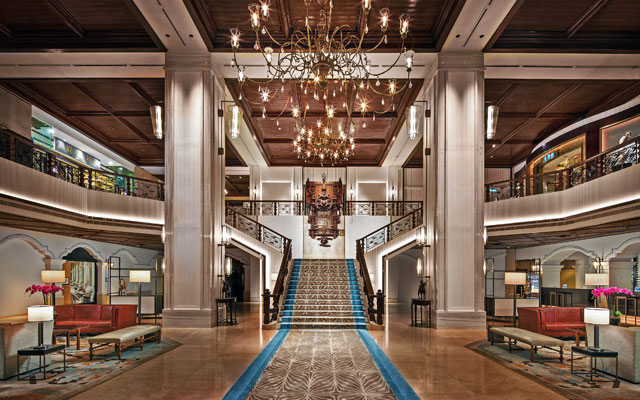
Andaz Singapore has welcomed German hotelier Stephan Karl as its newly-appointed general manager.
With a career spanning over 24 years, Karl first started at Hotel Bayerischer Hof in Lindau as an apprentice. Over the next decade, he rose through rooms, F&B and banqueting roles at Carlton Hotel St. Moritz, Sheraton Suites Galleria-Atlanta and Castle Hospitality & Catering in Heidelberg, south-west Germany.
In 2006, his Hyatt journey began at Hyatt Regency Mainz followed by other luxury properties such as Park Hyatt Dubai, Grand Hyatt Beijing and Park Hyatt Sydney. In 2018, he received the Hyatt Leadership Award for Americas as a testament to his broad-based experiences, and for playing a pivotal role in the opening of Andaz Mayakoba Resort Riviera Maya Mexico in 2016.
His tenure in the luxury hotel scene then led him to Vietnam. For close to two years, he was part of the pre-opening team for Hyatt Regency Nha Trang as general manager, before moving on to Andaz Singapore in the same capacity.
Tourism players fear that visa fee and stringent health protocols may deter foreign visitors to Sri Lanka
Sri Lanka is slowly picking up the pieces of tourism devastation as airport operations resume after a 10-month lockdown, with arrivals for January 2021 numbering just 1,682.
In January 2020, Sri Lanka welcomed 228,434 arrivals.
Arrivals climbed the following month, with 2,700 visitors between February 1 and 25, according to official data.
Scheduled flights from Kazakhstan and Ukraine are helping to lift tourism arrivals to Sri Lanka
Madhubani Perera, director at Sri Lanka Tourism Promotion Bureau, said tourism recovery is boosted by twice weekly scheduled flights from Kazakhstan and Ukraine to Sri Lanka’s second international airport in southern Hambantota.
Both services carry 200 passengers each every week.
In January 2021, Ukraine, Belarus, China, Russia and Germany were Sri Lanka’s top five international tourist source markets, with Ukraine accounting for 86.8 per cent of the total traffic largely due to an experimental month-long travel bubble involving 1,700 visitors prior to the airport’s reopening to foreign visitors.
Meanwhile, domestic tourism continues to keep hotels busy, especially during weekends.
“Our hotels are full on weekends, particularly during long weekends, with local guests. This is paying for our staff salaries and electricity bills,” said Hiran Cooray, chairman of Jetwing Symphony Hotels.
He hoped that foreign arrivals would pick up in summer (May/June), particularly from the UK as citizens would have been vaccinated by then. The UK was once Sri Lanka’s biggest source market.
He also suggested that Sri Lanka relax arrival guidelines to allow vaccinated tourists into the destination without PCR tests and other regulations.
While Sri Lanka does not enforce a mandatory quarantine on arrival, all visitors must get visas online with confirmed hotel bookings, pre-purchased PCR tests and a mandatory Covid-19 insurance cover providing US$50,000 worth of hospitalisation or medical bills for a month. All arrivals must present a valid PCR test taken 96 hours before arrival.
Locals are not allowed to mingle with tourists while there are 20 locations to visit by tourists travelling in a bubble.
A hotel manager from Kandy, a city famed for a sacred Buddhist temple and an annual street pageant featuring dozens of elephants that is popular with tourists, said this was the time for the industry to bring in fresh thinking and new tourist locations.
“This is a near-50 year-old product which hasn’t changed, where tourists are taken on the same routes to see the same places,” he remarked.
Global destination management specialist Discova has obtained the ChildSafe certification for its Asian teams and destinations, signifying the company’s commitment to protecting the well-being of children through responsible travel initiatives.
In an interview with TTG Asia, Michaela Connor, regional peopleworks leader for Discova, noted that there are many instances where child abuse could happen within tourism.
Discova’s team in Saigon has been ChildSafe certified along with other colleagues across Asia
“Largely, the abuse is a result of exploitation. One of the most common scenarios is found in orphanage tourism. Here, the children themselves become a tourist attraction as their disadvantage is exploited for the financial gain of others. Another shocking example, which gained significant media coverage, involves several cases where tourists have been targeted by locals using ill-looking children as emotional leverage. The claim being that the adult in this scenario wants some money to buy powdered milk formula for their child,” shared Connor.
“These are just two examples where tourists unwittingly support the exploitation of children. By thoroughly training all our staff, specifically our guides, we can give the best advice to our passengers and take the appropriate action to ensure exploitation and abuse is reported in the correct way,” she added.
Connor reflected that being able to influence customers towards child-safe behaviour may be the most difficult to enforce as part of upholding ChildSafe guidelines. “If, for example, we advise customers not to take photographs of local children, by law we cannot enforce this or take the camera off them. We can do our best to educate and influence a change in behaviour and that is always challenging no matter where you are in the world or industry you are in,” she explained.
Discova’s existing relationship with the ChildSafe Movement in Asia made training and certification a natural progression.
“Rolling out training across all our destinations in Asia was always going to be a big job so having some history with the organisation’s practises helped a lot,” said Connor.
Prior to certification, 12 Discova employees volunteered as ambassadors to represent ChildSafe within and outside of Discova. They undertook four assignments that expanded their subject matter knowledge prior to a virtual training course.
The virtual training course, led by Marie Duong, ChildSafe international coordinator, detailed seven ChildSafe tips for travellers and case studies the ambassadors could work on together. Post training, Discova employees sat for an exam and had three weeks to prepare to deliver parts of the same training and be assessed by Duong.
Upon passing the virtual training, exam and live assessment, these Discova employees were granted approval to train the rest of the Discova team.
In response to a question about tracking adherence to the programme, Conner said strategies are in place to raise awareness among partners, suppliers and local communities and to ensure staff are aware of guidelines.
“There will be monthly communications to all employees of what we have achieved that month related to ChildSafe and yearly refreshers and exams to test knowledge,” she added.
There are plans to take training to the Americas and the programme will be tailored to each destination.
Passengers travelling on Emirates’ Economy Class can now purchase up to three empty adjoining seats on their flight – an initiative introduced to address customers’ feedback.
Customers will not be able to pre-book empty seats, as these are subject to availability. Empty seats will only be offered for purchase at the airport check-in counter prior to flight departure, and cost from AED 200 (US$55) to AED 600 per empty seat, plus applicable taxes depending on flight sector.
Passengers can purchase empty seats around them at the airport check-in counter prior to flight departure
In addition, Emirates has rolled out a variety of seat products for Economy Class customers, such as extra legroom seats; twin seats on select aircraft; and preferred seats in the first section of the cabin and on the upper deck of a two-class Airbus 380.
These seats are offered for free or at a charge, depending on the customer’s Emirates Skywards membership tier, fare type, time to departure, and other special needs.
Further, to help customers flying on essential trips take home what they need most, the airline has introduced generous discounts of 35 to 60 per cent on excess baggage rates.
Emirates’ latest round of service enhancements join the airlines’ customer care initiatives that were introduced during the pandemic. They include flexible booking policies and multi-risk insurance coverage.
The first of three properties under Oakwood’s new brand, The Unlimited Collection by Oakwood, opened on Monday, with the second following in mid-March.
Wanderlust and the soon-to-launch KēSa House are heritage landmarks that retain their unique identity and architectural charm while delivering guest experiences in line with Oakwood’s expertise in hospitality management and service initiatives, supported by its global distribution.
Guests can participate in a leathercraft workshop conducted by Crafune, a homegrown Singaporean brand
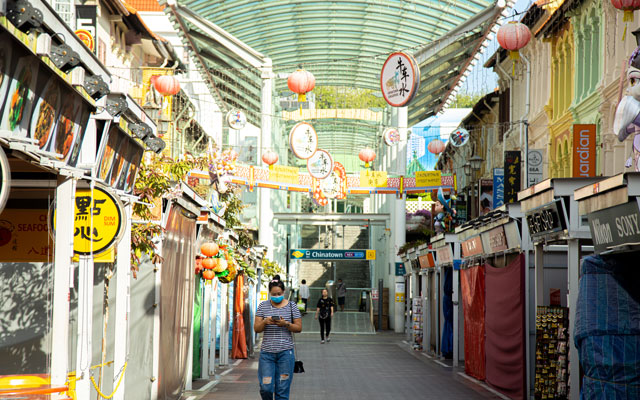
Guest experiences at both hotels are designed to reflect Singapore’s unique multiracial and multicultural identity. The Culinary exploration of Little India and Chinatown, curated by award-winning Singabites, for instance, comprises five stops that will introduce guests to significant cultural attractions and culinary highlights in each neighbourhood.
An interactive leathercraft workshop, conducted by Crafune, a homegrown Singaporean brand, allows guests to acquire basic knowledge of leather, types of leather crafting tools, scoring and cutting of leather, edge finishing and burnishing as well as cleaning and caring for leather. In doing so, guests craft their own leather souvenir.
There is also a locally-inspired Kombucha workshop that uses ingredients sourced in Singapore.
Commenting on the openings, Dean Schreiber, chief executive officer of Oakwood, said The Unlimited Collection by Oakwood “supports the growth strategy in an emerging market segment, especially in key gateway cities where multiple Oakwood brands are already in operation”.
The company aims to double its portfolio of managed properties by 2025.
Grand Park Kodhipparu, Maldives is offering an Easter Getaway package for families, which comes with free bed and breakfasts for children under nine and festive amenities.
Available for a stay period from March 15 to April 30, 2021, the package includes 20 per cent off on speedboat transfers, daily breakfast and dinner for two adults at all-day dining restaurant The Edge; a bottle of house wine upon arrival; an Easter Chocolate amenity; couples mixology class; and one-time four-course set dinner with a complimentary bottle of wine for two people at the award-winning, Firedoor restaurant.
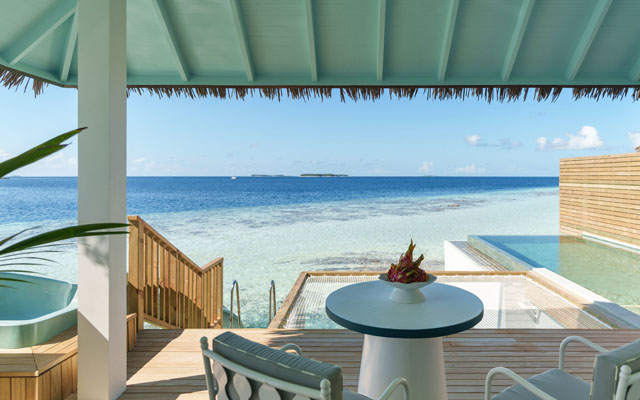
Ocean pool villas at Grand Park Kodhipparu, Maldives
The resort promises six exclusive benefits for direct bookings – best rate guarantee, exclusive member’s rate for Park Rewards members, flexibility, pre-arrival requests assistance, free Wi-Fi during stay, and a tree planted under the hotel group’s Room for Trees programme with every booking made through its website.
Tourism operators in Myanmar are calling on the international industry to shun military-owned operations as the nationwide civil disobedience movement against the coup continues.
In the midst of the Covid-19 pandemic, Myanmar’s tourism was dealt another devastating blow when the country awoke to a military coup at the start of February. Since then, resistance has been gathering across the country as peaceful protestors take to the streets.
Myanmar’s domestic tourism restart has been halted due to the military coup; Myanmar people taking to the streets last month to protest against the coup pictured
DMCs in the destination fear that the military take-over will have a devastating long-term impact on the tourism industry. They are urging international players not to boycott the country as a whole, but to join the nationwide civil disobedience movement and sanction military-owned and backed businesses.
The local general manager of a leading cruise operator said: “International tour operators should blacklist all these businesses and not support them. This is very sad because we will have to work very hard to rebuild the image of the country; tourism is always relative to politics.”
Sammy Samuels, founder of Myanmar Shalom Travels, added: “One of the biggest concerns for anyone travelling to Myanmar is whether their money is in any way funding the military operation.”
He said the hundreds of thousands of locals who rely on tourism to survive have already been badly hit by Covid-19. “Being a responsible traveller (or) responsible tour operator can be part of a strategy to reassure visitors their visit will support the local economy and its people,” he added.
Activist organisation Justice for Myanmar recently published a list of military-owned businesses and is calling for sanctions against them.
The managing director of an international tour operator said that once travel resumes, it is key that overseas operators carry out “due diligence”. He noted: “It’s good for tour operators to be very careful and look into businesses and who their shareholders are.”
While international borders remain firmly closed, Myanmar’s domestic tourism was starting to take off as Covid restrictions were eased across the country. However, this has halted in the wake of the coup.
Said the cruise operator: “If the military remains in power, I don’t think we will be able to do business for another six months, and even then, will it be enough to sustain business?”
The prospects for Indonesia’s hospitality sector may be less grim than painted in recent media reports on more hotels closing or going up for sale amid the pandemic, with major property consultants saying that they are not seeing an uptick in hotel sales within the country.
On the contrary, a flurry of new hotel openings across the country proves that demand remains strong.
Long-term outlook for Indonesia’s hotel industry remains bright
Aldi Garibaldi, senior associate director of capital markets & investment services at Colliers International Indonesia, said selling property assets would usually occur when lenders were putting significant pressure on borrowers.
“There are steps to take to sell a property and (hotel owners) will usually hire a consultant to manage the process – which we are not seeing happening,” he said.
Corey Hamabata, senior vice president for Asia Pacific investment sales at JLL Hotels and Hospitality Group, said: “I would counter (news reports that many hotels in Indonesia are up for sale) with the question: ‘How many properties have we actually seen being transacted in this environment?’ As far as we are aware, (there have) been very few.”
Historically, in times of crisis, sales activity of real estate businesses slows down significantly because there is a lot of uncertainty among buyers and sellers. “We saw this last year when Asia-Pacific transaction volumes were down by nearly 60 per cent year-on-year,” Hamabata said.
Unlike the global economic crisis 12 years ago where lenders were forcing borrowers to sell their assets, Hamabata was not seeing that same storyline unfold amid the pandemic so far.
He also saw that hotels in Indonesia were not performing too badly – thanks to its huge domestic market – such that it would trigger hotel owners to sell their properties.
As such, the move by a handful of hotel owners to sell their properties in Indonesia was more likely due to strategic reasons, such as finding better opportunities to invest elsewhere, he said.
As well, the occurrence of new hotel openings in Indonesia indicates that there are opportunities in the market, said Satria Wei, managing partner at Hotelivate. “In fact, I am handling a couple of hotels which are preparing to open this month. Investors would not dare do so unless they see an opportunity,” he added.
Satria also noted that Indonesia’s hotel industry had started to recover last October-November. “It slowed down again (due to activity restrictions), but this proves that demand and opportunity are still there,” he said.
RedDoorz has partnered with Singapore-based charity organisation Daughters Of Tomorrow (DOT) to launch a CSR campaign where Singaporeans can donate their unused SingapoRediscovers Vouchers (SRVs) to help DOT beneficiaries redeem temporary accommodations at the group’s hotels.
As part of the initiative, RedDoorz will also match every room night donated by the public during the campaign.
RedDoorz provides free temporary accommodations by launching CSR initiative with local charity
Established in 2014, DOT aims to facilitate livelihood opportunities for underprivileged women and support them in achieving financial independence and enable social mobility for their families. DOT beneficiaries are women aged 20-60 from low-income families, most of whom reside in government-subsidised flats and face multiple internal and external stressors that affect their job prospects and ability to break out of poverty.
The initiative is part of Trip.com’s Pay It Forward campaign, which calls on Singaporeans to donate their SRVs to selected charities and organisations via their platform. Singaporeans may make their donations through Trip.com’s website here.
Adil Mubarak, vice president of operations, RedDoorz, said: “RedDoorz strongly believes in the importance of supporting our communities and we hope that through this initiative, we can provide much needed help for people who might be more vulnerable during these tough times.”
DOT fundraising and events manager, Cheryl Chen, added: “In the past year, we have seen an increase in the number of women seeking emergency housing due to less-than-ideal situations at home. The Pay It Forward campaign will help provide these women with interim housing while they find alternative permanent housing solutions.”
Malaysia’s tourism minister has raised concerns over the recent announcement by the health director-general that the ongoing ban on interstate and inter-district travel, put in place since January 13, will likely continue until 70 to 80 per cent of the population has been vaccinated.
In a statement, Nancy Shukri said that she was worried that Noor Hisham Abdullah’s announcement would result in a worsening impact on the local tourism industry which has been severely affected for a year now.
New approach needed to balance public health with economic wellbeing amid pandemic: Shukri
She elaborated: “The tourism industry is closely related to the movement of people from one location to another. When there is no movement, it means there is no tourism and there is no economic activity, which in turn means, no jobs and no income for those working in this industry chain. Therefore, I hope to find a meeting point that can balance the health and economic wellbeing of the people.”
Stressing that a new approach is necessary in controlling the spread of Covid-19 apart from continuing the ban on cross-state travel, she said the ministry was willing to work with all parties to find the best way forward.
Passengers travelling on Emirates’ Economy Class can now purchase up to three empty adjoining seats on their flight – an initiative introduced to address customers’ feedback.
Customers will not be able to pre-book empty seats, as these are subject to availability. Empty seats will only be offered for purchase at the airport check-in counter prior to flight departure, and cost from AED 200 (US$55) to AED 600 per empty seat, plus applicable taxes depending on flight sector.
In addition, Emirates has rolled out a variety of seat products for Economy Class customers, such as extra legroom seats; twin seats on select aircraft; and preferred seats in the first section of the cabin and on the upper deck of a two-class Airbus 380.
These seats are offered for free or at a charge, depending on the customer’s Emirates Skywards membership tier, fare type, time to departure, and other special needs.
Further, to help customers flying on essential trips take home what they need most, the airline has introduced generous discounts of 35 to 60 per cent on excess baggage rates.
Emirates’ latest round of service enhancements join the airlines’ customer care initiatives that were introduced during the pandemic. They include flexible booking policies and multi-risk insurance coverage.