Accor made its debut in Langkawi with the opening of the four-star, 164- key Mercure Langkawi Pantai Cenang. This is the only international hotel brand on Pantai Cenang, a popular public beach on the western shoreline of Langkawi.
With the newly opened Mercure Hotel, Accor now has a total of 21 properties in Malaysia including six Mercure hotels.
Keh: towards year-end, international tourists will form the bulk of guests
Mercure Langkawi Pantai Cenang’s general manager, Jasmine Keh, shared that forward bookings were promising during the promotional period up to June 30 with opening rates from RM448 (US$103) per night including breakfast for two.
Guests are predominantly locals as Malaysia had only recently reopened its borders to international tourists. Keh opines that towards year-end, international tourists will form the bulk of guests as Langkawi, especially Pantai Cenang Beach, has always been popular with foreign tourists.
Mercure Langkawi Pantai Cenang offers comfortable accommodation, Wi-Fi and meeting facilities. Its ballroom, which accommodates up to 200 people in theatre seating, along with three small meeting rooms, are ideal for both business and leisure events.
The hotel boasts breathtaking ocean views and lush hillside greenery, and is within walking distance to the beach, Dataran Pantai Cenang, Cenang Mall, duty-free outlets, and numerous restaurants and souvenir shops.
Keh said the hotel will collaborate with Tourism Malaysia and Langkawi Development Authority to promote the hotel and destination locally and internationally, targeting niche segments such as diving and soft adventure seekers as well as the destination wedding market.
With its many Instagrammable locations, Langkawi has always been a popular destination for weddings and honeymooners from India, China, Europe and the Middle East.
Ally Bhoonee, executive director, World Avenues Travel & Tours, said: “There is a shortage of four-star hotels on Langkawi Island – the opening of Mercure will add inventory in the four-star category and provide more hotel options for travellers.”
Carnival Corporation has completed the installation of nearly 600 food waste biodigesters across its fleet in support of ongoing food waste management and reduction efforts as part of its overall commitment to environmental compliance.
The technology has been added to ships from the company’s nine cruise line brands.
Carnival Cruise Line is the first major cruise line to employ biodigesters across its entire fleet
The biodigester technology uses a natural aerobic digestion process inside each machine to efficiently break down food waste utilising a mix of beneficial microorganisms, processing anything that is consumable by a human. Performing automated digestion 24 hours per day, the biodigesters are strategically placed in key areas of the ship where food is processed, making it easier and more efficient for crew members to manage and control food waste. Additionally, the machines capture non-food items or other materials accidentally mixed with food waste, providing an additional layer of protection for environmental compliance on each ship.
Since first piloting the technology in 2019, Carnival Corporation and its nine global cruise line brands have continued to expand the use of these systems across their fleets.
Carnival Cruise Line is the first major cruise line to employ biodigesters across its entire fleet.
The installation supports Carnival Corporation’s aggressive food waste management objectives, as part of its 2030 sustainability goals. These goals support the company’s circular economy focus area by including a commitment to achieve a 30 per cent reduction in unit food waste by 2022 and a 50 per cent reduction in unit food waste by 2030. These new goals build on the company’s latest achievement of reducing food waste per person by over 20 per cent at the end of 2021, which doubled its original goal of reaching a 10 per cent reduction in food waste by the end of last year, relative to a 2019 baseline.
New data from ForwardKeys on May 6 reveals that Russian outbound tourism, already severely handicapped by pandemic travel restrictions, has fallen even further, because of Russia’s military operations in Ukraine.
In the week commencing February 18, before the outbreak of war, outbound international air tickets from Russia stood at 42% of pre-pandemic levels. However, in the week immediately after the invasion, issued air tickets fell to just 19%. Since then, flight bookings have sunk deeper still and have been hovering at around 15%.
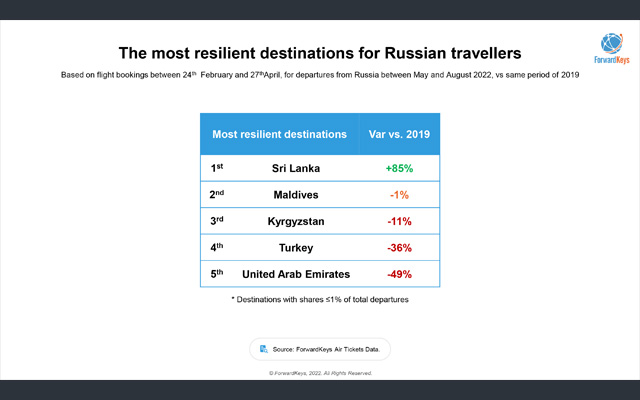
The top five destinations for travel are Sri Lanka, the Maldives, Kyrgyzstan, Turkey and the UAE (Photo: ForwardKeys)
Due to war-related sanctions on civil aviation, Russians are unable to book flights to many of their favourite destinations in the West; thus, they book trips to the Middle East and Asia instead.
Olivier Ponti, vice president insights, ForwardKeys, said: “The war with Ukraine, and the consequent sanctions on flying, have effectively caused Russia’s outbound tourism market to dry up. Those people who are still flying comprise a small, affluent niche, who are forced to holiday in Asia and the Middle East rather than in Europe, which is their favourite destination in normal times.”
An analysis of flight bookings made between February 24 (the start of the invasion) and April 27 reveals that the top five destinations for travel between May and August, in order of resilience, are Sri Lanka, the Maldives, Kyrgyzstan, Turkey and the UAE. Bookings to Sri Lanka are currently 85% ahead of pre-pandemic levels, to the Maldives 1% behind, to Kyrgyzstan 11% behind, to Turkey 36% behind and to the UAE, 49% behind.
However, Sri Lanka’s position at the head of the list is not a true reflection of the island’s attractiveness as a destination. Instead, it is a consequence of terrorist bombings, which scared away visitors in 2019, the pre-pandemic benchmark year.
Further analysis of the recent tickets booked to Turkey and the UAE suggests that a very substantial proportion are affluent Russians going on holiday, based on the number of seats sold in premium cabins tripled, compared to 2019, with the average trip duration for premium travellers being 12 nights in Turkey and 7 nights in the UAE.
Changes to flight schedules, following Russian hostilities in Ukraine, have been ongoing since the beginning of the invasion, with the recent cessation of flights to Russia by Air Baltic on April 14, and EgyptAir’s resumption of daily direct flights between Cairo and Moscow on April 22.
Outright ban on elephant tourism will hurt a long supply chain of small local businesses and communities
Tour operators under pressure to shift towards more responsible models
Public-private sector efforts ongoing to transition to ethical and sustainable elephant tourism
World Animal Protection (WAP) is optimistic that an unprecedented tourist void in the past two years is the catalyst for venues to rethink what the London-based animal rights activist slams — and bans — as “cruel” business practices such as riding. Its ideal is “observation-only” and ultimately, an end of captive elephants used for commercial tourism.
For Chiangmai-based Asian Captive Elephant Standards (ACES), a company that audits elephant venues, it is a chance to advance regulation and education that will enable venues to still offer riding and other “touching” activities without harming the mammals. ACES joins a huge voice in Thailand maintaining that outright bans of venues will not only hurt elephants, but owners, mahouts and a long supply chain of small local businesses and communities.
Thailand has the largest number of elephants used in tourism
“Elephant tourism can be a well-regulated, cruelty-free and culturally respectful experience for post-pandemic travellers,” said ACES communications and policy advisor, Ingrid Suter.
Both camps of thought mean well. But has the moment for a reset passed, or is there still time for change? Thailand has scrapped its terminally complicated Test & Go scheme, and simplified the much-maligned Thailand Pass. Tourists are already flocking in, with the Tourism Authority of Thailand forecasting seven to 10 million tourists this year and 20 million next year.
According to a WAP report, Taken for a Ride, published in 2017, Thailand has the largest number of elephants used in tourism. At around 2,200, that’s roughly twice as many as elephants in tourism in India, Sri Lanka, Nepal, Laos and Cambodia combined.
Starving but surviving
Despite media reports of captive elephants starving to death as venues shuttered and the tourist dollars to feed them dried up, elephants overall have survived the ordeal, observed John Roberts, Minor’s director of sustainability and conservation, based at the Anantara Golden Triangle Elephant Camp & Resort, 75-minute drive from Chiang Rai airport.
He said: “There isn’t an official count but it hasn’t been as disastrous as we predicted at the beginning (of Covid-19). There have been deaths due to old age or related to gastrointestinal issues, but there has also been breeding going on, although I wish not. An elephant is pregnant for 18-23 months, so one that was conceived just before the pandemic would have been born three months ago.”
Keeping the elephants fed during the pandemic has been “very difficult”, he added.
An adult Asian elephant needs about 150kg of food a day and spends two-thirds of each day feeding on grass, according to WWF. It costs about US$18,000 a year to feed one jumbo, estimates the Golden Triangle Asian Elephant Foundation, whose largest single donor is Minor International.
Fundraising by the likes of Thai Elephant Alliance Association, Human Elephant Learning Programs (H-ELP) Foundation and WAP, and live streams by venues for donations, are a key lifeline.
More pressure
With elephants alive and the return of elephant tourism, tour operators can expect a bigger shift towards observation-only models, and eco-friendlier, community-based models with activities such as visits to elephant conservation centres and trekking among nature.
Consumers are also more environment conscious, while animal rights groups are stepping up the lobby.
WAP puts the pressure directly on tour operators and OTAs. Its global head of campaign-wildlife, Nick Stewart, told TTG Asia that as tourists begin to return, it will launch new campaigns.
Stewart: we have highlighted the issues around wild animals being made dependent on humans
This includes the second edition of its Tracking the Travel Industry report, revealing which travel companies have improved their offerings in the last two years and which ones are “laggards”. In its first report in 2020, the laggards included companies such as Get Your Guide, Klook, Musement, Expedia and Flight Centre.
In the UK, the group is part of a lobby for an Animals Abroad Bill to pass through Parliament. This will ban domestic advertising of venues abroad where elephants are exploited.
Campaigning has not stopped since Covid-19, said Stewart.
“We have highlighted the issues around wild animals being made dependent on humans, and how this can be devastating when external factors such as the pandemic impact humans’ ability to care for them,” he said.
To prevent the dependency from worsening, in 2020, the lobby group sent an open letter to the Thai government calling for a temporary ban on elephant breeding. More than 190 other organisations signed the letter.
Its team in Thailand has also been gaining signatures for the government to introduce a new elephant bill that focuses on a breeding ban “to make this the last generation of elephants suffering in captivity for tourist entertainment while the existing ones should be able to live out the remainder of their lives in elephant-friendly conditions”, said Stewart.
Another perspective
Realistically, that is unlikely to happen. Human-elephant contact in Asia has existed for 4,000 years and elephant tourism will not disappear, argues the other camp. So, the better way is to set up common standards, backed by science on elephant welfare, and help camps rise to these standards, it says.
Work on this is on-going in Thailand, but there is a new regional movement. ACES and PATA are collaborating to work with NTOs, DMCs, tour operators and elephant venues towards responsible, ethical and sustainable elephant tourism, said Suter. The project is funded by Germany-Thailand cooperation, GIZ.
She explained: “We are looking at a cohesive move forward for elephant tourism, focusing on community and mahout engagement, job creation, responsible travel and cultural appreciation, (safeguarding) the captive elephant population as threats face the wild populations.”
Suter: organisations that take a more balanced approach are more likely to assist the voiceless members of the elephant community
Suter reminds that there are humans involved, not just elephants.
Mahouts, for one, are “the most voiceless members of the elephant community”, added Suter.
She said: “Animal rights organisations vilify mahouts – they typically don’t help them. Donors want to help elephants, not people, even if those people care for the elephants on a daily basis.”
She decries the unbalanced emphasis on animal rights.
“Organisations that take a more balanced approach are more likely to assist the voiceless members of the elephant community,” said Suter, citing H-ELP as an example. The Australian foundation uses “humane, evidence-based training initiatives, education, engagement with local communities and relevant stakeholders” to improve elephant welfare in Asia, it says on its website.
Looks like the moment for a reset of Asia’s elephant tourism has not passed.
The Indonesian travel industry has lost one of its top inbound specialists with the passing of Freddy Rompas, general manager inbound of Pacto on May 8.
Freddy lost the battle to cancer, leaving behind two daughters, a son and Thor, an Alaskan Malamute. He was 57.
He was a familiar face among international tour operators due to his active participation at tradeshows and sales missions representing Pacto since 2002, and with Accor Group earlier on.
The funeral will be held on May 11 at noon, at Taman Mumbul Cemetery, Bali.
6G is coming and hyperconnectivity will give rise to extended reality (XR), and it will not only have to be mobile-first strategies but artificial intelligence (AI)-driven, with new travel businesses offering digital natives experiences and products that are sustainable, safe and people-centric.
This is a current reality, said Caroline Bremner, head of travel research and senior industry manager, travel, Euromonitor International, who spoke at recent PATA webinars on innovation and next-gen technology enabling travel recovery.
Bremner: hyperconnectivity from 6G will lead to XR, holograms, digital twins and truly immersive experiences in real time
Bremner cited the October 2021 board meeting of a Japanese citizen group of virtual reality (VR) users being conducted on the NosVR Metaverse platform where they participated and voted as avatars. Use of the platform contributed to diversity, inclusion, empowerment and equality as the true gender and age of members were not known, she explained.
AI is also being used to combat over-tourism. Bremner said the October 2021 launch of the Venice Smart Control Room is restricting certain cruise vessels with barriers and turnstiles, deploying big data, AI, machine learning and IoT to monitor and alleviate bottlenecks.
She noted: “AI is used to monitor real-time data 24/7 – collected from sensors – on pedestrians, vehicles and gondolas. The key to success is interoperability across different organisations along with connecting with nationwide schemes once they are up and running.
“By 2030, there could be almost 500 billion connected machines, including wearables, vehicles, drones, appliances, robots and smart sensors, and hyperconnectivity from 6G will lead to XR, holograms, digital twins and truly immersive experiences in real time.”
Bremner stated that innovation pillars for the path ahead will have to be “digital – business transformation to deliver the consumer experience; sustainable – to address climate change, creativity and transparency; safe – provide contactless, self-service and seamless experiences; and people-centric – to empower, be inclusive and renewable”.
XR refers to all real-and-virtual combined environments and human-machine interactions generated by computer technology and wearables. It includes representative forms such as augmented reality, mixed reality, VR and the areas interpolated among them.
Japan’s restrictive stance against leisure travellers may ease as early as this month, as the government voiced plans to welcome a limited number of group tours from overseas by end-May on a trial basis.
The decision will hinge on the state of Covid-19 infections following the peak Golden Week domestic travel season, which ran from April 29 to May 5.
Japan may welcome a limited number of group tours from overseas by end-May on a trial basis
The news is a ray of hope for travel and tourism providers who have been feeling the pain of lost revenue from international arrivals, which numbered a record high of 31.9 million in 2019, according to the Japan Tourism Agency.
Under the government’s new plan, all tourist arrivals will be part of package tours with fixed itineraries that must be submitted so their movements can be tracked and contact tracing can be carried out if required.
Visitors will also have to meet certain criteria, including proof of three Japan-recognised Covid-19 vaccination shots, thereby effectively keeping some countries with other vaccination programmes locked out.
However, tourism players are concerned if the reopening would benefit all of Japan since demand and supply for tours remain highest in well-known destinations such as Tokyo, Kyoto and Hiroshima.
Speaking in London on May 5, Japanese prime minister Fumio Kishida said the relaxation of Japan’s border controls would be reviewed and carried out “in stages” alongside consultation with public health experts, with further easing in June. The goal is international arrival protocols on a par with other G7 nations, he said.
Should Covid-19 cases in Japan remain manageable, the government plans to raise the cap on the number foreign arrivals, currently 10,000 people per day, in the coming months to accommodate more international tourists.
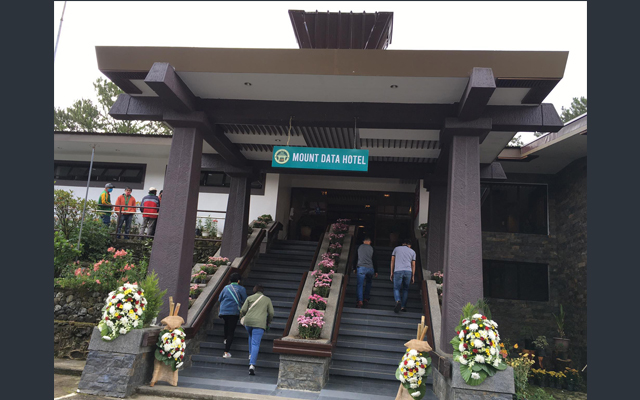
The Tourism Infrastructure and Enterprise Zone Authority (TIEZA) of the Philippine Department of Tourism (DoT) has reopened 50-year Mount Data Hotel in Bauko, Mountain Province to help jumpstart sustainable tourism and ease the accommodation shortage in the Cordillera Administrative Region.
A pit stop for tourists going to and from Baguio City, Sagada, Banaue, and UNESCO World Heritage-listed Cordillera rice terraces, the iconic hotel has been spruced up through a 40 million pesos (US$754,091) renovation project during the pandemic and will be included in DoT’s marketing efforts.
Revitalised Mount Data Hotel to revive Mountain Province’s tourism potential
At 2,195m above sea level boasting chilly weather all year round and set amid a 7.7-hectare ground of lush pine trees and vegetation, Mount Data Hotel has 22 spacious rooms with veranda; two dorms each with a 10-pax capacity; two conference rooms; a restaurant; a coffee shop and bar; and sun terrace.
A reopening introductory rate is pegged at US$75.
Jetro Nicolas Lozada, TIEZA assistant chief operating officer, said the next phase of the hotel’s development will be to build facilities and introduce activities for families and business events, including villas, a convention centre, playgrounds, and hiking trails.
Lozada also said that within Bauko are several attractions which can be developed for tourism, including strawberry and other farms, caves as well as the biodiversity of the protected Mount Data National Park.
Mount Data Hotel was built by TIEZA to encourage tourism, and became part of Philippine history when it hosted the September 1986 Mount Data peace accord between then president Corazon Aquino and the Cordillera People’s Liberation Army that led to the creation of the Cordillera Administrative Region.
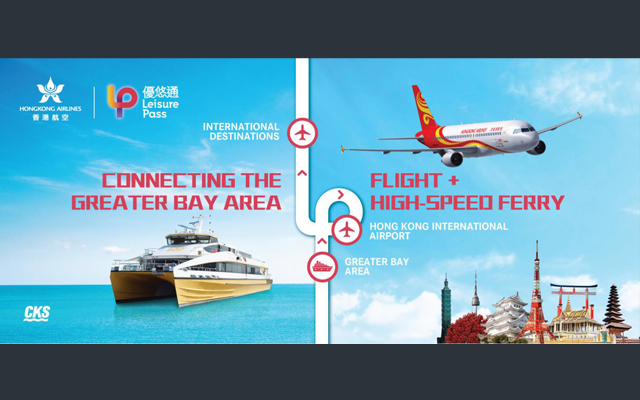
Hong Kong Airlines has partnered with Chu Kong Passenger Transport to launch the Leisure Pass, a code-sharing sea-to-air service that connects Hong Kong International Airport with six major ports in the Greater Bay Area.
China ports that benefit from the Leisure Pass include Shenzhen Shekou, Shenzhen Fuyong, Guangzhou Lianhuashan, Guangzhou Nansha, Zhongshan and Dongguan Humen.
The Leisure Pass offers fast and convenient transfer services
Passengers will enjoy one-stop booking for ferry and air tickets through a travel agent in China, and be exempted from the Hong Kong International Airport Air Passenger Departure Tax.
The Leisure Pass promises fast and convenient transfer services for cross-border travellers in the region, with the shortest ferry journey taking only 30 minutes between Shenzhen Shekou and Hong Kong International Airport SkyPier, compared to other services that take around two hours.
Leisure Pass holders will also enjoy one-stop check-in and baggage drop at their departing ferry ports before boarding the high-speed ferry for the Hong Kong International Airport SkyPier. Once there, they can board their Hong Kong Airlines flights directly to their final destinations, bypassing additional immigration and customs formalities or check-in procedures.
At the initial stage, the Leisure Pass will only be eligible for the service from Shenzhen Shekou to Hong Kong. The remaining services will be launched once pandemic preventive measures are lifted.
IHG Hotels & Resorts has signed its first hotel on the New South Wales (NSW) South Coast, with the Crowne Plaza Shell Cove Marina slated to open in 2025.
This is IHG’s second hotel with Oscars Group.
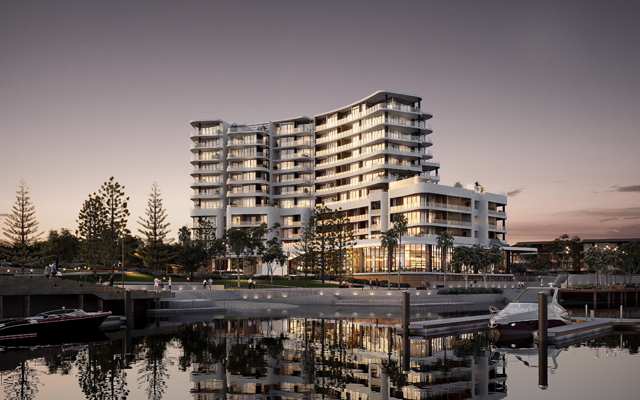
Crowne Plaza Shell Cove Marina will open in 2025
Located in Shellharbour and close to Wollongong, just 1.5 hours’ drive from Sydney, Crowne Plaza Shell Cove Marina will include a man-made in-shore harbour and a 270-berth marina, as well as a vibrant town centre featuring a supermarket, retail outlets, restaurants, library, community centre, and parklands.
The 181-key Crowne Plaza will showcase the brand’s new hallmark design innovations and trademark features, three F&B outlets including a café, chic restaurant and bar, extensive meeting and events space, and an outdoor pool.
Matt Tripolone, managing director, IHG Hotels & Resorts Australasia & Pacific, said: “We’re thrilled to be extending our reach across regional NSW with the addition of this stylish, design-forward hotel on the NSW South Coast, highlighting the increasing demand for contemporary new hotels in regional NSW.”
Damien Cameron from Oscars Group added: “We are passionate about the South Coast of NSW and are excited to be growing our presence in the region, particularly as development plans for Shell Cove and the Marina take hold. We look forward to working with the local community and welcoming guests to this stunning new hotel in 2025.”